
Ten at night, the shutter of a packaging shop in Rajkot is half down, and Bhavesh sits on a plastic stool with his phone at 12% battery, staring at a sign-up page he has opened four times this week. He has stock. He has a supplier in Morbi who can refill within three days. What he does not have is an answer to one nagging question: what must he actually hand over before Amazon lets him sell?
Learning how to create Amazon seller account in India is genuinely a one-evening job once you stop guessing and start gathering. The paperwork list is short and the screens are ordinary. The real friction comes from small mismatches — a name spelled differently on your bank passbook than on your PAN, a GST certificate you assumed you did not need, an address proof six months too old.
This walkthrough takes you from the documents on your desk, through every registration screen, into GST, costs, verification and your first listing. By the end, you will know exactly what to do tomorrow morning.
Why Selling on Amazon India Is Worth Your Time
A shop on a busy road might be seen by two thousand people a day, and most walk past without looking. The same product listed online sits in front of buyers across metros, tier-two towns and pin codes you have never visited. That reach explains the queue to register, and it also explains why the platform rewards preparation over enthusiasm.
The reach you get from day one
You do not build an audience before you sell; the audience is already there, typing what it wants into a search bar. Your job is to appear in that search and look trustworthy enough to be chosen. Meenakshi Raghavan in Coimbatore listed six SKUs of handloom bath towels in her first week and reached forty orders a month by her third month, without spending on ads initially. Her lesson was blunt: the traffic exists, but only for listings that answer the exact words a buyer types.
Who actually does well on the platform
Successful sellers usually have one of three things — a supply advantage, a price advantage, or patience with detail. Manufacturers and people near a manufacturing cluster start ahead. Resellers buying from a distributor at thin margins struggle unless they pick low-competition categories worth entering. Nobody wins by listing two hundred random products and hoping.
What to decide before you register
Decide your business structure, your first three products and your fulfilment method before you touch the form, because all three come up during the amazon seller account registration process. Expect your first ninety days to be about learning — a few orders, a few returns, plenty of adjustment to price and images. Revenue follows once listing quality settles.

What You Need Before You Start Registration
Half the delays come from opening the form first and hunting for documents later, with a session timing out somewhere in the middle. Spend twenty minutes putting clearly named, properly scanned files into one folder, and the rest is typing.
Identity and PAN details Amazon asks for
Amazon needs a verifiable person or entity behind the account. A sole proprietor supplies a personal PAN, an identity proof such as Aadhaar, passport or voter ID, and an active mobile number and email under your control. A private limited company supplies the company PAN, the certificate of incorporation and the signatory’s ID. The rule that trips everyone up is consistency: the name should read the same way, in the same order, with the same spelling, everywhere.
Bank account and address proof
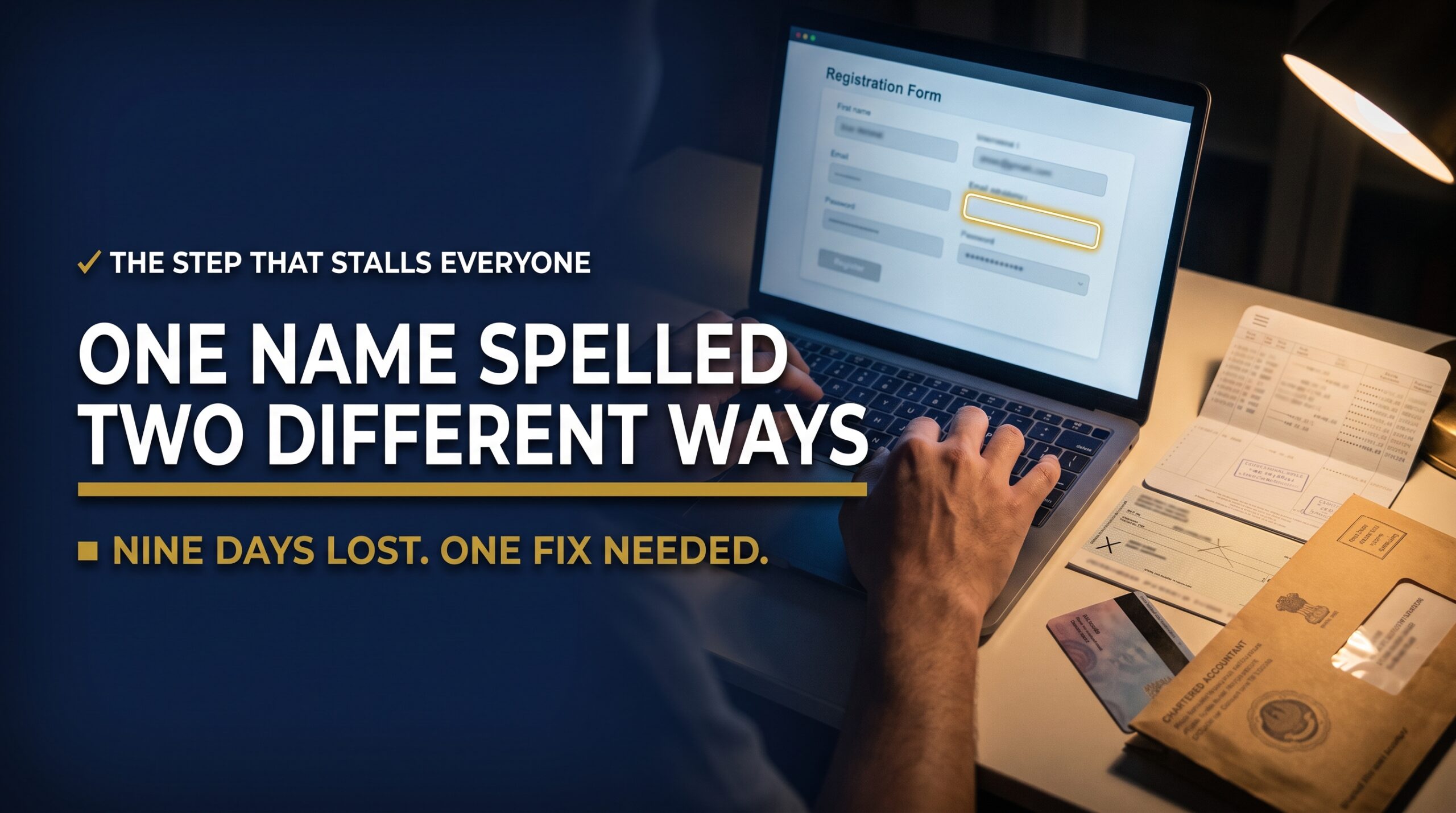
You need a bank account in the seller entity’s name with a cancelled cheque, passbook copy or statement showing the account number, IFSC and holder name. You also need address proof for your registered and pickup addresses — a recent utility bill, rent agreement or bank statement usually works. Faizan Qureshi in Lucknow lost nine days because his cheque leaf read “Faizan Qureshi” while his PAN read “Mohd Faizan Qureshi”; one corrected bank record and the account cleared within a day.
Choosing your business structure first
You can sell as a sole proprietor, partnership firm, LLP or private limited company, and you do not need a registered company to begin. A proprietorship needs no incorporation — your own PAN serves as the firm’s PAN — which is why most first-timers start there and convert later. Here is the short list of documents required for amazon seller account setup as a proprietor:
- PAN card of the proprietor, matching the name used everywhere else
- Aadhaar or another government photo ID for the signatory
- GSTIN certificate, unless you sell only GST-exempt goods
- Bank details with a cancelled cheque or recent statement
- Address proof for your registered address and your pickup location
Keep these as clear PDFs or crisp scans, under the file size limit, with all four corners visible. That single habit prevents most re-upload requests.
How to Create Your Amazon Seller Account Step by Step
With the folder ready, sign-up feels closer to filling a form for a new SIM card than anything intimidating. Sandeep Ahuja in Ludhiana finished the whole thing in ninety minutes on a Sunday evening and was live with three listings by Thursday, purely because he had scanned everything the night before.
Starting the sign up on Seller Central
Go to sellercentral.amazon.in and choose to register as a seller. You can sign in with your shopping credentials, though most sellers prefer a separate business email so personal and business notifications never mix. Enter your legal business name exactly as it appears on your PAN or incorporation certificate, because this is the name Amazon verifies against every other document you upload.
Verifying your mobile number and email
Amazon sends an OTP to your mobile and a verification link to your email. Use a number that stays with the business, since Seller Support calls it and delivery teams reference it for pickups. Once both are confirmed, your amazon seller central india login is active, and you can return to a half-finished registration instead of starting over.
Adding tax, bank and pickup details
Next come the sections that decide your payouts: GSTIN, PAN, bank account and pickup address. Type the account number twice and check the IFSC against your passbook rather than memory. Your pickup address is where couriers collect parcels, so use the place you actually pack from.
Finishing the store and product setup
You then choose the display name customers see, pick your categories and confirm your shipping method. Amazon asks whether you are the brand owner and whether you hold a trademark, because Brand Registry and its extra tools sit behind a registered trademark. Save, submit, and the account moves into review.
Registration is the easy half. For the harder half — product selection, pricing and the plan that makes the account earn — join the 3-Day Amazon Business Training and build it before your first shipment leaves.
Sorting Out GST and Tax Registration
GST stalls more registrations than anything else, mostly because sellers apply general small-business logic to a marketplace with its own rule. The turnover threshold you heard about at your CA’s office does not automatically protect you here.
When a GSTIN is compulsory for you
If you sell taxable goods through a marketplace, you need a gst number for amazon seller registration regardless of turnover, because the exemption limits that apply offline do not extend to most e-commerce supply. Arrange your GSTIN before you register, not after. Apply on the GST portal with your PAN, photograph, address proof and bank details, and a certificate typically arrives within a week. A local chartered accountant will file it for a modest fee, and for a first-timer that money buys speed.
Selling exempt categories like books
There is one genuine exception. If your catalogue contains only GST-exempt goods — books being the common example — you can run an amazon seller account for individual without gst registration. Nandita Basu in Kolkata started with titles from her College Street contacts on that basis, then registered for GST within three months when she added stationery and gift wrap. The exemption belongs to the product, not to you.
Linking your tax details to the account
You add or update your GSTIN in the tax settings inside Seller Central, and you can do it after the account exists if your certificate arrives late. Make sure the legal name on the certificate matches the legal name on the account, because a mismatch blocks verification and payouts alike. Once linked, tax-compliant invoices are issued against your orders automatically.
What Registration Actually Costs You
A persistent belief that Amazon charges a large joining fee keeps people from starting for months. The money does move — just not at the point most sellers expect.
The truth about the joining fee
Opening the account carries no joining charge, and listing products costs nothing upfront. What you spend before your first order goes on everything around the account: GST registration through a CA, a current account, packaging material, barcode labels and inventory. So when people ask about amazon seller registration fees in india, the honest answer is that your real starting cost is stock and paperwork, not a payment to Amazon.
Referral, closing and shipping charges
The charges begin when you sell. A referral fee, set as a percentage of the selling price and varying by category, comes off every order. A closing fee applies on many categories and price bands, a weight-based shipping or fulfilment fee applies depending on how you deliver, and GST is charged on those fees. Vikram Pillai in Kochi ran a ₹500 kitchen tool through the fee calculator in Seller Central and found roughly ₹330 reached him against a ₹210 landed cost. The margin was real but thin, so he repriced to ₹599 the same week.
Budgeting your first three months
Plan for stock, packaging, a small advertising budget and the gap between a sale and a payout, which follows a settlement cycle rather than arriving instantly. Keep working capital for two restocks. Sellers who run dry in month two are almost always the ones who spent everything on the first purchase order.

Getting Verified and Going Live
Submitting the form feels like an ending, but it starts a short conversation between you and a verification team who have never met you and are working only from your uploads.
How long verification usually takes
Most straightforward accounts clear within a few days, and clean proprietorship applications often move fastest. Company accounts with multiple directors take longer because more documents get cross-checked. If nothing has happened after a week, check your registered email — a request is usually sitting there.
Why accounts get put on hold
Holds come from mismatches, not suspicion: a name spelled differently across PAN and GST, an address proof older than the accepted window, a blurred scan where the IFSC is unreadable, or a personal bank account paired with a firm’s GSTIN. Harshita Jain in Jaipur was held for an address discrepancy, uploaded a current electricity bill and her rent agreement together in one reply, and was approved within forty-eight hours. One complete response beats five partial ones.
Responding to document requests fast
Read the exact wording, send precisely what is asked in the accepted format, and add a short note explaining any variation — for instance, that your trade name differs from your legal name. Reply inside the same Seller Support case so the history stays in one thread, then check it daily until it closes.
Once verified, the real question becomes what to sell and at what price — which is where the 3-Day Amazon Business Training earns its place, because an approved account with the wrong products is just an expensive login.
Setting Up Your First Listings
An empty catalogue earns nothing, and the first listing is always the slowest. After that it becomes muscle memory.
Picking between FBA and Easy Ship
With FBA you send inventory to a fulfilment centre and Amazon picks, packs, delivers and handles returns; with Easy Ship you store stock yourself and a courier collects from your pickup address. FBA suits small, fast-moving, well-sized products and usually improves the delivery promise. Easy Ship suits bulky or slow movers where storage fees would bite. Arvind Kulkarni in Pune moved three fast-selling yoga mats to FBA, kept his heavier equipment on Easy Ship, and saw order volume rise about thirty percent over two months.
Writing a listing that converts
Write the title as brand, product type, key attribute, size or quantity — for a buyer, not for a search engine. Bullets should answer the objections a customer would raise in your shop: material, fit, what is in the box, care instructions, warranty. Use a clean white-background main image that follows your category’s rules, then add lifestyle and detail shots.
Pricing and stock before you launch
Price after running your costs through the fee calculator, never before, and hold enough inventory to survive a sudden three-day spike. Running out in week one damages the ranking you just earned.

Mistakes New Sellers Make in Month One
The errors that hurt new accounts are dull and entirely preventable, which is the good news — each has a fix you can apply the same day.
Documents that do not match each other
Names, addresses and spellings must agree across PAN, GST, bank records and the account itself. If your bank holds an old address or an initial instead of a full name, correct it at the bank before uploading, not after Amazon flags it.
Ignoring account health metrics
Late dispatch, cancellations and unanswered buyer messages quietly pull your account health down, and a poor score restricts your listings long before anyone warns you. Check the account health page weekly and answer buyer messages within a day, ideally before you shut shop each night.
Waiting too long to list anything
Perfectionism is the costliest mistake of all. Zoya Ansari in Hyderabad sat on an approved account for three months waiting for “better photographs”, then listed four products with decent phone images and took eleven orders within twenty days. You learn more from one live listing than from six weeks of planning.
Frequently Asked Questions
What documents are required to create an Amazon seller account in India?
A sole proprietor needs a PAN card, a government photo ID such as Aadhaar, a GSTIN certificate unless selling only exempt goods, bank details with a cancelled cheque or statement, and address proof for the registered and pickup addresses. Companies also supply incorporation certificate, company PAN and signatory documents. Names must match everywhere.
Is GST mandatory to sell on Amazon India?
For taxable goods sold through a marketplace, yes. The small-turnover exemption that many offline traders rely on does not extend to this kind of e-commerce supply, so you need a GSTIN even on modest sales. The only exception is a catalogue made entirely of GST-exempt products, books being the common example.
How much does it cost to open an Amazon seller account in India?
Opening the account and listing products carries no joining charge. Your real outlay before the first sale is GST registration through a chartered accountant, a bank account, packaging, labels and inventory. Once you sell, Amazon deducts a category-based referral fee, a closing fee, a weight-based shipping or fulfilment charge, and GST on those fees.
Can I sell on Amazon India as an individual without a registered company?
You can. A sole proprietorship needs no incorporation — your personal PAN doubles as the firm’s PAN, and you obtain a GSTIN in your own name. Most first-time sellers start this way because it is quick and inexpensive, converting to an LLP or private limited company later when turnover grows or liability matters.
How long does Amazon seller account verification take in India?
Clean proprietorship applications often clear within a few days; company accounts take longer because more documents are cross-checked. Delays come almost entirely from mismatched names, expired address proofs or unreadable scans. If a week passes without movement, check your registered email and Seller Support case, then reply with everything requested in one complete response.
Can I use a savings account instead of a current account?
A savings account in the proprietor’s name is often accepted at registration, but a current account in the business name is the better habit. It separates personal and business money, simplifies GST filing and reconciliation, and saves awkward questions at year end. Open it while your GST application is processing so both are ready together.
Can I register two seller accounts with the same PAN?
Amazon’s policy allows one selling account unless you have a documented business need and explicit permission. Registering a second account on the same PAN or bank details without approval risks both being linked and suspended. If you genuinely run distinct businesses, raise a case with Seller Support and get written approval before registering.
How soon after approval will I get my first order?
Some sellers see an order within days; others wait two or three weeks. Category competition, price and listing quality matter far more than luck. Make sure your main image is clean, your title carries the words buyers actually search, your price sits within the visible range, and stock shows as available. A small ad budget speeds up the first reviews.
Conclusion
Registration is the part everyone worries about and the part that takes one evening. Gather your PAN, ID, GST certificate, bank proof and address proof into one folder, check that every name matches, complete the sign-up on Seller Central, answer any verification request in a single thorough reply, and you are live. That is genuinely the whole of it.
What decides whether the account earns money is everything that follows — which products you choose, how you price against your fees, how your listings look, and how quickly you fix what is not working. Those are skills, and skills can be learned.
If you want the selling plan that sits behind the account you just opened, come and build it inside the 3-Day Amazon Business Training. Bring your product idea. Leave with a plan you can act on this week.
