

Saturday morning, and Devika Rao sits in her Pune flat with two browser tabs open. One shows a supplier quote for 300 silicone kitchen mats. The other shows Amazon’s search results for “kitchen mat” — forty listings, most of them the same mat, undercutting each other by ten rupees. She has stared at both tabs for three weeks. The money is ready. The decision is not.
What she wants is a list of the best products to sell on Amazon India, as though the right answer were a secret held by a few and hidden from everyone else. It isn’t. The sellers who build something durable didn’t guess a hot product — they ran every idea through the same filter and killed the bad ones fast.
So that’s what you’re getting here: a filter you can apply to any idea, the category clusters where independent sellers still win, an honest look at where the profit actually sits, and a real rupee figure for going live. By the end, you’ll be able to judge Devika’s kitchen mat yourself in about ten minutes.
What Actually Makes a Product Worth Selling
Before any category conversation, you need a scorecard. Otherwise every product looks promising on a Tuesday and terrible by Thursday. Learning how to choose a product to sell on Amazon India is really about turning a gut feeling into four checkable numbers.
The four numbers that decide every listing
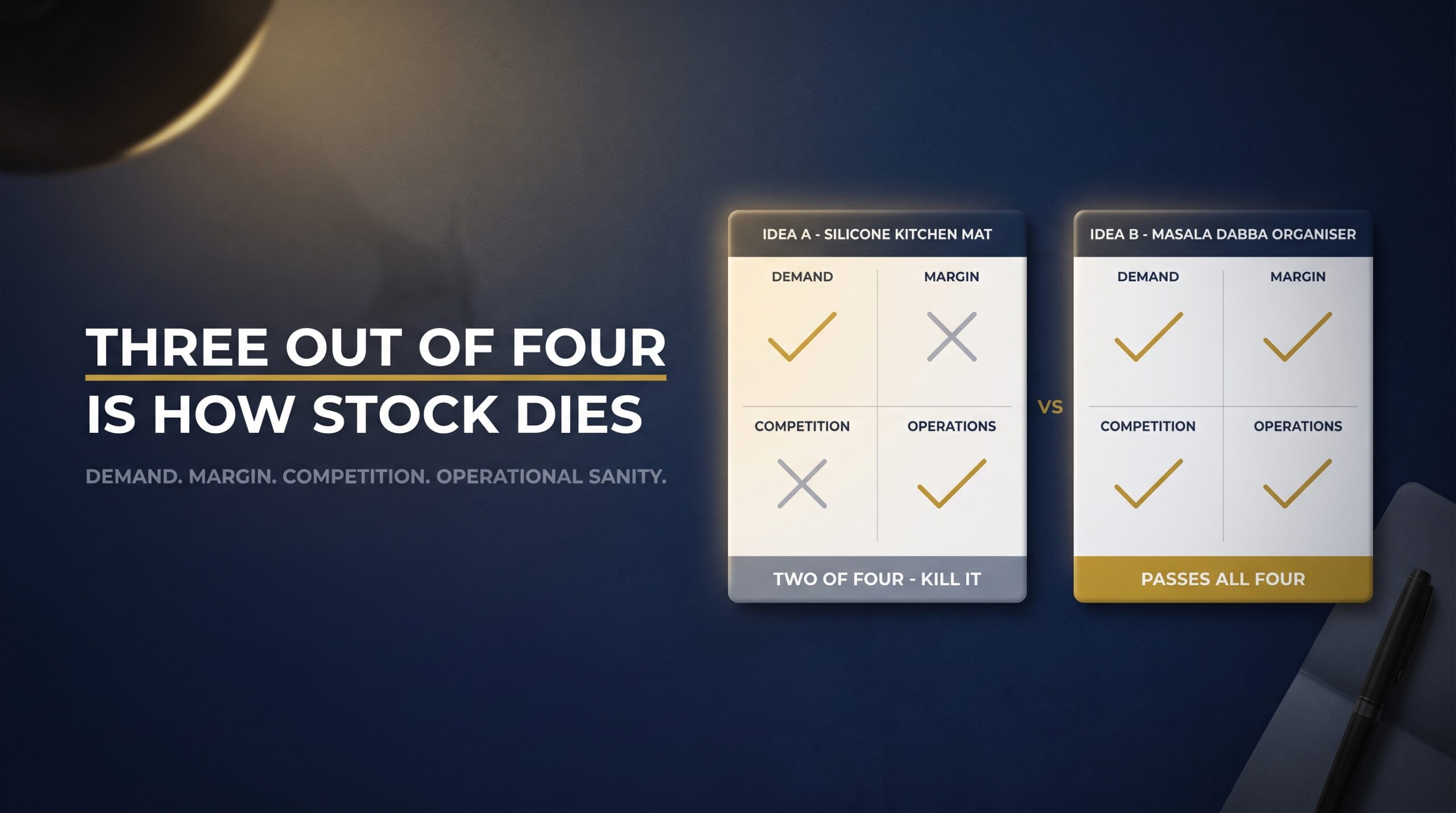
Demand, margin, competition, operational sanity. Demand means steady monthly search volume, not one festival spike. Margin means what survives after Amazon takes its cut. Competition means how many established sellers hold the first page. Operational sanity covers weight, fragility, shelf life and return rate. A product must clear all four — three out of four is how sellers end up with 400 units in a spare bedroom.
Margin maths after fees, shipping and returns
Take your selling price, subtract the referral fee for your category, then closing and fulfilment fees, then shipping to the fulfilment centre, then your landed product cost. Now cut another eight to twelve percent for returns and damage. What’s left should be at least 25 to 30 percent of the selling price, because advertising will eat into that during your first ninety days.
Signs a product will drain your cash
Glass, liquids, anything with a battery, anything sized for a specific body, anything expiring inside twelve months. Ankit Deshmukh in Nagpur learned this with ceramic mugs — 620 units sold in four months and still a loss, because 11 percent arrived broken and every replacement cost him twice. He moved to stainless steel travel mugs, kept the same buyers, and breakage fell below one percent. Your scorecard is only as honest as the line you least want to fill in.
Categories Still Wide Open to New Sellers
The best selling categories on Amazon India are not the ones with the biggest headline sales numbers. They’re the ones where a small seller can still earn a first-page position with a better photograph and a sharper variant.
Home, kitchen and storage essentials
Urban flats keep shrinking and buyers keep hunting for ways to reclaim space — under-sink organisers, stackable fridge trays, wardrobe dividers, spice racks sized for Indian kitchens. Meera Iyer in Coimbatore built a business on one narrow idea, a masala dabba organiser that fits a standard overhead cabinet, reaching 48 orders a day within seven months. Her lesson: one specific problem beats ten generic products.
Pet supplies and hobby niches
Pet ownership in Indian cities has grown fast, and those buyers repurchase without thinking twice. Slow-feeder bowls, grooming gloves, harnesses cut for Indian breed sizes. Hobby niches behave the same way — resin art supplies, aquarium accessories, embroidery kits. Small audiences, but loyal ones, and far fewer sellers fighting over the same keywords.
Car and bike accessories
Seat organisers, phone mounts, boot mats, helmet locks, covers sized for popular Indian models. Cheap to source, light to ship, and buyers search using model names, which hands you long-tail keywords the big sellers never bother to target.
Health, wellness and daily-use consumables
Posture correctors, resistance bands with printed guides, sleep masks, foot care kits, ayurvedic oils. The money sits in repeat purchase, particularly at the consumable end, where a satisfied buyer returns every six weeks without an ad ever touching them. Which raises the obvious question: where does the profit actually live?
Which Categories Make the Most Money
Revenue and profit are different animals, and the most profitable categories on Amazon India are rarely the ones with the flashiest top sellers.
High margin versus high volume thinking
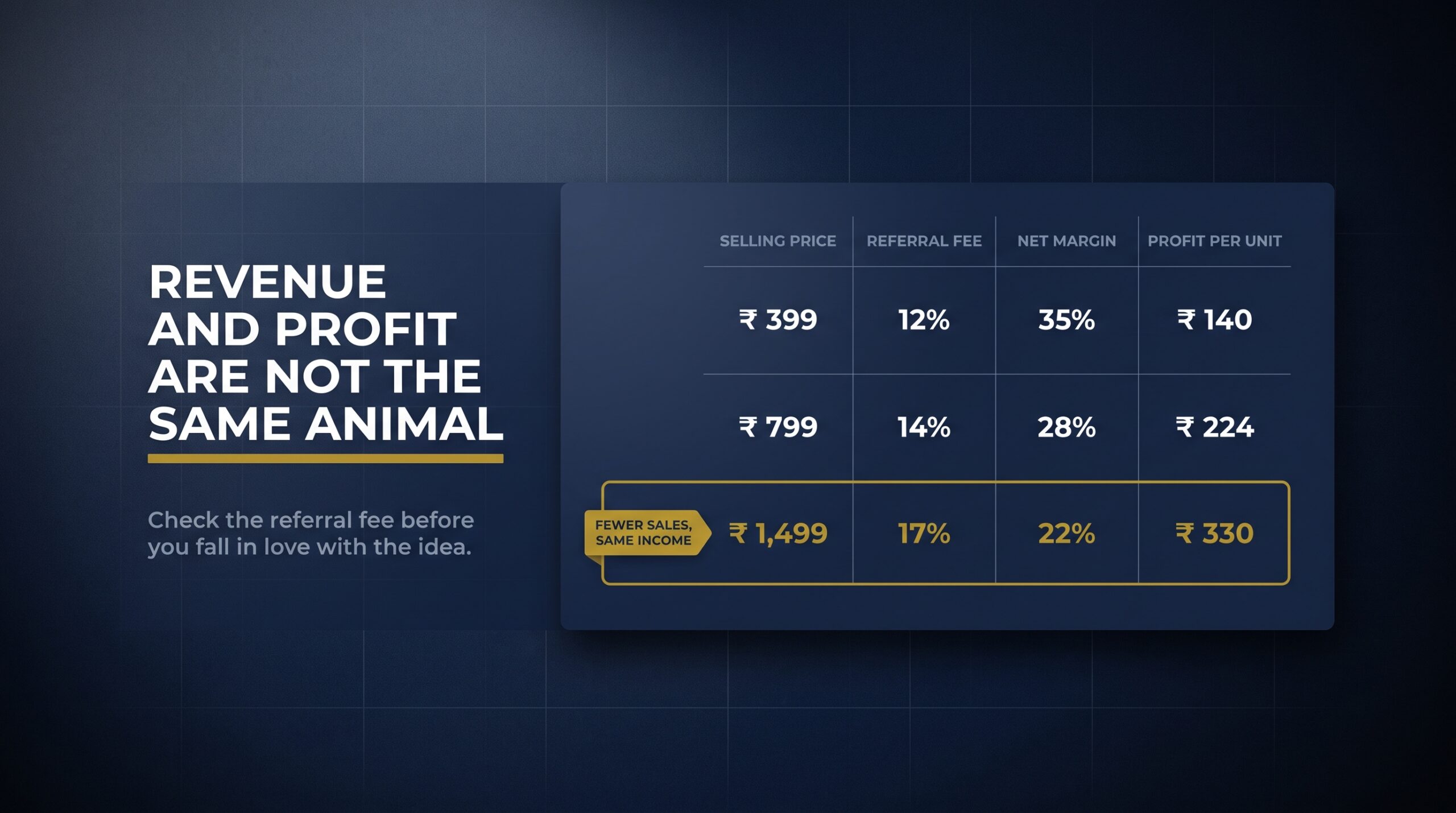
A ₹399 product at 35 percent margin earns ₹140 a unit. A ₹1,499 product at 22 percent earns ₹330. The second needs fewer sales, less storage and less packing labour for the same income. Farhan Qureshi in Hyderabad moved from ₹249 phone accessories to ₹1,299 ergonomic laptop stands and matched his old monthly profit on a third of the order volume within five months.
Repeat purchase products beat one-off sales
A yoga mat sells once in three years. A supplement, a cleaning refill, a pet treat or a skincare oil sells every month. Repeat products let you spend more to win a customer because you earn from them four or five times over. If two ideas score equally, pick the one people run out of.
Where the fee structure quietly eats profit
Referral fees vary sharply by category and by price band within the same category. Check the exact percentage for your sub-category and your price point before you fall in love with an idea. Remember too that fulfilment fees step up in weight brackets, so a product at 480 grams can ship for meaningfully less than one at 520 grams.
If you want that laid out as a working sheet, our Amazon seller cost calculator walks through referral, closing and fulfilment charges with Indian category examples, so you can price a product before ordering a single unit.
How to Spot Low Competition Niches
Finding low competition products to sell on Amazon India is a skill, not a lucky search. Most of it happens with your own eyes on the results page — good Amazon India product research for new sellers should never depend on an expensive software subscription.
Reading the first page of search results
Type your keyword and look at what’s actually there. Are the images shot on white with proper lighting, or are half of them phone snaps? Do the titles read like keyword soup? Is there A+ content, or thin one-line descriptions? A first page of mediocre listings is an open door.
Review counts, seller counts and listing age
If the top ten listings all carry 3,000-plus reviews, walk away. If several sit between 40 and 300 reviews and still rank, a good launch can break in. Check how many sellers share the same ASIN, too — a crowded buy box means a price war you cannot win.
Keyword tools and what the data really says
Tools give you search volume and trend lines. They do not tell you whether a product is worth selling. Use them to confirm demand holds steady across twelve months, then return to the listings to judge quality. Volume without a weak first page is simply a harder fight.
Building a shortlist you can actually verify
Shortlist three products, not thirty. Sneha Kulkarni in Nashik spent two weekends narrowing 26 ideas to three, ordered samples of all three, and launched the one with the worst competitor photos. She hit her first 100 orders in six weeks. A short list you verify beats a long list you admire.
What Is Trending Versus What Keeps Selling
Trending products to sell on Amazon India can double your launch speed or bury your capital, and the difference is almost entirely timing.
Where to look for genuine demand shifts
Watch Movers and Shakers and the Best Sellers lists inside your category, read the one- and three-star reviews on competing products for repeated complaints, and notice what Instagram sellers push three months before it reaches Amazon. Real shifts appear as rising searches across several related keywords, not one viral spike.
Seasonal spikes you can plan around
Festive gifting, school reopening, monsoon gear, winter skincare, summer cooling. These repeat every year, so you can order inventory 90 days ahead with confidence. Rohit Bansal in Jaipur stocked two-wheeler rain covers in April, sold through 1,400 units by late July, and used that cash to fund his off-season range.
When a trend is already too late to join
If your sourcing lead time is 45 days and the trend is four months old, your stock lands exactly as demand turns down. Ask one question before committing: will anyone search for this a year from now? If the honest answer is no, buy a small test batch or skip it. And before you commit to anything, check whether you’re even allowed to list it.
Gated Categories and Approvals You Must Clear
Some categories won’t let you list until you clear an approval, and discovering that after your stock arrives is an expensive way to learn.
Categories that need approval before listing
Automotive parts, certain beauty and grocery lines, fine jewellery and some health products commonly require approval, and Amazon typically asks for supplier invoices, brand authorisation letters, product images and applicable certificates. Start the application before you place a bulk order, not after it ships.
Why Brand Registry changes what you can do
A registered trademark opens Brand Registry, and Brand Registry opens A+ content, Stores, Sponsored Brands and protection from listing hijackers. Kavita Menon in Bengaluru filed her trademark on day one of her skincare plan and had Brand Registry live by the time her stock landed — her conversion rate ran noticeably higher than her earlier test listing, because buyers saw a brand rather than a generic SKU.
Compliance, BIS and labelling essentials
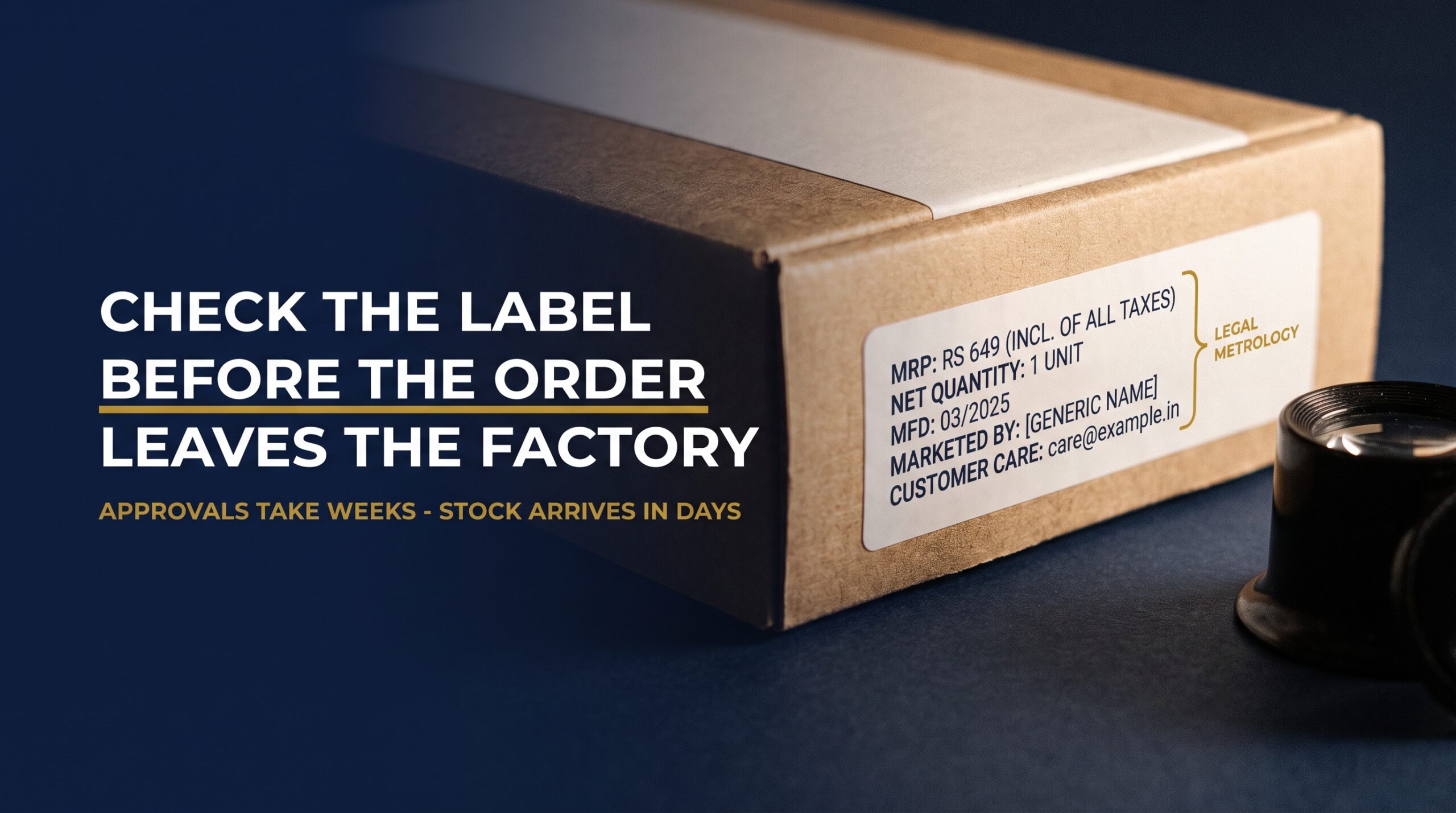
Legal Metrology rules require importer or manufacturer details, net quantity, MRP, date of manufacture and a customer care contact printed on the pack. Some electricals, toys and food-contact items need BIS certification. Get your supplier to confirm compliance in writing, and photograph the finished label before the full order leaves the factory.
What It Costs to Get Your First Product Live
Nobody tells you the real number, so sellers either overspend on the wrong things or underspend and stall halfway.
Registration, GST and the paperwork bill
GST registration, a current account, and a trademark filing if you’re building a brand. Budget roughly ₹8,000 to ₹20,000 depending on whether you use a consultant. Seller account registration itself costs nothing beyond your time.
First inventory order and sample budgets
Order samples from three suppliers first, usually ₹1,500 to ₹5,000 including courier. Then a first batch of 100 to 300 units. At ₹120 landed per unit, that’s ₹12,000 to ₹36,000. Resist the bigger MOQ discount until you know the product sells.
Photography, packaging and launch ads
Professional photos run ₹3,000 to ₹10,000 for a set, printed packaging and labels another ₹3,000 to ₹8,000, and a launch ad budget of around ₹500 a day for the first month. Arjun Pillai in Kochi spent ₹9,000 on photography before his first sale and credits it for a 19 percent conversion rate in month one.
A realistic starting budget range
Between ₹50,000 and ₹1,50,000 gets a private label product live and properly supported. You can start lower by reselling established brands, but expect thinner margins and a harder fight for the buy box.
To make the supplier stage less nerve-racking, our supplier enquiry script pack gives you the exact messages to send on IndiaMART and WhatsApp — sample requests, MOQ negotiation, and the compliance questions most new sellers forget to ask.
Turning Your Shortlist Into a First Launch
Research stops paying the moment it becomes procrastination. This is where a shortlist becomes stock, a listing, and real data.
Sourcing and validating a supplier
Contact at least five suppliers, order samples from three, and compare response speed as carefully as product quality. A supplier who takes four days to answer a sample query will take two weeks when you’re in a stockout. Ask for GST details and a past invoice.
Testing small before you commit stock
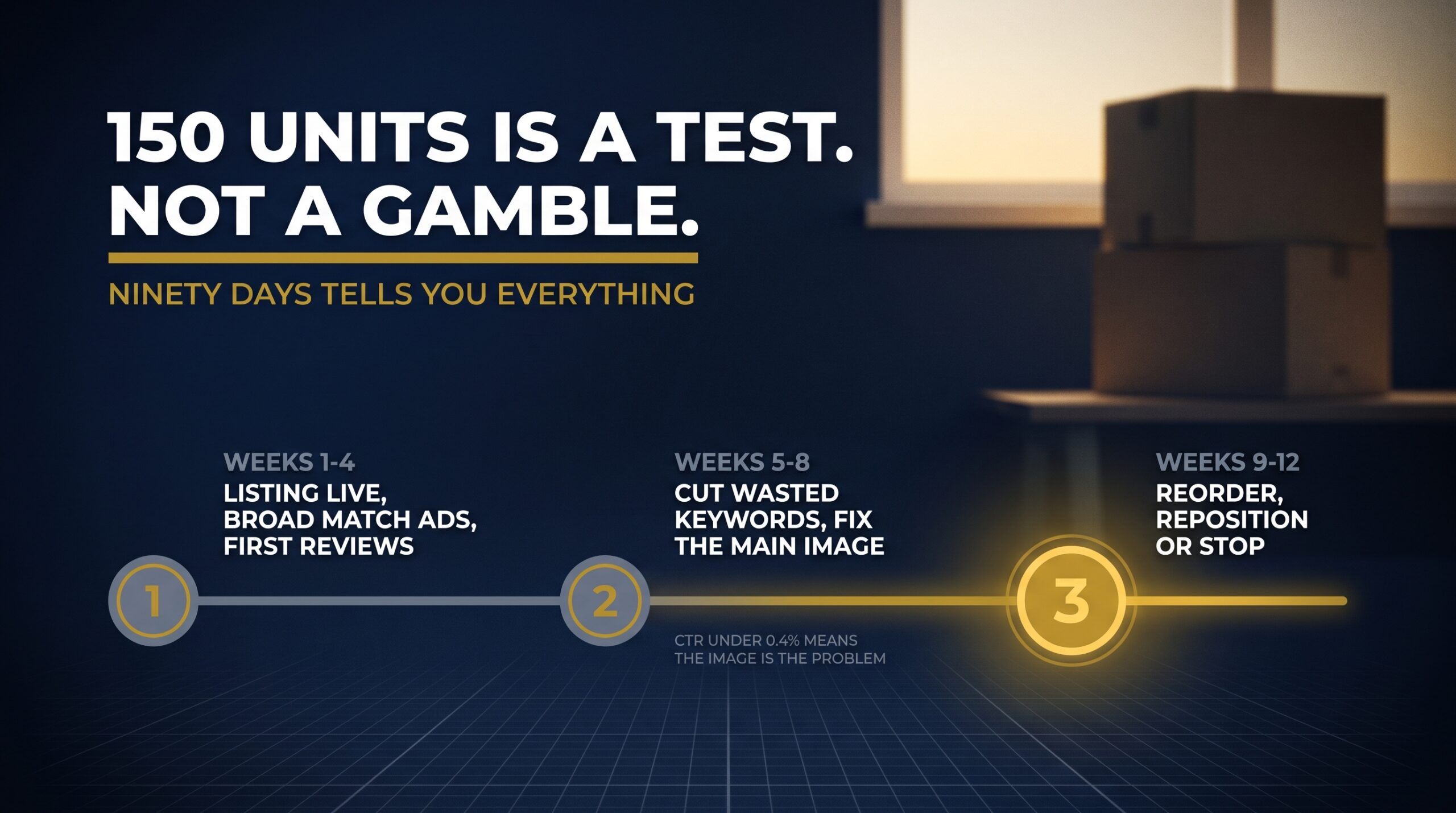
Start with 100 to 200 units. Nisha Agarwal in Surat tested 150 cotton laundry bags, sold through in 23 days, then reordered 800 with confidence and better pricing. Had it failed, her loss would have been under ₹20,000 instead of a year’s savings.
Your first ninety days on the listing
Weeks one to four: complete the listing, run Sponsored Products on broad match, gather early reviews through legitimate programmes. Weeks five to eight: cut wasteful keywords and fix your main image if click-through sits under 0.4 percent. Weeks nine to twelve: decide honestly whether to reorder, reposition or stop.
Mistakes That Kill New Sellers in Month One
Every failure below traces back to a number the seller skipped on the scorecard.
Chasing crowded categories on price alone
Entering phone cases or resistance bands with a ₹10 discount isn’t a strategy — it’s an invitation to be undercut by someone with deeper pockets. If price is your only difference, you failed the competition test before you started.
Ignoring returns and reverse logistics
Apparel and footwear carry return rates that can reach a quarter of orders, and returned units often come back unsellable. Vikram Chauhan in Ludhiana sold 900 t-shirts in his first quarter, celebrated the revenue, then found that 210 returns had erased his profit. He moved to accessories with fixed sizing and his margin held.
Copying another seller without the margin
That top listing may have negotiated at 5,000 units, funded ads at a loss for months, or sit in a category you haven’t been approved for. Copy the approach, never the product. Your cost structure is yours alone, and the scorecard tells you within minutes whether the maths works at your scale.
Frequently Asked Questions
What are the best products to sell on Amazon India for a new seller?
Start with light, non-fragile, non-expiring products priced between ₹400 and ₹1,500 that solve one specific problem. Home and kitchen organisers, car and bike accessories, pet supplies and hobby items fit well. Steady year-round demand, manageable shipping, and enough weak listings that a better photo and sharper title can win first-page placement.
Which product categories are most profitable for Amazon India sellers?
Profit follows margin percentage, order value and repeat purchase, not headline sales. Wellness consumables, pet supplies, home organisation and work-from-home accessories combine reasonable referral fees with prices high enough to absorb advertising. Fashion looks attractive until returns are counted. Always check the exact referral fee for your sub-category and price band first.
How do I find low competition products to sell on Amazon India?
Search your keyword and study page one critically. Look for listings under 300 reviews still ranking, phone-quality images, thin descriptions and missing A+ content. Confirm with a keyword tool that demand holds across twelve months rather than spiking once. Then shortlist three products, order samples, and verify quality before any bulk order.
How much money do I need to start selling products on Amazon India?
A realistic private label launch sits between ₹50,000 and ₹1,50,000. That covers GST and trademark paperwork, samples, a first batch of 100 to 300 units, photography, packaging and roughly ₹15,000 of launch advertising. Reselling established brands costs less because there’s no branding spend, but margins are thinner and differentiation harder.
Which Amazon India categories need approval or brand registry before listing?
Automotive parts, fine jewellery, and certain beauty, grocery and health lines commonly require approval, with Amazon asking for supplier invoices, authorisation letters, images and certificates. Brand Registry is separate: it needs a registered trademark and unlocks A+ content, Stores, Sponsored Brands and hijacker protection. Begin both before your stock ships, since approvals take weeks.
Should I sell under my own brand or resell existing products?
Reselling gets you live faster and teaches you Amazon’s operations with less capital at risk, though margins stay thin and buy box competition is relentless. Your own brand needs a trademark, packaging and patience, but it’s the only route to pricing power. Many sellers resell for three to six months, then launch their label.
How long does it take to make a profit as a new Amazon India seller?
Expect three to six months before one product turns consistently profitable. The first sixty days usually run at a loss, because ad spend is high while conversion rate and reviews are still building. By month four, with keywords trimmed and reviews accumulating, ad costs drop sharply. Sellers who quit at week six quit early.
Is FBA or self-ship better for a first product launch?
FBA suits small, light, fast-moving products because it wins Prime placement and lifts conversion noticeably. Self-ship makes sense for bulky, low-margin or slow-turning items where storage fees erode profit. Many sellers launch a first batch on self-ship to confirm the product sells, then move the reorder into FBA once demand is proven.
Conclusion
Devika’s kitchen mat, run through the scorecard, fails on competition and barely passes on margin — which is useful, because she can now stop staring and start examining the adjacent ideas nobody has bothered to do properly. That’s what a filter gives you: not certainty, but speed.
You have the four numbers, the categories where small sellers still win, the honest cost of going live, and a ninety-day plan that tells you whether to reorder or walk away. None of this requires a perfect idea. It requires one idea you’re willing to test with 150 units.
If you’d like to build that plan with guided steps and get your shortlist checked before you spend, join the 3-Day Amazon Business Training and walk out with a validated product decision instead of another open browser tab.

One Response
sir,Good Morning
I am girija from Tamilnadu , Retired person interested todo with Amazon products.Your day class is SUPERB.Pl help me to continue contact with you
With Best Wishes,
Girija