
Priya Sharma from Pune still remembers the Tuesday morning her phone would not stop buzzing. Her organic skincare listing, the one that had taken eighteen months to build, was suddenly selling at forty per cent below her price — except it was not her product. Someone had piggybacked on her ASIN with a cheap knockoff, customers were leaving one-star reviews about a cream that smelled wrong, and she had no authority to edit the page carrying her own brand name. Six weeks after her Amazon Brand Registry India approval came through, the counterfeit offers were gone, her product page carried her own story in A+ Content, and conversions had climbed twenty-three per cent. Her only regret, she says, is that she treated the paperwork as something to get to later.
That “later” is what this post is about. Brand Registry is not a button you press on a Saturday afternoon — it sits on top of a trademark, product evidence and an account in decent shape. Get those three right and enrolment is almost boring. Get them wrong and you enter a rejection loop that eats months. Let’s sort out exactly what you need before you apply.
What Brand Registry Actually Gives You
Think of enrolment as Amazon formally recognising you as the rights owner of a name. Once it does, the catalogue starts treating your word as final rather than as one opinion among several sellers touching the same ASIN.
Control over your listings and content
Registered brands get authority over titles, bullets, images and backend attributes on their own ASINs, which means a reseller cannot quietly rewrite your product page. You also unlock A+ Content that builds buyer trust, Stores, Sponsored Brands and Brand Analytics search data. Anita Desai in Mumbai added A+ modules to eleven home décor listings and watched conversion lift eighteen per cent inside three weeks — same traffic, same price, better page.
Tools that fight copycats and hijackers
Report a Violation lets you search the catalogue by keyword, image or ASIN and flag infringement directly, and Amazon’s automated protections screen listings that misuse your brand before you ever see them. Rajesh Kumar in Bengaluru enrolled his electronics accessories brand and saw forty-seven suspected counterfeit listings blocked in his first month. The lesson: protecting your listing from hijackers works quietly, but only after you are enrolled.
Who benefits most from enrolling early
If you own a private label, manufacture your own goods, or plan to spend seriously on ads, enrol before you scale. Brands that grow first and register later spend the growth phase defending listings they do not legally control.

The Eligibility Checklist Before You Apply
Most rejections are decided before anyone opens the application form. The amazon brand registry requirements india sellers must meet are not complicated, but they are checked literally.
Your brand must appear on the product
Amazon wants the brand permanently affixed — printed, moulded, embossed, woven or stitched onto the product or its packaging. A peel-off sticker, a paper insert or a logo added in Photoshop will not survive review. If your current packaging is unbranded, fix the packaging before you fix the application.
A seller or vendor account in good standing
You need an active Seller Central or Vendor Central account, and account health metrics matter here. Farhan Qureshi in Lucknow had a policy warning sitting unresolved on his account; clearing it took five weeks, and only after that did his enrolment move. Sort out health metrics first, then apply.
Matching names, spellings and capitalisation
Amazon compares your brand name against the trademark record character by character. “EcoGlow”, “Eco Glow” and “Eco-Glow” are three different brands to the system. Copy the name straight off the certificate rather than typing it from memory, and keep capitalisation identical.
Why Your Trademark Decides Everything
Everything else in this process is admin. The trademark is the actual gate, and the amazon brand registry trademark requirement is where most Indian sellers lose their months.
Registered marks and the classes that matter
Amazon accepts word marks, which protect the name as text, and device or design marks, which protect the logo as artwork. A word mark is the stronger starting point because it travels across every visual treatment of your name. Whether you need a trademark at all is a separate question, but your trademark also has to sit in a class that matches what you sell — Class 3 for cosmetics, Class 9 for electronics, Class 25 for apparel, and so on across the forty-five Nice classes.
Applying with a pending application
A pending application can open the door when it is filed through Amazon’s IP Accelerator network of vetted law firms, which gives eligible brands earlier access to registry benefits while the mark works through examination. You still complete the full registration eventually; the pathway shortens your wait, it does not replace the trademark.
Where the IP India application number fits
Your mark is filed with the CGPDTM through the IP India portal, and the application or registration number from that filing is what you enter during enrolment. Vikram Patel in Ahmedabad skipped a proper public search before filing “EcoGlow”, collected an objection six months in, and finished registration in fourteen months instead of the usual eight to ten. A ninety-minute search on the IP India Public Search tool would have saved him half a year.
If you want the brand thinking that goes behind these filings — which name, which category, which product line is worth protecting — that is exactly what we work through in the 3-Day Amazon Business Training.
Documents and Images You Should Collect First
Gather everything before you open the form. A half-filled application that times out while you hunt for a certificate is how small errors creep in.
Photos of branded products and packaging
Shoot in daylight, straight on, close enough that the brand name fills a good part of the frame. Amazon wants to see the brand as it exists in the real world, not as a mock-up. Any digital editing, overlay or rendered label reads as manipulation to a reviewer and costs you the application.
Trademark certificate and applicant details
Keep the certificate, the registration or application number, the filing date, the class, and the exact applicant name handy. If the trademark is held by your company and you sell through a different entity, be ready to explain the relationship.
Here is the practical collection list before you start:
- Clear photos of the product with branding permanently affixed
- Photos of packaging or labels carrying the same brand name
- A standalone image of your logo as filed
- Your trademark certificate or IP India application number with class details
- A list of the categories you sell in and the countries where you manufacture and distribute
Manufacturer or licensing proof if relevant
Selling under licence, or sourcing from a third-party factory? Keep the licensing agreement or manufacturing authorisation ready. Meera Reddy in Hyderabad was rejected because her brand name appeared only on a paper insert inside the box; she reprinted the outer carton with the name directly on it and was approved on her second attempt.
How to Enroll Step by Step
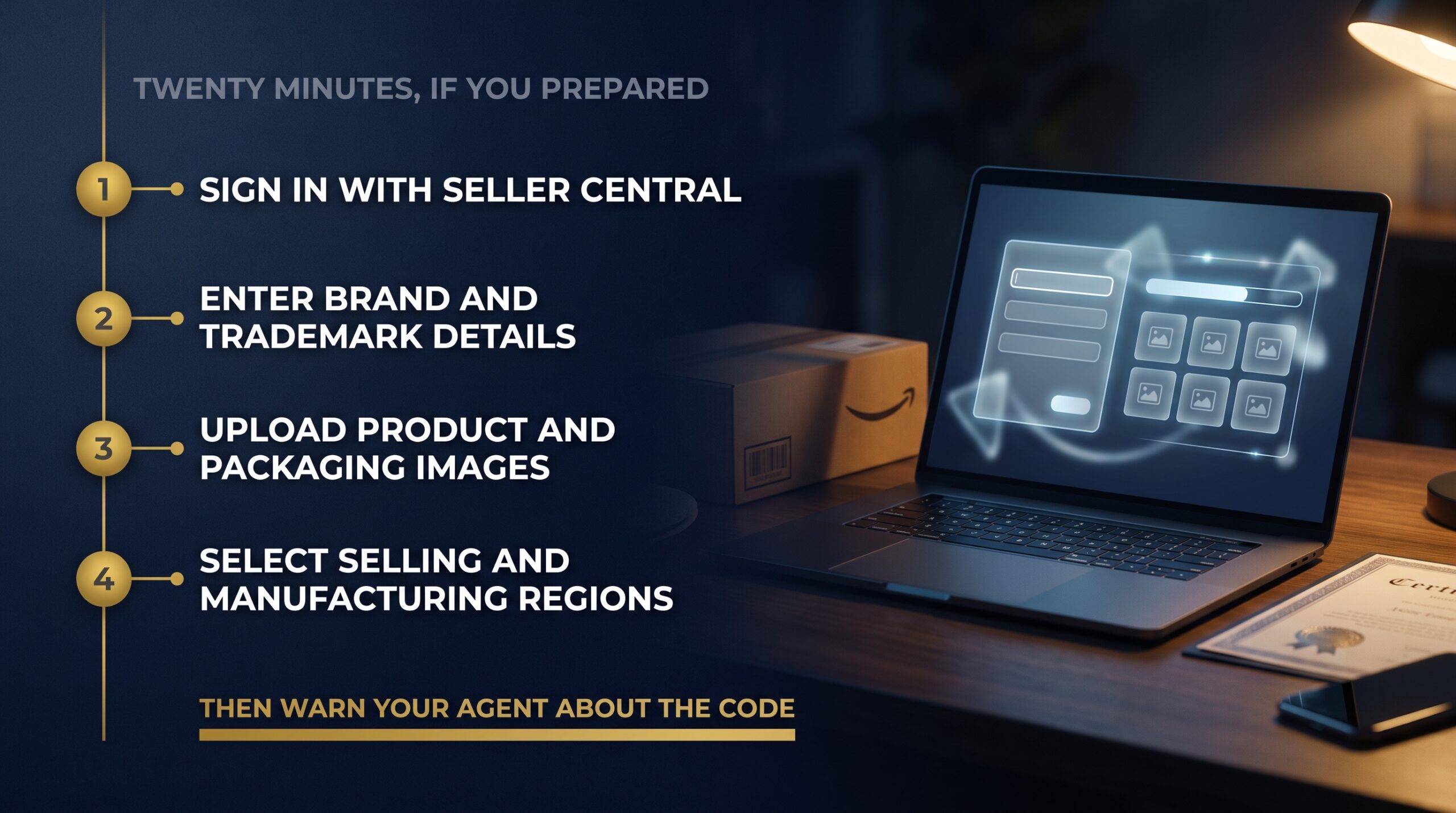
With documents in hand, the actual enrolment takes twenty minutes. This is the how to register brand on amazon india walkthrough, start to finish.
Signing in and starting the application
Go to brandregistry.amazon.in and use your brand registry amazon seller central india login — the same credentials as your selling account. Using the same sign-in links the two accounts so registry tools appear inside your seller dashboard. Then choose to enrol a new brand.
Filling brand, trademark and product details
Enter the brand name exactly as on the certificate, pick word mark or design mark, add the registration or application number, select India as the country of registration, and add the date. Then upload your product, packaging and logo images and select the categories you sell in.
Choosing selling and manufacturing regions
List every country where you manufacture and distribute. This feeds the anti-counterfeiting systems that later decide which suspicious listings to block, so accuracy here pays off months down the line.
Submitting and handling the verification code
After submission, Amazon sends a verification code to the contact on the trademark record — often your agent or attorney, not you. Kavya Nair in Kochi lost eleven days because her filing agent treated the email as spam. Warn your agent before you submit, and the code lands the same week.
What Enrollment Costs You in India
Sellers usually ask about amazon brand registry cost india and imagine an Amazon invoice. The money goes somewhere else entirely.
Amazon side versus trademark side spending
Amazon does not charge a fee to enrol a brand. Your spend is the trademark: government filing fees, and professional help if you use it. Budget per class, not per brand, because each class you file in is a separate fee.
Attorney, filing and renewal expenses
Government fees for online filing run around ₹4,500 per class for individuals, startups and small enterprises, and around ₹9,000 per class for other applicants. Professional or attorney assistance typically adds ₹2,000 to ₹10,000. Registration lasts ten years and then needs renewal — diarise it. Deepak Joshi in Indore filed across two classes for his kitchenware range, spent roughly double what he expected, and later called it the cheapest insurance he had bought, after a copycat was removed in under a week.
Budgeting the wait before you sell hard
The real cost is time. If registration takes eight to eighteen months, do not build a launch plan that assumes A+ Content and Sponsored Brands from day one. Sell lean, keep inventory tight, and scale spend once you own the page.
Working out that sequencing — file, launch, then scale — is one of the first things we map out in the 3-Day Amazon Business Training.
How Long Approval Takes and What Happens Next
Once the trademark is sorted, approval is fast. It is the waiting between steps that feels endless.
Typical timelines after you hit submit
With clean documents and a matching name, most applications clear in one to two weeks. Anything longer usually means Amazon has asked for something and the email is sitting unread in an inbox you rarely check.
The verification code bottleneck explained
The single most common delay is the verification code sitting with an unresponsive trademark agent. Amazon will only send it to the contact on record, so if that address is stale, update it with your agent before applying rather than after.
First things to do once you are approved
Claim every ASIN carrying your brand, fix titles and images that resellers mangled, then build A+ Content on your top sellers. Sunil Kapoor in Delhi enrolled his fitness equipment brand and, within a week, found three sellers using his name without authorisation; all three came down inside thirty-six hours. Approval is a starting line, not a finish.
Why Applications Get Rejected and How to Fix It
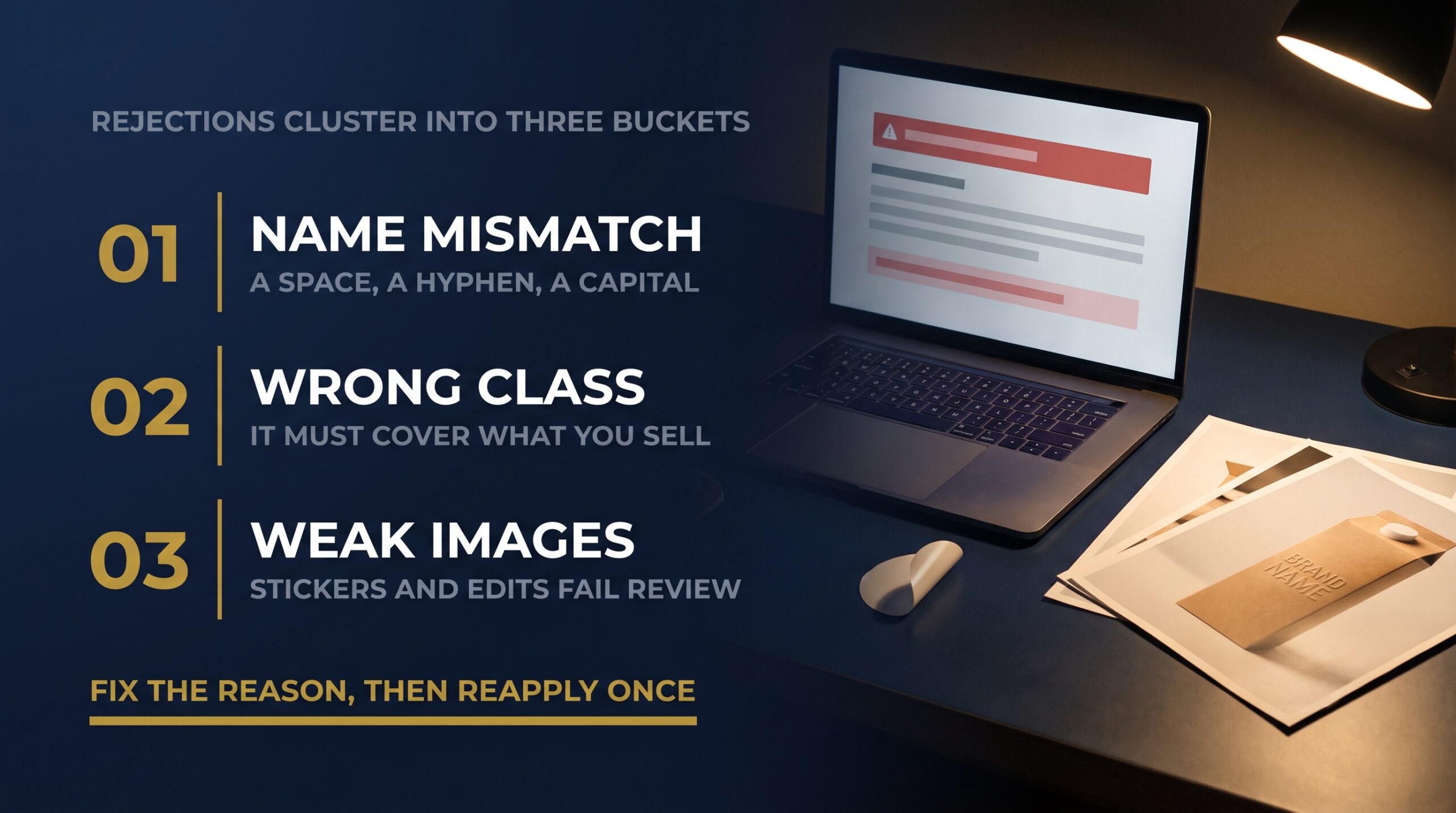
Rejection stings, but it is rarely mysterious. The amazon brand registry application rejected reasons cluster into three predictable buckets.
Name mismatches and wrong trademark class
A stray space, a hyphen, or a class that does not cover your products will end the review. Harpreet Singh in Ludhiana was rejected twice over capitalisation before he copied the name straight from his certificate; the third attempt cleared in nine days. Check the class covers what you actually list.
Weak or edited product images
Blurry shots, branding visible only on removable stickers, or logos that look digitally placed all fail. Reshoot in daylight with the real product, and if the branding genuinely is not permanent, change the packaging rather than the photo.
Reapplying without burning your case
Read the rejection notice properly and fix the specific reason before resubmitting. Firing off identical applications back to back gets you identical answers. And remember that Brand Registry and GTIN exemption are separate processes with separate reviews — enrolment does not exempt you from barcodes.
Mistakes Sellers Make After Getting Approved
Enrolment is easy to celebrate and easy to then ignore. The benefits decay quietly if nobody tends them.
Leaving old listings uncorrected
Ritika Bansal in Jaipur discovered twenty-two ASINs carrying her brand with wrong titles and reseller images, eight months after approval. Fixing them over one weekend lifted her catalogue-wide conversion by nine per cent the following month. Claim and clean everything, not just your bestsellers, and treat it as part of building a strong brand presence on Amazon.
Ignoring Transparency and Project Zero
Report a Violation is the manual tool; Project Zero lets you remove infringing listings yourself, and Transparency puts a unique code on every unit so counterfeits are caught before dispatch. Sellers in copy-prone categories — chargers, supplements, cosmetics — should evaluate both rather than assume basic protection is enough.
Letting brand admin access drift
Agencies leave, staff change, and old logins keep full rights over your brand. Review user permissions every quarter, remove anyone who no longer works with you, and keep the trademark contact email current so future verification codes reach a human who answers.
Frequently Asked Questions
What documents are required for Amazon Brand Registry in India?
You need your trademark registration certificate or IP India application number with the class and filing date, clear photos of your product showing the brand permanently affixed, images of your branded packaging or labels, a standalone logo image, and a list of categories you sell in along with the countries where you manufacture and distribute. Licensing or manufacturing authorisation is needed if you do not own the mark yourself.
Can I enroll in Amazon Brand Registry with a pending trademark application?
Yes, when the application is filed through Amazon’s IP Accelerator network of vetted law firms, which gives eligible brands earlier access to registry benefits while examination continues. You supply the IP India application number instead of a registration number. This is a head start, not a substitute — the trademark still has to complete registration, and if it is refused, your enrolment status is affected.
How long does Amazon Brand Registry approval take after applying?
Most complete applications are reviewed within one to two weeks. The delay sellers actually experience comes earlier or later in the chain: the trademark itself takes roughly eight to eighteen months in India, and the verification code Amazon sends to the trademark contact often sits unopened with an agent. Tell your agent the code is coming before you submit and the timeline usually holds.
Is Amazon Brand Registry free for sellers in India?
Amazon does not charge a fee to enrol your brand. Your actual spend is the trademark: government filing fees of roughly ₹4,500 per class for individuals, startups and small enterprises, or around ₹9,000 per class for other applicants, plus ₹2,000 to ₹10,000 if you use professional help. Add renewal every ten years, and extra classes if your catalogue spans categories.
Why was my Amazon Brand Registry application rejected?
Usually one of three things. The brand name entered did not match the trademark record exactly, down to spaces and hyphens. The images showed branding that was removable, digitally added or too blurry to verify. Or the trademark class did not cover the products you sell. Read the rejection notice, correct that specific issue, and reapply once — repeated identical submissions simply repeat the outcome.
Can I register more than one brand under a single seller account?
Yes. Each brand needs its own trademark and its own enrolment, but they can all sit under the same Seller Central account and the same registry sign-in. Sellers running multiple private labels typically enrol each one separately as its trademark completes, which is why staggering your filings by priority — bestseller first — makes financial sense.
Do I need a GST registration to enroll my brand?
GST registration is part of selling on Amazon India in most taxable categories, so you will almost certainly already have it, but Brand Registry itself is assessed on your trademark, your branded products and your account standing. Keep your business details consistent across your GST record, your seller account and your trademark filing, because mismatched entity names invite extra questions during review.
What happens to my registry status if my trademark lapses?
Registry status rests on a live trademark. If the mark lapses at the ten-year mark or is cancelled, your brand benefits can be withdrawn, and you lose listing authority along with A+ Content, Stores and reporting access. Set a renewal reminder years in advance, keep the agent contact details current, and treat renewal as a fixed business cost rather than an optional one.
Conclusion
Brand Registry is best understood as an ownership decision rather than a form. Sellers who sort the trademark, fix their packaging and photograph the real product get years of quiet control over their listings, their content and their ad tools. Sellers who rush the application with a mismatched name and a Photoshopped logo spend those same months in a rejection loop. The gap between the two groups is preparation, not luck.
So start where it actually starts: search the IP India database, choose your class, file, and build your evidence folder while examination runs. Then enrol, claim your ASINs and use what you have unlocked.
If you want the brand strategy that makes all this paperwork worth doing, come and build that plan with us at the 3-Day Amazon Business Training.
