
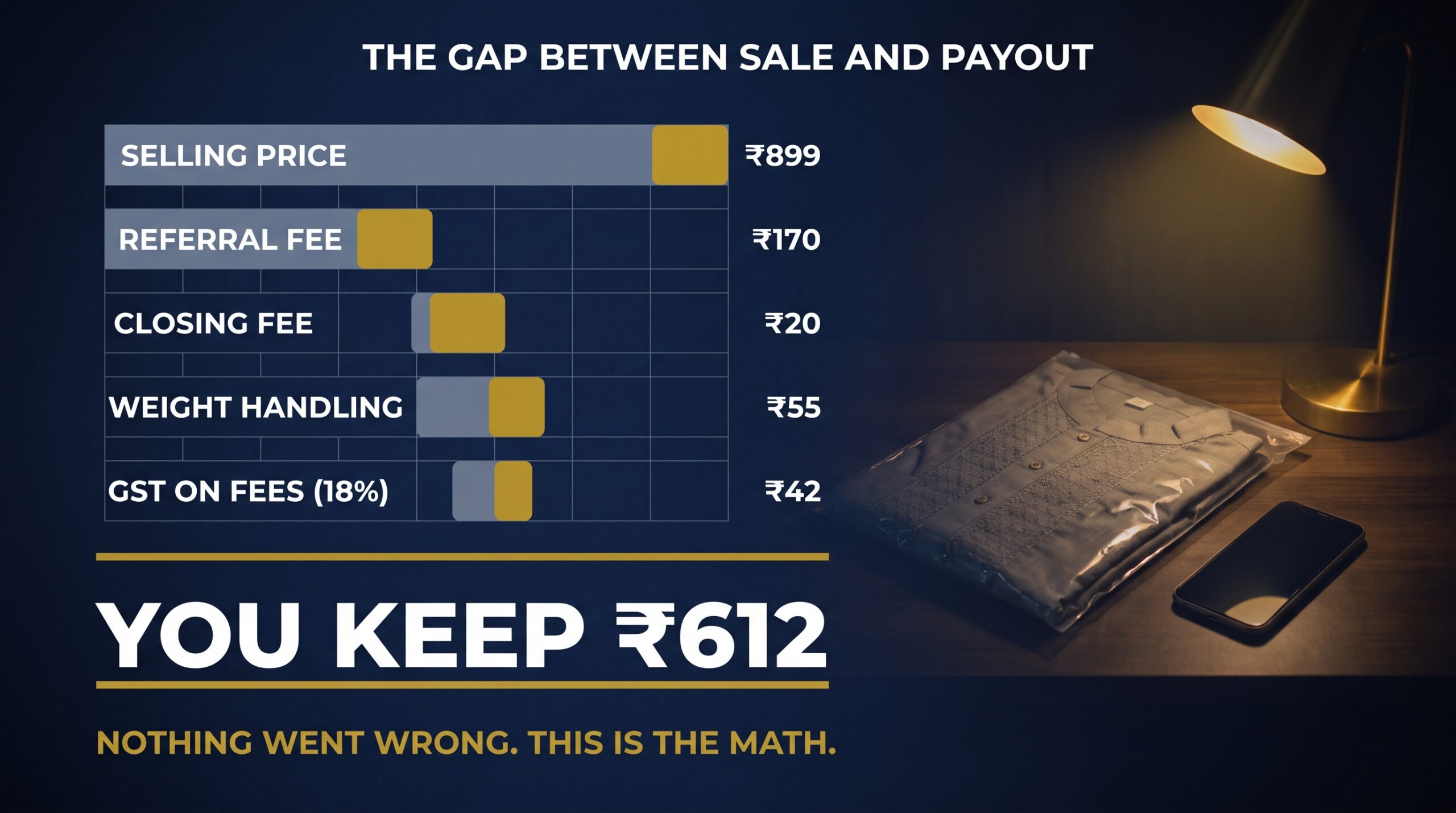
The first settlement report is where most sellers meet reality. You watch a ₹899 kurta sell on a Tuesday evening, you mentally bank the ₹899, and then Friday’s payout shows ₹612 sitting in your account. Nothing has gone wrong. Nobody has cheated you. You simply met amazon seller fees in india for the first time without a map.
That gap between the price on the listing and the money in your bank is not random. It is a stack of four or five predictable deductions, each with a published rate, each tied to something specific about your product — its category, its price, its weight, and who carries the parcel to the customer’s door. Once you can name them, you can price for them.
This is the walkthrough nobody gives you before you start. You will see a real order broken down rupee by rupee, understand why the seller next to you pays a different commission on an almost identical product, learn where GST and TCS sit in the picture, and finish with a formula you can run on your own SKUs before you buy a single unit of stock.
Where Your Money Goes On Every Order
Almost every order on Amazon.in carries the same short list of deductions. They are applied automatically at the point of sale, they appear line by line in your payment report, and they are far easier to plan for than to be surprised by.
The four charges that hit almost every sale
Here is the core set you should assume on any order, before anything optional gets added:
- Referral fee — a percentage of your selling price, set by category
- Closing fee — a flat amount tied to the item’s price band and fulfilment channel
- Weight handling or shipping fee — based on packed weight and delivery distance
- GST charged on those platform fees themselves
- Programme-specific charges, such as pick, pack and storage under FBA
Everything else — advertising, removals, long-term storage — is a choice you make, not a default.
A sample order broken down rupee by rupee
Take that ₹899 kurta on Easy Ship. The referral fee at the apparel rate takes a meaningful slice, a closing fee of roughly ₹20 applies in that price band, and a 500g parcel travelling regionally adds ₹50–₹70 of weight handling. Add GST on that total and you land near ₹280 — almost exactly the gap our seller found.
Why two sellers pay different amounts
Priya Raghavan in Coimbatore sold the same style at ₹899 while a competitor sold at ₹649. Her referral fee was higher in rupees, but her packed weight was 200g lighter after she switched to a poly mailer. Over 400 orders in one month she kept ₹9,000 more than he did. Same product, different arithmetic — and the difference sat entirely in decisions she controlled.
How Much Commission Amazon Charges Sellers
The commission everyone talks about is the referral fee, and it is the single largest deduction on most orders. Understanding how it is applied matters more than memorising any one number, because amazon commission rates in india are revised periodically.
How the percentage is applied to your listing price
The fee is a straight percentage of the item price customers pay, before taxes and shipping are counted. Sell a book at ₹450 in a category carrying a 4% rate and you pay ₹18. Sell at ₹1,000 with a 5% rate and you pay ₹50. No minimum order value protects you, and the percentage does not shrink as your volume grows.
Why some categories cost far more than others
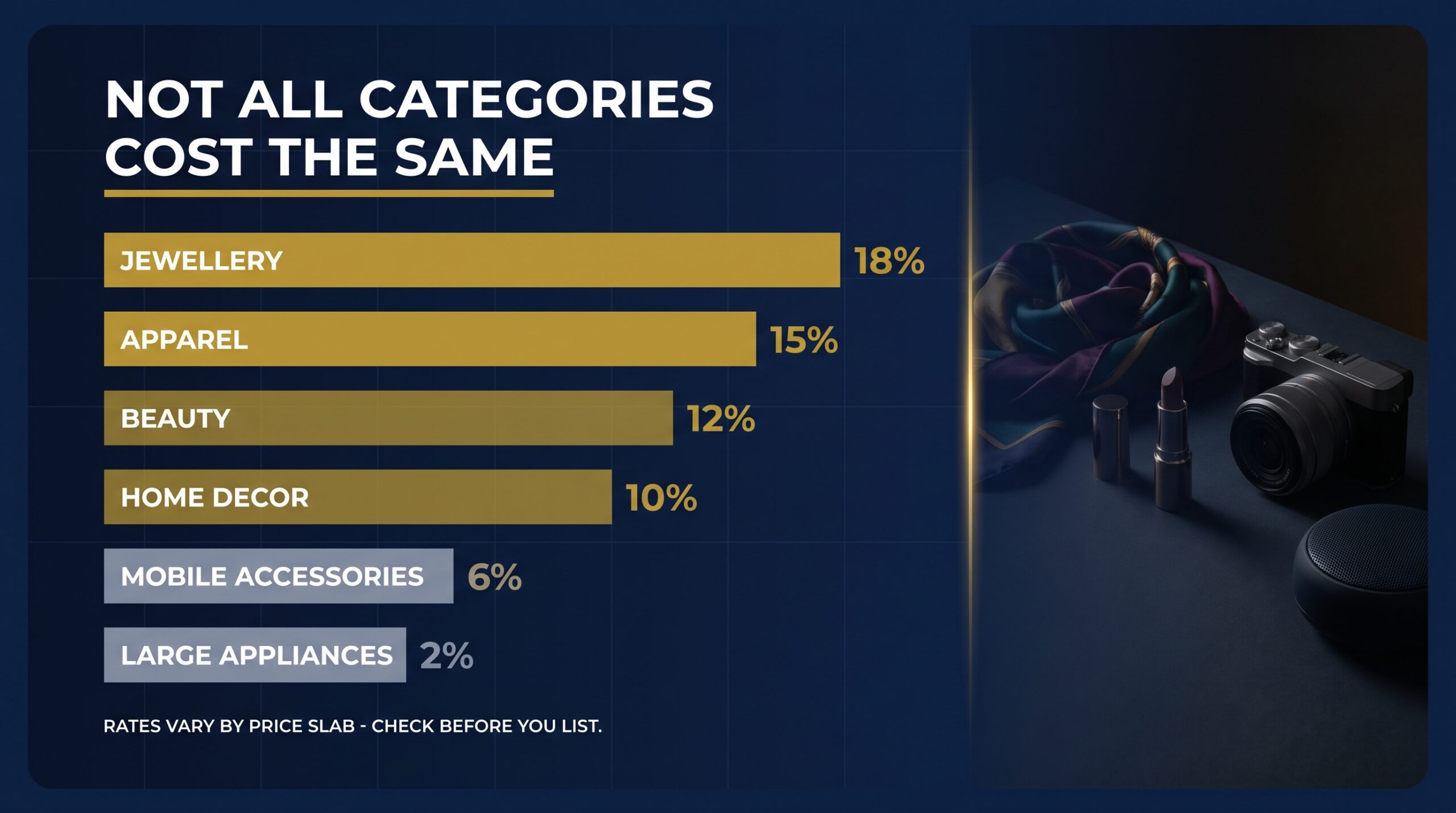
Broadly, referral rates sit between roughly 2% and 18%. Fashion, beauty, jewellery and home décor sit at the higher end because Amazon spends more to acquire those customers. Large electronics and appliances sit low, often in low single digits, because the ticket size is high and margins are thin across the whole chain.
Price slabs that change the rate on the same product
Many categories split by price band, so the same SKU can attract one rate at ₹499 and another at ₹599. Rohit Bansal in Jaipur found his brass planters crossed into a higher slab at ₹800; he repriced a variant to ₹749, kept conversion steady, and trimmed roughly ₹4,200 of commission over six weeks. Check the slab before you round any price upward.
Referral Fees Category By Category
You will not find a shortcut around the amazon referral fee category list. What you can do is learn which bands your products fall into, so you know roughly what to model before you check the exact figure.
Apparel, beauty and everyday high-rate categories
Clothing, footwear, personal care, jewellery and home furnishing generally carry the steepest commissions, frequently in the 10–18% band depending on price slab. These are also the categories with the highest return rates, which means the effective cost runs higher still. Sourcing at 25% of MRP in apparel gives you less headroom than the number first suggests.
Electronics, appliances and low-margin categories
Laptops, cameras, large appliances and mobile accessories usually sit far lower, sometimes in the 2–6% range. That sounds comfortable until you notice the weight handling fee on a 12kg appliance and the ₹500 the customer expects you to absorb in an exchange offer. Low commission does not automatically mean high profit.
Where to check the current rate before you list
Sneha Deshmukh in Pune keeps a simple sheet of her twenty SKUs and refreshes the referral percentages from the Seller Central fee schedule every quarter. In January she caught a slab revision on two products, adjusted prices within a week, and protected about ₹15,000 of margin that quarter. Fifteen minutes of checking beats a month of quiet leakage.
If putting these numbers against your own products feels like guesswork right now, that is exactly what the 3-Day Amazon Business Training is built to fix — you work through category selection and pricing with someone watching your actual figures.
Closing Fees And Weight Handling Explained
The amazon closing fee and weight handling fee are the two charges sellers consistently underestimate, mostly because they scale with things you control — price band and packed weight.
What the closing fee actually pays for
Closing fees are flat rupee amounts tied to your selling price band and fulfilment channel. Books at ₹200 under FBA typically attract around ₹12; a speaker at ₹450 lands nearer ₹20. Easy Ship and Self Ship carry their own, usually lower, tables. On a ₹250 product, those few rupees are a real slice of your margin.
How shipping weight is measured and rounded
Amazon charges on whichever is greater: dead weight or volumetric weight, calculated from length × breadth × height divided by the standard divisor. A light but bulky cushion is billed on its volume, not its grams. Weight is then rounded up into slabs, so 520g and 990g often cost the same, while 1.02kg jumps you a tier.
Local, regional and national delivery bands
Distance bands stack on top. A 700g book from Delhi to Chandigarh works out to roughly ₹40 plus ₹17 for the regional band. A 3.5kg electronic item from Bengaluru to Shillong runs closer to ₹178 once national and additional-kilogram rates apply. Arjun Menon in Kochi cut his average shipping cost by ₹22 an order over one quarter, simply by stocking closer to his southern buyers.
What Changes When You Move To FBA
Moving to Fulfilment by Amazon swaps one set of costs for another. The question is never whether amazon fba charges in india are high; it is whether they are lower than what you already spend doing the same job yourself.
Pick, pack and storage charges you take on
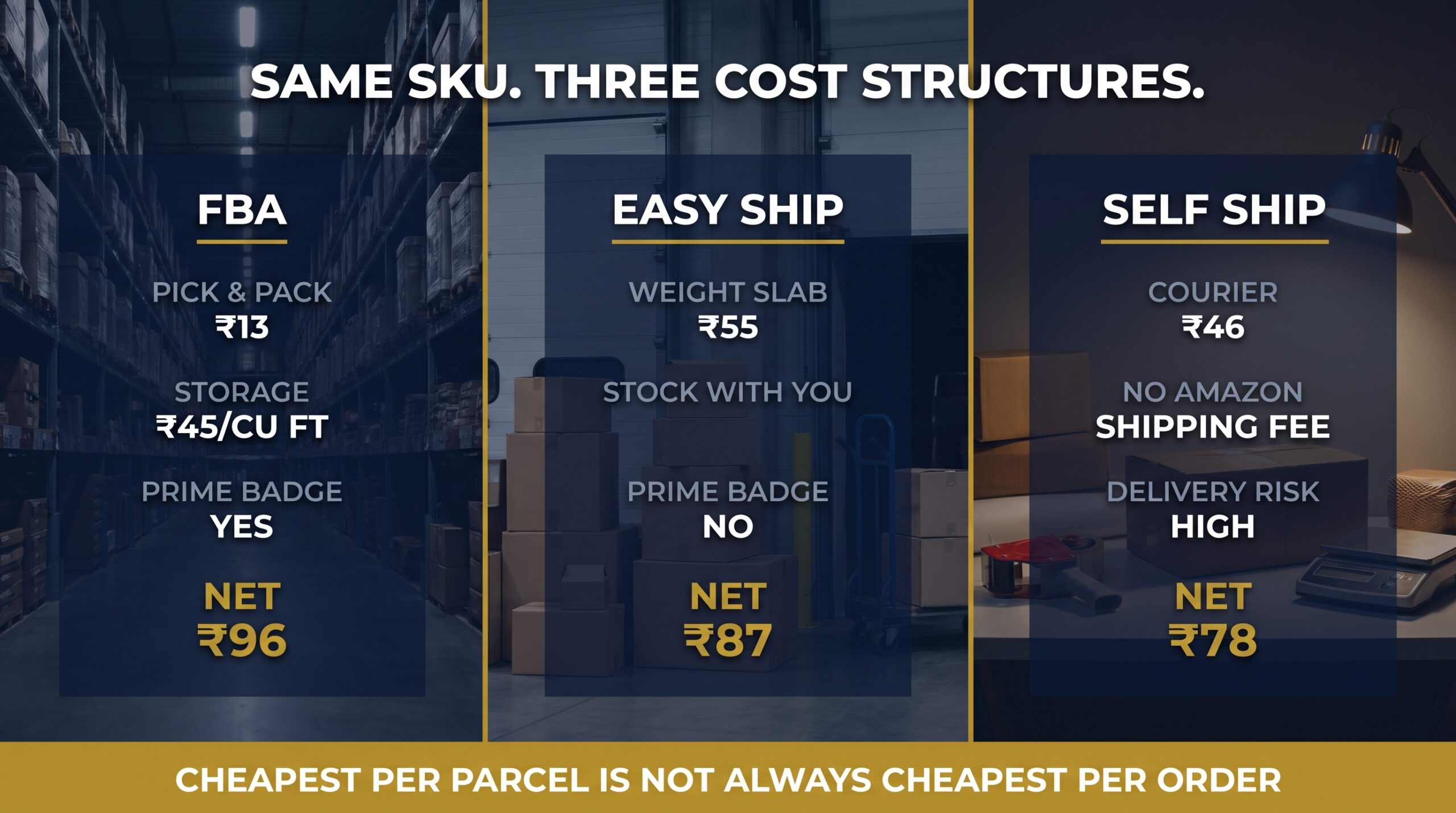
FBA adds a per-unit pick and pack fee — around ₹13 for standard-size items and roughly ₹26 for oversize or heavy units — plus monthly storage charged at about ₹45 per cubic foot. Storage is cheap only if inventory moves; a slow SKU sitting for eight months quietly doubles its landed cost.
Fees you stop paying when Amazon ships
In exchange, you stop paying for packaging material, courier pickups, warehouse rent, packing staff and the hours you spend printing labels. You also gain Prime badging, which typically lifts conversion enough to change the maths on its own.
Easy Ship and Self Ship compared on cost
Easy Ship keeps stock with you while Amazon collects and delivers at published weight slabs. Self Ship levies no Amazon shipping fee at all, because you pay a courier directly. Kavita Shah in Ahmedabad ran both for ninety days across 1,100 orders: Self Ship was ₹9 cheaper per parcel, but her delivery failures cost more than the saving, so she moved her top five SKUs to FBA — the same trade-off covered in this guide to choosing the right fulfilment mix as you scale.
GST, TCS And The Tax Layer On Top
Tax is where otherwise careful sellers lose track, because it moves in two directions at once — added to what you pay Amazon, and deducted from what Amazon pays you.
Tax added to the fees Amazon charges you
GST applies to the fees Amazon charges you, currently at 18% on referral, closing, shipping and FBA charges. That is why your deduction total always runs higher than a quick percentage calculation suggests. When you model gst on amazon seller fees, multiply your fee subtotal by 1.18 before subtracting anything else, and keep this breakdown of how GST affects Indian sellers close by.
Claiming input credit on platform charges
That GST is generally available as input tax credit against your output liability, provided your GSTIN is correctly registered on your seller account and the invoices match. Farhan Qureshi in Hyderabad discovered a mismatched GSTIN after eleven months of trading and forfeited close to ₹40,000 of credit he could not reclaim. Check that field today, not next quarter.
Tax collected at source on your settlements
Separately, Amazon deducts TCS at 1% on the taxable value of your sales and deposits it against your GSTIN. It is not a cost — it is an advance you adjust in your returns — but it does reduce the cash landing in your bank, so build it into your working capital plan.
Working out what all of this means for your own catalogue is far quicker with guidance, which is the whole point of the 3-Day Amazon Business Training.
Returns, Refunds And Other Hidden Costs
The charges that break margins are rarely the published ones. They are the ones that arrive after the sale has already been counted as a win.
What happens to fees on a cancelled order
When a customer cancels before dispatch, referral and closing fees are generally reversed. Once the item has shipped and comes back as a return, the picture changes — a refund administration charge may apply, and the outbound shipping is already spent.
Return shipping and repackaging losses
You pay to bring the unit back, then inspect it, repack it and often discount it as an open-box unit. In apparel, where returns can touch 25–30%, this single line decides whether the category works for you at all, which is why reducing your return rate is a margin exercise as much as a service one.
Long-term storage and removal charges
Inventory sitting past 180 and 365 days attracts long-term storage charges that climb steeply. Nikhil Rao in Bengaluru removed 340 slow units at the 150-day mark, paid the removal fees, and still finished about ₹27,000 ahead of what storage would have cost him over the following year.
Advertising spend as a cost per order
Sponsored Products spend comes out of the same margin. If your ACoS runs at 20% in a category charging 15% commission, over a third of your price is gone before product cost. Treat ad spend as a per-order fee, not a marketing budget.
Working Out Your Real Profit Per Order
Knowing how to calculate amazon seller profit is the skill that separates sellers who scale from sellers who grow revenue and lose money faster.
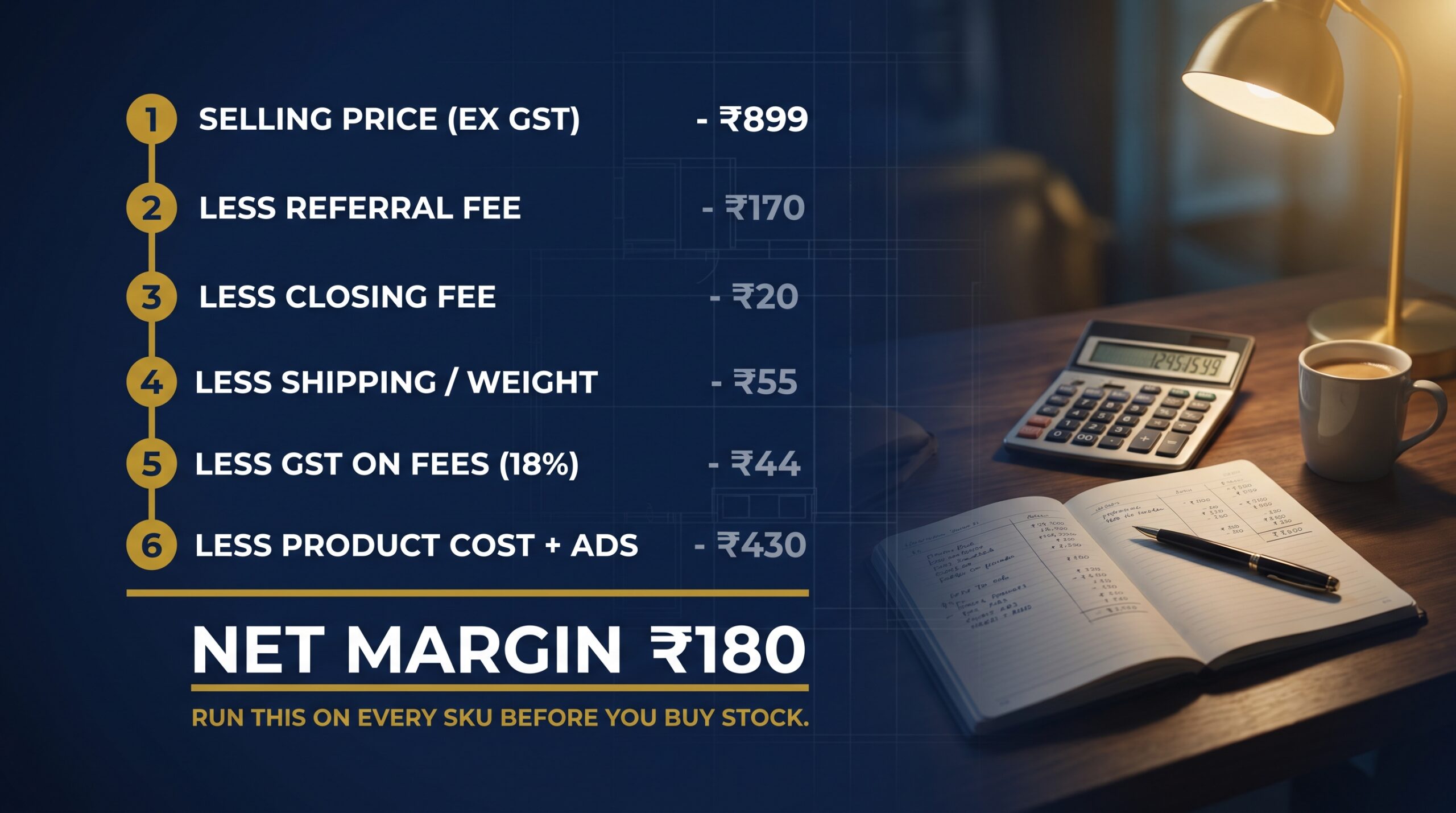
A simple formula from MRP to take-home
Work through it in order, once per SKU:
- Start with your selling price, excluding GST charged to the customer
- Subtract the referral fee for your category and price slab
- Subtract the closing fee for that band and fulfilment channel
- Subtract shipping or weight handling, or your courier cost on Self Ship
- Subtract FBA pick, pack and apportioned storage where applicable
- Add 18% GST on that fee subtotal, then subtract product cost and ad spend
Whatever survives is your true margin. Anjali Verma in Lucknow ran this on her top three SKUs and found one was losing ₹11 per unit across 600 monthly orders — a bestseller that had been funding its own decline.
Setting a price that survives every deduction
Price backwards from your target margin rather than forwards from your cost, the same discipline behind this practical guide to setting your selling price. If deductions total 34%, a product costing ₹220 needs to sell above ₹420 to hold anything workable.
Using the fee calculator before you launch
Amazon’s revenue calculator in Seller Central lets you test a price, weight and category combination before committing stock. Run every new product through it while you are still negotiating with the supplier, not after the first consignment lands in your godown.
Practical Ways To Keep Your Fee Bill Lower
You cannot negotiate the rate card, but you can change almost everything it is applied to.
Packaging smarter to drop a weight slab
Volumetric weight is the easiest win available. A back support pillow shipped flat can be compressed and rolled into a fraction of its volume, moving down a slab on both shipping and storage. Deepak Patel in Surat redesigned the carton for a set of towels, dropped 240g and one size tier, and saved roughly ₹18 per order across 900 monthly orders.
Choosing the right category and price point
Listing in the correct category is a compliance requirement, but within it you still control your price slab. Sitting ₹5 below a slab boundary is often worth more than the extra ₹5 of revenue above it.
Bundling and catalogue decisions that pay off
Bundling two units into one shipment spreads a single closing fee and one shipping charge across a higher order value, and it lifts average order value, which makes advertising cheaper per rupee earned. Meanwhile, prune dead SKUs before they reach long-term storage — a smaller, faster catalogue almost always outperforms a wide, sleepy one.
Frequently Asked Questions
How much commission does Amazon charge sellers in India?
Referral commission generally ranges from about 2% to 18% of the selling price, depending on category and price slab. Large electronics sit at the low end; apparel, beauty and jewellery sit at the top. Rates are revised periodically, so check the current fee schedule in Seller Central rather than an old figure.
What are the different Amazon seller fees in India?
Almost every order carries a referral fee, a closing fee, a weight handling or shipping fee, and 18% GST on those charges. FBA adds pick and pack per unit plus monthly storage. Beyond that sit situational costs: advertising, removals, long-term storage and refund administration. Map all of them against one SKU.
How is the Amazon referral fee calculated on a sale?
Multiply your item price by your category’s referral percentage. A book at ₹450 in a 4% category attracts ₹18; an item at ₹1,000 in a 5% category attracts ₹50. Shipping and the GST your customer pays are excluded. Where slabs apply, your selling price decides which percentage is used.
Is GST charged on Amazon seller fees in India?
Yes. GST at 18% applies on top of the referral, closing, shipping and FBA charges Amazon bills you, which is why deductions run higher than a simple percentage sum. That tax is normally claimable as input credit against your output liability, provided your GSTIN is correctly linked and the invoices reconcile.
How do I calculate my profit after Amazon fees?
Take your selling price excluding customer GST, subtract referral, closing and shipping fees, add FBA charges where they apply, then add 18% GST on that fee total. Subtract product cost and advertising spend per order. What remains is your real margin. Test it in the revenue calculator before committing stock.
Do I pay any fee if a customer returns the order?
If the customer cancels before dispatch, referral and closing fees are usually reversed. Once an item has shipped and returns, outbound shipping is already spent, return logistics apply, and a refund administration charge may be deducted. Budget for this as a standing cost in high-return categories like apparel.
Is there a monthly subscription charge for Amazon sellers?
Amazon.in offers selling plans, and a Professional plan carries a monthly subscription while the individual route charges per sale instead. Which works out cheaper depends purely on your order volume; beyond a modest number of monthly orders, the subscription usually costs less per unit. Check plan details in Seller Central.
Which is cheaper for a small seller, FBA or Easy Ship?
For small, light, fast-moving products, Easy Ship is usually cheaper per order because you avoid pick, pack and storage charges. FBA wins once volume rises, delivery failures start costing money, or Prime badging lifts conversion. Run both on the same SKU for sixty days and compare net profit per order.
Conclusion
Amazon seller fees in india only feel unpredictable while they stay abstract. Attach them to a real product — a price, a category, a packed weight, a delivery band — and they become numbers you can forecast to the rupee before you place a purchase order. That is the shift worth making this week.
Take your three best-selling SKUs, run each one through the full deduction list, and see which ones actually earn what you assumed. One of them will surprise you. Fix that before you spend another rupee scaling it.
And if you would rather work through pricing, category choice and fulfilment decisions with someone who has seen these numbers across hundreds of Indian sellers, come and take a seat at the 3-Day Amazon Business Training.

One Response
Thanks for elaborate explanation.