

At 11:40 on a Tuesday, Ananya Deshpande opened Seller Central expecting a payout and found a hold notice instead. Eleven weeks of selling handmade cold-process soaps from her flat in Pune, good reviews, a climbing reorder rate — and none of it mattered, because GST for Amazon sellers in India begins with one boring detail she had got wrong. The legal name on her GST certificate did not match the legal name on her seller account. Three weeks and roughly ₹1.9 lakh of stuck cash later, she learned what most sellers learn the hard way: tax registration is not paperwork you sort out after the business works. It is the thing that lets the business work at all.
The good news is that this is solvable, and mostly one-time. Registration takes days, not months. The filings settle into a rhythm you can run in an hour a month. And a real chunk of what you pay comes back to you if you know where to look. This guide covers who must register, who genuinely need not, what Amazon deducts, what you can claim back, and how to keep the whole thing clean.
What GST Actually Means for Your Amazon Store
Think of GST as a single pipe that replaced a tangle of older ones. The difference from offline trade is that every rupee you earn online is recorded digitally before you touch it, so your returns are matched against a trail the department can already see.
The tax that replaced VAT, CST and service tax
Before 2017 you juggled VAT on goods, CST on interstate movement and service tax on commissions. GST folded those into one destination-based tax — CGST plus SGST within a state, IGST when the buyer sits in another state. Your job is simply to charge the right one on every order.
Why marketplace selling is treated differently
Amazon is an e-commerce operator under the law, which places it between you and the department. It reports your supplies, deducts tax at source before settling you, and those figures appear in your GST portal whether or not you file. That visibility is why marketplace sellers get flagged faster than shopkeepers do.
Who collects, who pays and who files
You collect GST from the buyer inside the selling price. Amazon deducts a slice at source and deposits it. You file the returns and pay the balance. Ravi Menon, who sells brass pooja items from Kochi, skipped that last step for two quarters and paid ₹9,400 in late fees before his CA brought him current — filing is your responsibility, never the marketplace’s.

Is a GSTIN Mandatory Before You Start Selling?
The short answer most sellers want: if you sell taxable goods through a marketplace, yes. The question of whether is gst mandatory for selling on amazon has a cleaner answer than the internet suggests, and it has nothing to do with your revenue.
The interstate supply rule that catches most sellers
Selling through a marketplace means buyers across state lines, and supply to another state is compulsorily registrable regardless of turnover. Amazon also requires a valid GSTIN before you can list taxable goods and raise compliant invoices. Waiting until you “get some sales first” is not an option the system allows.
Turnover thresholds and where they do apply
The ₹40 lakh threshold for goods and ₹20 lakh for services is real, but it covers intra-state sellers who are not supplying through an e-commerce operator, and some special category states use lower limits. If you ship pan-India from a marketplace, treat the threshold as background reading rather than an exemption.
What happens if you list without registering
Without a GSTIN you cannot use FBA, Sponsored Ads or B2B pricing, and a compliance sweep can freeze payouts and suspend the account. Priya Nair in Coimbatore launched her kitchenware listings on a friend’s GSTIN, lost the account within two months, and restarted from zero — a shortcut that cost her ₹1.4 lakh in dead inventory, and one of the harder account suspensions to get reinstated.
When You Can Sell on Amazon Without a GST Number
There is one narrow, legitimate door, and it stays narrow. You can sell on amazon without gst only if every single product you list falls under a GST-exempt category. One exception in your catalogue closes the door.
GST-exempt categories Amazon allows
Exempt goods carry no output tax, so supplying them through a marketplace triggers no registration. Amazon maintains a list of categories it accepts from sellers without a GSTIN and checks category and HSN at listing time. Confirm the exemption for your specific product, not the broad category name.
Books, handloom and other exempt listings
Printed books are the classic example, alongside certain handloom and unbranded agricultural items. Vikram Sethi in Jaipur ran a used-book store on Amazon for fourteen months without registration, reached about ₹60,000 a month, then registered voluntarily the day he added stationery — one taxable SKU changed his obligation entirely.
Why exempt sellers still need a PAN and bank proof
No GSTIN does not mean no paperwork. You still need a PAN, a bank account in the selling entity’s name and address proof to clear verification, and your payouts still follow income tax rules. Archive invoices and settlement reports exactly as a registered seller would.
Getting this judgement right early saves months of cleanup, and it is one of the first things we work through in the 3-Day Amazon Business Training, where you set up the account, the tax settings and your first listings in the correct order.
Documents and Steps to Get Your GSTIN
Gst registration for amazon seller accounts is refused far more often for sloppy uploads than for genuine ineligibility. Gather clean documents first and the application usually clears in under a week.
PAN, Aadhaar, bank and address proof checklist
Scan everything at full clarity, in the exact legal name of the entity you will sell under. Here is what the portal asks for:
- PAN of the proprietor, firm or company, matching your entered name letter for letter
- Aadhaar of the proprietor or authorised signatory for OTP-based verification
- Proof of principal place of business: electricity bill, property tax receipt, or rent agreement with the owner’s NOC
- Bank proof: a cancelled cheque or passbook page showing name, account number and IFSC
- Photograph of the signatory, plus incorporation documents for firms and companies
Upload them in the formats and size limits the portal specifies, because oversized or rotated scans are a common rejection reason.
Filing on the GST portal step by step
On gst.gov.in, choose New Registration, enter PAN, email and mobile to generate a TRN, then log in with it to complete Part B — constitution, principal place of business, additional places such as out-of-state FBA warehouses, bank details and your HSN codes. Verify by OTP, e-sign or DSC, then track the ARN until your GSTIN and certificate appear.
Choosing your principal place of business
Your principal place is where you actually operate and keep records, and it must match the proof you upload. Sana Qureshi in Hyderabad listed her warehouse as principal but uploaded a home electricity bill; the officer raised a query and her approval slipped by nine days. One address, one proof, no improvisation.

How Amazon Deducts TCS and How You Claim It
Every settlement you receive has already had tax shaved off it. Understanding amazon tcs under gst turns that deduction from a mystery line item into money you reclaim every month.
The one percent rate and what it applies to
TCS applies to the net taxable value of your marketplace supplies — sales minus returns and cancellations — not to your fees. Most sellers still quote 1% from memory, though the notified rate has since been revised downward, so read the current figure on the portal rather than trusting an old blog.
Reading TCS entries in your Seller Central reports
Pull your monthly transaction report and the TCS statement from the tax section of Seller Central. Tally what they show against the GSTR-8 data Amazon files, which appears in your portal for acceptance. Mismatches usually trace back to returns recorded in a different month.
Matching TCS credit in your cash ledger
Accept the TCS entry on the portal and it lands in your electronic cash ledger, ready to offset liability when you file. Arjun Bhatia, a fitness accessories seller in Ludhiana, found ₹27,000 of unaccepted TCS sitting idle from eight months of trading, and recovered all of it in one afternoon once he knew which screen to open.
Claiming Input Tax Credit on Your Business Costs
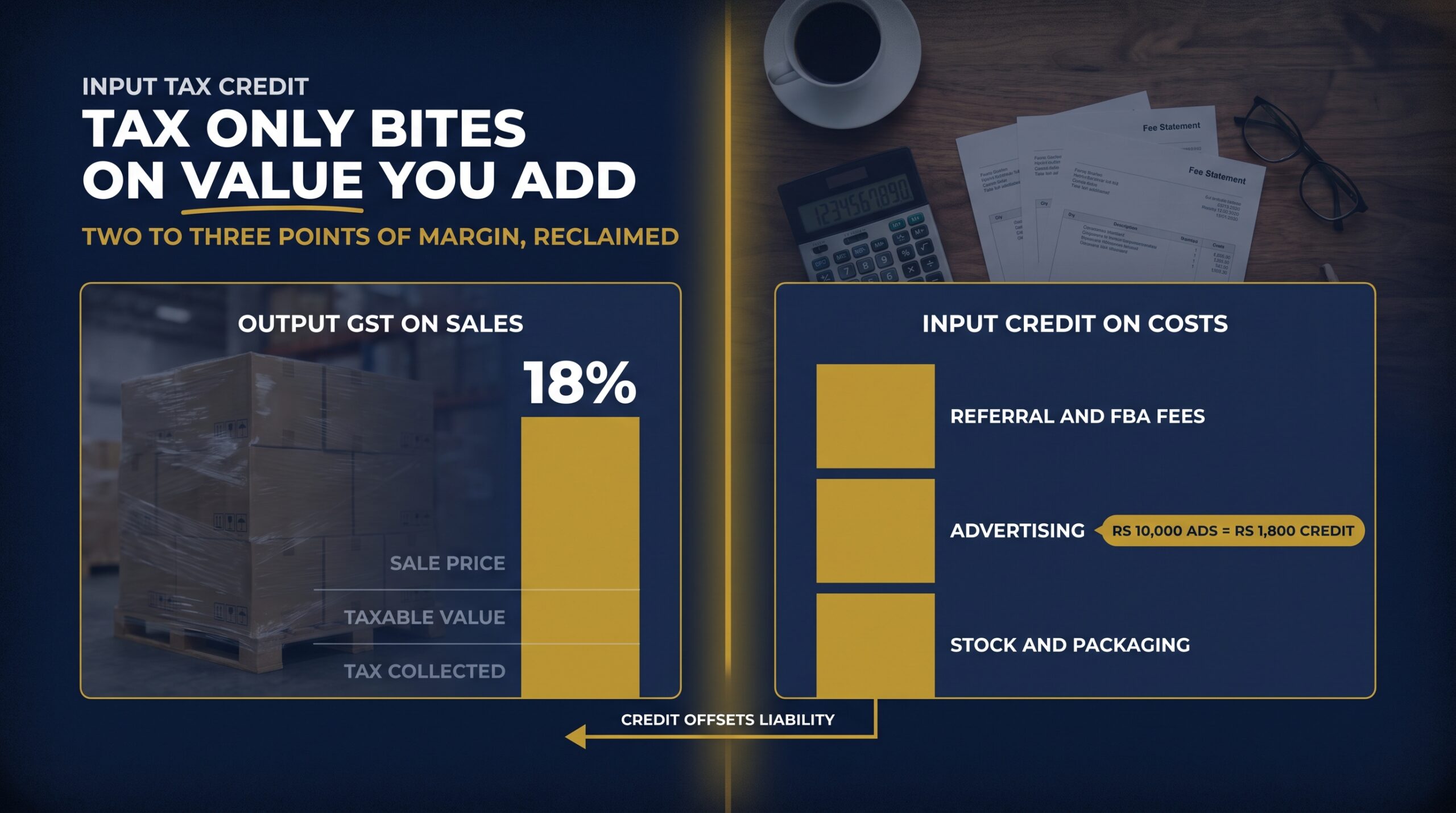
This is the part that quietly improves your margin. Input tax credit for amazon sellers means the GST you pay on business inputs offsets the GST you owe on sales, so tax only bites on the value you add.
Amazon fees, packaging and supplier invoices
Referral fees, FBA and storage charges, shipping, advertising, photography, packaging and stock purchases all carry GST, and Amazon issues fee invoices against your GSTIN. Spend ₹10,000 on ads and the ₹1,800 of GST at 18% comes straight off your liability. Disciplined ITC typically returns two to three points of margin — worth reading alongside this breakdown of Amazon seller fees.
Why supplier compliance decides your credit
Your credit only exists if your supplier actually files. Reconcile GSTR-2B monthly and chase any invoice that has not appeared. Deepak Iyer in Surat lost ₹41,000 of credit in a year to a fabric supplier who filed late and erratically; moving to a compliant vendor recovered it within two quarters.
Blocked credits worth knowing about
Some inputs are blocked by law regardless of the invoice — personal expenses, most motor vehicles, food and beverage, and anything bought under the composition scheme. Claiming them invites reversal with interest, so keep a clean line between business and personal spending from day one.
If compliance still feels like a language you do not speak, that is exactly what a guided start fixes — you can work through it with us over three days of training instead of learning it from a payout hold.
The GST Returns You Have to File and When
Gst return filing for amazon sellers settles into a predictable loop once you have done it twice. The trouble starts only when a month gets skipped and the next one inherits the mess.
Monthly sales and purchase filings explained
GSTR-1, your outward supplies, is due by the 11th of the following month, or quarterly if you have opted into QRMP. GSTR-3B, where you actually pay, falls on the 20th. Before filing, download your transaction, fee and TCS reports, reconcile sales against returns, match GSTR-2B to purchase invoices, then pay the balance after ITC and TCS.
The annual return and who it applies to
GSTR-9 consolidates the year and is mandatory above the prescribed turnover limit, with GSTR-9C reconciliation required at the higher slab. Even when optional for you, filing it is a useful audit of whether your monthly numbers drifted anywhere.
Late fees, interest and dormant account risks
Late fees accrue daily per return and interest runs on unpaid tax, but cancellation for continuous non-filing is the real danger, because it takes your listings down with it. Nisha Agarwal in Guwahati paused selling for a season, stopped filing nil returns, and spent six weeks reviving a cancelled GSTIN before she could relist.
Pricing, Invoicing and Margins After GST
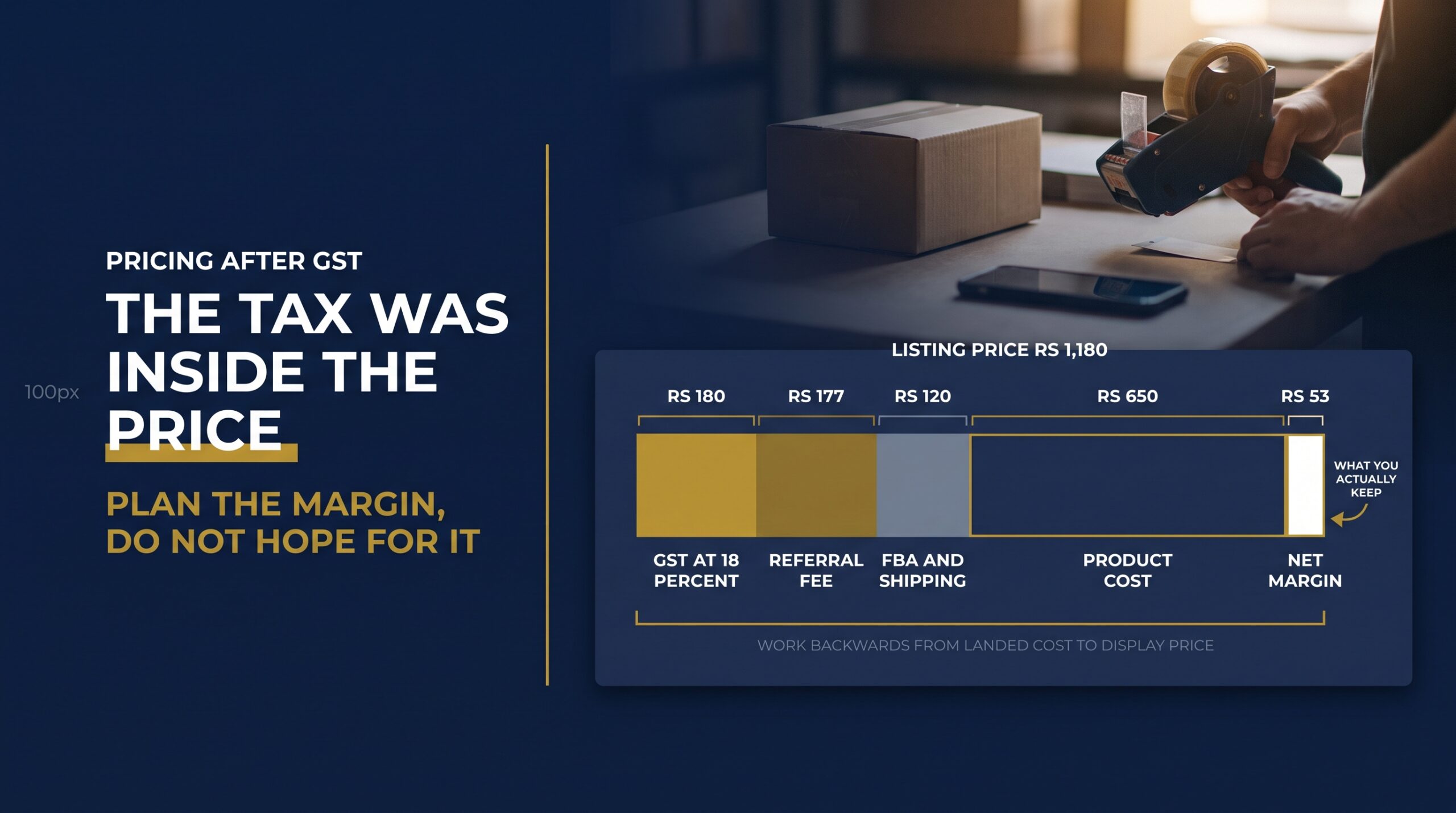
New sellers price a product, subtract Amazon’s fee, smile at the number, then discover the tax was inside that price all along. Building GST in from the start is the difference between a margin you planned and one you hope for.
Building tax into your listing price
Your listing price is tax-inclusive. At 18%, a ₹1,180 price contains ₹180 of GST, leaving ₹1,000 as taxable value before referral fees, FBA and shipping. Work backwards from landed cost to the display price rather than forwards from cost plus a guess, the same discipline behind deciding your product’s selling price.
HSN codes and correct tax rates
Every product needs the right HSN and the rate attached to it. Guessing a neighbouring code either overcharges buyers or underpays tax, and both get noticed. Keep a master HSN sheet for your catalogue and reuse it across listings, invoices and returns so the three never disagree.
Invoices Amazon generates versus your own
Amazon can generate compliant invoices for marketplace orders, but off-Amazon sales, B2B supplies and credit notes for returns are yours to issue. Kavya Reddy in Bengaluru sold candles for a year without raising credit notes, paying tax on roughly ₹2.7 lakh she never kept — build the habit alongside a proper returns handling process.
Common GST Mistakes That Cost Sellers Money
Most notices are not sophisticated. They come from three or four errors repeating across thousands of accounts, and each has a fix that takes minutes if you catch it early.
Wrong state code on the registration
The first two digits of your GSTIN are your state, and they drive whether a sale is IGST or CGST plus SGST. Get the place of supply wrong and your GSTR-1 disagrees with Amazon’s GSTR-8, which is the fastest route to a mismatch notice.
Ignoring reconciliation for months
Reconciliation compounds: skip it in April and you are untangling four months by August. Rohit Kulkarni in Nagpur let it slide for a full financial year and paid his CA ₹18,000 to rebuild the trail — roughly nine months of what a monthly routine would have cost him.
Selling from an address not on your GSTIN
If you store stock in a state, that state needs a GSTIN, and every storage location must appear on your registration as a principal or additional place of business. Sellers who move into out-of-state FBA without amending their registration are the ones caught during verification.
Your First Ninety Days as a GST-Compliant Seller
Compliance feels heavy only while it is undefined. Give it a calendar and it becomes a ninety-minute monthly chore that protects everything else you are building.
Week one: registration and Seller Central linking
Apply on the portal, track the ARN, and the moment the certificate arrives, enter the GSTIN in Seller Central tax settings with the legal name matching character for character. Add bank details in the same entity name. That alignment prevents Ananya’s payout hold, and it mirrors the care you apply when you set up the seller account itself.
Month one: first filing and first reconciliation
File GSTR-1 and GSTR-3B on time even when sales are small, accept the TCS entry, and reconcile GSTR-2B against purchase invoices. Meera Joshi in Indore filed her first return on a ₹14,000 sales month and says that practice run is exactly why her ₹4 lakh months now feel painless.
Month three: systems that keep you compliant
By now you want a cloud folder of invoices by month, a master HSN list, calendar alerts on the 11th and the 20th, and an accountant who understands marketplace flows. Automate the downloads, keep the judgement calls human, and compliance stops being a fire drill.
Frequently Asked Questions
Is GST registration mandatory for selling on Amazon in India?
For taxable goods, yes. Supplying through an e-commerce operator to buyers in other states counts as interstate supply, which requires registration regardless of turnover, and Amazon needs a valid GSTIN before you list taxable products. The ₹40 lakh threshold applies only to purely intra-state sellers outside marketplaces. Register before you list.
Can I sell on Amazon without a GST number?
Only if every product in your catalogue is GST-exempt — printed books being the common example, along with certain handloom and unbranded agricultural goods. Amazon checks category and HSN at listing. Add one taxable SKU and registration becomes compulsory. Even exempt sellers need PAN, address proof and a bank account in the entity’s name.
Which documents are needed for GST registration as an Amazon seller?
PAN for the business entity, Aadhaar of the proprietor or authorised signatory, proof of principal place of business such as an electricity bill or rent agreement with the owner’s NOC, bank proof by cancelled cheque or passbook page, and a recent photograph. Companies and partnerships add incorporation papers. Every name must match exactly.
How much TCS does Amazon deduct under GST and how do I claim it?
Amazon deducts at source on the net taxable value of your marketplace sales after returns, and deposits it against your GSTIN. The widely quoted rate has been revised, so check the current notified figure on the portal. Amazon files GSTR-8, the amount appears for acceptance, and accepting it credits your electronic cash ledger.
Which GST returns must an Amazon seller file and by when?
GSTR-1 for outward supplies is due by the 11th of the following month, or quarterly under QRMP. GSTR-3B, where you settle tax after ITC and TCS, is due on the 20th. GSTR-9 is annual, mandatory above the prescribed turnover, with GSTR-9C at the higher slab. File nil returns during quiet months too.
Can I use my home address for GST registration as a seller?
Yes, and thousands of sellers do. You need proof tying you to that address — an electricity bill or property tax receipt if you own it, or a rent agreement plus the owner’s no-objection letter if you rent. Upload a clear, current scan matching the application word for word, and amend later if you move stock.
Do I need separate GST numbers for each state I store stock in?
Yes. Registration is state-wise, so storing inventory in an out-of-state FBA warehouse requires a GSTIN in that state, with the location listed on your registration. Dispatch everything from one state and a single GSTIN covers you. With multiple registrations, file state by state and filter Amazon reports per warehouse.
What happens to my listings if my GSTIN gets cancelled?
Cancellation removes your ability to list taxable products, and Amazon can deactivate listings and hold payouts until you supply valid registration. Revocation is possible if you apply within the prescribed window and clear pending returns with fees and interest, but it takes weeks while rank decays. Nil returns are far cheaper than revival.
Conclusion
Strip away the jargon and gst for amazon sellers in india is a loop you repeat: register once with clean documents, charge the right rate, let Amazon deduct at source, accept that credit, claim input tax credit on fees and stock, file by the 11th and the 20th, reconcile, repeat. Sellers who run that loop spend their attention on products and listings. Sellers who dodge it spend it on notices and frozen payouts.
You do not need to master tax law. You need the right setup on day one and a routine that survives a busy month. If you want that built with you — account, compliance and first listings in the correct order — come and build it at the 3-Day Amazon Business Training.
