

Lakshman from Madurai had his best week ever during the Great Indian Festival. His dashboard showed ₹1,12,000 in sales of his steel lunch boxes. On Thursday, his bank SMS said ₹38,400. He called his CA with one question: “Has Amazon cheated me?”
It hadn’t. Lakshman had simply never learned the Amazon seller payment cycle in India, and almost no new seller does. Some of his money was still travelling with the courier. Some was sitting in a seven-day wait. Some covered Amazon’s fees and his own ad spend. And a slice was tax he could claim back, if he knew where to look.
This guide walks you through all of it, written for FBA sellers. You’ll see exactly when your money lands, where the gap between sales and payout goes, why Amazon keeps a reserve, and how to claim back the TCS and TDS deducted from every order.
Why Your Amazon Seller Payment Never Matches Your Sales
Sales Is the Promise, the Payout Is the Receipt
The sales figure on your dashboard counts orders placed. Your payout counts something narrower: orders that were delivered, cleared their waiting period and fell inside a closed settlement. An order placed on Saturday might be delivered on Monday, become payable a week later, and reach you in the settlement after that. So one big week of sales never arrives as one big payment. It spills across the next two or three settlements.
Why Is My Amazon Payout Less Than My Sales?
Once timing settles down, the gap comes from four places. Amazon keeps a reserve against returns, takes its fees and your ad spend, and deducts two small taxes called TCS and TDS.
There’s also a trap hiding inside your sales number. The price a customer pays includes GST, and Amazon passes that GST through to you. It isn’t yours to keep. You owe it to the government when you file GSTR-3B. Meghna Rao from Hyderabad treated three months of payouts as profit, then found herself ₹41,000 short when her GST payment fell due.

The Amazon Seller Payment Cycle in India, Step by Step
How the 7-Day Amazon Payment Settlement Cycle Works
Amazon pays Indian sellers on a 7-day cycle. When each seven-day settlement period closes, Amazon adds up everything payable inside it, subtracts fees and deductions, and starts a bank transfer for the balance, usually within a couple of days.
My own FBA account shows the pattern. All of its last 20 settlements, from late August to early November 2026, covered exactly seven days, with each deposit initiated two days after the period closed.
Settlement Date, Deposit Date and Bank Credit
Three dates confuse almost everyone. The settlement period is the seven-day window your orders are grouped into. The deposit date is when Amazon starts the transfer, and the bank credit is when the money appears, which can take a little longer depending on your bank. One recent period of mine ran from 29 October to 5 November, with the deposit initiated on 7 November.
When Will Your First Payment Arrive?
Amazon’s seller guide says your first settlement comes about 14 days after you register, then every seven days. In practice, your first real money depends on your first delivered order clearing its seven-day wait. Your balance must also be positive, and your bank account verified. Ritu Agarwal from Jaipur got a first settlement of ₹0 because her launch ads cost more than the few orders that had cleared. The next one brought her first ₹6,200.
Why FBA Speeds Up Your Amazon Seller Payment Cycle
What DD+7 Means for Your Cash
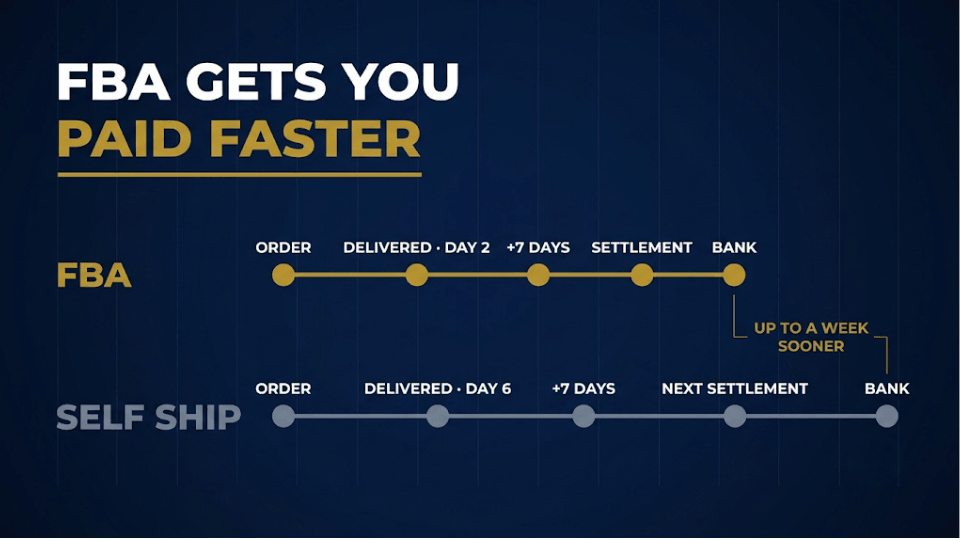
Amazon doesn’t release an order’s money when the customer clicks Buy. It waits until seven days after the delivery date, a rule sellers call DD+7. That week gives the buyer time to return the product before you’re paid for it. Once the seven days pass, the order joins the next settlement that closes. So the real clock starts at delivery, and anything that slows delivery slows your money.
FBA vs Self Ship: Same Sale, Different Payday
This is where FBA quietly pays you back. Amazon’s fulfilment centres deliver most Prime orders in one or two days, so the seven-day clock starts almost immediately. A self-shipped order that takes five or six days to arrive starts that clock later and often misses a settlement. Sameer Khan from Lucknow tracked this after moving his kitchen organisers to FBA. His average gap between order and bank credit fell from about 19 days to about 13. Same product, same customers, nearly a week less waiting.
Want to see this in your own numbers? Grab our settlement tracker sheet and map one week of orders to the settlement each lands in.
Amazon Account Level Reserve: Money You Can’t Touch Yet
Why Amazon Holds Back Part of Your Balance
Separate from the DD+7 wait, Amazon can hold back a slice of your whole balance. This is the account level reserve. It protects Amazon if refunds, A-to-z Guarantee claims or chargebacks land after it has already paid you. The money is still yours, just not available yet. New sellers usually carry a bigger reserve because Amazon has no history to trust, and high return rates or weak account health push it higher.
How to Check and Shrink Your Reserve
Open the Payments dashboard in Seller Central and compare your total balance with the amount marked available. The difference is what’s being held, and each settlement statement shows the reserve as its own line. You can’t negotiate a reserve away, but you can earn it down.
Ananya Ghosh from Kolkata had ₹24,000 of a ₹62,000 balance held in her first month, with returns running at 9%. She fixed her size chart, added real-wear photos and watched returns fall to 4%. Over the next two months, her reserve shrank to almost nothing. For comparison, my own mature account has shown ₹0 held back in each of its last 20 settlements.
Every Deduction Between Your Sale and Your Bank
Referral, Closing and FBA Fees, Plus 18% GST
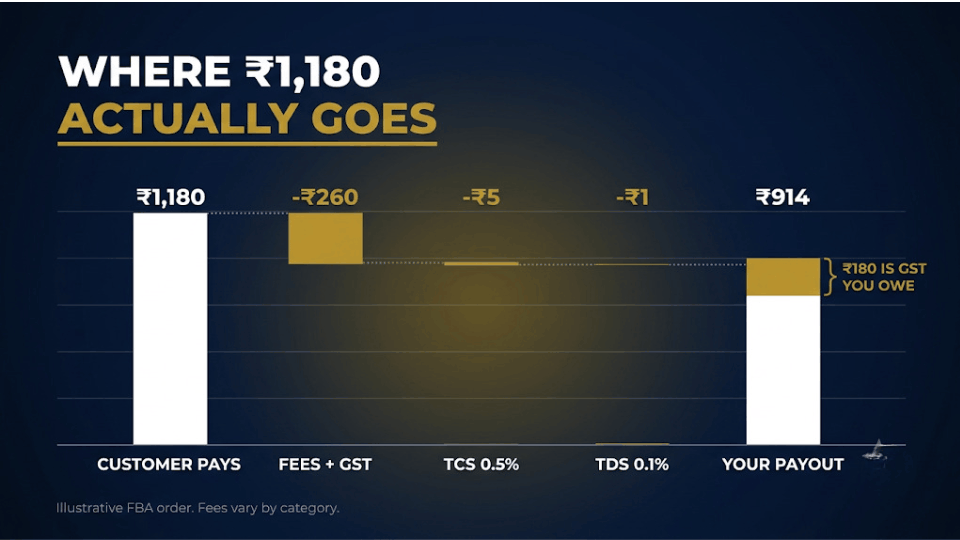
Amazon’s fees come off every order first. That means a referral fee (zero below ₹1,000 in over 1,800 categories since March 2026), a closing fee, and FBA fees for picking, packing and shipping, all with 18% GST on top. Here’s how one ₹1,180 order (₹1,000 plus 18% GST) reaches your bank if its fees total ₹260:
- The customer pays ₹1,180.
- Fees, including the GST on them, take ₹260.
- TCS at 0.5% of the ₹1,000 taxable value takes ₹5.
- TDS at 0.1% takes ₹1, leaving a payout of ₹914.
Of that ₹914, ₹180 is GST you still owe. But about ₹40 of GST on fees, plus the ₹5 and ₹1, come back to you as credits. Check your own product’s fees in Amazon’s Revenue Calculator.
Returns, Weight Disputes and Ad Invoices
Three more deductions catch FBA sellers off guard. A return processed this week reduces this week’s payout, even if the original order was paid a month ago. If the fulfilment centre remeasures your product as heavier or bigger than your listing says, Amazon charges the higher fee retroactively. And if your ads are billed to your seller account, your Sponsored Products spend comes out of the settlement too.
Vikram Shetty from Mangaluru lost ₹6,400 when Amazon remeasured his storage boxes. He disputed it with photos on a scale and against a tape, and recovered ₹4,900.
TCS on Amazon Sales: What It Is and How to Claim It
Why Amazon Deducts 0.5% TCS
Under Section 52 of the GST law, marketplaces like Amazon must collect tax at source from every seller. Since 10 July 2024, the rate is 0.5% of your net taxable sales after returns: 0.25% CGST plus 0.25% SGST within your state, or 0.5% IGST across states. It used to be 1%. TCS isn’t a cost. It’s an advance on your GST bill, deposited in your name.
How to Claim TCS Credit on the GST Portal
That credit only reaches you if you accept it. Here’s the flow:
- Amazon reports your TCS in its GSTR-8 return by the 10th of the following month.
- The amounts appear in your GSTR-2X on the GST portal.
- You or your CA accept them and file GSTR-2X.
- The accepted credit moves into your electronic cash ledger.
- You use it to pay GST in GSTR-3B, or claim a refund of any excess.
If the figures don’t match your records, compare them with the TCS report in Seller Central and check that the GSTIN on your account is correct. Imran Sheikh from Surat found ₹11,200 of TCS sitting unaccepted for seven months, simply because nobody had opened GSTR-2X.
Our monthly TCS and TDS checklist stops that happening. Hand it to your CA and nothing sits unclaimed.
Section 194O TDS and Your Amazon Seller TDS Refund
The 0.1% TDS and the April 2026 Section Change
TDS is the income tax cousin of TCS. Amazon deducts 0.1% of your gross sales, down from 1% before October 2024. Most sellers still call it Section 194O, but from 1 April 2026 it sits under Section 393(1) of the new Income-tax Act 2025, at the same rate. If you sell as a resident individual or HUF, have furnished your PAN or Aadhaar, and keep sales within ₹5 lakh a year, no TDS is deducted at all.
How to Claim TDS Credit in Your Tax Return
Amazon deposits the TDS against your PAN, and it appears in your annual tax statement. That’s Form 26AS for years up to 2025-26, and Form 168 from tax year 2026-27. You claim it in your income tax return like tax already paid. If your final tax is lower than the TDS, the department refunds the difference. Amazon never refunds it directly.
Pooja Patel from Ahmedabad claimed ₹2,140 of TDS last year. With a modest first-year profit, she got every rupee back in her refund.
Amazon Seller Payment Delayed? What to Check First
Negative Balance, Bank Details and Account Health
Most delays come down to three causes. The first is a negative balance: if ads, storage fees or returns outweigh what cleared that week, there’s nothing to send, and the shortfall carries forward. The second is bank details, because any change must be verified again before money flows. The third is account health, where a policy issue or verification check can hold payouts until it’s resolved. Gurpreet Kaur from Amritsar switched banks in August and missed two settlements before she noticed the verification request waiting in Seller Central.
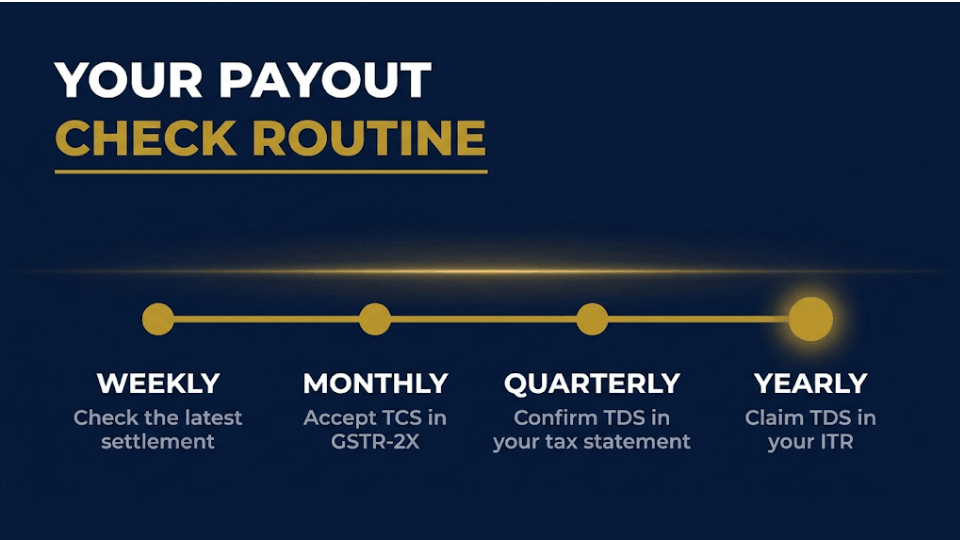
Your Weekly 10-Minute Payout Check
A small routine catches nearly every problem early:
- Every week, open the latest settlement and scan for unusual fees, remeasurement charges and changes in the reserve.
- Every month, make sure the TCS in your GSTR-2X has been accepted.
- Every quarter, check that Amazon’s TDS appears in your annual tax statement.
- Every year, claim that TDS in your income tax return.
Keep this up for a month and the bank SMS stops being a mystery. You’ll know the number before it arrives.
Frequently Asked Questions
How long does Amazon take to pay sellers in India?
Amazon settles every seven days and starts the bank transfer about two days after each settlement closes. An order is only included once seven days have passed since delivery. With FBA’s fast delivery, most orders reach your bank roughly 10 to 18 days after the customer buys.
Why is my Amazon payout less than my sales?
Your sales figure includes orders that haven’t cleared yet, plus GST that belongs to the government. The payout then loses Amazon’s fees, ad spend billed to your account, returns, the reserve, and small TCS and TDS deductions. Most of the gap is timing or tax you get back, not lost money.
What is an account level reserve, and when is it released?
It’s a portion of your balance Amazon holds to cover future refunds and claims. It’s released gradually as orders age past their return and claim windows. Lower return rates, fewer A-to-z claims and a clean track record shrink it, which is why mature accounts often see none at all.
How do I claim the TCS Amazon deducts?
Log in to the GST portal each month and open GSTR-2X. Accept the TCS entries Amazon reported and file the form. The credit then moves to your electronic cash ledger, where you can use it to pay your GST or claim a refund of any excess.
Can I get the TDS Amazon deducts refunded?
Yes, through your income tax return rather than from Amazon. The TDS shows in your annual tax statement against your PAN, and you claim it in your ITR as tax already paid. If your total tax for the year is lower than the TDS, the excess comes back as a refund.
Does TCS mean Amazon has paid my GST for me?
No. TCS is only an advance credit worth 0.5% of your taxable sales. You still owe the full GST on every sale and pay it through GSTR-3B. The TCS credit simply reduces the cash you need to pay, once you’ve accepted it in GSTR-2X.
What is a settlement report on Amazon?
It’s the statement for one seven-day settlement period, listing every order, refund, fee, reserve movement and tax deduction behind that payout. You’ll find it in the payment reports in Seller Central. Reading one line by line is the fastest way to see exactly where your money went.
Conclusion
Karthik’s festival money was never lost. Part of it was waiting out its seven-day window, part sat in a reserve, part paid for fees and ads, and a slice was tax credit waiting to be claimed. Once you can read the Amazon seller payment cycle this way, every payout becomes predictable. Predictable cash flow, not just profit, is what lets you reorder stock on time.
If you want to run your FBA business with that kind of grip on the numbers, join our 3-Day Amazon Business Training. We’ll walk through the whole system, from choosing a product to reading your profit, so you understand your brand rupee by rupee. Your next bank SMS will thank you.
