
It is 9:40 on a Tuesday night in Varanasi, and Neha Agarwal is taping her forty-first box of stainless steel kitchen accessories while her family eats dinner without her. Her pickup slot closed twenty minutes ago, so tomorrow she will ring the courier hub, apologise and reschedule. Her store turns over about ₹80,000 a month, and every rupee of it passes through her own hands first.
The amazon easy ship vs fba decision is the one that ends nights like that. Neha moved her five best-selling SKUs into FBA, and six weeks later those five products alone were pulling ₹1,40,000 a month while her evenings belonged to her again.
This is not a debate about which model “real” sellers use. It is a per-SKU maths question, and the answer flips as your volume climbs. Get it right and your margin improves without you touching your price. Get it wrong and you either burn your evenings packing boxes or pay storage on stock nobody wants. Let us work through it properly, with numbers.
How Fulfilment Choice Decides Your Margin
Most sellers treat fulfilment as plumbing — a boring choice made once at account setup and never revisited. In reality it sits directly on your profit line, and it moves margin faster than any coupon or price test you will run.
What each model actually does for you
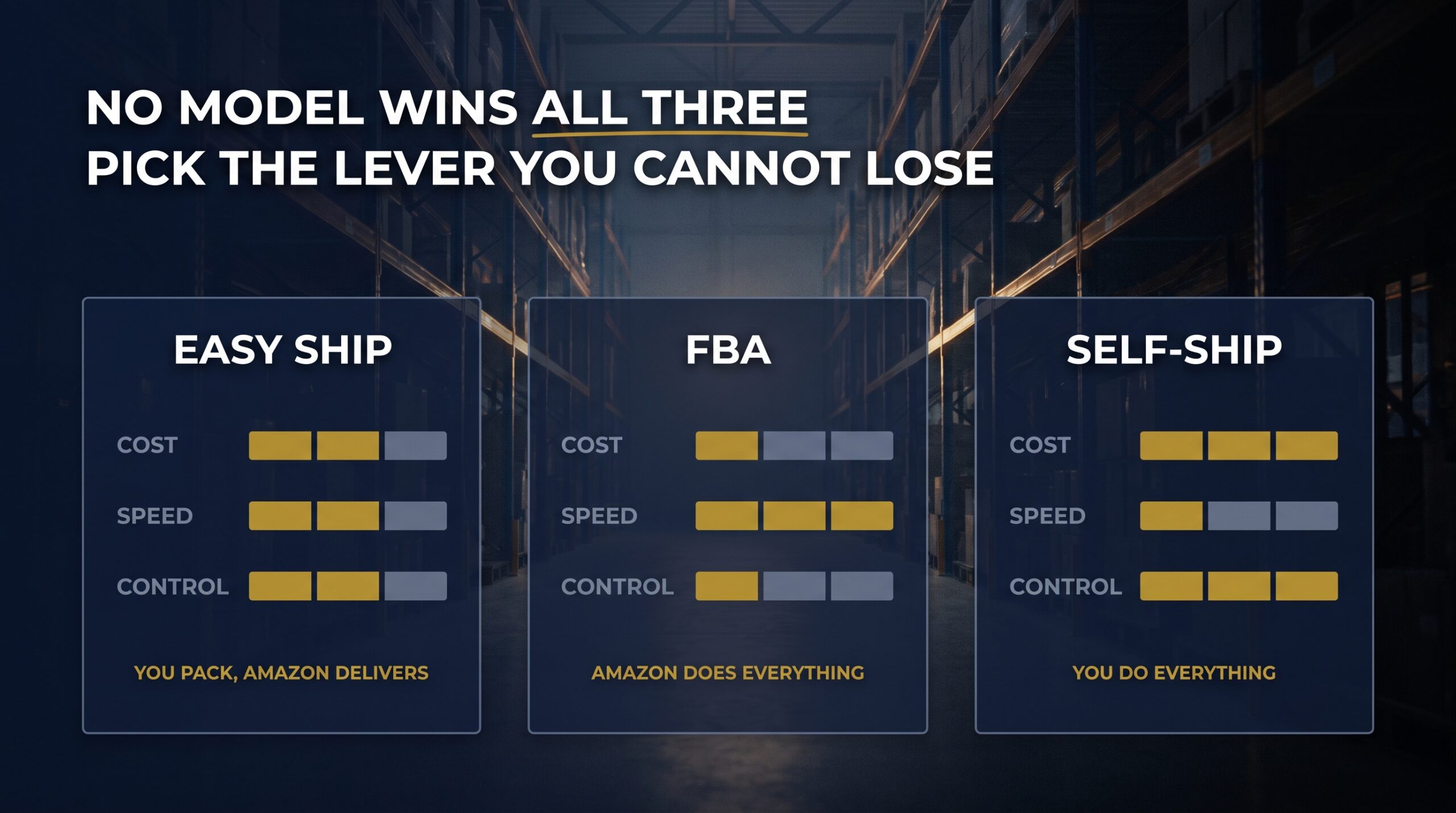
There are three amazon fulfilment models india sellers work with. Easy Ship means you store and pack while Amazon collects and delivers. FBA means Amazon stores, packs, delivers and handles returns. Self-ship leaves the whole chain, courier relationship included, with you. Each trades money for time in a different ratio, and if you want the wider view, the difference between FBA and FBM sets the same trade-off out in full.
Why the same product earns differently
Kavita Iyer from Coimbatore sells yoga mats. The same mat, same listing, same price earned her 9% net margin on Easy Ship and 17% on FBA within ten weeks — not because fees fell, but because Prime delivery lifted conversion enough to spread her fixed costs across three times the orders. Her lesson: cost per unit means nothing without volume attached to it.
The three levers: cost, speed, control
Every fulfilment decision pulls three levers. Cost is what you pay per shipment plus storage. Speed is how fast the parcel arrives, which drives conversion. Control is your say over packaging, handling and courier choice. No model wins all three, so pick the lever your specific product cannot afford to lose.
Easy Ship, Explained From Pickup to Payout
Easy Ship is where most Indian sellers start, and for good reason. You keep your inventory, you keep your cash, and Amazon’s delivery network does the hard mile.
How a typical Easy Ship order moves
An order lands, you confirm it, print the Amazon label, pack the item and schedule a pickup slot. The courier collects, the network delivers, the buyer sees tracking, and COD works across most Indian pin codes. Amazon easy ship charges are billed per shipment on weight band and distance zone — local, regional or national.
What you stay responsible for
Storage, packing material, label printing and being physically present when the courier arrives all stay yours. Imran Qureshi from Lucknow sells brass puja items and runs about 60 Easy Ship orders a month, spending two hours a day packing and coordinating pickups — nearly 60 hours a month. His lesson: Easy Ship looks cheap until you price your own hours honestly.
Who this model suits best
Easy Ship earns its place on new listings you have not validated, slow SKUs where storage would eat the margin, and products whose demand is too unpredictable to commit stock to a fulfilment centre. Treat it as a testing lane. The moment a product shows steady weekly demand for a month, it has outgrown that lane.
How FBA Works Once Your Stock Is In
FBA flips the arrangement. Instead of paying per shipment out of your own godown, you push inventory in once and let the machine run.
Sending inventory into the network
You create a shipment plan, label each unit, box it to Amazon’s packaging specification and send it to the fulfilment centre you are assigned. Once checked in, units go live and orders ship without you touching anything. Inbound freight is your cost, so send meaningful quantities rather than dribbles of ten units, and read up on the inbound shipment mistakes that delay inventory before your first box leaves.
Storage, picking and returns handled for you
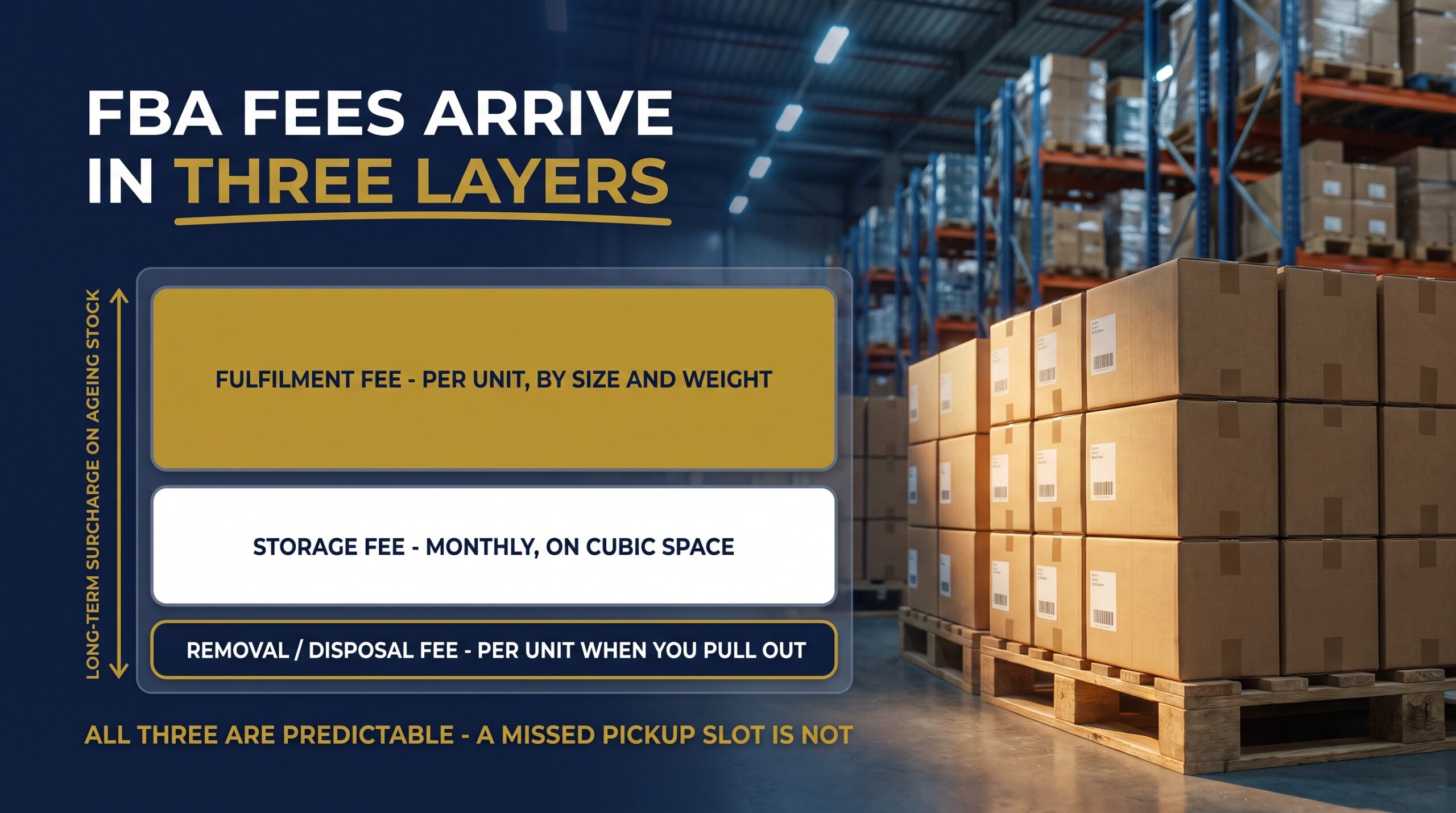
Amazon fba fees india for sellers stack in three places: a per-unit fulfilment fee driven by weight and size, a monthly storage fee on the cubic space your stock occupies, and removal or disposal fees when you pull units out. Long-term surcharges apply to stock that sits too long. All three are predictable — which is exactly what a missed pickup slot is not.
The Prime badge and buy box effect
Sellers consistently underprice this part. Divya Patel from Ahmedabad sells premium spice sets at ₹899. After moving to FBA her conversion went from 8% to 14% on identical traffic — roughly ₹45,000 more revenue a month with no change to her listing, price or ads. Her lesson: the Prime badge is not decoration, it is a filter deciding whether shoppers see you at all.
If mapping fees to your own SKUs still feels like guesswork, that is exactly the exercise we run together inside the 3-Day Amazon Business Training, using your catalogue rather than a generic example.
Where Self-Ship Still Beats Both Options
Self-ship gets dismissed as the beginner option, which is unfair. For a narrow band of products, it is the only sane choice.
Products no network wants to handle
Oversized furniture, glassware, anything needing three layers of bubble wrap, anything classed fragile or liquid — these get handled roughly and damaged often in high-volume networks. The amazon self ship vs fba comparison tilts towards self-ship the moment breakage costs exceed the fulfilment savings.
Local delivery and custom packaging cases
Arjun Nair from Kochi sells handmade brass decor above ₹1,200. He self-ships through two courier partners he has used for four years, with custom crating, and holds damage claims under 2% on roughly 90 orders a month. His lesson: self-ship works brilliantly at small scale in a fragile niche, and stops working the day you want to double volume.
The hidden cost of doing it yourself
RTO is the quiet killer. COD rejection in some categories runs 20-30%, and with self-ship every failed delivery means paying shipping both ways with no safety net. Add courier negotiation, claim follow-ups and complaints landing in your inbox, and self-ship becomes a full-time operations job dressed up as a cost saving.
Running the Numbers on a Real Product
Enough theory. A proper easy ship vs fba profit comparison needs one SKU, one price and honest numbers, because the answer genuinely inverts as volume climbs.
Cost per order under each model
Take a 500-gram product. On Easy Ship you pay weight-and-zone shipping plus your own packing material and labour. On FBA you pay a fulfilment fee plus monthly storage, with no labour and no pickup coordination. In practice FBA lands roughly ₹15-25 per unit higher on a product like this once storage is counted.
How order volume changes the answer
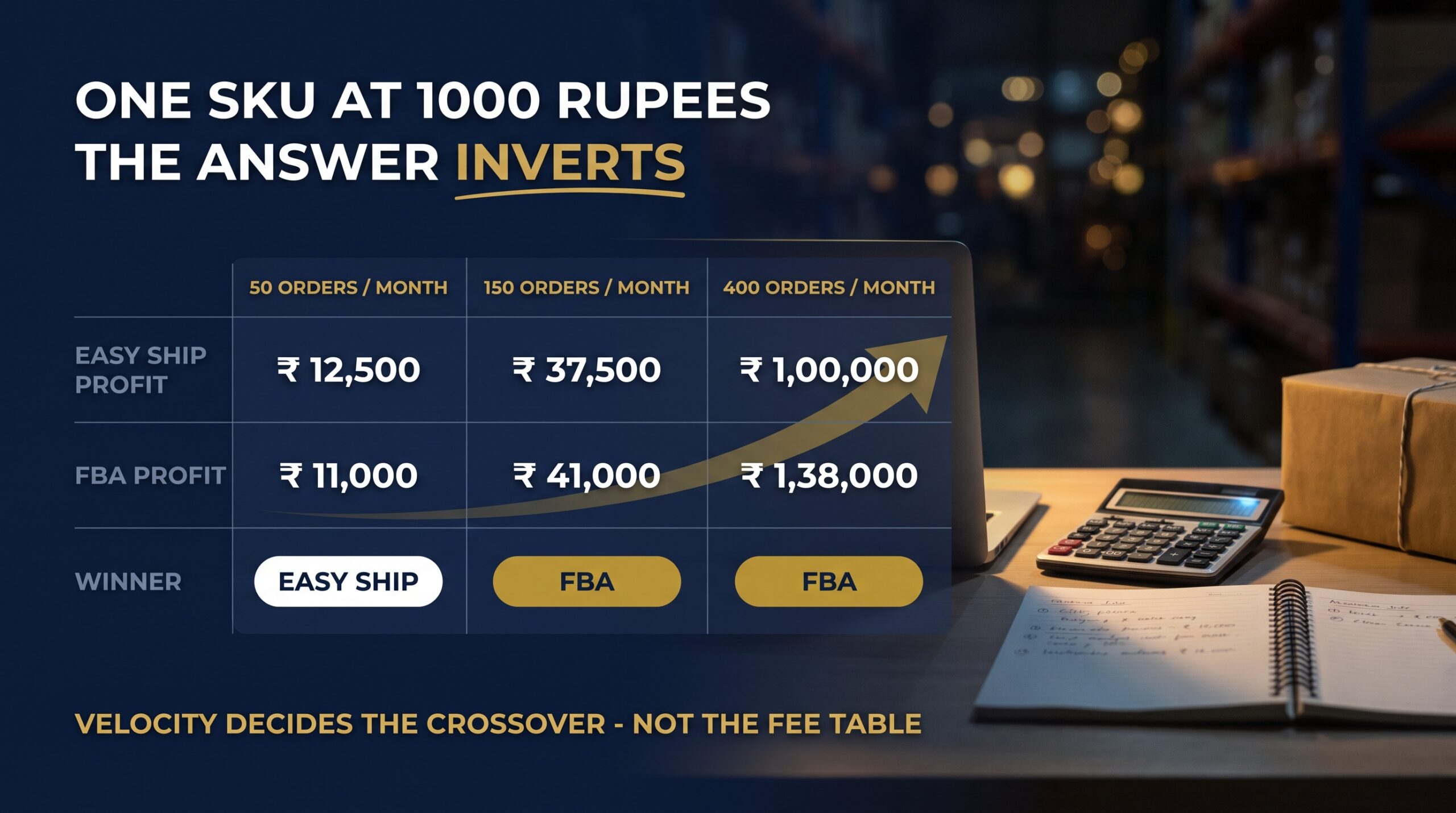
At 20 orders a month that gap is real money, and FBA rarely pays for itself. At 300 orders it is dwarfed by the extra volume Prime visibility brings, and your own packing hours become the binding constraint. Velocity decides the crossover, not the fee table.
A worked example at 1000 rupees selling price
Sneha Reddy from Hyderabad tested a cotton kurta on both models across 60 days. Easy Ship saved her ₹18 a unit, but conversion fell about 15% without the Prime badge. On a ₹1,000 product, saving ₹18 across 100 orders is ₹1,800, while losing 15% of 100 orders at ₹250 contribution is ₹3,750 gone. Her lesson: the cheaper model lost more money.
Delivery Speed, Reviews and Buy Box Wins
Fees are only one side of the ledger. On the revenue side, amazon easy ship vs fba stops being close.
What faster delivery does to conversion
Shoppers filter by Prime, sort by delivery date and abandon listings promising a seven-day wait. Amazon’s own data points to Prime products seeing up to three times the sales of comparable non-Prime listings. FBA is not buying you convenience, it is buying shelf position in the way buyers actually shop.
Return handling and customer complaints
Manpreet Kaur from Ludhiana sells woollen stoles. On Easy Ship, winter brought roughly 40 buyer messages a week about returns and delays. After she moved her top eight SKUs to FBA that dropped to six, and her rating climbed from 3.9 to 4.3 across the season. Her lesson: fewer complaints is a ranking benefit, not a soft one.
Metrics Amazon watches in each model
On Easy Ship and self-ship, late dispatch rate, cancellation rate and valid tracking sit on your shoulders and shape account health directly. Under FBA those delivery metrics move to Amazon, leaving you to manage stock cover, listing quality and Inventory Performance Index, where a score above 500 can earn storage discounts of up to 25%.
Working out which of your SKUs deserve that Prime badge first is exactly the call we walk through together when you sit in on the 3-Day Amazon Business Training.
Signs It Is Time to Move a Product to FBA
The question is rarely whether to move, but when. These are the signals worth acting on rather than watching.
Volume and velocity thresholds to watch
Vikram Mehta from Jaipur moved five proven phone-accessory SKUs to FBA at around 100 orders a month between them. Within three months those five delivered 70% of his revenue while 30 other SKUs stayed on Easy Ship. His lesson: move the winners early and let the rest wait their turn.
Storage cost versus cash flow reality
Knowing when to switch from easy ship to fba comes down to a handful of honest triggers you can check monthly:
- The SKU has sold consistently for four to six weeks with no dead weeks.
- You are dispatching 20 or more units of it every month.
- Sell-through clears your stock in under 90 days.
- Packing and pickup coordination is eating more than an hour a day.
- Margin after estimated FBA fees still sits above 20%.
Clear four of those five and the product belongs in a fulfilment centre. Clear one and you are simply converting working capital into storage bills.
Seasonal spikes and festive planning
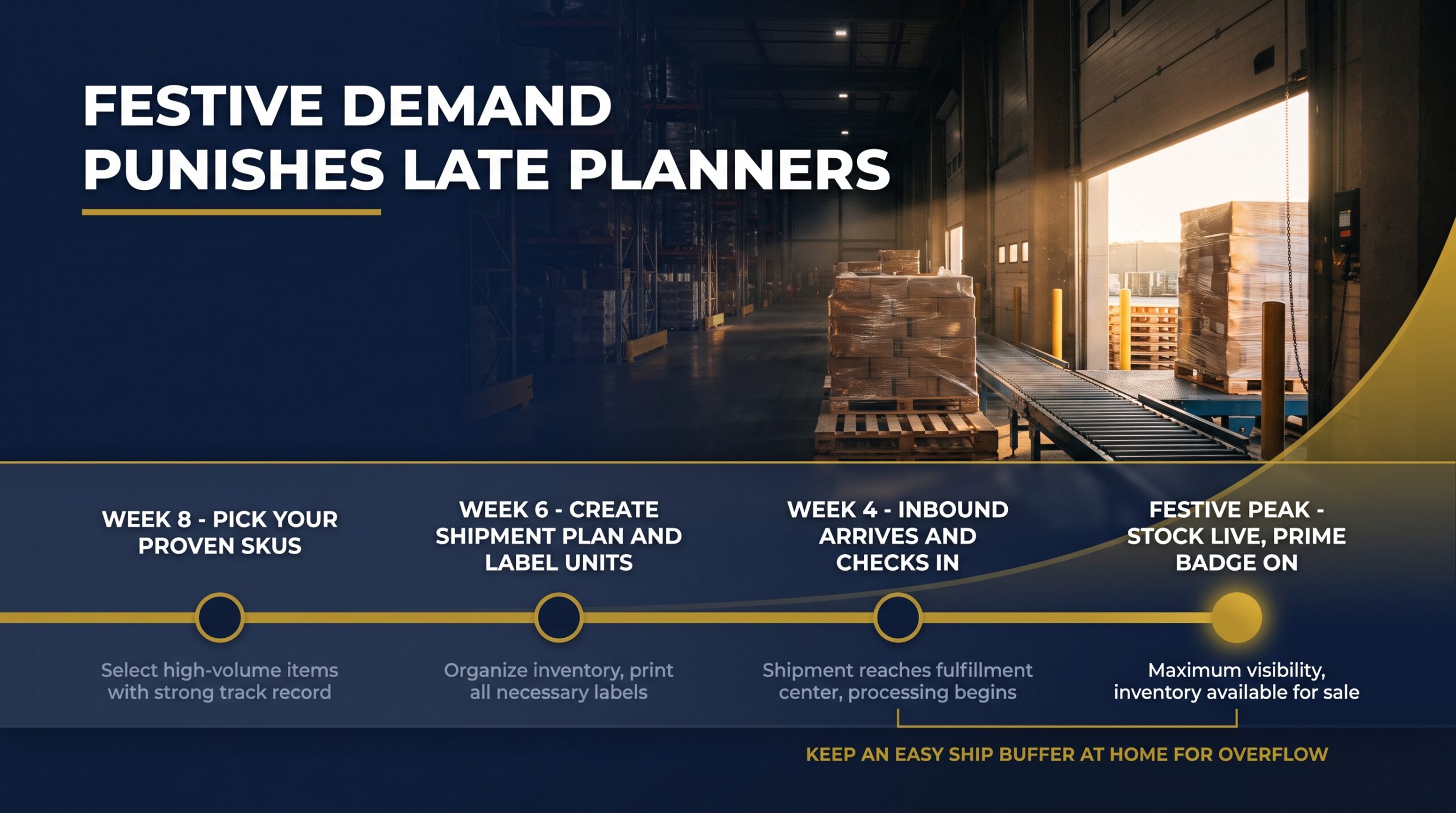
Festive demand punishes late planners. Inbound receiving slows as everyone ships at once, so stock going in during October is often too late. Plan festive FBA shipments six to eight weeks ahead, keep an Easy Ship buffer at home for the overflow, and build the rest of your festive season strategy for Amazon sellers around those dates.
Building a Mixed Fulfilment Setup That Scales
Mature sellers do not pick one model. They run all three at once and assign each product to the lane its margin and velocity justify.
Splitting your catalogue by SKU behaviour
The rule is simple enough to apply without a spreadsheet. Margin above 25%, more than 20 units a month, competitive category where Prime matters — that is FBA. Steady but thin margins with modest demand stay on Easy Ship. Fragile, oversized or locally concentrated items stay on self-ship.
Using both models in one seller account
One account happily runs all three. Pooja Krishnan from Chennai manages 85 SKUs: 40 on FBA, 35 on Easy Ship, 10 on self-ship, and her FBA products generate 75% of revenue from under half the catalogue. Her lesson after three years is that the flow is one-directional — products move into FBA far more often than out.
A simple quarterly review routine
Once a quarter, pull 90 days of unit sales per SKU, check sell-through and margin after fees, then move anything that crossed the thresholds and pull anything that stalled. Sellers at serious monthly volume can also explore Seller Flex, holding stock in their own warehouse under Amazon’s delivery umbrella, subject to its eligibility criteria.
Mistakes That Quietly Kill Profitability
Switching models badly costs more than never switching at all. Three errors show up most often in seller P&Ls.
Sending slow movers into storage
The commonest mistake is sending the whole catalogue in at once. Rahul Gupta from Delhi waited eight months to try FBA, then overcorrected and shipped everything. His 15 proven SKUs took monthly revenue from ₹2,10,000 to ₹3,40,000 in 60 days, while the rest sat accruing long-term storage fees until he paid removal fees. His lesson: proven demand first, everything else later.
Ignoring weight bands and packaging size
Fees follow dimensional weight, not just actual weight, so a light product in an oversized carton gets billed like a heavy one. Slim your packaging before you calculate anything, because dropping into a lower band can be worth more per unit than a price increase.
Forgetting returns and removal costs
Returns are part of the model’s cost, not an accident. Budget a realistic return rate for your category, add expected removal or disposal fees on unsold units, and only then compare models. Skip that and your FBA maths will look better on paper than it ever does in your settlement report.
Frequently Asked Questions
What is the difference between Amazon Easy Ship and FBA?
With Easy Ship you store and pack yourself, and Amazon’s courier network collects from your address and delivers. With FBA you send stock into a fulfilment centre in advance, and Amazon stores, packs, ships and handles returns. Easy Ship preserves cash and control; FBA buys back your time and earns Prime visibility.
Is FBA or Easy Ship more profitable for a small Indian seller?
At genuinely low volume Easy Ship usually wins, because you pay no storage on slow-turning stock. Once a product sells 20 or more units a month at over 20% margin, FBA typically produces more total profit despite higher per-unit cost, because Prime lifts conversion. Compare monthly profit, never cost per unit.
How are Amazon Easy Ship charges calculated compared to FBA fees?
Amazon easy ship charges are billed per shipment, driven by parcel weight band and delivery zone — local, regional or national. FBA arrives in layers instead: a per-unit fulfilment fee by size and weight, monthly storage on cubic space, long-term surcharges on ageing stock, and removal fees. Referral fees apply to both.
At how many orders per month should I move a product from Easy Ship to FBA?
Around 20 consistent units a month is a sensible floor for a mid-priced product, provided sales held steady for four to six weeks. By 50 units, packing and pickup coordination alone justify the move. A heavy, thin-margin item needs more volume than a light, high-margin one.
Can I use Easy Ship and FBA for different products in the same account?
Yes, and most experienced sellers do. You choose the fulfilment channel at listing level, so unvalidated and slow SKUs sit on Easy Ship while proven winners run on FBA and awkward items stay on self-ship. Running all three from one account is the normal shape of a mature catalogue.
Do I need a GST number for both Easy Ship and FBA?
You need GST registration to sell taxable goods on Amazon under any fulfilment model. For FBA, keep your tax details aligned with the states where your stock is stored, since inventory placement can create compliance obligations. Speak to your accountant before your first inbound shipment rather than fixing invoicing later.
What happens to my FBA stock if a product stops selling?
It keeps accruing monthly storage fees, then long-term surcharges. From there you either create a removal order to bring units back to your address, or a disposal order to have them destroyed, both carrying per-unit fees. Watch sell-through monthly so clearance pricing can still shift a stalling SKU.
Can I switch a product back from FBA to Easy Ship later?
You can. Raise a removal order to bring remaining units to your address, change the listing’s fulfilment channel and resume dispatching yourself. Factor in removal fees and the inbound freight already spent, because a round trip is expensive. That is the real argument for validating demand on Easy Ship first.
Conclusion
There is no winning fulfilment model, only the right model for a specific product at your current volume. Easy Ship earns its keep while demand is unproven and cash is tight. FBA takes over the moment a product sells predictably, because the Prime badge buys visibility no fee saving can replace. Self-ship holds the edge cases — fragile, oversized, hyper-local.
Your next move is small and concrete. Pull your last 90 days of unit sales, find the SKUs doing 20-plus units a month at healthy margin, and plan your first FBA shipment for those alone.
If you would rather make those calls with guidance instead of guesswork, come and take a seat at the 3-Day Amazon Business Training and build your fulfilment mix properly.
