
Eleven at night, fourteen tabs open, and a notepad with six product ideas scribbled on it — that was Rohit’s Tuesday, every Tuesday, for a month. He’d scroll Amazon’s best seller lists, spot something promising, imagine the margins, then lose his nerve by morning. The problem wasn’t effort. Browsing a marketplace with crores of listings by eye isn’t research; it’s window shopping with extra steps.
This helium 10 black box tutorial exists to end that loop. Black Box turns Amazon’s catalogue into something you can interrogate — price band, monthly revenue, review count, weight, seller type — and hands back products that match the kind of business you can actually run. Used badly, it burns search credits and returns 3,000 irrelevant ASINs. Used well, it moves you from “I don’t know what to sell” to three genuinely quotable ideas in an afternoon.
What follows is the India version: rupee price bands instead of dollar presets, revenue floors that reflect Indian order values, weight filters that respect Easy Ship rates, and an honest look at where the data drifts. By the end you’ll know which filters to set, and which to ignore.
What Black Box Actually Does for Sellers
Ritika Shah in Ahmedabad spent six weeks browsing kitchen categories by hand before trying a filtered search. Her first Black Box run returned 47 silicone kitchen tools under ₹700 with fewer than 120 reviews; she launched one and crossed ₹2.4 lakh in monthly revenue within five months. Her lesson: she’d been eyeballing the wrong 0.1% of the catalogue all along.
The database behind the search results
Black Box holds a stored index of Amazon listings with estimated sales, revenue, review counts, prices and physical attributes. Your filters query that index rather than Amazon live, which is why results arrive in seconds — and why the figures are estimates refreshed on a cycle, not dashboard truth.
Why filters beat browsing best seller lists
Best seller lists show you where competition already sits. A filtered query shows you where demand exists without a crowd — products selling steadily that nobody has bothered to optimise. That gap is the whole argument for helium 10 product research india over gut feel and screenshots from someone’s video.
What Black Box will not tell you
It won’t tell you landed cost, GST implications, whether a supplier in Rajkot can hit your target price, or whether the category is gated. It narrows the field. Every rupee decision still sits with you, and that’s exactly where the real work starts.

Setting Up Your First Product Search
Manav Deshpande in Pune spent four hours a week hunting products. After learning how to use helium 10 black box properly, he got the same output in forty minutes — and stopped shortlisting things he could never source under ₹300.
Choosing the Amazon.in marketplace
Before anything else, switch the marketplace selector to Amazon.in. Every number that follows — price, revenue, BSR — then reflects Indian buyer behaviour rather than American. Skipping this step means analysing a market you aren’t selling in, the most common opening error in helium 10 black box amazon india searches.
Picking the right category to start
Start with one category you understand as a buyer. Home & Kitchen, Sports, Beauty and Office Products are forgiving for first-time private label sellers. Narrow categories give sharper results; searching all categories produces a soup of unrelated ASINs that teaches you nothing.
Reading your first result set
Your table shows the ASIN, title, price, estimated monthly sales and revenue, review count, rating and often weight. Sort by revenue, then scan review counts. You’re hunting the mismatch: strong revenue sitting beside a thin review count. That gap is your opening.
Rupee Price Filters That Make Sense
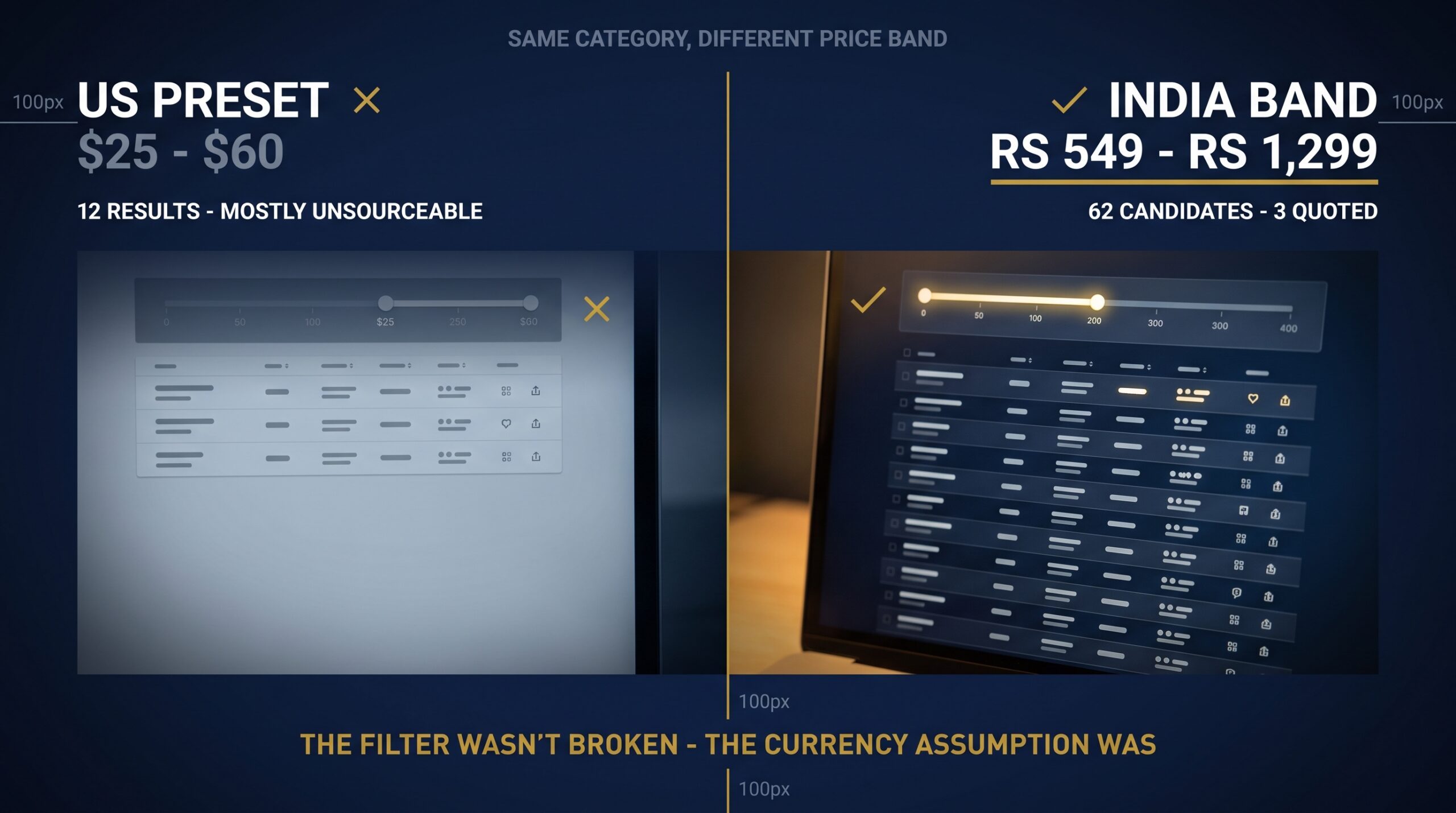
Farhan Qureshi in Hyderabad copied a US preset of $25–$60 into his first three searches and got twelve results, all imported gadgets he couldn’t source. He reset the band to ₹549–₹1,299 and the same category returned 62 candidates, three of which he eventually quoted. The filter wasn’t broken; the currency assumption was.
Why dollar-based advice breaks here
A $25 floor is roughly ₹2,100 — a price point where Indian conversion rates thin out sharply in everyday categories. Most healthy Indian private label volume sits well below that, so imported filter advice quietly excludes the exact band where you’d make money.
A sensible price band for new sellers
For a first product, ₹499–₹1,499 works. Below ₹499, referral fees, shipping and returns eat the margin unless your landed cost is tiny. Above ₹1,499, buyers want brand reassurance and reviews you don’t have yet. That band produces realistic helium 10 black box filters output.
Adjusting bands by category
Beauty and stationery run lower, so drop to ₹299–₹899. Home appliances, fitness equipment and pet products support ₹999–₹2,499. Match the band to the category’s own centre of gravity instead of forcing one preset across everything.
If working through these numbers with someone watching over your shoulder sounds better than guessing alone, join the 3-Day Amazon Business Training and run a live search with guidance.
Revenue, Review and Rating Filters
Sneha Iyer in Kochi ran one category three times, changing only the review cap: under 500, under 200, under 75. The tightest run returned eleven ASINs, and one — a travel organiser doing ₹3.1 lakh a month on 41 reviews — became her best launch, profitable inside four months.
Monthly revenue floors worth using
Set a revenue floor of ₹1,00,000 per listing for a first product, or ₹1,50,000 for more headroom. Below a lakh you’re fighting over a market too small to fund advertising. Cap it near ₹8,00,000 as well; above that you’re usually facing brands with budgets you can’t match yet.
Review count caps that reveal openings
Cap reviews at 100, or 200 in a mature category. Serious revenue on double-digit reviews means buyers want the product more than they trust the seller. That’s the definition of low competition products amazon india, and it’s ground you can make up quickly.
Using rating filters to spot weak listings
Set maximum rating at 4.2. Listings between 3.4 and 4.2 with real volume are telling you something is wrong — packaging, durability, sizing — and those complaints are a free product brief for the version you build.
Weight, Size and Fulfilment Filters
Gaurav Malhotra in Jaipur shortlisted a 2.8 kg storage rack, ordered 300 units, then found shipping and returns taking ₹190 off every sale. He now filters weight before anything else, and says the ₹70,000 he lost bought the most useful rule in his business.
Screening out heavy shipping killers
Set maximum weight at 500 grams for a first product, with 1 kg as an absolute ceiling. Light products ship cheaply, store cheaply and survive returns undamaged. Weight is the quietest margin killer on Amazon India because it never shows up in your excitement spreadsheet.
Size tiers and what they cost you
Filter dimensions so your product stays within standard size. Anything bulky moves into a higher fee tier, changing your unit economics before you’ve sold a piece. A flat, compact product also photographs better and costs less to package properly.
Filtering by seller type and fulfilment
Filter by fulfilment method to see how the incumbents operate. A niche full of merchant-fulfilled sellers with slow delivery promises is an opening. A niche dominated by Amazon retail itself is usually one to walk away from.
Advanced Filter Combinations Worth Copying
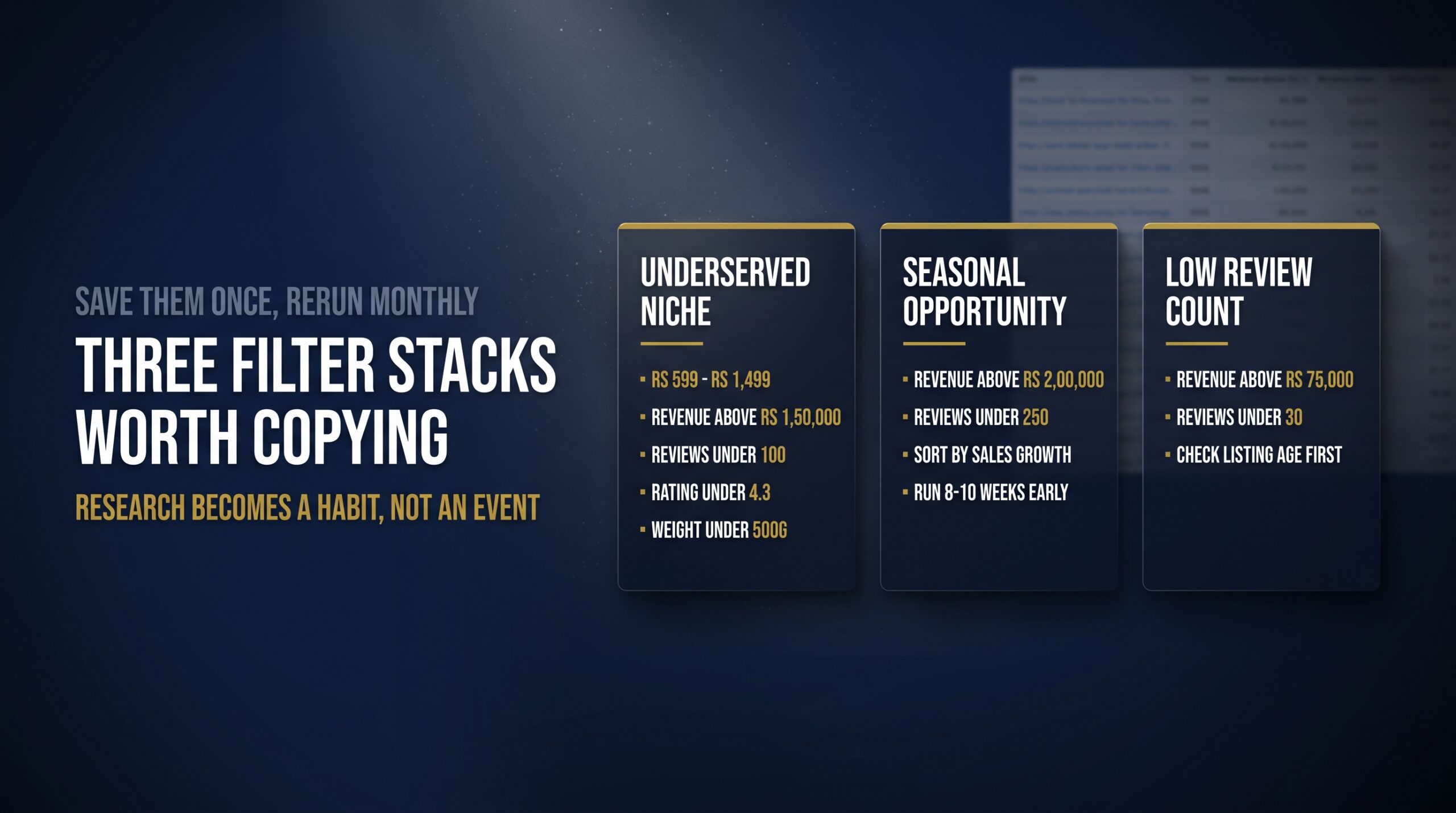
Aditya Rane in Nagpur saved three filter stacks and reran them on the first Monday of every month. On the eleventh run he caught a monsoon-season product climbing early, ordered ahead of the rush, and did ₹6.8 lakh across nine weeks. Saved stacks turn research from an event into a habit.
The underserved niche stack
Price ₹599–₹1,499, monthly revenue above ₹1,50,000, reviews under 100, rating under 4.3, weight under 500g, single category. This surfaces products with proven demand and unhappy customers — the cleanest entry point available to a new brand.
The seasonal opportunity stack
Same price band, revenue above ₹2,00,000, reviews under 250, then sort by recent sales growth rather than absolute revenue. Run it eight to ten weeks before a season begins — festive, summer, monsoon, exam period — so sourcing has time to catch up.
The low review count stack
Drop the revenue floor to ₹75,000 and pull the review cap to 30. You’ll get fewer results and some noise, but the survivors are brand-new demand nobody has claimed. Check listing age first; a two-week-old ASIN proves nothing.
Those three stacks are the backbone of a repeatable routine, and you can watch them run end to end when you book a seat at the 3-Day Amazon Business Training.
How Accurate Is the Data for Amazon India?
Priya Menon in Coimbatore compared Black Box estimates against her own sales for six months across four SKUs. Her verdict: directionally right, roughly 15–25% off on absolute units, and reliably correct about which product outsold which. That’s precisely the right way to use it.
Where the estimates come from
Helium 10 builds estimates from Amazon’s data feeds combined with sales-rank modelling. Rank-to-sales relationships differ by category and marketplace, so what you’re reading is an informed approximation rather than a meter reading.
Categories where numbers drift
Drift is worst where ranking behaviour is erratic — fashion with many variations, cheap high-velocity consumables, and anything heavily discounted during sale events. Treat those as ranges. In steadier categories like kitchen, storage and stationery, the estimates hold up well.
Cross-checking before you commit money
Before any purchase order, verify three things by hand: current BSR on the live listing, review velocity over the past ninety days, and a real supplier quote in your inbox. If the maths survives halving the estimated demand, you have a genuine candidate.
Working Within Free Plan Search Limits
Imran Shaikh in Surat validated his first product entirely on a free plan, running two searches a week for a month and landing on a car accessory that did ₹1.9 lakh in its third month. Constraints made him think before clicking.
What the free tier lets you run
The helium 10 black box free version limits how many searches you run and how many results you can view or export from each. That’s enough to test a hypothesis, not enough to browse aimlessly. Plan every query on paper first.
Making each search count
Write your filter set down before opening the tool: category, price band, revenue floor, review cap, weight ceiling. Change one variable per run so you learn what each filter does, and export every result set so you never spend a credit seeing the same ASINs twice.
When upgrading actually pays back
Upgrade when you’re researching weekly, managing more than one SKU, or need keyword tools beside Black Box. If a subscription costs less than one bad inventory decision — and it always does — the maths answers itself.
From Filtered List to Shortlist You Trust
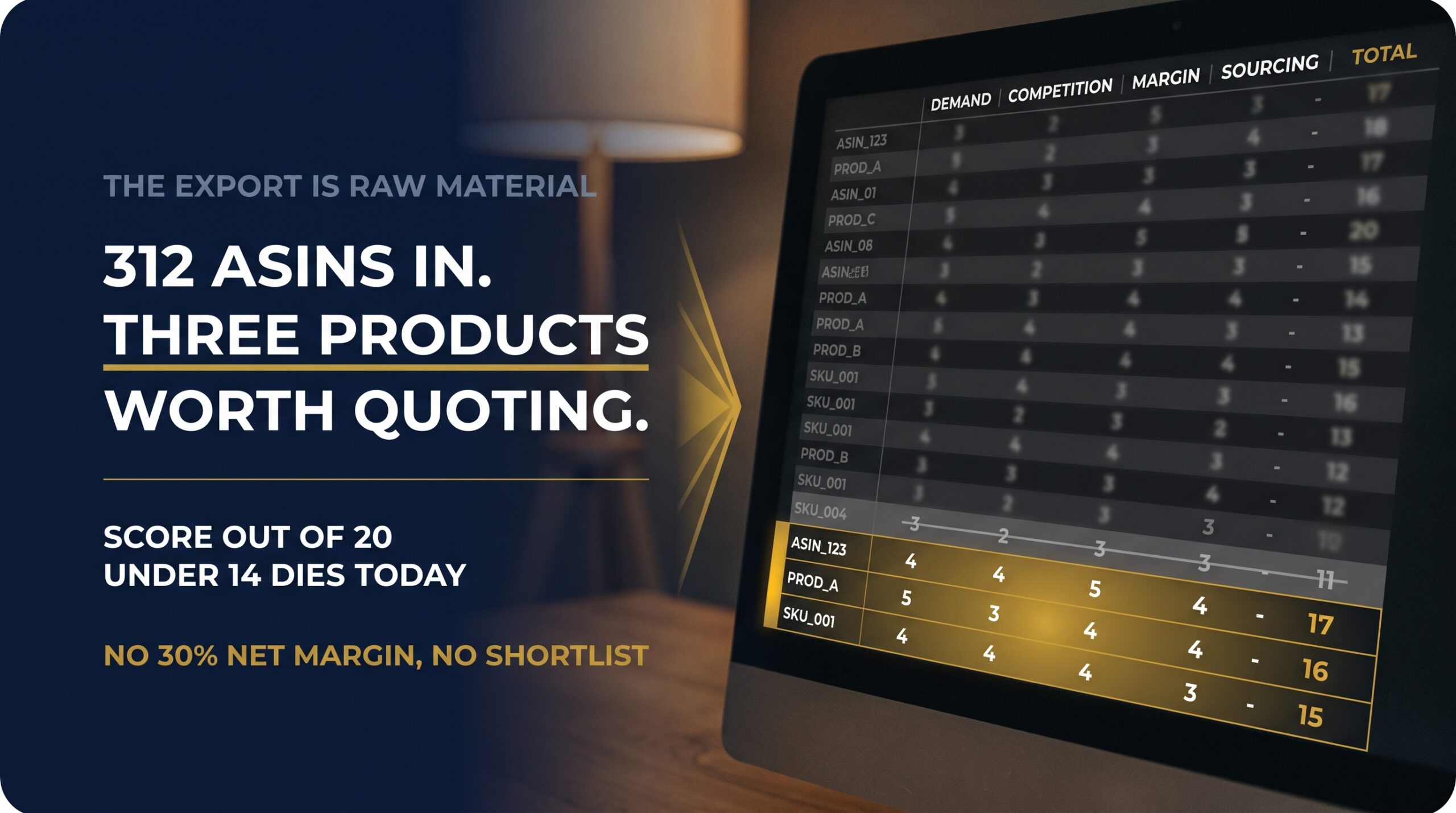
Nandini Rao in Bengaluru exported 312 ASINs, scored them over two evenings, and finished with three products worth quoting. Two suppliers came back too expensive; the third became a business doing ₹9 lakh a month within a year. The export is raw material, not a decision.
Scoring candidates on four criteria
Score every candidate out of five on demand, competition, margin potential and sourcing ease. Anything under 14 out of 20 gets cut without debate. Scoring forces you to compare like with like instead of falling for the prettiest product photo.
Checking sourcing before you get excited
Send enquiries to three suppliers — IndiaMART, a local manufacturing cluster, and one importer — before any further analysis. A product with no sourcing route at your target cost isn’t an opportunity, however good the numbers look on screen.
Killing ideas fast without regret
Set a rule: if a product can’t clear 30% net margin after fees, shipping, ads and a 5% return allowance, it dies today. Killing ideas quickly is what leaves you time to find the one that works.
Mistakes That Waste Your Search Credits
Vikram Chaudhary in Lucknow ran nine straight searches that returned zero results because he’d stacked every filter at its most aggressive setting. Loosening two produced 84 candidates on the tenth try. Nine credits, one lesson.
Filters set so tight nothing returns
Start loose and tighten. Set price band and category first, look at the volume of results, then add the review cap, then the weight ceiling. If a run returns nothing, relax the most recent filter rather than starting over.
Chasing revenue without checking margin
A listing doing ₹5 lakh a month at ₹399 with a ₹280 landed cost is a treadmill, not a business. Take the price, subtract fees, shipping, ad cost and landed cost before anything enters your shortlist.
Ignoring what the top listings do well
Open the top three listings in every niche you shortlist. Read the A+ content, the image sequence, the review complaints. If the leaders are excellent and the reviews glowing, that niche isn’t underserved — it’s simply popular.
Frequently Asked Questions
What is Helium 10 Black Box used for?
Black Box filters Amazon’s catalogue by price, estimated monthly revenue, review count, rating, weight, category and seller type. Instead of scrolling listings manually, you describe the product you want to sell and get matching ASINs in seconds. Sellers use it to find demand with weak competition before spending on inventory.
How do you use Helium 10 Black Box for product research?
Select Amazon.in, choose one category, then set filters individually: price band, revenue floor, review cap, rating ceiling, maximum weight. Run the search, sort by revenue, and look for listings earning well on few reviews. Export the promising ASINs, score them, verify numbers on live listings, then request supplier quotes.
Which Black Box filters should Indian sellers set for rupee pricing?
Start at ₹499–₹1,499 for a first product — that band clears fees while staying inside comfortable impulse territory for Indian buyers. Drop to ₹299–₹899 for beauty and stationery, raise to ₹999–₹2,499 for fitness or appliances. Pair it with a ₹1,00,000 revenue floor and a 100-review cap.
Is Helium 10 Black Box data accurate for Amazon India?
Accurate enough to rank opportunities, not to plan a purchase order alone. Estimates come from Amazon data feeds and rank-to-sales modelling, so expect 15–25% variance on units, with wider drift in fashion and cheap consumables. Shortlist with it, then verify live BSR, review velocity and supplier quotes.
Can you use Helium 10 Black Box on the free plan?
Yes. The free plan caps how many searches you run and how many results you view or export, which is enough for a handful of well-planned hypotheses each week. Write your filter set down before logging in, change one variable per run, and save every result set.
How many products should a shortlist contain before sourcing?
Three. Fewer leaves you no negotiating position when a supplier quotes high; more spreads your attention until nothing gets verified properly. Score your export down to three, request quotes on all three at once, and let landed cost decide. Whichever clears your margin threshold first becomes the launch.
Does Black Box work for private label and reselling both?
Both, with different settings. Private label sellers hunt weak listings — low review counts, ratings under 4.3, obvious complaints they can fix. Resellers filter by seller type and buy box competition to find listings with few sellers and steady demand. Same tool, different question asked of it.
How often should you rerun the same product search?
Monthly suits evergreen categories; every two weeks in the eight to ten weeks before a season. Demand shifts, competitors enter, review counts climb. Save your stacks so a rerun takes a minute, then compare against your old export — products appearing in both runs deserve a closer look.
Conclusion
Filters do one job well: they shrink a catalogue of crores into a list of dozens. They won’t tell you whether a supplier in Surat can hit your cost, whether your margin survives a 6% return rate, or whether you have the patience to fix a weak product properly. Those answers come from arithmetic and phone calls.
So run the searches. Set the rupee bands, cap the reviews, kill the heavy stuff, and score what’s left honestly. Then pick up the phone. If you’d rather learn the full sequence — research, sourcing, listing, launch — with someone answering your questions as they arise, take your seat at the 3-Day Amazon Business Training and build your first shortlist alongside sellers doing exactly the same thing.

One Response
A WONDERFUL CONTENT WITH EASY TO UNDERSTAND WORDS ,I APPRECIATE YOUR EFFORTS ….THANK YOU FOR YOUR THIS KIND OF SUPPORT …HAVE A WONDERFUL DAY