

Vinoth Sharma still remembers the sound of the packing tape. Three months of waiting, ₹1.9 lakh gone, and there he was in his Jaipur godown slicing open the first carton of 300 bamboo desk organisers from Guangzhou. The edges had warped somewhere between the port and his doorstep. Forty-five days of freight, a customs delay he had not budgeted for, and a batch he could not list without inviting one-star reviews. Two weeks later a friend mentioned a unit in Jodhpur pressing the same product for less.
That story repeats every week, and it is why IndiaMART for Amazon sellers has become the starting point for so many first private label launches. A directory holding millions of Indian suppliers sits open in your browser, and most new sellers either ignore it completely or get burned by a trader posing as a factory.
This guide walks the whole path: what the platform actually does, how to separate manufacturers from middlemen, how to verify a supplier before money moves, and how to turn a decent vendor into a brand partner who grows with you.
Why Indian Sellers Start Sourcing Here
Most sellers arrive expecting an Amazon-style shopping experience and leave confused within ten minutes. Understanding what the platform is built to do changes how you use it.
What IndiaMART actually is (and is not)
It is a lead-generation directory, not a transaction marketplace. You post a buying requirement or click a listing, and suppliers call you back, often within the hour. Nothing else happens inside the platform. Negotiation, payment, dispatch and quality control all sit with you, which is a feature once you stop expecting otherwise.
The kind of sellers it works best for
It suits sellers with modest first budgets who want small trial quantities and a supplier they can visit on a train ticket. Product sourcing for Amazon India works best here in categories the country already makes well: cotton textiles from Tirupur, brass from Moradabad, jute from Bengal, handicrafts from Jaipur.
Where it fits in your sourcing plan
Treat it as your discovery layer, not your decision layer. Two evenings of searching gives you names, price bands and geographic clusters. The real filtering happens on phone calls, in sample boxes and on factory floors, and no directory can do that part for you.
Deepika Rao from Bengaluru spent four months chasing a Guangzhou supplier for cotton tote bags before finding eleven Tirupur manufacturers in one afternoon. Her landed cost fell roughly 30 per cent and her restock cycle dropped from six weeks to ten days. Check what India already makes before you import it.

Traders, Factories and the Gap Between Them
The biggest source of disappointment here is not fraud. It is paying factory-level expectations to someone reselling another unit’s output with a margin stapled on top.
Telltale signs you are talking to a middleman
Look at the catalogue first. A genuine factory lists variations of one product family; a trader lists leather bags, LED bulbs and yoga mats on the same page. Stock photographs, no production images, a residential address on the GST certificate and vague answers about machine count all point the same way.
When a trading company is still worth using
A trader is not automatically a bad partner. For a 50-unit test batch, a reseller who can source quickly and accept a tiny order beats a factory with a 1,000-piece minimum. Use them to validate demand, then move upstream once the product actually sells.
Why factory access changes your margins
Every resale layer typically adds eight to fifteen per cent, and those layers compound. On a product landing at ₹200, removing two intermediaries hands you around ₹50 per unit. That is frequently the difference between an ad budget you can defend and one you cannot.
Ankit Gupta from Lucknow ordered 500 wooden phone stands from a listing marked “manufacturer”. The finishes came back inconsistent, and a surprise visit revealed a two-room warehouse stacked with imported goods. He wrote off close to ₹85,000. One visit before the order would have saved all of it.
Searching Smart Instead of Scrolling Endlessly
Knowing how to find manufacturers on IndiaMART is mostly a discipline problem. Sellers open twenty tabs, drown in enquiry calls and abandon the search. A structured hour beats a scattered week.
Framing your search query like a buyer
Search the way a purchase manager would. Instead of “steel water bottle”, try “750ml double wall stainless steel bottle manufacturer Mumbai”. Specification-led queries surface units that genuinely produce that item and quietly filter out the aggregators sitting on broad keywords.
Reading listings, not just headlines
Set the business type filter to manufacturer, then read past the banner. Check years in operation, response rate, the GST-linked address, and whether the gallery shows machines and workers rather than catalogue renders. Nature of business, turnover band and employee count are usually declared on the profile page.
Shortlisting ten names before you call
Build the list before you speak to anyone, so comparison stays honest. A workable shortlist entry captures:
- Company name, city and the manufacturing cluster it sits in
- Declared business type and years in operation
- Whether the product range is focused or scattered
- Indicative price band and stated minimum order quantity
- Any certification claimed, such as ISO, BIS or FSSAI
- Your own gut score out of five after reading the profile
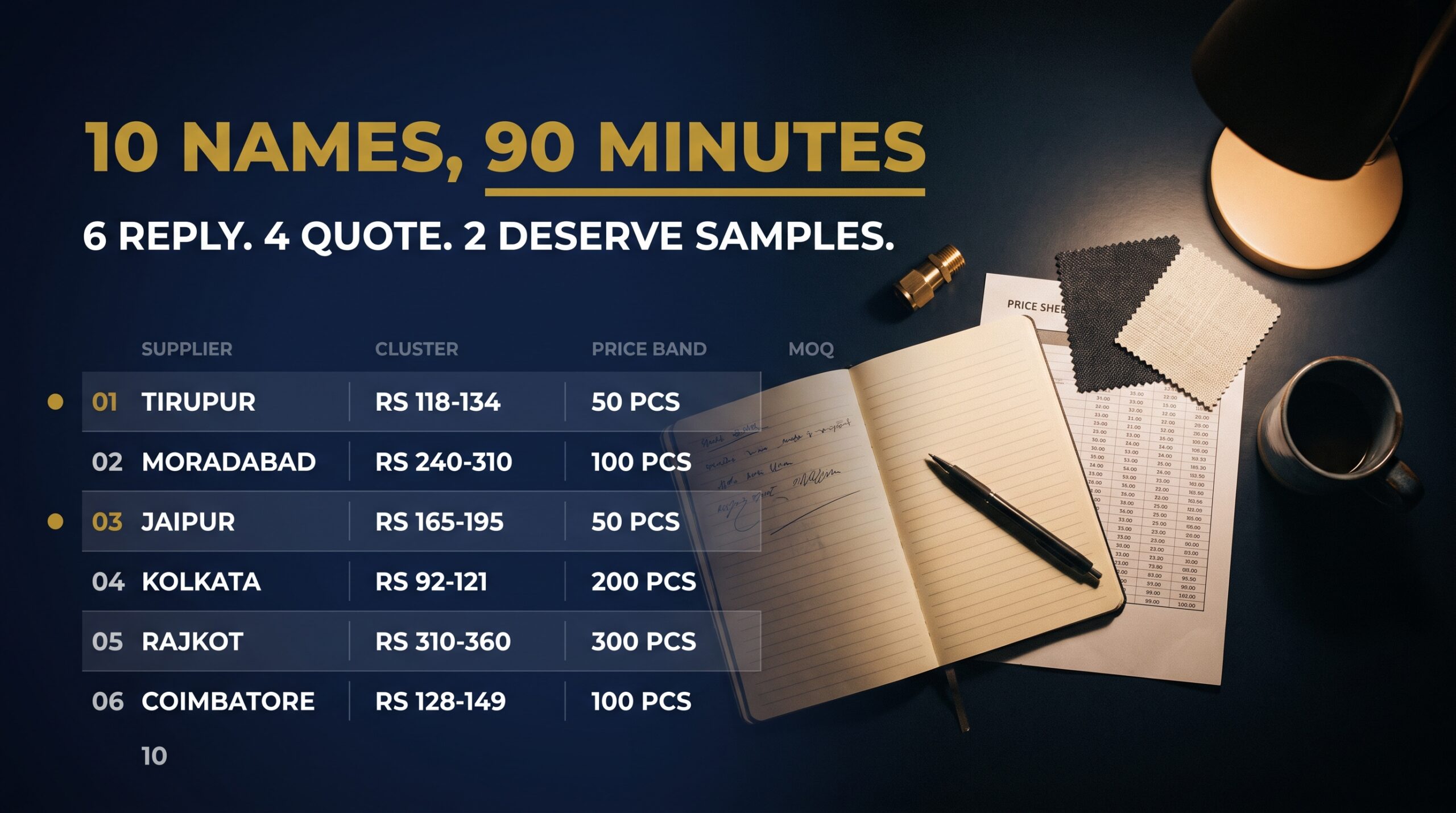
Ten entries take about ninety minutes. Six will answer, four will quote sensibly, and two will be worth samples.
Suresh Nair from Kochi rewrote his buyer profile with his GST number and a two-line brief for stainless steel kitchen accessories. Fourteen suppliers responded within 48 hours, against three the previous month. Suppliers prioritise buyers who look like businesses.
Sourcing is one link in a chain that includes listing, pricing, ads and cash flow, and sellers who get it right usually learn the whole system at once. If that is where you are heading, join the 3-Day Amazon Business Training and build it in order.
Checking a Supplier Before You Send Money
IndiaMART supplier verification is not one check. It is a short sequence you repeat every time, and done properly it takes an afternoon and removes almost all of your downside.
Documents every genuine factory can show
Ask for the GST certificate, Udyam registration and a factory or trade licence. Category-specific proof matters too: a BIS licence for regulated goods, FSSAI registration for anything edible, an Import Export Code if they buy components abroad. A real unit sends these within a day without treating the request as an insult.
Cross-checking GST, address and company records
Run the GSTIN through the official GST portal to confirm legal name, registration date and status. For a private limited company, pull master data from the MCA portal. Then drop the address into satellite view, because a shed with a loading bay looks nothing like a flat in a housing society.
Red flags that should end the conversation
Walk away if they refuse a live video walkthrough of the floor, insist on payment into a personal savings account, quote far below every other unit in the cluster, or push you to decide today. Reluctance to put specifications in writing is the loudest warning of all.
Meenakshi Iyer from Coimbatore verified three yoga mat suppliers in a single day and found one GSTIN had been cancelled months earlier. That five-minute lookup protected a ₹1.4 lakh first order. Verification is cheap; recovery is not.
The First Conversation That Filters Out Fakes
Your first call does more filtering than any filter on the site. Suppliers reveal their real scale within four or five questions, provided you ask about production rather than price.
Questions that reveal real production capacity
Ask their monthly output for this exact item, how many machines run it, how many workers sit on that line, and the lead time for 500 pieces against 5,000. Then ask which buyers they currently supply. Traders stumble on specifics; factories answer in numbers without pausing to invent them.
Talking about samples before talking price
Request paid samples from your top three and pay willingly. A supplier who gives samples away too eagerly is often forwarding someone else’s stock. Compare material, weight, finish, dimensions and packaging side by side, and photograph everything, because the winning sample becomes your reference standard.
Getting a quote you can actually compare
Insist every quote states the same things: unit price, whether GST is included, packaging type, ex-works or delivered, lead time and payment terms. One supplier quoting ex-factory against another quoting delivered will mislead you by ten per cent or more on the headline number alone.
Farhan Qureshi from Hyderabad asked four ceramic mug suppliers for identical delivered-and-taxed quotes. The apparent cheapest rose from ₹96 to ₹131 once freight and GST landed, and he chose the unit that had looked costliest. Compare like for like, always.
Order Quantities, Pricing and Payment Terms
Wholesale suppliers for Amazon India are usually far more flexible on quantity than overseas factories, which is precisely why a domestic first order makes such a useful experiment.
What a realistic starting quantity looks like
Simple stitched or assembled goods often start at 20 to 50 pieces. Branded packaging pushes the minimum to 100 to 300 units, because printing carries its own setup cost. Anything needing a new mould or die sits in the thousands, so postpone that until the product has proven it sells.
Negotiating a trial run without burning goodwill
Do not grind a supplier on a fifty-piece order. The margin is not there and you will start the relationship badly. Accept their price for the trial, then negotiate hard on the repeat rate by showing a realistic quarterly volume you can genuinely commit to.
Advance payments and how to stay protected
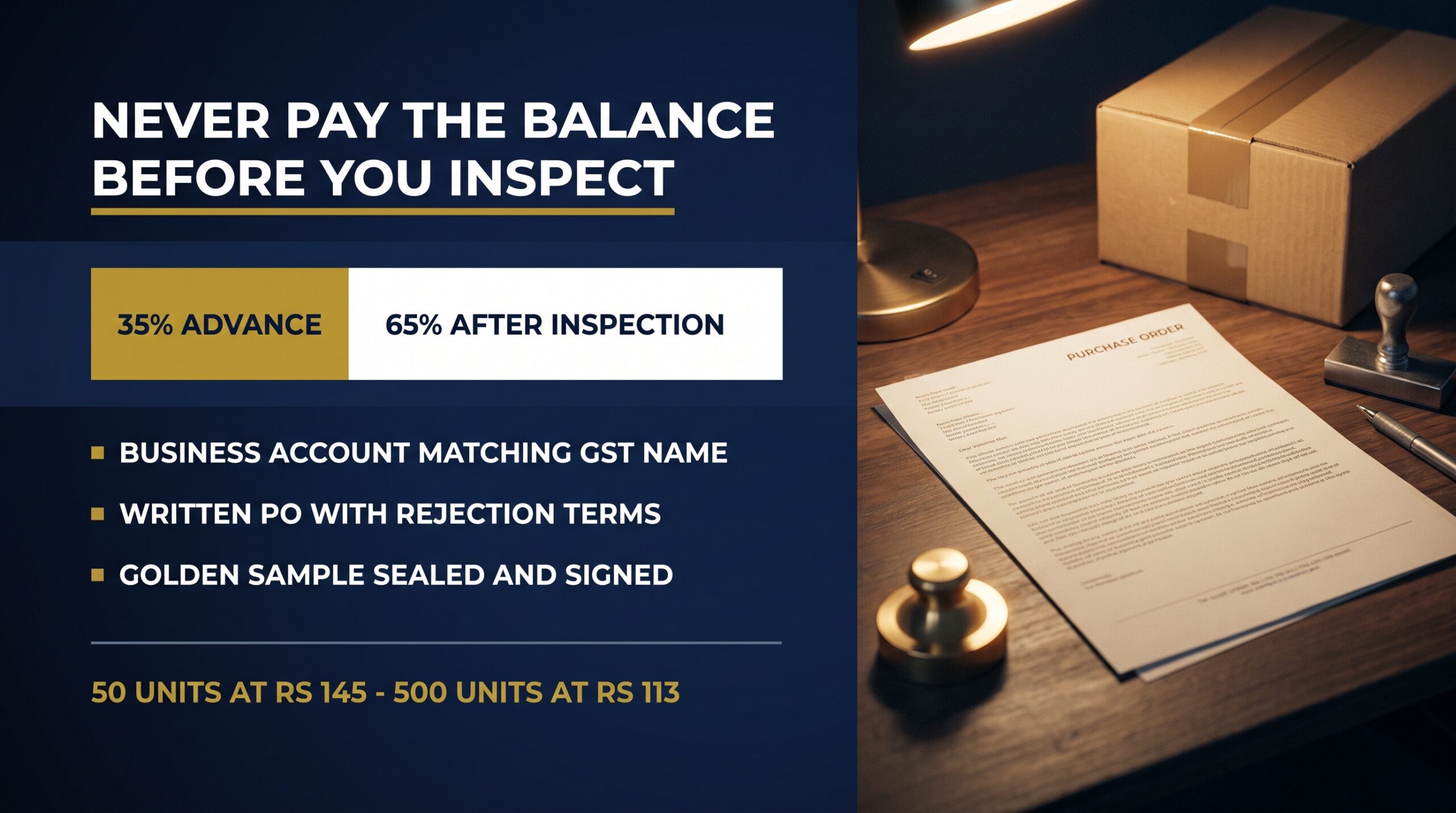
A common structure is 30 to 40 per cent advance to begin production, balance after you or your inspector clear the goods. Pay only into a business account matching the GST-registered name, keep a written purchase order covering specification, quantity, delivery date and rejection terms, and hold the balance until inspection.
Rohan Desai from Surat launched jute laptop sleeves with a 50-unit run at ₹145 each. The batch sold out in three weeks, and a 500-unit quarterly commitment brought his cost to ₹113, a 22 per cent drop. Volume promised honestly beats pressure applied early.
Getting the sourcing maths right only helps when fees, pricing and ad spend are modelled alongside it, which is exactly what you can work through inside the 3-Day Amazon Business Training.
Turning a Supplier Into a Private Label Partner
Generic stock sells once. A brand compounds. The move from buying to building happens in conversations most sellers never start.
Customisation that suppliers will actually do
IndiaMART private label suppliers will usually agree to printed labels, custom colours, your logo on the product, a thank-you insert and branded cartons long before they will cut a new mould. Start with everything that needs no tooling, then invest in moulds after two or three successful restocks.
Branding, packaging and barcode requirements
Your packaging must carry your brand name consistently, the FNSKU label for fulfilment and the statutory declarations for retail sale. Brand Registry requires a registered trademark in your own name, so file it early, because examination takes time you will wish you had spent earlier.
Locking quality standards before mass production
Approve one golden sample in writing, keep it sealed in your office, and make every production batch answerable to it. Write a one-page specification listing dimensions, weight, material grade, colour reference, finish and acceptable defect rate, and have the supplier sign it before production starts.
Kavita Singh from Delhi added branded boxes, care cards and inserts to brass decor from a Moradabad unit. Her rating held at 4.6 stars and she completed Brand Registry four months after launch. Packaging was the cheapest part of the build and did the most work.
IndiaMART or Alibaba: Picking Your Route
The IndiaMART vs Alibaba for Indian sellers debate is rarely about which platform is better. It is about which route survives your cash flow and your category.
Landed cost once duties and freight are counted
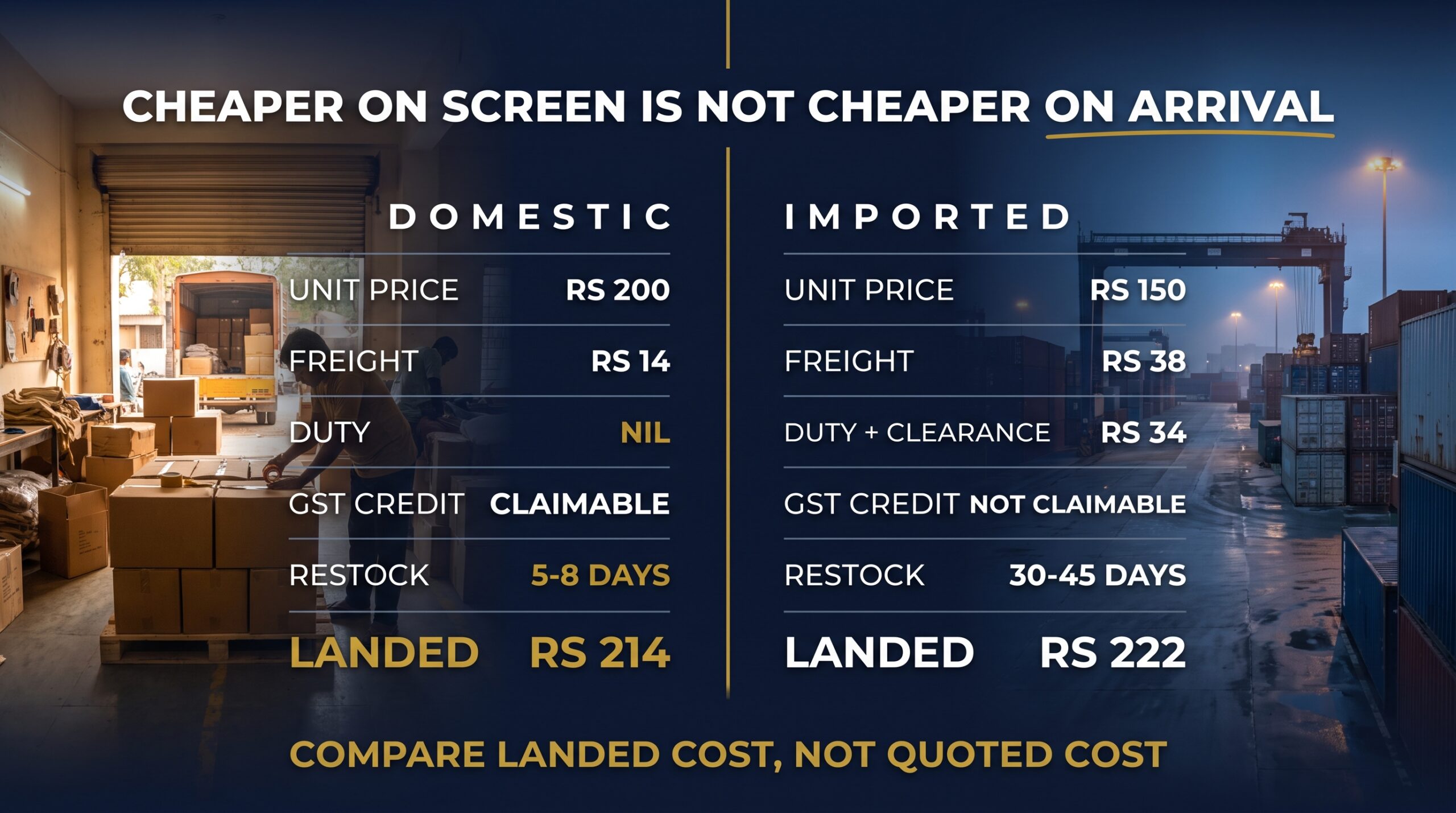
A Chinese quote almost always looks cheaper on screen. Add international freight, customs duty, clearance charges, port handling and currency movement, and the gap narrows sharply or reverses. Domestic purchases also give you a GST invoice you can claim input credit against, which an overseas invoice will not.
Speed, reshoots and restocking reality
Domestic dispatch to a fulfilment centre typically takes five to eight days. Imports run 30 to 45 days before clearance. When a listing starts selling faster than expected, that gap decides whether you stay in stock or hand your rank to a competitor.
When importing still makes more sense
Precision electronics, complex injection moulding and high-volume tooling are handled more maturely in China. If your product needs consistency across 10,000 identical plastic parts, import it and accept the lead time. Be honest about where India’s manufacturing strengths genuinely lie.
Awantika Deshpande from Pune built her brand on handcrafted jute bags from Bengal artisans. Within eight months she was moving 120 units a week at margins above 40 per cent, largely because nothing identical existed in the category. Domestic craft is a moat imports cannot copy quickly.
Compliance Checks Before Your First Purchase Order
Nothing stings quite like stock arriving in perfect condition and then failing at the listing stage. Clear the paperwork before you release the advance.
Invoices, GST credit and purchase records
Insist on a proper tax invoice carrying your GSTIN, the supplier’s GSTIN, HSN code and the tax split. Confirm the invoice appears in your GST portal statement so the input credit actually reaches you. File every purchase order, invoice and transport document by batch number.
Product certifications your category demands
Regulated categories carry non-negotiable requirements: BIS for many electricals and toys, FSSAI for food and supplements, specific approvals for cosmetics. Ask for the certificate number and verify it with the issuing authority rather than trusting a scanned image forwarded on WhatsApp.
Labelling rules that protect your listing
Retail packs must carry the manufacturer or packer name and address, net quantity, MRP inclusive of taxes, month and year of manufacture, country of origin and consumer care details. Have the supplier print this at the factory rather than stickering it later in your godown.
Harpreet Kaur from Ludhiana had 400 units held back because the cartons carried no MRP declaration. Relabelling cost her ₹11,000 and nine selling days. Send the label artwork with the purchase order, not after it.
Frequently Asked Questions
Is IndiaMART good for Amazon private label sourcing?
Yes, particularly for a first launch. Low trial quantities, conversations in your own language and the option to visit a factory let you test a product without committing lakhs. It suits textiles, jute, brass, handicrafts, kitchenware and ayurvedic goods. Precision electronics and complex moulded plastics stay harder domestically.
How do I verify a genuine manufacturer on IndiaMART?
Collect the GST certificate, Udyam registration and factory licence, then verify the GSTIN on the GST portal and company details on the MCA portal. Check the address on satellite view, request a live video walkthrough of the floor, and order paid samples. Visit in person before your second order.
Is IndiaMART cheaper than Alibaba for Indian sellers?
Usually, once you calculate landed cost rather than quoted cost. Chinese quotes look lower until freight, duty, clearance and currency movement are added, and domestic purchases also earn GST input credit. China stays genuinely cheaper on high-volume tooling and precision work. Run the arithmetic per product rather than assuming.
Do I need a GST number to buy from IndiaMART suppliers?
Most suppliers will sell to an unregistered buyer, but register anyway. Without a GSTIN you cannot claim input credit on the tax you pay, which quietly erodes margin on every restock. A verified number also makes suppliers take your enquiries seriously. Selling on Amazon needs it regardless.
What minimum order quantity should I expect from IndiaMART manufacturers?
For simple stitched, woven or assembled products, 20 to 50 pieces is often achievable. Add printed branded packaging and expect 100 to 300 units, because printing carries setup cost. Custom moulds or dies usually start in the thousands. Take a small trial at their price, then negotiate repeat volume.
Should I visit the factory before placing a bulk order?
For a first small test batch, a thorough video call is usually enough. Before committing serious money, go in person. You will see machinery, staffing, raw material stock and finished goods in one visit, and none of that can be staged convincingly. Suppliers also prioritise buyers they have actually met.
How do I handle a supplier who sends defective stock?
Document everything immediately with photographs, video and a count of affected units, then compare against your signed golden sample and specification sheet. Raise it in writing rather than only on a call, and propose a specific remedy such as replacement or a credit note. Hold the balance until resolved.
Can one supplier serve both my Amazon and offline orders?
Yes, and many sellers plan it that way. Combined volume strengthens your negotiating position and lowers per-unit cost. Keep packaging separate, since Amazon shipments need FNSKU labelling and specific carton requirements. Give the supplier one consolidated forecast so they can plan raw material, then split finished stock at dispatch.
Conclusion
Finding a real factory is not luck. It is a filter: search by specification, shortlist ten, verify documents, interview for capacity, pay for samples, compare quotes on identical terms, then start small and scale on repeat pricing. Run that sequence honestly and the traders drop out on their own.
What sourcing cannot do is carry the business alone. A brilliant supplier will not rescue a weak listing, a thin margin or an ad campaign bleeding money into the wrong keywords. Sellers who last build every link at the same time, not one at a time.
If you want that full system mapped out with guidance rather than guesswork, take your next step with the 3-Day Amazon Business Training and place your first order with a plan behind it.
