

Last month, Nikhil Bhat from Mangaluru got the LinkedIn message he had secretly hoped for. A deal scout from a brand roll-up liked his kitchenware brand, which did ₹3.2 crore on Amazon.in last year, and wanted a quick call about his Amazon business valuation. Nikhil opened his laptop and froze. His sales sat in Seller Central, his costs in three Excel sheets, and his real profit somewhere inside his CA’s Tally file. Four years building the brand, and not one hour spent pricing it.
That gap is everywhere. Almost every guide for Indian sellers is about building, and almost none explain how a buyer turns your years of work into one number. Here’s how Amazon business valuation works, what moves your number, and what to start documenting today, whether you sell next year or never.
Why Every Indian FBA Seller Needs an Exit Number
How Much Is My Amazon Business Worth, Really?
Ask most sellers how much their Amazon business is worth and they’ll quote a revenue multiple they heard at a meetup. Buyers don’t start there. They start with the profit one owner actually takes home, then ask how safe that profit is. A ₹5 crore brand on 4% margins can be worth less than a ₹2 crore brand earning 18%.
Why the 2021 Aggregator Numbers Misled Sellers
During the 2021 roll-up rush, funded aggregators competed for the same brands, and stories of huge revenue multiples spread through every seller WhatsApp group. Meera Joshi from Nagpur expected “eight times revenue” for her yoga-mat brand this year. Her offer came in near 0.6 times revenue, and she spent a week convinced the buyer was cheating her. They weren’t. The market had simply gone back to pricing brands on earnings.
An Exit Number Makes You a Better Operator Today
Even if you never sell, knowing your value turns “grow” into specific goals: lift margin, reduce dependence on one product, clean up your books. It becomes a quarterly scorecard.

How Amazon Business Valuation Actually Works
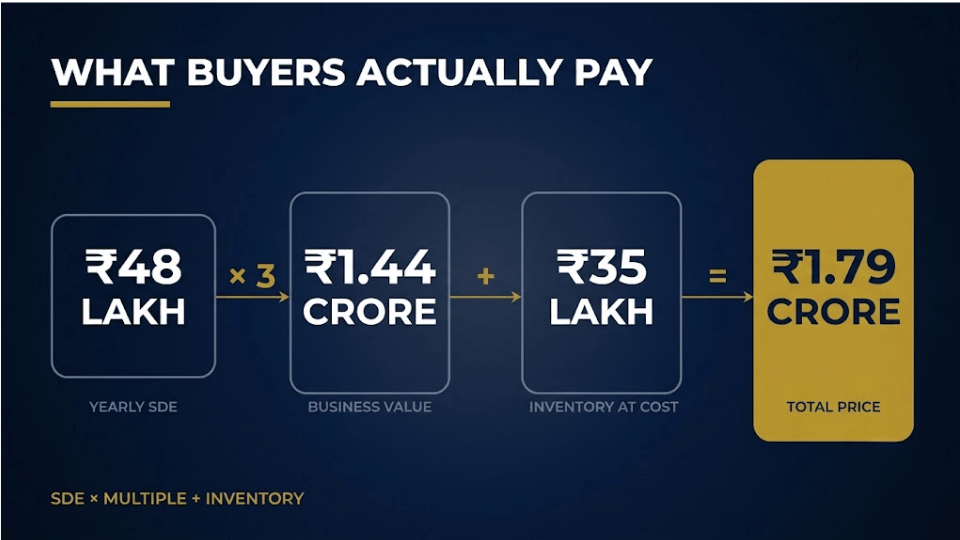
Most FBA brands are valued with one formula: seller discretionary earnings multiplied by a market multiple, plus inventory at cost. Every Amazon business valuation you receive comes down to the two numbers inside it.
Seller Discretionary Earnings (SDE) in Rupees
Seller discretionary earnings, or SDE, is the total profit one full-time owner takes out of the business in a year: net profit from your Amazon profit and loss statement plus your own salary and any one-time or personal costs a new owner wouldn’t carry. Nikhil’s brand earns ₹48 lakh in SDE on ₹3.2 crore of revenue. At 3x, it’s worth ₹1.44 crore before inventory. Buyers use the trailing twelve months, then check a three-year average to rule out a one-season spike.
The Add-Backs Buyers Accept, and Those They Reject
Buyers accept a founder’s salary, a one-off photoshoot or trademark legal fees, provided each has an invoice. They reject anything that depends on the future, like “we’ll cut ad spend next year.” At a 3x multiple, every genuine ₹1 lakh add-back is worth ₹3 lakh, so the paperwork pays for itself.
Why Inventory Sits Outside the Multiple
Stock in Amazon fulfilment centres and your own warehouse is valued separately at landed cost. Nikhil’s ₹35 lakh of sellable stock takes his total to ₹1.79 crore.
The Amazon Business Valuation Multiple, Decoded
What Multiple Do FBA Businesses Sell for Today?
Broker data for 2026 puts most Amazon FBA business valuation deals at roughly 2.5x to 4x SDE, down from the 4x to 6x peaks of 2021. Treat these as global benchmarks, since India publishes little deal data, but Indian buyers price risk the same way.
How D2C Brand Valuation in India Differs
D2C brand valuation in India often arrives in different language. Roll-ups and corporate buyers may quote EBITDA or revenue multiples instead of SDE, so convert every offer to the same base. Karthik Subramanian from Coimbatore got two offers for his ₹2.5 crore cotton-towel brand. “1x revenue” sounded like the bigger number, but 4x his ₹70 lakh SDE came to ₹2.8 crore, which was ₹30 lakh more.
Amazon FBA Business Valuation vs Omnichannel Brands
Valuation advisors estimate that an Amazon-only brand trades one to two turns below an equivalent brand selling across several channels. On ₹50 lakh of SDE, one turn is ₹50 lakh of value.
Want to see where your own brand lands? Our SDE and valuation worksheet takes you from your Amazon.in settlement report to a realistic value range in about an hour.
What Pushes Your Multiple Up, or Drags It Down
Buyers pay for their confidence that your profit will still exist in three years, and every factor below moves that confidence.
The Hero-ASIN Trap and the 60% Line
If one ASIN brings in more than 60% of revenue, expect a lower multiple, or no deal. Imran Shaikh from Bhopal had 70% of his sales riding on one steel water bottle. His buyer cut the offer by ₹30 lakh, noting that a single aggressive copycat could halve the business.
Why Amazon.in-Only Brands Get Discounted
A brand living only on Amazon.in depends on one fee structure, one algorithm and one account. Advisors generally treat more than 40–50% of revenue from one channel as a drag. Even a small Flipkart store or a modest D2C website shows customers follow your brand, not just the marketplace.
Organic Rank vs Sales Bought With PPC
Sales from organic rank are worth more than sales you rent through PPC, so buyers dig into your ad reports. These are the factors they check most:
- Steady year-on-year growth lifts your multiple, because buyers pay for momentum.
- A registered trademark with Brand Registry raises it, since it proves you own something defensible.
- A healthy share of repeat customers raises it, because future sales become predictable.
- A rising TACoS lowers it, as sales increasingly depend on ad spend.
- Account health warnings and long stockouts lower it, because they signal operational risk.
You won’t fix everything at once. Pick the two weakest areas and work on them for the next two quarters.

Can You Sell an Amazon Seller Account?
Why Amazon.in Seller Accounts Don’t Change Hands
Amazon’s position, repeated by its staff on the seller forums, is that seller accounts generally aren’t transferable and a new owner should set up their own. So the buyer isn’t paying for your login or seller rating; they’re paying for the brand and the machine behind its profit. Confirm the current process with Seller Support before signing anything.
What Actually Transfers: Brand, Listings, Suppliers
What changes hands is your trademark, listing content, supplier relationships, inventory and systems. Once the trademark moves to the buyer’s entity, they can enrol it in Brand Registry and manage listings from their own account. That makes a trademark registered with IP India, in the right class and owner’s name, one of your most valuable documents.
Proprietorship vs Pvt Ltd: Why Your Entity Matters
A proprietorship sells assets: the brand, stock and contracts. A Pvt Ltd company can also sell shares, which some buyers prefer. Harsh Maheshwari from Indore had his trademark in his father’s name rather than his company’s, and untangling it delayed his deal by four months. Ask your CA and a lawyer early which structure suits you.
Increase Amazon Business Value: Document From Day One
The fastest way to increase Amazon business value isn’t a new product. It’s proof. Buyers pay more for profit they can verify in an afternoon than for profit they must take on trust.
Books That Match Your GST Returns and Settlements
Buyers cross-check your P&L, GST returns and Amazon.in settlement reports. If the three disagree, they assume the lowest number is true. Reconcile them monthly, not the week before due diligence.
SOPs That Let the Business Run Without You
If every reorder and PPC tweak lives in your head, the buyer is buying a job, not a business. Written SOPs, the kind you’d hand to a virtual assistant, prove the brand runs without you.
Supplier Agreements and Landed-Cost Records
Supplier terms, MOQs and landed-cost sheets prove your margins survive a change of owner. Keep these records from your first year:
- A monthly P&L by ASIN, showing which products actually make money.
- GST returns reconciled with Amazon.in settlement reports.
- Your trademark certificate, in the name of the entity you’ll sell.
- SOPs for reordering, advertising and customer service.
- Supplier agreements and landed-cost workings for every SKU.
- Advertising and business reports, exported monthly.
Divya Hegde from Mysuru kept exactly this folder for her herbal hair-oil brand. She shared a complete data room within a week of a buyer’s request, and her offer moved from 2.8x to 3.3x SDE, or ₹20 lakh more on ₹40 lakh of SDE.
To save you building this from scratch, grab our exit-ready data room folder template and SOP starter swipe file, and add to them as your brand grows.
How to Sell an Amazon Business in India
If you decide to sell your Amazon business in India, the buyer you approach shapes the price, structure and timeline.
Amazon Brand Aggregators in India Today
Amazon brand aggregators in India, often called roll-ups, include Mensa Brands, GlobalBees, Evenflow, 10Club, GOAT Brand Labs and Upscalio. They usually buy majority or full stakes and grow brands with shared marketing and supply chains. They’re selective about size: GlobalBees has said it targets brands doing roughly $1 million to $20 million in revenue, so a brand below about ₹8 crore may not be on their radar yet.
Strategic Buyers, Competitors and Family Offices
Consumer giants such as Hindustan Unilever, Marico, Emami, Tata Consumer Products and Aditya Birla Group have bought D2C brands outright. For smaller FBA brands, the realistic buyer is often a competitor, a manufacturer wanting a consumer brand, or a family business moving online.
Building Your Amazon Exit Strategy Timeline
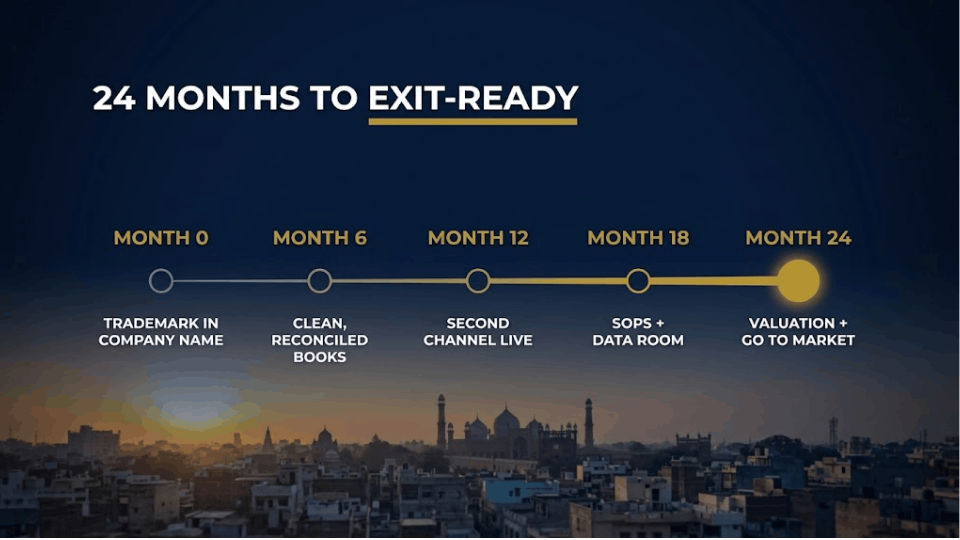
A strong Amazon exit strategy starts long before you meet buyers, and brokers commonly advise 18 to 24 months of preparation. Parth Shah from Surat began preparing his saree-storage brand two years ahead, added a Flipkart channel, and went to market after his strongest Diwali quarter. Sell while the graph points up, never in the month after a suspension.
Mistakes That Shrink Your Amazon Business Valuation
Most damage to an Amazon business valuation is self-inflicted, which means it’s avoidable.
Personal Expenses Mixed Into Business Books
Family phone bills, car EMIs and holidays run through the business muddy your profit, and too many add-backs make buyers distrust the whole P&L.
Unrecorded Sales Buyers Can’t Verify
Revenue missing from your GST returns or settlement reports doesn’t exist in a buyer’s spreadsheet. Off-book sales earn nothing in the multiple and can raise compliance concerns that kill a deal.
Inflated Add-Backs and Panic Selling
Stretched add-backs collapse once a buyer’s accountant checks invoices, and selling under pressure costs even more. Riya Sen from Guwahati listed her tea brand days after a listing suppression and accepted 1.8x SDE. Three months later the issue was resolved and sales recovered, but the brand already belonged to someone else.
FAQ
How is an Amazon FBA business valued?
Most FBA businesses are valued by multiplying seller discretionary earnings (SDE) by a market multiple, then adding inventory at landed cost. SDE is the profit one owner takes home after adding back their salary and genuine one-time costs. The multiple reflects how safe that profit looks.
What multiple do Amazon businesses sell for?
Broker data for 2026 places most Amazon FBA sales between roughly 2.5x and 4x SDE. Small, owner-dependent brands land near the bottom; trademarked, diversified, growing brands reach the top. Indian buyers sometimes quote EBITDA or revenue multiples, so compare offers on the same base.
What factors raise or lower the valuation multiple?
Growth, a registered trademark, repeat customers and multiple sales channels raise it. Dependence on one ASIN, rising ad costs relative to sales, account health issues and stockouts lower it. Buyers also discount anything they can’t verify, so clean records matter.
Can you sell an Amazon seller account?
Generally, no. Amazon treats seller accounts as non-transferable, and a new owner opens their own. You sell the brand: trademark, listings, inventory, suppliers and systems. Confirm the current process with Seller Support and a lawyer before structuring a deal.
When should I start preparing to sell my Amazon business?
Ideally 18 to 24 months before you sell. That gives you time to reconcile books, move your trademark into the right entity, reduce single-product dependence and write SOPs. Better still, keep these records from year one so you’re ready whenever an offer arrives.
Is FBA inventory included in the sale price?
Usually it’s added on top of the multiple. Sellable stock is typically valued at landed cost, while aged, damaged or slow-moving stock may be discounted or excluded. Keep inventory lean and landed-cost records accurate.
Do I need a Pvt Ltd company to sell my Amazon brand?
Not necessarily. A proprietorship can sell its assets, such as the trademark, stock and contracts, while a Pvt Ltd company can also sell shares. Either way, make sure the trademark sits with the selling entity, and involve your CA early.
Can a brand doing under ₹1 crore a year still be sold?
Yes, though the buyer pool changes. Roll-ups look for larger brands, so smaller FBA businesses usually sell to competitors, manufacturers or individuals at lower multiples. Clean books and a registered trademark still lift the price.
Conclusion
Your Amazon business valuation isn’t decided on the day a buyer calls. It’s built month by month, in the records you keep and the risks you remove: a trademark you own, a catalogue that doesn’t hang on one ASIN, channels beyond Amazon.in, and systems that run without you. None of it is wasted if you never sell, because a brand built to be bought is a better brand to own.
If you want help building that kind of business, join our 3-Day Amazon Business Training, where we walk through the brand-first systems that make an Indian FBA business profitable and valuable. Build it like you’ll sell it, and you’ll be ready either way.
