

Six months ago, Priya from Chennai had built a steady Amazon India business selling organic cotton bedsheets. Revenue was decent, margins were shrinking, and every price war left her wondering whether there was a better market out there. Then a friend mentioned Amazon UAE — a marketplace where customers spend more per order, English listings work out of the box, and Indian textiles are genuinely in demand. She opened a browser tab, searched “how to sell on Amazon UAE from India,” and hit a wall of contradictory advice. One blog said she needed a Dubai trade license. Another said she didn't. Nobody explained the actual fees or how long the whole process really takes.
If that confusion sounds familiar, this guide is for you. We're going to walk through the exact requirements to sell on Amazon UAE from India, break down every fee you'll encounter, and give you a realistic week-by-week timeline from registration to first sale.
Why Indian Sellers Are Eyeing Amazon UAE Right Now
The Numbers Behind the UAE Opportunity
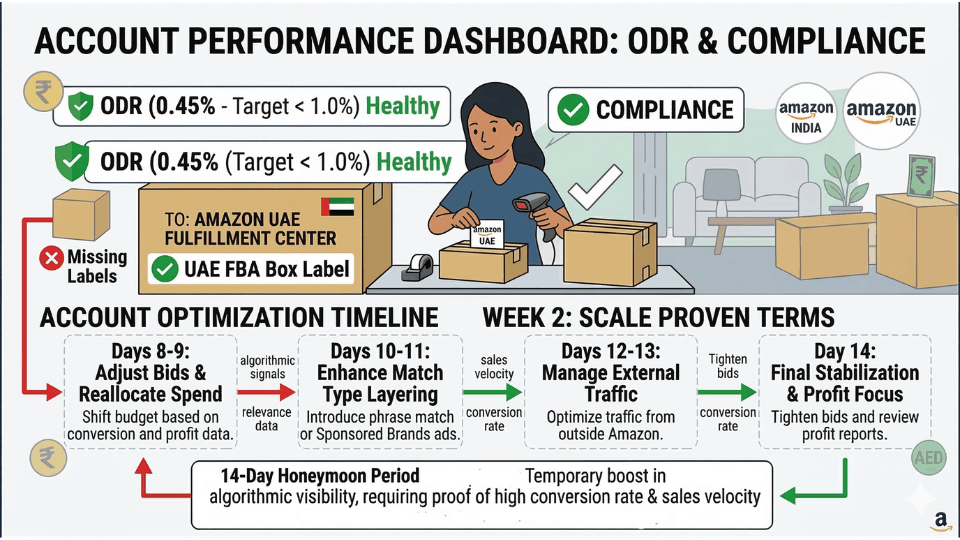
The UAE e-commerce market has crossed the $10 billion mark, and Amazon.ae sits at the centre of it with roughly 28 million monthly customer visits. What makes those numbers more interesting for Indian sellers is the average order value — around $102, which is significantly higher than what most sellers see on Amazon India. The marketplace operates in English, so you don't need to translate a single listing. For someone already running an Amazon India business, the UAE feels less like a foreign market and more like a natural extension.
What CEPA Means for Your Margins
The India-UAE Comprehensive Economic Partnership Agreement gives Indian exporters a real edge. Under CEPA, products in categories like textiles, spices, dry fruits, leather goods, and jewellery can enter the UAE with zero import duty. Arjun Mehta from Surat leveraged this — he exported cotton bed linen to Amazon UAE under CEPA, paid zero import duty, and hit ₹8 lakh in monthly revenue within four months.
Seasonal Peaks That Favour Indian Products
The UAE shopping calendar works in your favour. Ramadan and Eid drive massive online spending — think Diwali-level demand compressed into a few intense weeks. The Dubai Shopping Festival in January and February adds another spike, and Prime Day UAE rounds out the peak calendar. Indian product categories like home textiles, ethnic wear, spices, and personal care see especially strong demand during these windows. If you want to understand how to plan around sale events, our guide on maximising Amazon sale events covers the strategy in depth.
The opportunity is real, but it only works if the registration process doesn't trip you up. Let's walk through that next.
Amazon UAE Seller Registration India: Step-by-Step
Documents You Need Before You Start
Before you touch the registration page, gather your documents. You'll need a valid ID proof — Aadhaar card or passport works best. You'll also need a business license, which can be your GST registration number, Udyam Registration, or FSSAI license depending on your product category. A credit or debit card enabled for international transactions is mandatory. Finally, keep a recent bank statement or credit card statement handy as address proof — it must be less than three months old.
Registering Through Amazon Global Selling India UAE
The registration happens through Amazon Global Selling. If you already have an Amazon India seller account, you can link it and add Amazon.ae as a marketplace — this takes about 20 minutes. New sellers create a fresh account on Seller Central, submit their KYC documents, and wait for a video call verification. During the video call, you'll need to show the physical copy of the ID you uploaded. Once verification passes, your Amazon.ae seller account is typically approved within two to five business days.
Common Registration Mistakes That Delay Approval
Kavitha Reddy from Hyderabad got stuck for ten days because her bank statement was four months old. Amazon rejected it silently, and she didn't realise until she checked her application status. After re-submitting a current statement, approval came through in 48 hours. The most common mistakes are mismatched names between your ID and application, blurry document scans, and using a domestic-only debit card instead of one enabled for international transactions. For a broader look at pitfalls new sellers face, check out our article on common mistakes Amazon sellers should avoid.
Before you start your registration, make sure you have every document lined up. A simple pre-registration checklist — covering ID, business license, international card, and address proof — can save you a week of back-and-forth with Amazon's verification team.
Do You Need a UAE Trade License to Sell on Amazon UAE?
Selling Without a Trade License (How It Works)
This is the question that confuses most Indian sellers, so let's clear it up. If you're registering through Amazon Global Selling as an international seller and using FBA to ship inventory to UAE warehouses, you do not need a UAE trade license to get started. Amazon acts as the marketplace facilitator for VAT purposes — they deduct the 5% VAT from your sale proceeds and remit it to UAE tax authorities on your behalf. The limitation is that without a Tax Registration Number, you cannot claim input VAT credits on your FBA fees, shipping costs, or other business expenses.
When Getting a UAE License Makes Sense
Deepak Nair from Kochi started selling on Amazon UAE without a trade license, and it worked fine for his first few months. But once his monthly revenue crossed AED 30,000, the unrecoverable input VAT started adding up. He spent about AED 5,000 on an SPC Free Zone e-commerce license, registered for a TRN, and immediately started claiming back VAT on his FBA fees and freight costs. The license also unlocked Brand Registry on Amazon UAE, which gave him access to A+ Content and better protection against listing hijackers. If you're considering Brand Registry, our step-by-step guide on Amazon Brand Registry in India walks you through the setup.
If you decide a license makes sense, free zones are the preferred route for Amazon sellers. The SPC Free Zone and IFZA offer e-commerce licenses starting around AED 5,000 to AED 7,500. For the most budget-friendly option, the DED Trader license in Dubai costs just AED 1,370 and allows online selling as a home-based business. Mainland licenses cost more and are typically only worth it if you plan to open a physical retail presence in the UAE.
The license question is settled — now let's look at what you'll actually pay in fees.
Amazon UAE Seller Fees: The Real Cost Breakdown
Amazon UAE Referral Fees by Category
Amazon charges a referral fee on every sale, and the percentage depends on your product category and price point. For most categories, products priced at AED 50 or below attract an 8% referral fee, while products above AED 50 are charged 15%. Some categories like electronics sit at different tiers. Sneha Agarwal from Jaipur figured out this threshold early — she prices her handmade jewellery at AED 45, just under the AED 50 mark, and pays 8% instead of 15%. That difference saves her roughly ₹200 per unit, which adds up fast across hundreds of monthly orders. For a deeper understanding of how Amazon fees work across the board, our breakdown of Amazon selling fees covers the Indian context in detail.
Amazon FBA UAE from India: Fulfillment and Storage Fees
If you're using FBA, you'll pay fulfillment fees based on your product's size tier and weight. These fees cover picking, packing, shipping to the customer, and handling returns. Storage fees are charged monthly based on the cubic volume your inventory occupies in the warehouse. To get your products to the UAE fulfillment centre in the first place, Amazon Global Selling SEND provides a cross-border shipping solution — you ship from India, and Amazon handles the last mile into their UAE warehouse.
Hidden Costs Most Indian Sellers Miss
Beyond Amazon's published fees, factor in currency conversion costs when your AED earnings hit your Indian bank — most payment services charge 1-3%. You'll also pay for IEC registration (one-time, around ₹500), freight forwarding, and international packaging. Build a 5-8% buffer into your pricing to absorb exchange rate fluctuations.
VAT Registration for Indian Sellers on Amazon UAE
When Amazon Handles VAT for You
For Indian sellers using FBA or MFN without a UAE Tax Registration Number, Amazon operates as the marketplace facilitator. This means Amazon calculates, collects, and remits the 5% VAT on your behalf for each sale. You don't need to file UAE tax returns, and you don't need a TRN to start selling. The trade-off is straightforward — you can't recover VAT paid on your business expenses like FBA fees, storage, and shipping costs. If you'd like to understand how Indian tax obligations fit in, our guide on how GST impacts Amazon sellers covers the domestic side.
Why You Might Want to Register Voluntarily
Rohan Gupta from Delhi skipped VAT registration for his entire first year on Amazon UAE. When he sat down with an accountant, they calculated he had lost roughly AED 12,000 in unrecoverable input VAT on FBA fees and freight. The registration process through the FTA's EmaraTax portal requires a UAE trade license, passport copy, and bank IBAN details. It's not complicated, but it does mean getting a trade license first.
VAT Registration Timeline and Penalties
Once you submit your application on the EmaraTax portal, expect 10 to 20 working days for FTA verification and TRN issuance. Late registration after crossing the AED 375,000 mandatory threshold can attract fines starting at AED 10,000. For sellers who are building volume, the smarter move is to register voluntarily before you hit the threshold — it protects your margins and shows professionalism to B2B buyers.
Navigating UAE VAT as an Indian seller can feel overwhelming. Inside our 3-Day Amazon Business Training, we break down the exact compliance steps — including fee calculations and tax workflows — so you launch with confidence, not confusion.
Export from India to UAE Amazon: Shipping and Logistics
FBA vs MFN — Which Route Fits Your Business?
You have two ways to fulfill orders on Amazon UAE. With FBA, you ship inventory in bulk to Amazon's UAE fulfilment centre — they store, pick, pack, and ship each order. You get Prime eligibility and faster delivery, but you pay storage and fulfillment fees. With MFN, you ship directly to each customer from India or through a third-party logistics provider. MFN avoids storage fees but means longer delivery times and no Prime badge.
Export Documents Every Indian Seller Needs
To export from India to UAE Amazon, you'll need an Importer Exporter Code from DGFT, an Authorized Dealer Code from your bank, a GST Letter of Undertaking to export without paying IGST, a commercial invoice cum packing list, and a certificate of origin. Depending on your product, you may also need a halal certificate or specific compliance documentation. Amazon's Export Navigator dashboard walks you through requirements based on your product and destination.
Shipping Timelines and Costs to Expect
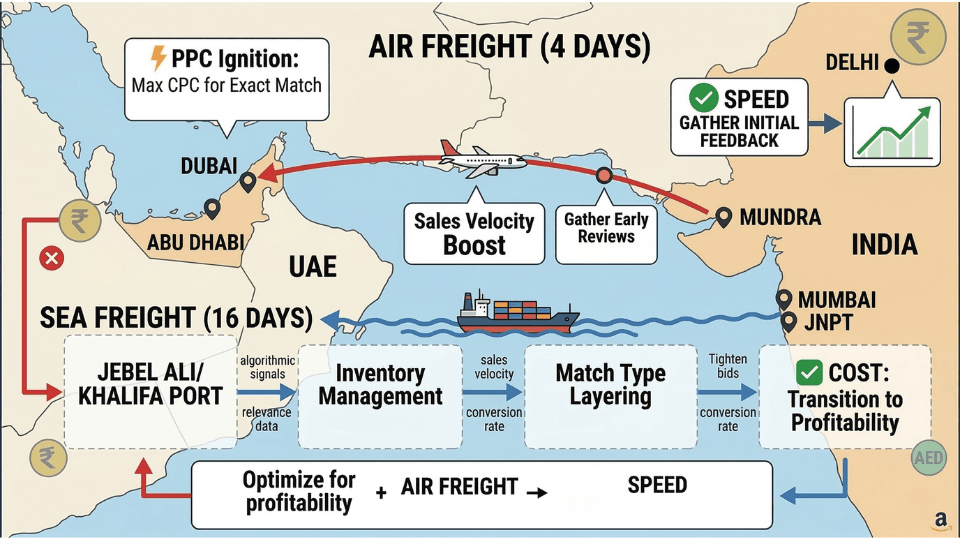
Anita Bhatia from Mumbai shipped her first FBA consignment of kitchen textiles via air freight — products reached the UAE fulfilment centre in four days and were live within seven days total. Her second shipment went by sea, taking 16 days but costing about 60% less per kilogram. For most sellers starting out, air freight makes sense for the initial shipment, while sea freight works for replenishment once demand is established.
Realistic Timelines: From Registration to First Sale
Week-by-Week Launch Roadmap
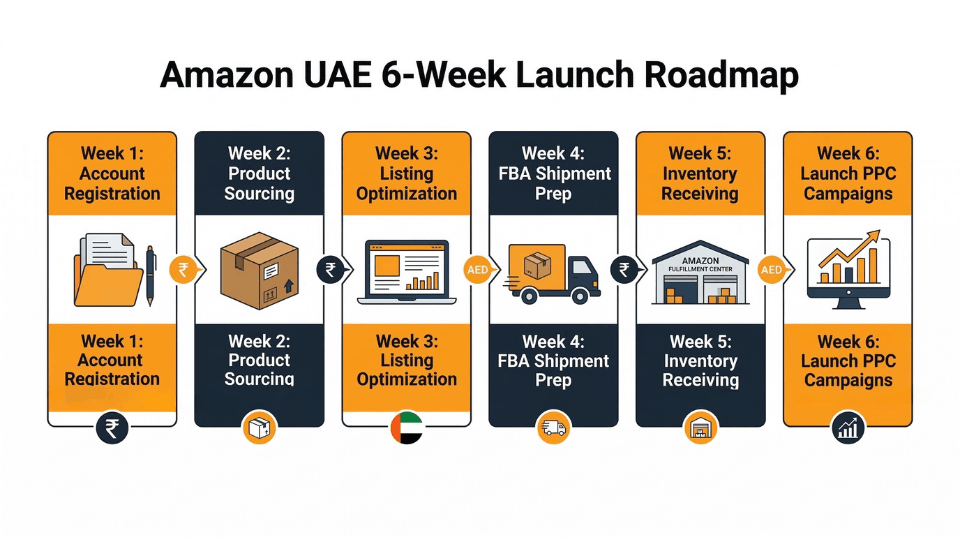
Here's what a realistic launch looks like. In Week 1, you gather documents and submit your Amazon Global Selling registration. Week 2 covers account approval and creating product listings — titles, images, and keywords optimised for UAE shoppers. Weeks 3 and 4 are for your first FBA shipment via air freight or finalising product sourcing. By Weeks 5 and 6, your inventory should be live, and you can launch Sponsored Products campaigns with a daily budget of AED 30-50 targeting long-tail keywords.
What Can Go Wrong (and How to Avoid It)
Vikram Singh from Ludhiana planned for a three-week launch and ended up taking seven weeks. The culprit was his IEC — the application took 12 days longer than expected because of a documentation error. His lesson is worth remembering: start your IEC application before you even begin Amazon registration. Other common delays include document rejections during video verification, incorrect product classification that triggers compliance reviews, and FBA inventory check-in backlogs during peak seasons.
When to Expect Consistent Revenue
Your first 90 days on Amazon UAE are a learning phase — gathering keyword data, adjusting pricing, and building reviews. Months three to six are when optimisation kicks in as you migrate converting search terms to exact match campaigns and refine listings based on feedback. Most Indian sellers following this approach see consistent monthly revenue by month four or five.
Frequently Asked Questions
Can I sell on Amazon UAE without a trade license from India?
Yes. Indian sellers registering through Amazon Global Selling can sell on Amazon UAE without a UAE trade license. Amazon acts as the marketplace facilitator and handles VAT on your behalf. However, without a trade license and TRN, you cannot claim input VAT credits on business expenses. Many sellers start without a license and get one later as they scale.
What are the fees for selling on Amazon UAE from India?
The main fees are referral fees (8-15% depending on category and price), FBA fulfillment fees based on product size and weight, and monthly storage fees. There's currently no monthly subscription fee for the Professional plan on Amazon.ae. Factor in currency conversion costs of 1-3% and shipping expenses from India to the UAE warehouse.
How long does it take to start selling on Amazon UAE?
From registration to first sale, expect four to eight weeks. Account approval takes two to five days, listing creation about a week, and your first FBA air shipment reaches the UAE in three to five days. Delays with document verification or IEC processing can stretch this timeline, so prepare all documents before you begin.
Do I need VAT registration to sell on Amazon UAE from India?
Not initially. Amazon deducts and remits VAT as a marketplace facilitator for international sellers without a TRN. Voluntary VAT registration becomes worthwhile once your FBA fees and shipping costs generate significant input VAT you'd like to recover. Mandatory registration kicks in at AED 375,000 in taxable turnover.
What documents are required to sell on Amazon UAE from India?
You need an ID proof like Aadhaar or passport, a business license such as GST or Udyam registration, a credit or debit card enabled for international transactions, and a recent bank statement as address proof. For exporting, you'll also need an IEC, AD Code, GST LUT, commercial invoice, and certificate of origin.
Can I use my existing Amazon India account to sell on Amazon UAE?
Yes. Through Amazon Global Selling, you can link your existing Amazon India seller account and add Amazon.ae as a marketplace. This is faster than creating a new account from scratch and typically takes about 20 minutes to set up, though business verification may still take two to three days.
What products sell best on Amazon UAE from India?
Home textiles like bedsheets and curtains, ethnic wear, jewellery, spices, dry fruits, personal care products, and electronic accessories perform well. Products under 1.5 kg priced between $15 and $60 tend to have the best margin-to-shipping ratio. Categories covered under CEPA enjoy duty-free access, boosting margins further.
How do I receive payments from Amazon UAE in India?
Amazon deposits your earnings in AED into your linked bank account. Many Indian sellers use payment services like Skydo or Payoneer that offer virtual AED accounts and convert funds to INR at competitive rates. Amazon disburses payments every two weeks after deducting applicable fees.
Conclusion
Selling on Amazon UAE from India isn't a speculative bet — it's a structured process with clear requirements, transparent fees, and realistic timelines. The documents are manageable, the registration is straightforward through Amazon Global Selling, and the fee structure rewards sellers who understand the thresholds. If you start your document preparation this week, you could realistically have products live on Amazon.ae within six weeks.
The sellers who succeed on Amazon UAE are the ones who plan before they register, price with all costs factored in, and treat the first 90 days as a data-gathering phase rather than a sprint to profit. If you want a structured roadmap for launching on Amazon UAE — covering everything from product selection to advertising — our 3-Day Amazon Business Training walks you through each step with the kind of detail that turns confusion into clarity. Your next market is waiting.
