

You are standing in a warehouse in Moradabad at eleven at night, wrapping brass planters in bubble wrap, and the order on your screen is from a buyer in Ohio who paid the equivalent of ₹4,200 for something you sell for ₹950 in Delhi. That gap is why amazon global selling from india keeps pulling sellers in. It is also why so many quit within a year, because the ₹3,250 difference is not profit — it is shipping, customs, referral fees, currency spread and one return that never came back.
The honest question in 2026 is not whether Indian sellers can export. Thousands already do, from Tiruppur T-shirts to Ayurvedic skincare to steel tiffin boxes. The question is whether your product, your margin and your paperwork are lined up well enough that exporting makes you money instead of just making you busy.
What follows is the whole picture — marketplaces, documents, IEC and AD Code, GST treatment, fees, payments, shipping and returns — explained the way a friend who has already made the mistakes would explain it. By the end you will know which of the three pillars is your weak one.
What Selling Overseas Actually Means for You
Rohit Menon in Kochi spent four years selling coir doormats domestically at ₹340 a piece on wafer-thin margins. He listed the same mats in the US at $18.99 and within seven months was shipping 600 units a month. His lesson was blunt: the product did not change, the buyer did.
Which marketplaces Indian sellers can reach
Amazon runs twenty-plus country marketplaces, and Indian exporters commonly sell into the United States, Canada and Mexico; the UK, Germany, France, Italy, Spain and the Netherlands; the UAE and Saudi Arabia; and Japan, Singapore and Australia. You do not open all of them. You open one, learn its rhythm, then borrow that learning for the next.
How exporting differs from selling domestically
Domestically you fight sellers with your exact cost base. Overseas you compete against importers who paid a middleman, and you are the factory floor. The disadvantage is distance: a twelve-day transit, a customs officer you will never meet, and a return you cannot economically bring home.
Who this business model suits best
Exporting rewards light, high-value, non-fragile goods with a story — handicrafts, textiles, jewellery, spices, wellness, niche home décor. It punishes heavy, low-ticket, heavily regulated items. If your product weighs 3kg and sells for ₹600, freight alone eats you. Ask what travels well, not what sells well here.

The Real Case For and Against Exporting in 2026
Sneha Agarwal in Jaipur moved her block-print quilts to the UK and watched net margin climb from 14% domestically to 31% in eight months — then lost six points of it to winter storage fees she had not budgeted for. Both halves of that sentence matter.
Where the margins are genuinely better
A handcrafted product that fights forty identical listings in India may face six in Germany. Less price pressure, higher willingness to pay for provenance, and a pound or dollar realisation against a rupee cost base. That structural gap is real, and it is the strongest argument for exporting at all.
The hidden costs nobody warns you about
Freight is the obvious one. The quiet ones are long-term storage on slow SKUs, removal and disposal orders, advertising in a market where cost-per-click runs far above India, compliance testing, and working capital locked in stock sitting 8,000km away for ninety days.
Signs your product is not export ready
If your item is bulky relative to price, needs cold chain, carries batteries or liquids without certification, or has no differentiation beyond being cheap, hold back. Hold back too if you cannot reorder within three weeks — running out abroad costs ranking you will spend months rebuilding.
Papers You Need Before You Can Ship
Imran Qureshi in Moradabad lost eleven weeks because his AD Code was registered with his bank but never activated at the port his freight forwarder actually used. One afternoon at the customs house fixed it. Eleven weeks of stalled shipments did not come back.
Business identity and bank proofs
The documents required for amazon global selling typically include your PAN, a GST registration certificate, a current account in the business name, proof of business address, and identity documents for the proprietor, partners or directors. Amazon also verifies a credit card that works for international transactions.
Before you touch Seller Central, assemble this set so verification does not stall:
- PAN card of the business entity and of the authorised signatory
- GST registration certificate, or your documented basis for exemption
- Current bank account details with a cancelled cheque or bank letter
- Import Export Code issued by DGFT against your PAN
- AD Code letter from your bank, registered at your export port
- Any category or destination-specific certification your product needs
With that folder ready, most verification steps clear in days rather than weeks.
Import Export Code and your AD Code
The IEC code and AD Code for exporting on Amazon work as a pair. IEC comes from the DGFT portal against your PAN and is a one-time registration. The AD Code is a fourteen-digit number your bank issues, which you then register at every port or courier terminal you ship through.
Product level compliance and certifications
Destination rules govern, not Indian ones. Cosmetics may need ingredient disclosure, toys need safety marking, electronics need regional standards, food needs local-language labelling. Check the target marketplace’s category requirements before you manufacture, not after your first shipment is held at the border.
If paperwork is where you feel shakiest, that is exactly the thing worth walking through with someone who has filed it before — you can join the 3-Day Amazon Business Training and get the sequence straight before you spend a rupee on freight.

Registering Your Account Step by Step
Divya Rangan in Coimbatore chose the UAE as her first market instead of the US, purely because transit was five days instead of eighteen. Her first ninety days produced 240 orders and, more usefully, a feedback loop fast enough to fix her packaging twice.
Choosing your first marketplace
The amazon global selling registration process begins with a decision you should not rush. The US has the deepest demand and the toughest competition. The UAE and UK are gentler entries with shorter transit. Pick on category demand, transit time, and how quickly you can stomach a learning curve.
Setting up the seller account correctly
Register under the exact legal entity name on your PAN and IEC — mismatches trigger verification loops that take weeks. Choose the Professional selling plan if you intend to advertise and bulk-list. Enter your bank details for the destination currency at setup rather than editing them afterwards.
Listing creation and category approvals
Build listings native to the market, not translated afterwards: local spelling, local units, local search terms. Some categories need approval before you can list, so apply early and keep supplier invoices ready — Amazon often asks for them as proof of sourcing.
How the Tax Side Works When You Export
Aniket Deshpande in Pune paid IGST on his first four months of exports, then waited five months for refunds while ₹2.6 lakh sat with the department. Filing a Letter of Undertaking in year two freed that cash entirely.
Why exports are treated as zero rated
Under GST rules for exports through Amazon, an export of goods is a zero-rated supply. You charge no Indian GST to the overseas buyer, and you keep input tax credit on what you spent making the product. Zero-rated is not the same as exempt, and that distinction is what protects your credits.
LUT filing versus paying and claiming refunds
Two routes exist. File a Letter of Undertaking on the GST portal and export without paying IGST, or pay IGST and claim it back later. The LUT is renewed each financial year and keeps cash in your account instead of the government’s. Most exporters move to it quickly.
Keeping records that survive scrutiny
Match everything: export invoice, shipping bill, Amazon settlement report, bank realisation. Your GSTR-1 export entries must reconcile with shipping bill data for refunds to flow. Sellers who keep a monthly reconciliation sheet clear scrutiny in an afternoon; those who do not spend a fortnight rebuilding history.
What It Costs to Sell Abroad
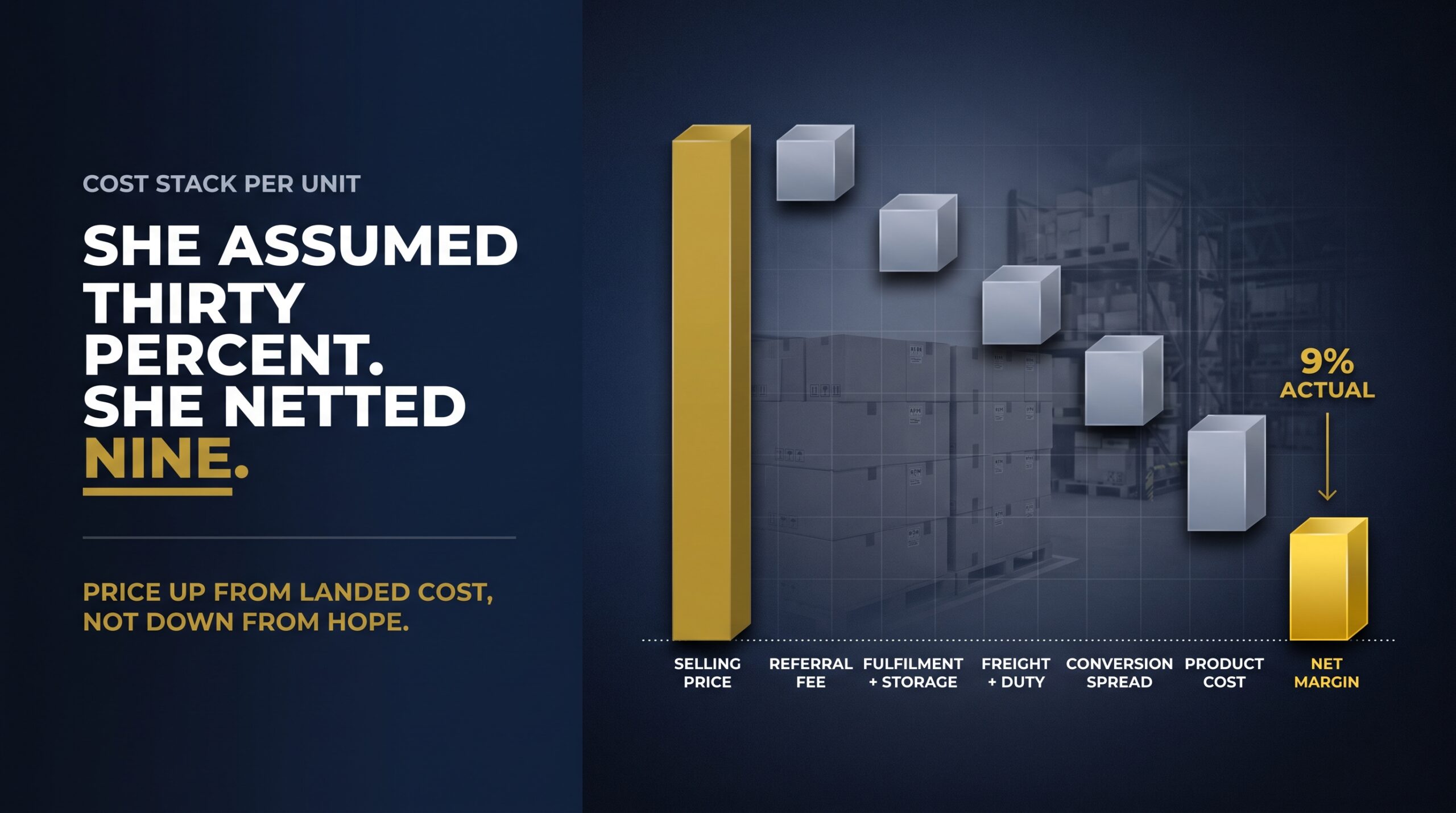
Kavita Shetty in Mangaluru priced her brass diya sets at $16.99, assumed a 30% margin, and discovered after her first settlement that she was netting 9%. Rebuilding the pricing from landed cost upward took a weekend and turned the SKU profitable within a month.
Referral fees and monthly plan charges
Amazon global selling fees for Indian sellers start with the referral fee, generally 8% to 15% of sale price depending on category, deducted on every order. Add the monthly Professional plan subscription, which pays for itself the moment you cross a modest order count.
Fulfilment, storage and shipping charges
Fulfilment fees scale with size and weight, so a well-designed carton earns money quietly. Monthly storage is charged per cubic foot and rises sharply in the last quarter. Then comes freight to the destination warehouse, customs clearance and duty — where most first-year budgets break.
Currency conversion and payment costs
Every settlement passes through a conversion, and the spread between the mid-market rate and the rate you receive is a real cost. Work a full example: selling price, minus referral, fulfilment, storage, freight and duty per unit, conversion, and product cost. Whatever remains is your actual margin.
Doing that calculation honestly separates exporters who last from those who do not, and it is one of the things we build together when you take a seat in the 3-Day Amazon Business Training.
Getting Your Money Home Without Losing It
Harpreet Singh Bhullar in Ludhiana exported hosiery for seven months before realising his bank had not closed a single shipping bill. Regularising 43 entries took him three weeks and a very patient relationship manager.
Choosing a payment route that suits you
How to get paid in USD as an Indian Amazon seller is simpler than it sounds. Receive settlements into an Indian bank account through Amazon’s currency conversion service, or hold a foreign currency collection account with an authorised payment provider and remit when the rate suits you. The second gives you timing control.
Conversion rates and what they quietly cost
Compare the rate you actually receive against the mid-market rate that day, not the headline fee. On ₹10 lakh of annual settlements, a one-percent difference in spread is ₹10,000 you never see on any invoice. Track two providers against Amazon’s rate for a month before committing.
Export documentation your bank will ask for
Your bank must link inward remittances to export invoices. Ask for a Foreign Inward Remittance Advice for each settlement, file shipping bills alongside, and make sure e-BRCs are generated so your export entries close properly on record.
Shipping, Fulfilment and Returns Across Borders
Meera Nambiar in Thrissur sold 900 ceramic mug sets in her first UK quarter, then absorbed a 7% return rate she had not priced in. Switching to a double-walled carton dropped breakage returns below 2% in ten weeks.
Self ship versus Amazon fulfilment abroad
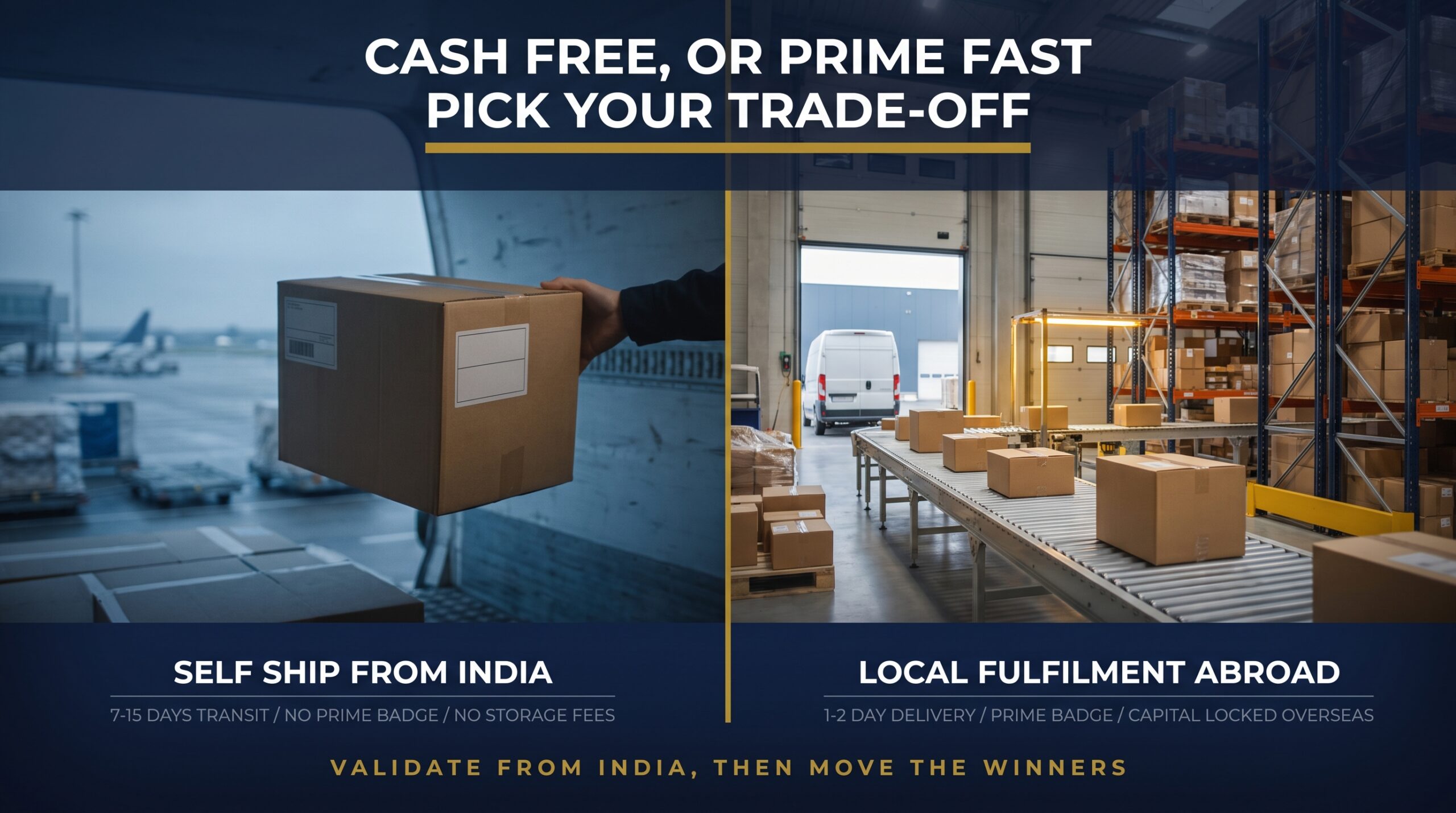
Self-shipping each order from India keeps cash free and avoids storage fees, but delivery takes a week or more and you forfeit Prime placement. Sending inventory into Amazon’s fulfilment centres abroad buys speed, the Prime badge and better conversion — at the price of capital locked up overseas.
Customs duties and who pays them
Decide this consciously. Under a delivered-duty-paid arrangement you absorb duty and the buyer sees one clean price. Leave duties unpaid and your customer faces an unpleasant demand at the door, which produces refunds and angry reviews. Build duty into your price and sleep better.
Handling returns you cannot bring back
A returned ₹1,200 item is rarely worth shipping back to India. Plan for local disposal, liquidation or a local return address. Price assuming a 5-8% return rate depending on category, and treat anything above that as a product or packaging problem to solve.
Your First Ninety Days as an Exporter
Tushar Jain in Indore launched three SKUs in the US, killed two by day sixty, and put his entire ad budget behind the survivor — a cotton yoga strap that reached 400 units a month by month five. The discipline was in the killing, not the launching.
Picking three products to test
Choose three SKUs that are light, durable, differentiated and reorderable within three weeks. Send a small quantity — enough for sixty to ninety days of expected sales, not a container. Your aim in the first quarter is information, not revenue.
Pricing for a foreign buyer, not a rupee buyer
Do not convert your Indian price. Research what comparable listings charge in that market, position against them, then work backwards to confirm your landed cost leaves a real margin. Underpricing signals low quality to buyers who associate cheapness with risk.
Reading early data before you scale
Watch session-to-order conversion, return rate, advertising cost of sale and days of cover. A SKU converting above category average with returns under 5% deserves more stock. One limping at half that conversion after 300 sessions deserves a decision, not more patience.
Frequently Asked Questions
What documents are required for Amazon Global Selling from India?
You need your PAN, a business bank account, proof of business address, identity documents for the proprietor or directors, an Import Export Code from DGFT, and an AD Code letter registered at your shipping port. GST registration applies in most cases. Add product-specific certifications the destination market demands.
Is GST registration mandatory to export through Amazon Global Selling?
In practice almost every exporter registers. Exports are zero-rated supplies, so you charge no GST to the overseas buyer while keeping input tax credit — but only registered sellers can claim it. Registration also lets you file a Letter of Undertaking. Confirm your position with a chartered accountant.
How much does Amazon Global Selling cost for an Indian seller?
Budget four layers: a referral fee of roughly 8% to 15% per sale, the monthly Professional plan subscription, fulfilment and storage if you use Amazon’s overseas warehouses, and freight plus customs duty. A conversion spread applies to every payout. Advertising is the fifth cost most sellers forget entirely.
Do I need an IEC code to sell on Amazon international marketplaces?
Yes. The Import Export Code is your licence to move goods out of India commercially, issued by DGFT against your PAN as a one-time registration. Pair it with an AD Code from your bank, registered at each port you ship through. Sellers routinely forget that port registration and stall.
How do Indian sellers receive payments in USD, GBP or AED from Amazon?
Amazon settles into a bank account in the destination currency, or converts and deposits into your Indian account. Many exporters use a foreign currency collection account from an authorised provider, holding USD, GBP or AED until the rate suits. Collect a FIRA for each remittance so entries close cleanly.
How long does it take to start selling internationally?
With IEC, AD Code, GST and bank documents already in order, registration and verification usually take one to three weeks, plus a week or two for listings and category approvals. From a standing start with no paperwork, allow six to ten weeks — mostly spent waiting on documents.
Can I sell abroad without holding stock in that country?
Yes. Fulfil each order from India, which keeps capital free and avoids overseas storage fees. The trade-off is seven to fifteen days of delivery time and no Prime badge, which hurts conversion. Many sellers validate demand this way, then move winning SKUs into local fulfilment once numbers justify it.
Which marketplace should an Indian seller start with?
The UAE suits sellers wanting short transit and lower entry costs. The UK offers strong demand for Indian handicrafts and textiles with manageable competition. The US has the largest opportunity and steepest curve. Choose where your category already sells — one profitable marketplace beats three loss-making ones.
Conclusion
Exporting works when three things line up: a product that travels well and commands a premium abroad, a margin that survives freight, duty, fees and conversion, and paperwork that lets goods and money move without friction. Most sellers have two of the three, and the weakest one decides your first year.
So be honest about it. If your product is the problem, you need a different SKU, not a different marketplace. If margin is the problem, rebuild your pricing from landed cost upward. If paperwork is the problem, that is the most fixable of the three — a fortnight of filing, not a business model change.
Work out which is yours, then come work through it inside the 3-Day Amazon Business Training with people who have already shipped.

One Response
Amaan sir
valuable informations
thank you!