

The countdown clock says four hours and forty minutes. The claimed meter sitting under your product has crawled to 18%. You booked this slot three weeks ago, picked the time yourself, and now you are refreshing Seller Central like it owes you money. Anyone who has run amazon lightning deals knows that particular cocktail of hope and buyer’s remorse that shows up the minute a deal goes live.
Here is the honest version, the one that rarely makes it into a webinar. A lightning deal is not a discount strategy. It is a paid visibility test, and like every paid test it can be brilliant or it can be an expensive way to sell stock you would have sold anyway. The difference sits entirely in three things: whether the product already has demand, whether your margin can absorb the cut, and whether you have the stock depth to finish what you start.
So let us go through it properly — what shoppers actually see, who Amazon invites, what the slot really costs once you stack the fees, the exact click path to book one, how lightning deals compare with the other promotions available to you, and the arithmetic that tells you afterwards whether the whole thing earned its keep.
How Amazon Lightning Deals Actually Work
A lightning deal is a time-boxed promotion. You commit a quantity of units at a discounted price, Amazon gives that offer a slot on its highest-traffic promotional real estate, and the whole thing usually runs somewhere between four and twelve hours before it vanishes.
What Shoppers See When a Deal Goes Live
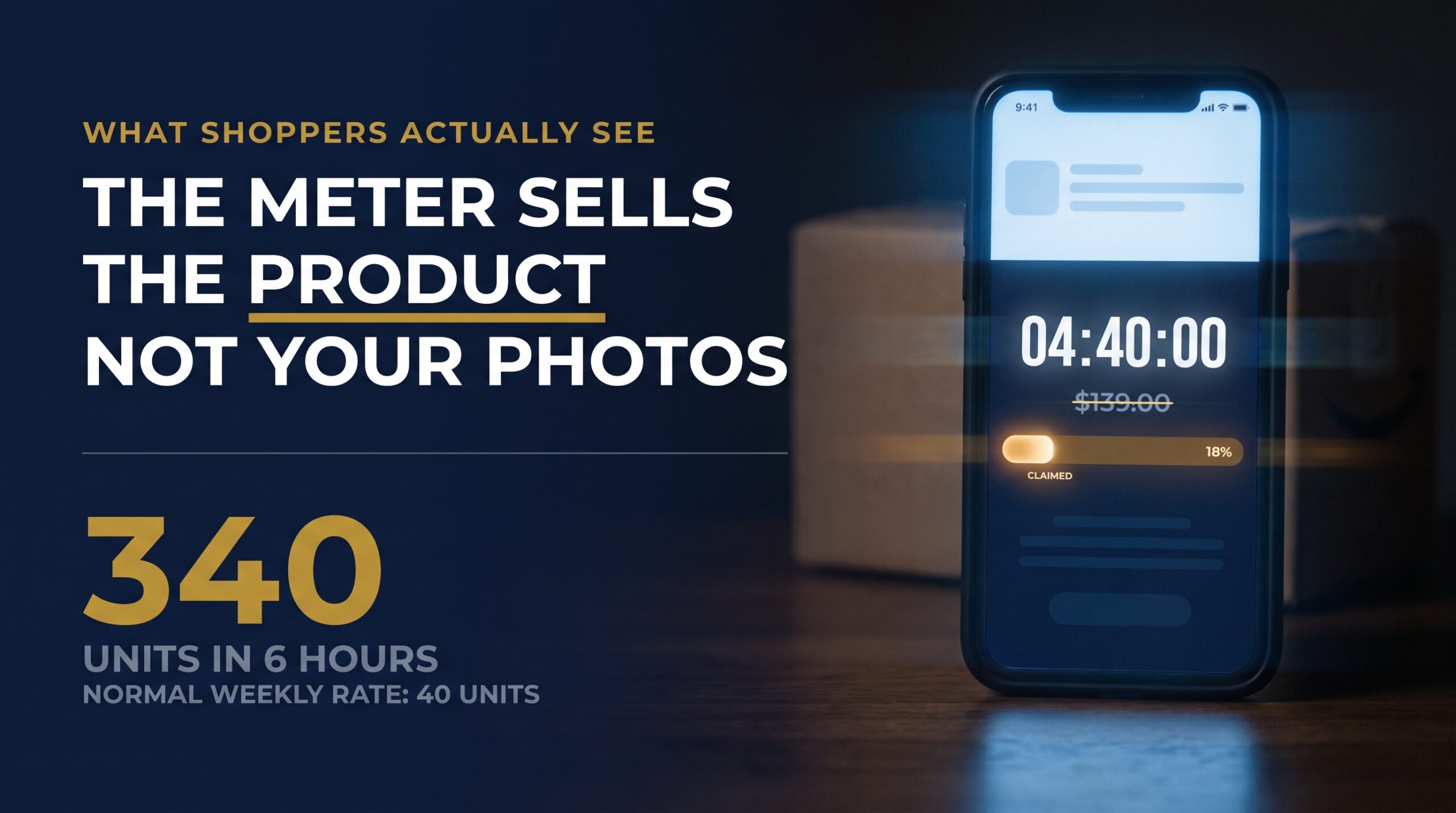
The shopper sees three things working on them at once: a ticking timer, a strike-through on your usual price, and a progress bar showing how much of the deal has been claimed. That bar does more selling than your bullet points ever will. Karthik Subramanian, who sells brass pooja diyas out of Coimbatore, ran a six-hour slot in the week before Diwali 2025 and moved 340 units against a normal weekly run rate of around 40. His read afterwards was blunt: the meter sold the lamps, not the photos.
Where Deals Appear Across Amazon.in
Your deal picks up placement on the Today’s Deals page, inside category deal rows, and in the deal carousels that appear on competitor product pages. Search results carry a deal badge for the duration, which lifts click-through rates on the same keywords you were already bidding on. App users often see it surface in notifications and the deals tab, which is where a lot of impulse buying happens in India.
Why Amazon Promotes Deals So Heavily
Amazon needs a constant supply of urgency to make its own traffic pages worth visiting. You supply the discount; Amazon supplies the eyeballs. That trade is fair, provided you remember who is paying for which half of it — which brings us to who even gets asked.
Who Gets Invited to Run a Deal
You do not simply create lightning deals on demand. Amazon recommends eligible ASINs to eligible sellers, and the lightning deal eligibility requirements sit at both levels — your account, then the specific product.
Account Health and Rating Thresholds
You need a Professional selling plan, a healthy seller feedback rating, and clean account health metrics — low pre-fulfilment cancellations, low late shipments, no policy strikes hanging over you. Consistent monthly order volume matters too, because Amazon is deciding whether you can handle a traffic spike without collapsing. A single unresolved policy violation will quietly remove recommendations you had last month, so it pays to know which metrics get you suspended before deal season starts.
What Your Product Needs to Qualify
The ASIN generally needs a decent review count, a star average of at least three, Prime-eligible fulfilment, and every variation in the parent covered by the deal rather than one lonely colour. Restricted categories are out entirely. Ritu Agarwal, a home textiles seller in Lucknow, spent six weeks getting stock into FBA for the two bedsheet sizes she had been running as merchant-fulfilled; her parent ASIN started appearing in deal recommendations the following month.
Checking Recommendations in Your Dashboard
Everything lives under Advertising, then Deals, in Seller Central. The dashboard shows recommended ASINs, the slots on offer, and the fee attached to each one before you commit to anything. Check it weekly during festival build-up, because good slots disappear fast — and the fee on them is not fixed.
What You Actually Pay for a Deal Slot
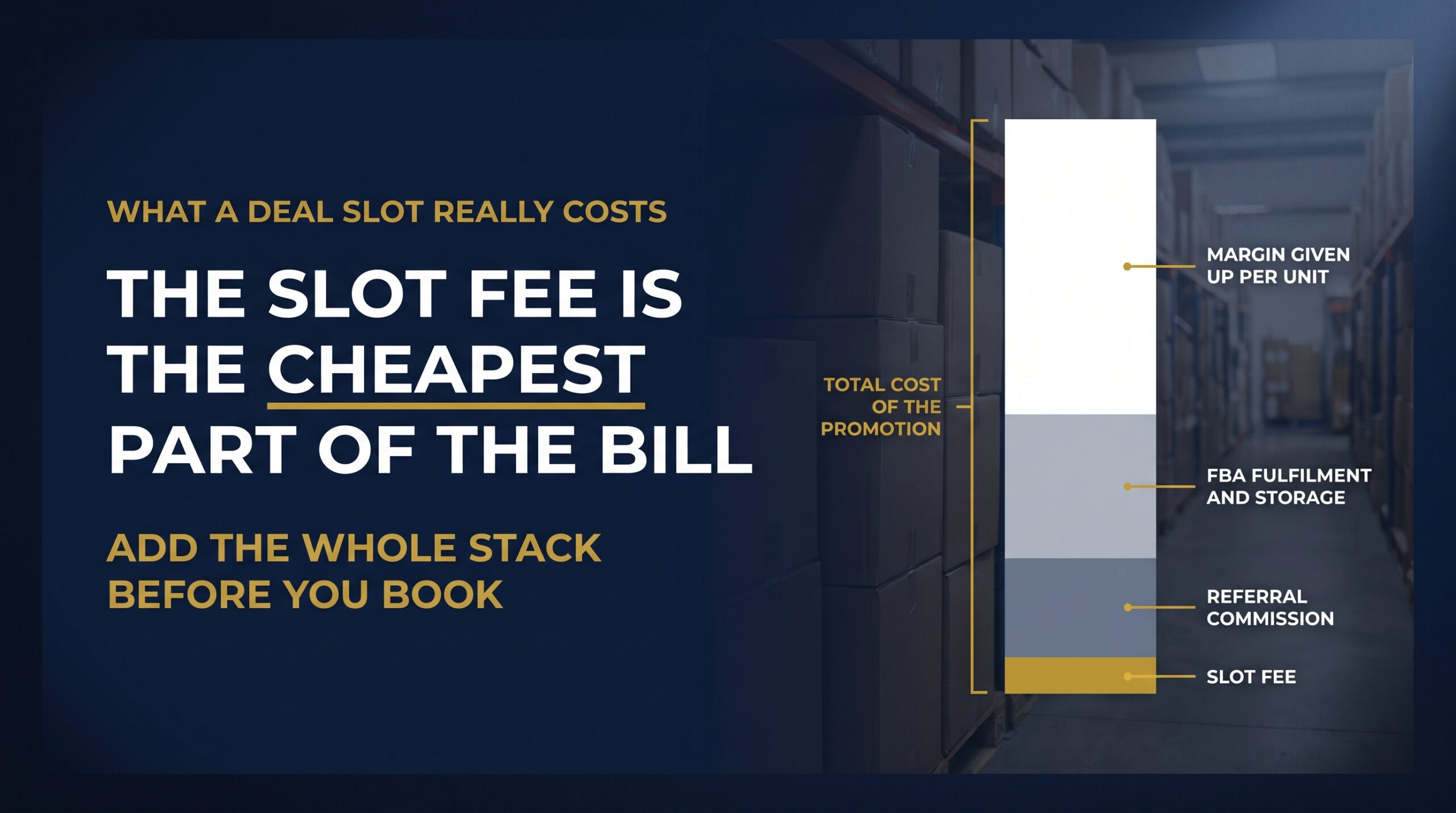
Amazon lightning deal fees start with the slot fee, charged per deal and shown to you before you submit, and that is the smallest of the three costs you are actually absorbing. Treat it as an entry ticket, not the price of the promotion.
How Slot Pricing Shifts Through the Year
An ordinary Tuesday in February is cheap. The Great Indian Festival, Prime Day and the Diwali run-up carry a clear premium, sometimes several times the off-season fee for the same product, which is why planning your festival calendar early changes what you end up paying. Sandeep Rathore, who sells laptop sleeves from Indore, compared two slots in 2025 — a quiet July Wednesday and an October event day. The October fee was roughly four times higher, but it delivered eleven times the units, so he stopped judging the fee in isolation.
Discount Depth and Price Floor Rules
Amazon sets a price ceiling for the deal, and it is usually tied to your lowest price over the previous month, so you cannot inflate the list price in September and call it a discount in October. In practice the discount lands in the 20% to 40% band. Anything shallower rarely gets approved, and if it does, shoppers scroll past it.
Costs That Sit Behind the Slot Fee
Behind that fee sit your category referral commission on the lower price, your FBA fulfilment and storage charges, the margin you hand over on every unit, and the returns that always follow a volume spike. When sellers say amazon lightning deal fees ruined their month, this stack is almost always what they mean, and it helps to have already mapped the full cost of selling on Amazon. Add them all up before you book, not after.
If working out those numbers for your own catalogue feels like guesswork right now, that is exactly the kind of thing we sit down and calculate together when you join the 3-Day Amazon Business Training — your products, your costs, your decision.
Setting Up Your First Deal Step by Step
Knowing how to create a lightning deal in seller central takes about ten minutes once you have decided which ASIN deserves the slot. The thinking takes longer than the clicking.
The path runs like this, and it is worth doing in one sitting rather than leaving a draft half-finished:
- Open Advertising, then Deals, and review the ASINs Amazon has recommended for you.
- Select your ASIN and confirm every variation you want included is showing.
- Enter your deal price and check it clears Amazon’s maximum allowed price for the slot.
- Set your committed quantity — the units reserved for the deal window.
- Pick the date and time slot from what is available, then review the fee shown.
- Submit, then check the deal status over the following days for suppression warnings.
After submission, watch for any listing suppression or stock shortfall alert, because those are the two reasons an approved deal quietly fails to run.
Picking the Right ASIN and Variations
Choose the product that already converts at full price, not the one gathering dust. Farhan Qureshi, a phone accessories seller in Hyderabad, learned this when his slow-moving car mount deal sold 22 units while his best-selling cable would have cleared hundreds.
Choosing Your Date, Time and Quantity
Pick slots that match when your buyers shop — evenings and weekends for most consumer categories. Commit a quantity that can survive the full window rather than a cautious number that empties in ninety minutes.
Submitting, Editing and Cancelling Safely
Edits and cancellations lock several days before the deal runs, so treat the submission as close to final. Cancelling inside the lock window may still leave the fee payable, which makes a rushed booking an expensive habit.
Lightning, 7-Day and Prime Exclusive Deals
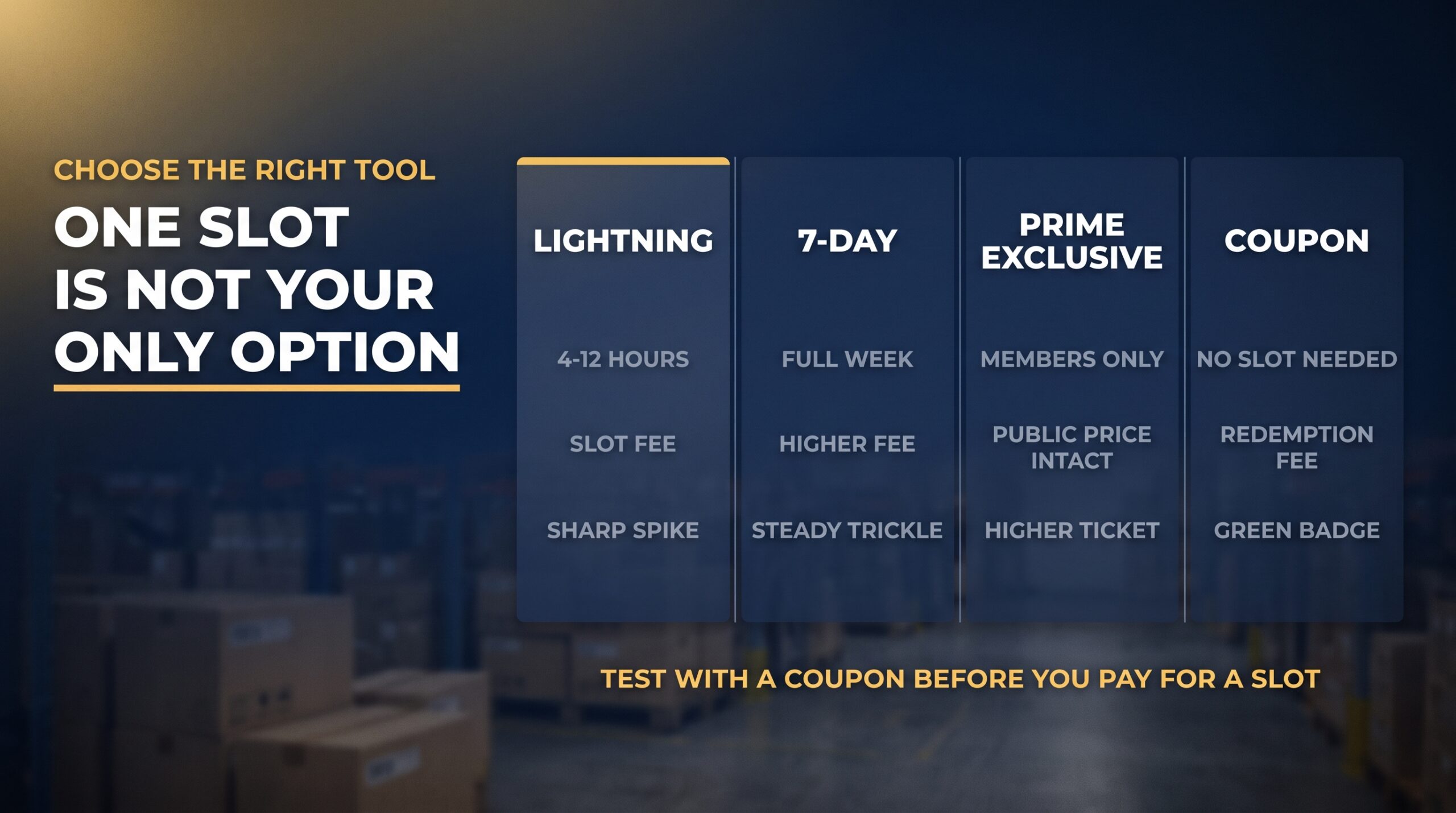
A lightning slot is one tool of several. Choosing badly here costs more than choosing badly on the time slot.
When a Week-Long Deal Works Better
The amazon 7 day deals vs lightning deals question comes down to shape of demand. A week-long deal costs more and carries a steadier trickle of sales rather than a spike, but it gives you seven days to point ads, WhatsApp broadcasts and Instagram traffic at one discounted page. Neha Kulkarni, who sells yoga props in Pune, ran a seven-day deal in January 2026 and cleared 480 units across the week with no single-day stockout — something her earlier lightning slots never managed.
Deals Built Only for Prime Members
Prime exclusive deals for sellers restrict the discount to Prime members, which keeps your public price intact while still earning badge visibility. They work hardest around Prime Day and tend to convert well on higher-ticket items, because Prime members buy more often and hesitate less.
Where Coupons and Best Deals Fit In
A coupon costs a small redemption fee, carries a green badge in search, and needs no slot at all. If your maths is thin, run the coupon first and see whether discounting even moves your conversion rate before you pay for a slot — this simple guide to coupons, deals and Prime discounts walks through the trade-offs.
Getting the Most Out of Your Deal Day
A booked slot is raw material. What surrounds it decides whether you get a one-day revenue bump or a ranking shift that pays you for weeks.
Stock Cover and FBA Cut-Off Dates
Work backwards from the deal date to the FBA inbound cut-off and add two weeks of slack for check-in delays, because inbound shipment mistakes that delay inventory are ordinary, not rare. Vikram Shetty, a stainless steel cookware seller in Mangaluru, shipped his October 2025 inventory a fortnight early after missing a slot the previous year on a shipment stuck at receiving.
Pairing Ad Spend With Your Deal Window
Lift your sponsored bids for the deal window on your best converting keywords. The deal badge improves click-through, which means the same bid buys better traffic, and the sales velocity feeds your organic rank afterwards.
Protecting Your Reference Price
Return to your full price promptly once the deal ends. Sitting at the discounted price for weeks teaches Amazon’s pricing systems, and your buyers, that the lower number is the real one.
Deal weeks reward sellers who planned in September, not sellers who reacted in October. If you want that planning done properly before this festival season, come and build it out inside the 3-Day Amazon Business Training.
Running the Numbers After the Countdown
Are amazon lightning deals worth it? Only your contribution margin can answer that, and the sum is simpler than most sellers expect.
Break-Even Maths on a Single Slot
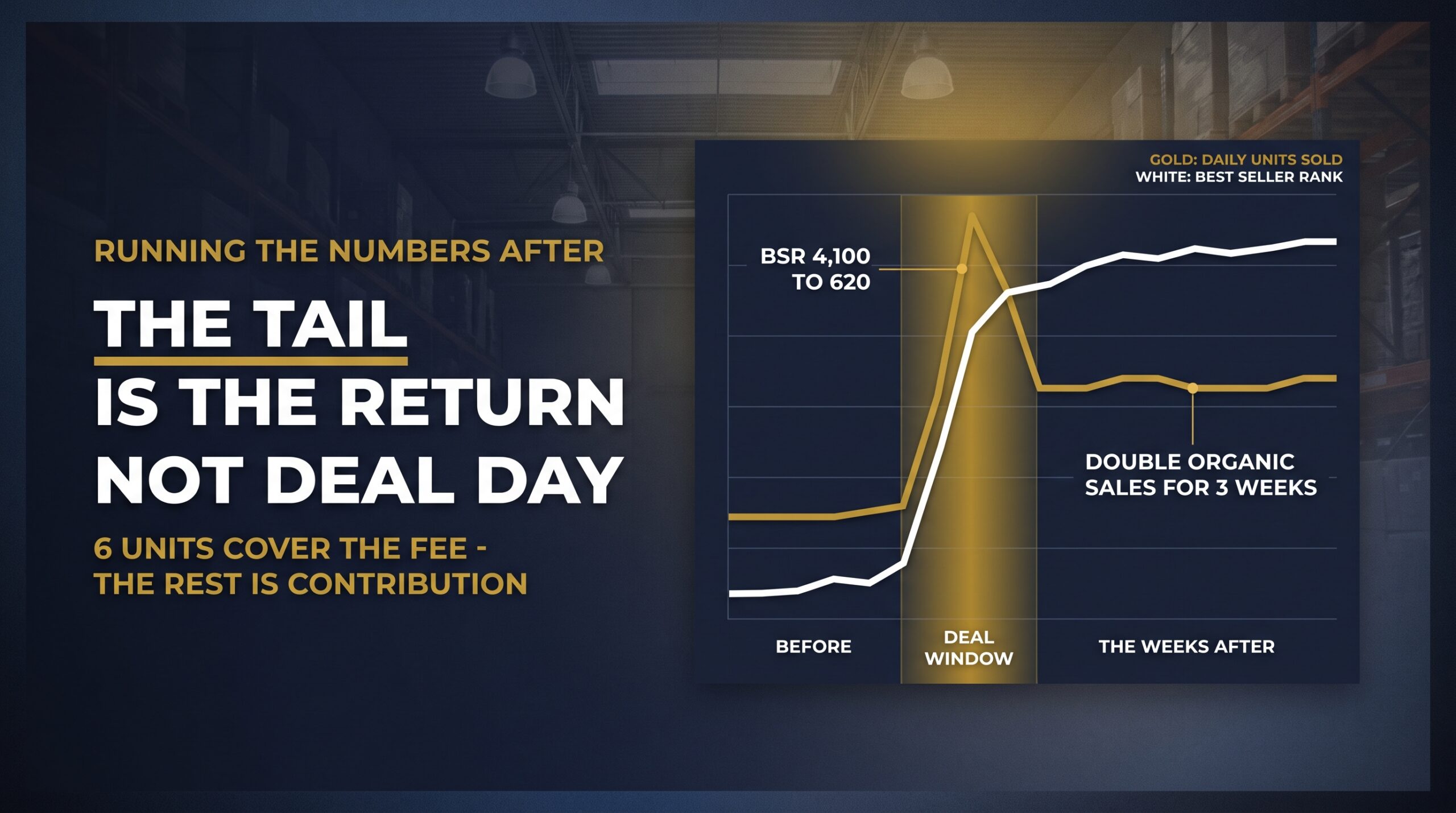
Say your product sells at ₹1,299 and your deal price is ₹909. Take off a 15% referral commission of ₹136, an FBA fee of ₹85, and a landed product cost of ₹420. You keep ₹268 per unit. If the slot fee is ₹1,500, six units cover the fee and everything after that is contribution — but knock 5% off for returns before you celebrate.
Rank Lift and the Days That Follow
The real payoff usually arrives in the week after. Anjali Deshmukh, who sells cotton kurtis from Nagpur, watched her best seller rank move from around 4,100 to 620 in her subcategory after a November 2025 deal, and held roughly double her old organic sales for three weeks at full price. That tail is the return, not the deal-day revenue.
When to Skip the Slot Entirely
Skip it when your contribution at the deal price is near zero, when you have under two weeks of stock cover, or when the ASIN has fewer than about twenty reviews. Discounting an unproven listing just buys you cheap traffic that does not convert.
Mistakes That Quietly Kill Deal Results
None of these look like mistakes while you are making them. They look like caution, or ambition, or momentum.
Discounting Something Nobody Searches For
A discount amplifies existing demand; it does not create it. Imran Shaikh, a kitchen gadget seller in Bhopal, discounted a garlic press with 30 monthly searches and sold 14 units against a slot fee he never recovered — then reran the same budget on his peeler and cleared 210.
Selling Out Two Hours In
Under-committing quantity ends your deal early, cuts your placement short, and wastes the fee you paid for a full window. Commit generously; unsold units simply return to normal inventory.
Turning Deals Into a Monthly Habit
Run deals on the same ASIN every few weeks and your repeat buyers learn to wait. Quarterly, timed to real demand peaks, keeps the discount meaningful and your full-price sales intact.
Frequently Asked Questions
What are Amazon Lightning Deals and how do they work?
They are time-boxed flash promotions on a single ASIN. You commit a quantity at a discounted price, Amazon places the offer on Today’s Deals and adds a badge in search results, and shoppers see a countdown timer alongside a meter showing how much has been claimed. The deal ends when the clock runs out or your committed quantity sells through, whichever happens first.
Who is eligible to run Amazon Lightning Deals?
You need a Professional selling plan, healthy account metrics, steady order volume and good seller feedback. The product side needs a reasonable review count, a rating of at least three stars, Prime-eligible fulfilment and all variations included in the deal. Restricted categories are excluded. Amazon surfaces qualifying ASINs as recommendations in the Deals dashboard rather than letting you nominate anything you like.
How much does an Amazon Lightning Deal cost?
Amazon lightning deal fees vary by date and demand, and the slot fee is displayed before you submit, so you always know the number in advance. Ordinary weekdays are inexpensive; festival and event weeks carry a significant premium. The fee is the smallest cost, though — the referral commission on the lower price, fulfilment charges and the margin you give up per unit usually add up to far more.
How long does an Amazon Lightning Deal run?
Most run between four and twelve hours, with the specific window shown when you pick your slot. The deal can finish sooner if your committed quantity sells out, which is why an under-committed quantity wastes the placement you paid for. If you want a longer runway, a seven-day deal keeps the discount and the badge live for a full week instead.
Are Amazon Lightning Deals worth it for small sellers?
They are, when three conditions hold: the ASIN already sells at full price, your contribution margin survives the discount, and you have at least a few weeks of stock cover. A small seller with one proven product and deep stock often gets more from a deal than a large seller spreading discounts thinly. With an unproven listing, spend the money on ads and reviews first.
Can I cancel a Lightning Deal after Amazon approves it?
You can, but only up to the cut-off, which falls several days before the scheduled window. Once editing locks, the price, quantity and timing are fixed, and cancelling late can still leave you liable for the fee. Treat submission as a commitment and confirm your inventory position before you click, rather than planning to adjust things later.
Do Lightning Deals work for FBM sellers in India?
Prime-eligible fulfilment is part of the eligibility picture, so your listing needs to carry Prime delivery for the deal to qualify. FBA is the straightforward route there, and it also removes the risk of you personally packing a few hundred orders overnight. If you fulfil your own orders, look at whether your account qualifies for a Prime-eligible seller-fulfilled programme.
How often should I run deals on the same ASIN?
Roughly once a quarter, timed to genuine demand peaks like festival weeks or category seasons. More often than that and your regular buyers start postponing purchases until the next markdown, which erodes the full-price sales the deal was supposed to protect. Between deals, use coupons or ad spend to keep velocity up without resetting your reference price.
Conclusion
Strip away the drama and a lightning deal is a rented spotlight. You pay a slot fee, hand over some margin, and Amazon points a very large amount of traffic at one product for a few hours. The spotlight only pays for itself when there is something worth looking at behind it — proven demand, margin headroom and enough stock to last the whole window.
So before this festival season, do the unglamorous part. Pick your two best converting ASINs, run the contribution maths at a 30% discount against the full stack of amazon lightning deal fees, check your FBA inbound timelines, and book only the slots that survive that test.
If you would rather work through those numbers with someone who has seen hundreds of deal cycles, bring your catalogue and take a seat at the 3-Day Amazon Business Training.
