
Last November, Kunal Sharma from Nagpur logged into his Amazon Seller Central dashboard and noticed something unexpected. His ethnic kurta line was doing well on Amazon, pulling in steady orders at an average price of Rs 1,200 per piece. But his cheaper, unbranded cotton kurtas priced under Rs 400 were barely moving. A friend suggested listing those budget products on Meesho. Within three weeks, Kunal was selling 80 units a day of those same kurtas on Meesho, to a completely different set of buyers from tier-3 towns he had never reached before. His Amazon store stayed untouched. No cannibalisation. Just two platforms, two audiences, and a wider net.
If you want to sell on Meesho and Amazon together, you are thinking in the right direction. But the approach matters more than the idea. This guide walks you through how to set up a multi-platform selling strategy for India, with Amazon as your core business and Meesho as your volume channel.
Why Indian Sellers Are Adding Meesho to Their Amazon Business
The Audience Split — Who Shops Where
The customers on Amazon and Meesho are not the same people. Amazon attracts urban, brand-aware buyers with higher spending power. The average order value on Amazon India hovers around Rs 1,850, while Meesho's average sits closer to Rs 400. Amazon shoppers search for specific products, read reviews, and compare features. Meesho shoppers scroll through affordable options and buy on impulse, often through social media links shared by friends.
Geetanjali from Coimbatore discovered this firsthand when she started selling handmade jute bags. On Amazon, her premium bags priced at Rs 800 sold consistently to metro buyers. But her simpler designs at Rs 250 found a much larger audience on Meesho, particularly from smaller towns in Madhya Pradesh and Rajasthan. She was not splitting her sales. She was reaching two markets that would never have overlapped.
What Meesho Offers That Amazon Does Not
Meesho removes several barriers that stop small sellers from going online. There is no commission on sales, no mandatory GST registration for turnover under Rs 40 lakhs, and the onboarding takes minutes. For sellers with budget products aimed at price-sensitive buyers in tier-2 and tier-3 cities, Meesho opens a door that Amazon's structure keeps partially closed.
Why Amazon Remains the Stronger Foundation
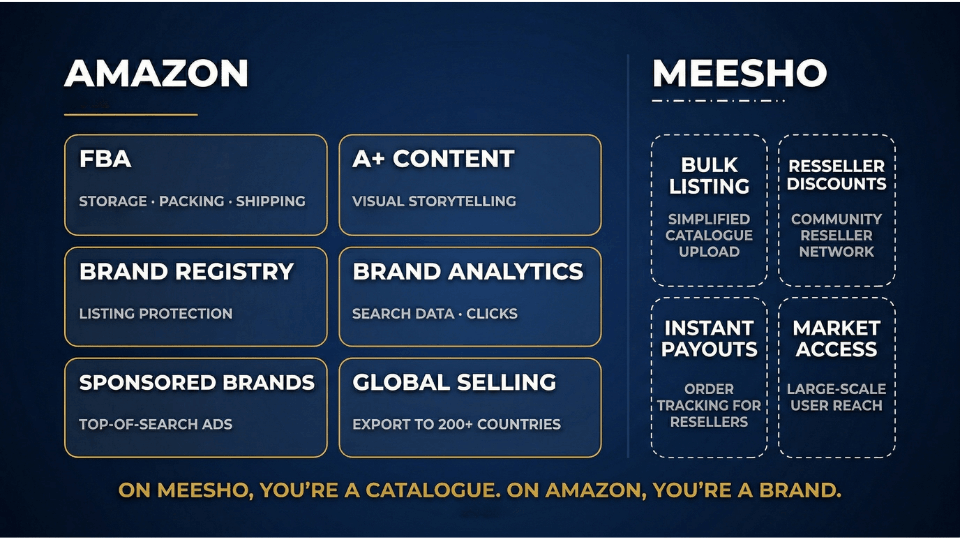
Those Meesho advantages sound attractive, but they come with a trade-off. Meesho gives you reach. Amazon gives you a business. The difference is significant. Amazon offers Fulfilment by Amazon, the Prime badge, A+ Content, Brand Registry, Brand Analytics, Sponsored Brands, and the ability to sell globally through Amazon Global Selling. None of these exist on Meesho. If you want to build a brand that customers recognise, trust, and return to, Amazon is the only platform in India that gives you the full toolkit to build a strong brand.
The sellers who succeed long-term are the ones who treat Amazon as their foundation and use Meesho to supplement volume on the side.

Can You Sell the Same Product on Meesho and Amazon?
The Short Answer — Yes, With Conditions
You can legally list the same product on both Meesho and Amazon. There is no rule stopping you from multi-platform selling in India. But “legal” and “smart” are two different things. Amazon has pricing parity expectations and strict listing quality standards. If your Meesho price is significantly lower for the same product, it can trigger issues on Amazon's side. Rohit Roy from Ahmedabad learned this the hard way when he listed identical phone cases at Rs 199 on Meesho and Rs 349 on Amazon. A customer screenshot led to a pricing complaint that temporarily flagged his Amazon listing.
The fix is simple. Either differentiate the product slightly across platforms through packaging, bundles, or variants, or maintain pricing that does not create obvious conflicts.
Products That Work on Both vs Products That Don't
Not every product belongs on both platforms. Budget fashion, ethnic wear, home decor, and kitchen essentials work well across Meesho and Amazon because the buyer expectation differs by platform. But branded, premium, or niche products perform far better exclusively on Amazon, where customers are willing to pay for quality and trust the platform's buyer protection. If you are still deciding what to sell, our guide on selecting a winning Amazon product can help you think through category fit.
Think of it this way. Your highest-margin products stay on Amazon. Your volume-clearance and budget lines go to Meesho. You are not choosing between the two. You are assigning each product to the platform where it performs best.
How Amazon Gives You an Edge That Meesho Cannot Match
FBA, Prime Badge, and Logistics You Can Trust
Fulfilment by Amazon handles storage, packing, shipping, and returns. You send your inventory to an Amazon warehouse, and they handle everything from there. The Prime badge alone can lift your conversion rate by 20-30 percent because customers trust two-day delivery. Meesho relies on third-party logistics with longer delivery windows, and sellers frequently report return-to-origin rates above 25 percent. If you are weighing your fulfilment options, our breakdown of Amazon Easy Ship vs FBA vs Self-Ship covers what works at each stage of growth.
Anita Deshmukh from Nagpur switched her best-selling kitchen organiser from self-fulfilment to FBA last August. Her daily orders went from 12 to 31 within a month, and her return rate dropped from 18 percent to 7 percent. That reliability does not exist on Meesho yet.
Brand Building Tools Only Amazon Offers
Amazon is the only Indian marketplace that lets you build a genuine brand presence online. A+ Content turns your product page into a visual story with comparison charts and lifestyle images. Brand Registry protects your listings from hijackers and counterfeiters. Brand Analytics shows you exactly what customers search for and where they click. Sponsored Brands puts your logo at the top of search results. Amazon Stores gives you a dedicated brand page that looks like a mini-website.
Meesho has none of this. On Meesho, you are a catalogue. On Amazon, you are a brand.
Amazon Global Selling — Take Your Products Worldwide
Here is something Meesho will never offer you. Amazon Global Selling lets you export your products to the US, UK, UAE, and over 200 countries from your Indian seller account. Meesho is India-only with no international roadmap. Arjun Mehta from Jaipur started selling block-printed textiles on Amazon India. Six months later, he expanded to Amazon US and UK through Global Selling. His international orders now account for 40 percent of his monthly revenue. That growth path does not exist on any other Indian platform. For a deeper look at this, check out our guide on leveraging Amazon Global Selling.
If you are serious about building a multi-platform ecommerce business with Amazon at the centre, the 3-Day Amazon Business Training by Aman covers exactly how to leverage FBA, Brand Registry, and Global Selling to build a business that scales beyond one marketplace.
The Real Cost Breakdown — Meesho vs Amazon Fees
Meesho's 0% Commission — What It Really Means
Zero commission sounds like a dream until you look at the full picture. Meesho does not charge referral fees, but you still pay for shipping, and those costs add up quickly on low-priced items. Meesho Ads are becoming essential for visibility as competition grows. And then there is the return problem. Sellers across forums consistently report return rates of 30-50 percent on fashion categories, with many citing used products being returned without proper compensation. On a Rs 300 kurta, one return can wipe out the profit from three successful sales.
Amazon's Fee Structure — Higher Cost, Higher Returns
Amazon charges referral fees ranging from 5 to 17 percent depending on the category, plus FBA fees if you use fulfilment services. On a product selling at Rs 1,000, you might net Rs 650-750 after all costs. That sounds steep until you compare the quality of the outcome. Amazon buyers have higher average order values, lower return rates, and stronger repeat purchase behaviour. For a complete look at how Amazon fees work, our guide on understanding Amazon fees breaks down every charge.
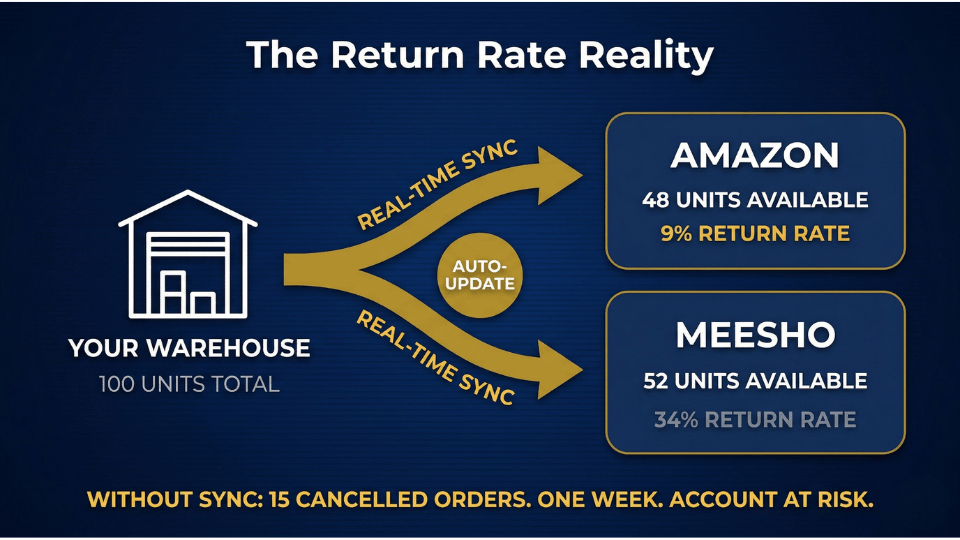
Sunita Rao from Hyderabad sells the same stainless steel kitchen set on both platforms. Her Amazon listing at Rs 899 gives her Rs 210 profit per unit with a 9 percent return rate. Her Meesho listing at Rs 549 gives her Rs 85 profit per unit with a 34 percent return rate. The math tells the story. Higher Amazon fees still lead to better per-unit profitability when the customer quality and return rate difference are factored in.
How to Manage Inventory Across Both Platforms
The Overselling Trap and How to Avoid It
The moment you list the same stock on two platforms without a sync system, you are walking into a trap. Imagine you have 50 units listed on both Amazon and Meesho. Both platforms sell 30 units in a day. You now owe 60 units but only have 50. The result is cancelled orders, penalties on Amazon, and a hit to your account health metrics. Amazon takes account health seriously. A spike in cancellations can trigger warnings or suspension.
Manoj Tiwari from Indore faced exactly this last Diwali. He was selling decorative diyas on both platforms without inventory sync. Fifteen orders got cancelled on Amazon in one week, and his account health dropped to critical.
Tools for Multi-Channel Inventory Sync
Once you cross 30-50 orders per day across platforms, manual tracking stops working. Unicommerce integrates with Meesho, Amazon, and Flipkart to sync stock in real time, priced between Rs 3,000 and Rs 8,000 per month. Zoho Inventory offers a lighter option at Rs 1,500-6,000 per month. Rekonsile focuses on payment reconciliation and RTO tracking across marketplaces.
The principle is non-negotiable. If you sell on multiple platforms, your inventory must update automatically across all of them.
If you want a structured framework for setting up multi-channel operations without the operational chaos, the 3-Day Amazon Business Training covers inventory planning, platform management, and scaling strategies that work across marketplaces.
A Practical Multi-Platform Strategy That Puts Amazon First
Start With Amazon, Expand to Meesho
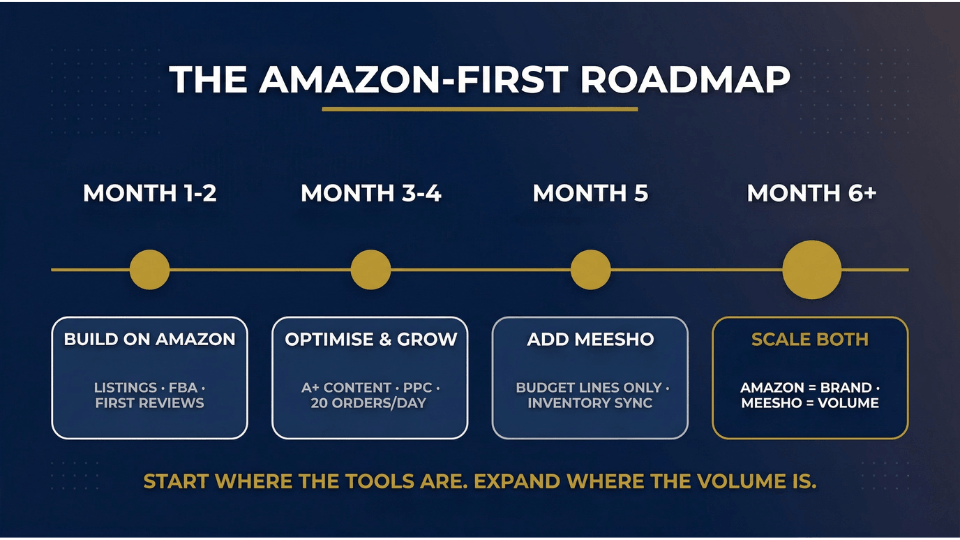
The biggest mistake sellers make is starting on Meesho because it is easier and then trying to move to Amazon later. It should be the other way around. Build your brand on Amazon first. Perfect your listings, establish a reliable supply chain, get your FBA operations running smoothly, and build a review base that gives customers confidence. Once your Amazon business is stable and profitable, duplicate your budget product lines to Meesho for incremental volume.
Priya Menon from Kochi followed this exact sequence. She spent four months building her organic skincare brand on Amazon, getting her A+ Content right, earning 150 reviews, and hitting 20 orders a day. Only then did she list her entry-level face wash on Meesho at a lower price point. Meesho added 35 extra daily orders without disrupting her Amazon operations at all.
What to Sell Where — A Category Playbook
Think of your product catalogue as a tiered system. Your premium, branded products with strong margins belong exclusively on Amazon, where buyers pay for quality and the platform protects your brand. Budget fashion, ethnic wear, home decor, and kitchen essentials work across both platforms, where different audiences buy at different price points. Generic, unbranded clearance stock is ideal for Meesho, where zero commission and price-sensitive buyers work in your favour.
The key principle is this. Never put your best-margin products on Meesho. Keep them on Amazon where the ecosystem supports brand value.
Pricing Strategy Without Cannibalising Yourself
Pricing across two platforms requires care. Amazon watches for pricing inconsistencies, and undercutting yourself on Meesho can create problems. The cleanest approach is to differentiate by variant. Sell a 250ml bottle on Amazon and a 200ml version on Meesho. Offer a combo pack on one platform and single units on the other. This way, the products are technically different, and no direct price comparison triggers complaints. Ramesh Choudhary from Surat uses this method for his cotton bedsheet business. His Amazon listing is a three-piece set at Rs 1,299. His Meesho listing is a single bedsheet at Rs 449. Same factory, same fabric, no conflict.
FAQ — Selling on Meesho and Amazon Together
Can I sell the same product on Meesho and Amazon at the same time?
Yes. There is no legal restriction on listing the same product across multiple platforms in India. Differentiate by variant, bundle, or packaging to avoid pricing conflicts. Keep your inventory synced to prevent overselling and ensure your Amazon listing quality stays high.
What is the difference between selling on Meesho and selling on Amazon?
Amazon offers brand-building tools like FBA, A+ Content, Brand Registry, and Global Selling, attracting higher-spending urban buyers. Meesho charges zero commission and targets price-sensitive buyers in tier-2 and tier-3 cities. Amazon builds your brand long-term. Meesho gives you volume on budget products.
How do I manage inventory across Meesho and Amazon?
Use a multi-channel inventory tool like Unicommerce, Zoho Inventory, or Rekonsile to sync stock across platforms in real time. This prevents overselling and cancelled orders. Manual tracking works for small volumes, but automated sync becomes essential once you cross 30-50 daily orders.
Is it legal to sell on multiple ecommerce platforms in India?
Absolutely. Indian law does not restrict sellers from listing on multiple marketplaces. You need valid GST registration for Amazon, though Meesho allows selling without GST for turnover under Rs 40 lakhs. Ensure your tax filings account for revenue from all platforms.
Which platform is more profitable for Indian sellers — Meesho or Amazon?
Amazon is generally more profitable per unit despite higher fees. Amazon buyers spend more, return less, and buy repeatedly. Meesho's zero commission is offset by high return rates and lower order values. Most multi-platform sellers report better net margins on Amazon.
Do I need GST registration to sell on both Meesho and Amazon?
Amazon requires GST for most categories. Meesho allows non-GST sellers with turnover below Rs 40 lakhs, though deliveries are limited to within your state. Getting GST registered upfront simplifies operations and unlocks nationwide delivery on Meesho as well.
Can I use Amazon FBA for Meesho orders?
No. FBA inventory can only fulfil Amazon orders. You cannot ship FBA stock to Meesho customers. Maintain separate inventory, one batch in FBA warehouses for Amazon and another at your location for Meesho fulfilment.
Should I start selling on Meesho or Amazon first?
Start with Amazon. It has a steeper learning curve but gives you tools to build a sustainable brand. Once your Amazon operations are profitable, add Meesho for budget product lines. Starting on Meesho first creates habits that are hard to scale on Amazon later.
Conclusion
Selling on Meesho and Amazon together is not about choosing one over the other. It is about understanding what each platform does best and assigning your products accordingly. Amazon is where you build your brand, earn trust, access global markets, and create long-term profitability. Meesho is where you push volume on budget products to an audience Amazon does not fully reach. The sellers who get this right treat Amazon as their business and Meesho as a channel.
If you want a step-by-step system for building a multi-platform ecommerce business with Amazon as your foundation, the 3-Day Amazon Business Training by Aman gives you the frameworks, strategies, and operational playbooks you need. Your next customer is already searching. Make sure you are on the right platform to greet them.
