
Vignesh Sundaram from Madurai learned about BIS certification for Amazon the expensive way. Earlier this year he found what looked like the perfect first product: vacuum-insulated steel bottles, a supplier quoting ₹340 a piece, and a category full of buyers. He paid about ₹2 lakh for 600 units, created his FBA shipment and watched the stock check in at the fulfilment centre. Two days later, the listing stopped and asked for his BIS licence details.
His supplier had sent a certificate weeks earlier, so Vignesh forwarded it. It turned out to be issued to the factory’s own brand, not his. For the next eleven weeks his bottles sat on a shelf, earning nothing and adding storage fees every month.
Vignesh did nothing shady. He simply checked compliance after buying the stock instead of before. In a regulated category, that order of operations is the most expensive mistake a new seller can make.
This guide fixes the order, ending with a 10-minute check to run before you pay any supplier a single rupee.
Why BIS Certification for Amazon Starts Before Sourcing
BIS certification is the Bureau of Indian Standards’ proof that a product meets an Indian Standard. For a long and growing list of products it is the law, and Amazon is the last place you want to find that out.
What does a BIS certificate actually prove?
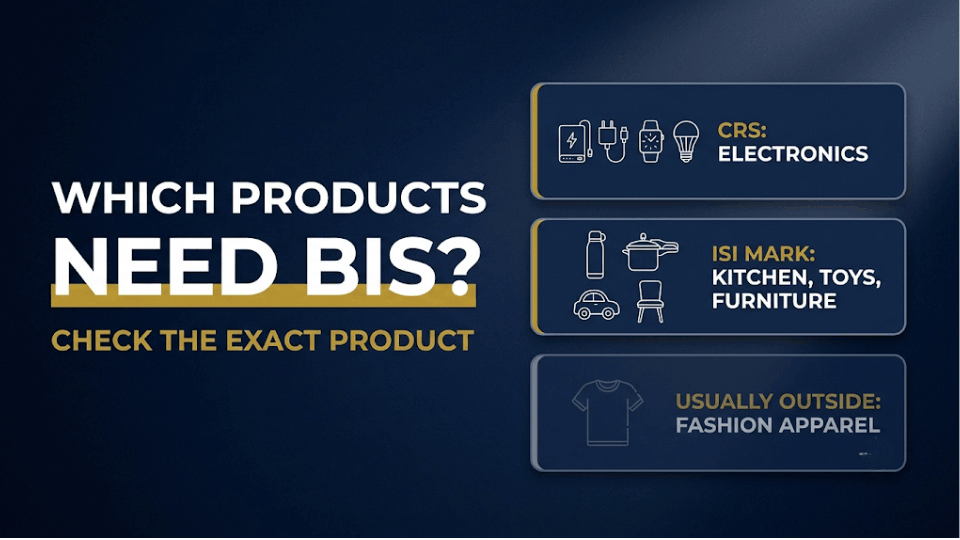
You will meet two forms as a seller. Most regulated goods, from steel bottles to toys, carry the ISI mark with a licence number (the CM/L number) printed beside it. Electronics such as power banks and chargers fall under the Compulsory Registration Scheme, where the product carries the BIS Standard Mark with a registration number that starts with R. Either way, the certificate covers a specific manufacturer, product, models and brands. It does not travel with the factory.
What happens to uncertified stock in an FBA warehouse?
Once a product is regulated, the BIS Act bans importing, storing and displaying it for sale without a licence, not just selling it. That matters because FBA stock lives in exactly the warehouses BIS inspects. In 2025, BIS raids on Amazon warehouses in Lucknow, Gurugram, Delhi and near Chennai seized toys, hand blenders, metallic water bottles, insulated flasks and ceiling fans without valid certification. The government made it clear that marketplaces are not exempt.
FBA is not the problem here. Uncertified stock is. When a listing is blocked after inbound, your inventory is stranded, storage fees keep running, and your only choices are to certify, remove or dispose. Vignesh eventually paid to remove his bottles and sold them offline at a loss.
Is BIS Certification Mandatory for Every Product?
No. By default, BIS certification is voluntary in India. A product becomes compulsory only when the government notifies it, usually through a Quality Control Order or, for electronics, by adding it to the Compulsory Registration Scheme list. So the honest answer to “is BIS certification mandatory?” is: only if your exact product is named.
When BIS is voluntary, and when a QCO changes that
A Quality Control Order (QCO) names a product, the Indian Standard it must meet and the date the rule starts. From that date, nobody can manufacture, import, store or sell that product without a valid BIS licence, whether they sell on Amazon, Flipkart, their own website or a shop counter. Small and micro enterprises sometimes get extra months, but the rule eventually covers everyone, including you.
Products that usually don’t need BIS
Large parts of the catalogue sit outside the regime; regular fashion apparel, for example, needs no BIS certification. Imran Shaikh from Nagpur has sold printed cotton bedsheets for two years without ever needing a licence. Last month he nearly added insulated tiffin boxes as a bundle deal. A quick check showed insulated food containers fall under a QCO, so his “easy add-on” would have needed certification of its own.
Check the specific product, not the category it feels like.
To make this check fast, grab our BIS Pre-Sourcing Checklist. It lists the questions to answer before you request a single quote.
Which Products Require BIS Certification on Amazon?
Which products require BIS certification? BIS reports more than 1,437 product categories under mandatory compliance, and 125 products were added in 2025 alone. For Amazon sellers, the risk clusters in a few places.
BIS certification for electronic products
Electronics are the biggest trap for beginners. Power banks, chargers, adapters, smartwatches, LED lights, speakers and many other gadgets fall under the Compulsory Registration Scheme, and every model must be registered separately. Amazon and Flipkart now ask for BIS details on power bank listings as standard. Ritika Agarwal from Indore had shortlisted a ₹1,299 smartwatch until she realised registration and testing would cost more than her entire first order. She switched to silicone watch straps and launched three weeks later.
Kitchen, home, toys and furniture under the ISI mark
Outside electronics, the ISI mark covers a long list of everyday Amazon products: insulated flasks and bottles, stainless steel and aluminium cookware, aluminium foil, pressure cookers, toys, many types of footwear, helmets and, since February 2026, a range of furniture. Electrical appliances are joining them, as the next section explains.
Where to find the mandatory BIS certification list
The only list worth trusting is the official one on the BIS website, which shows products under compulsory certification and the separate CRS list for electronics. Consultancy blogs can lag behind new notifications by weeks. If a product name is vague, match the Indian Standard number in the QCO instead.
Quality Control Orders: The List That Keeps Moving
You may have read that the government is scrapping Quality Control Orders. That is true, and misleading if you sell finished products.
Why the QCO rollback headlines don’t cover you
Since late 2025, the government has withdrawn dozens of QCOs after a NITI Aayog review flagged their cost to small manufacturers. But the withdrawn orders were mostly on raw materials and industrial inputs such as polyester fibre, polypropylene, PVC and certain chemicals. Sandeep Nair from Thiruvananthapuram read the rollback headlines and assumed his stainless steel cookware was now free of BIS rules. It was not. The cookware and utensils order was actually reissued in 2026, and his supplier’s expired licence nearly cost him a full container.
What’s been added for finished goods in 2026
While inputs were freed, finished consumer goods kept being added. A new electrical appliances order covers more than 90 categories of household and commercial appliances and took effect on 1 October 2026 for larger and foreign manufacturers, with later dates for small and micro units. New 2026 orders also cover aluminium products and cookware, and furniture rules began in February. A Transition Facilitation Order issued in June 2026 gives some manufacturers temporary sourcing flexibility, but covered products must still carry the ISI mark. It is not a waiver.
Treat the list as a moving target and check it on the day you source.
The 10-Minute BIS Check Before You Place an Order
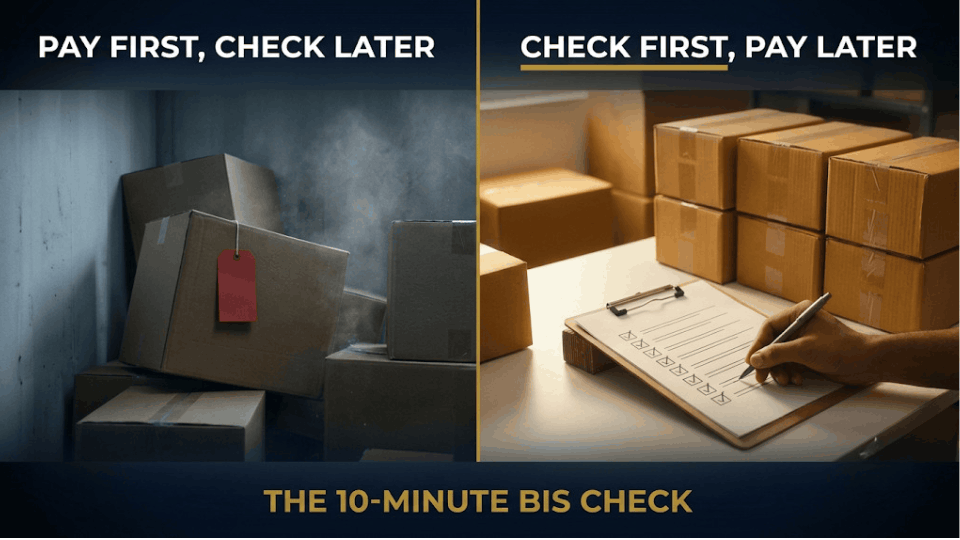
It all comes down to one habit: check before you pay. Run this on every shortlisted product before requesting samples.
Step-by-step: the pre-sourcing BIS check
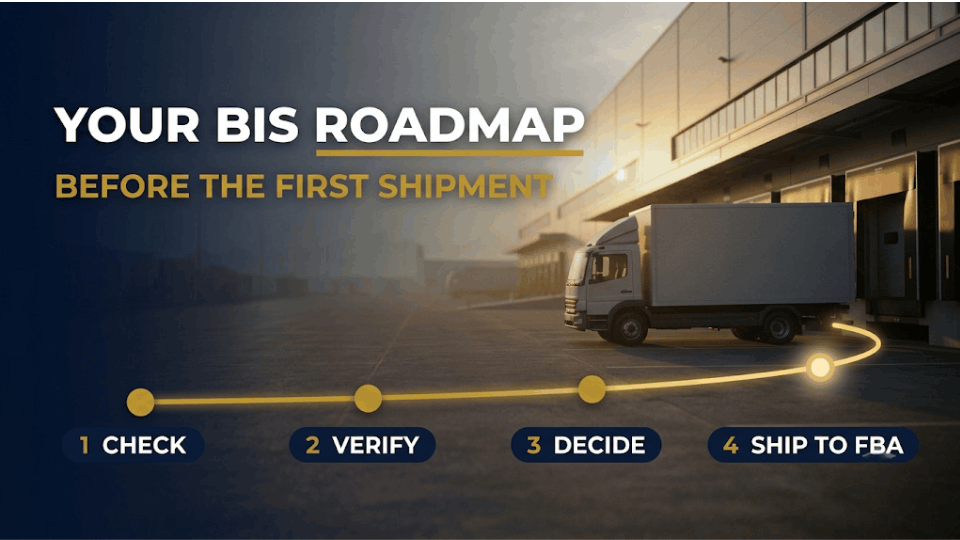
Work through these in order:
- Note the exact product, material and power source, because a battery or steel body can change the answer.
- Search the official BIS lists for that product and note its Indian Standard number.
- Check for QCOs notified but not yet in force, since a product free today may be regulated when your stock lands.
- Ask the supplier for a copy of their BIS licence or CRS registration and their latest test report.
- Verify the licence number yourself, and confirm the exact model and the brand you will sell under both appear on it.
- If certification is needed, get a written cost and timeline quote before committing.
- Confirm your Amazon listing and compliance details are accepted before you create the FBA shipment.
Any doubt? Pause the order. A week’s delay costs less than eleven weeks of stranded stock.
How to do a BIS certification check online
A BIS certification check online takes two minutes: search the licence or R-number on the BIS website, or verify it in the BIS Care app. Harpreet Kaur from Ludhiana did this for a power bank supplier in Shenzhen and found the R-number was genuine but registered to a different model. She caught it before paying the 70% balance.
Can you use your manufacturer’s BIS certificate?
Usually not. A reply on Amazon’s own seller forum states that an OEM’s BIS certificate cannot be used for your branded products, even with an authorisation letter. Ask the factory early how your brand will be covered.
BIS Certification Cost in India and How Long It Takes
BIS certification cost in India depends on the scheme, the number of models and where the factory is.
BIS CRS registration vs ISI mark vs FMCS
BIS CRS registration applies to listed electronics. It needs lab testing in India but no factory inspection. The ISI mark applies to most other regulated goods and involves a factory inspection. If an ISI-mark product is made overseas, the factory goes through the Foreign Manufacturers Certification Scheme, where BIS officials inspect the foreign plant, adding cost and time.
What it really costs and how long it takes
Consultants put a realistic total for most products between ₹60,000 and ₹1,80,000, covering government fees, lab testing and their own charges. After testing, CRS approval often takes 15 to 30 days, while ISI approval typically takes 30 to 45 days once the factory inspection goes smoothly. Lab queues can add weeks on top. CRS registrations last two years before renewal.
Does the maths work on your first product?
Divide the cost by your first order. Nikhil Deshpande from Nashik spent about ₹1.1 lakh and seven weeks getting CRS for his own brand of USB chargers. On a first batch of 800 units, that added roughly ₹137 per charger. It worked because few competitors had bothered. On a ₹499 product with thin margins, the same maths would have sunk him.
Before you message any factory, use our Supplier BIS Email Script. It requests the licence copy, registered models and brands, and latest test report in one message.
BIS Certification for Amazon FBA: Worth It or Walk Away?
BIS certification for Amazon is not a reason to fear regulated categories forever. It is a reason to enter them deliberately.
When a BIS category is worth the effort
Certification can be a moat. Once you hold a valid licence covering your brand, every uncertified competitor is one inspection away from losing their listing. If the category has steady demand, healthy prices and a product you can sell for years, the upfront cost spreads thin.
Start outside QCOs, then graduate
For your first product, choose something outside the mandatory list so your money goes into stock, listings and ads, not paperwork. This is exactly why we tell beginners to avoid electronics as a first product. Ananya Bose from Kolkata started with block-printed table linen, and eighteen months later added insulated bottles from a licensed factory with her brand named on the licence.
How to send BIS products to FBA cleanly
When you are ready, stay with FBA. It remains the best way for Indian sellers to earn the Prime badge, fast delivery and customer trust. Just make sure the ISI mark or Standard Mark and licence number are printed on the product and packaging, your compliance details are accepted on the listing, and only then create your inbound shipment. Ananya’s bottles went live within two days of check-in.
Frequently Asked Questions
Is BIS certification mandatory for all products?
No. BIS is voluntary by default and becomes mandatory only for products named in a Quality Control Order or the CRS list for electronics. That list passes 1,400 categories, so check your exact product on the BIS website.
Which products require BIS certification to sell on Amazon India?
Common ones include power banks, chargers, smartwatches and LED lights, plus insulated bottles, cookware, aluminium foil, pressure cookers, toys, footwear, helmets, furniture and many appliances. Regular fashion apparel sits outside the list, but confirm every specific product.
Why is a BIS certificate required to sell on Amazon?
Because the law requires it, not just Amazon. Notified products cannot be imported, stored or sold without a valid licence, and BIS has raided Amazon warehouses to enforce this. Without it, your listing gets blocked and your stock stranded.
How much does BIS certification cost in India?
Budget roughly ₹60,000 to ₹1,80,000 per product for fees, lab testing and consultant charges. CRS electronics usually sit lower because there is no factory inspection. ISI products from overseas factories cost more, and extra models add testing.
Can I use my manufacturer’s BIS certificate for my own brand?
Generally, no. Amazon’s seller forum has said an OEM’s certificate cannot be used for your brand, even with an authorisation letter. Settle how your brand will be covered before you place the order.
How long does BIS certification take?
Plan for one to three months. CRS approval often comes 15 to 30 days after testing, and ISI approval 30 to 45 days after a smooth inspection. Lab queues and overseas inspections can stretch this.
How do I check a BIS licence or R-number online?
Search the number on the BIS website or verify it in the BIS Care app. Confirm it is active and that the exact model and brand match. A real number registered to a different model is a common trick.
Is BIS only a problem if I use FBA?
No. BIS rules apply whether you use FBA, Easy Ship or your own warehouse. FBA just keeps stock where inspectors look, so problems surface sooner. Clear BIS before inbound and keep the Prime advantage FBA gives you.
Conclusion
BIS certification for Amazon is a sourcing decision, not something to fix after your stock reaches an Amazon warehouse. Check the exact product against the official list, watch for QCOs about to start, verify every licence number and make sure your brand is covered. If a product needs certification, decide with real numbers whether it is a moat worth building or a detour to skip for now.
Get that right and FBA does what it does best: puts your product in front of Prime customers fast. To learn how to choose products that avoid compliance traps and launch them properly, join our 3-Day Amazon Business Training. Your margins, and your warehouse bill, will thank you.
