
Ananya Iyer from Chennai had the deal almost done. An IndiaMART supplier had quoted ₹180 per silicone spatula set, the photos looked clean, and the MOQ was 1,000 units. That was ₹1.8 lakh of her savings, and the supplier was pushing: “Madam, sample is same as photo only. Place order.”
Instead, she paid ₹650 for samples from that supplier and one other, and learned how to evaluate product samples before committing a rupee more. The first set smelled of burnt plastic on a hot pan. The second passed every test, and it’s now selling under her brand.
If you followed our guide to sourcing products from IndiaMART, you already know how to get a supplier talking. This post covers what comes next: what to test, what to photograph, what to send back, and when to walk away before the MOQ order, with every step built for Amazon FBA.
Why You Must Check Product Quality Before a Bulk Order
A ₹1,500 Sample vs a ₹2 Lakh MOQ
A sample is the only point in sourcing where saying no costs almost nothing. You spend ₹500 to ₹2,000 to judge the product in your own hands. Skip it, and the first time you check product quality before a bulk order is when 1,000 units are already in your storeroom, and every flaw is one you’ve paid for.
What a Bad Batch Costs an FBA Seller
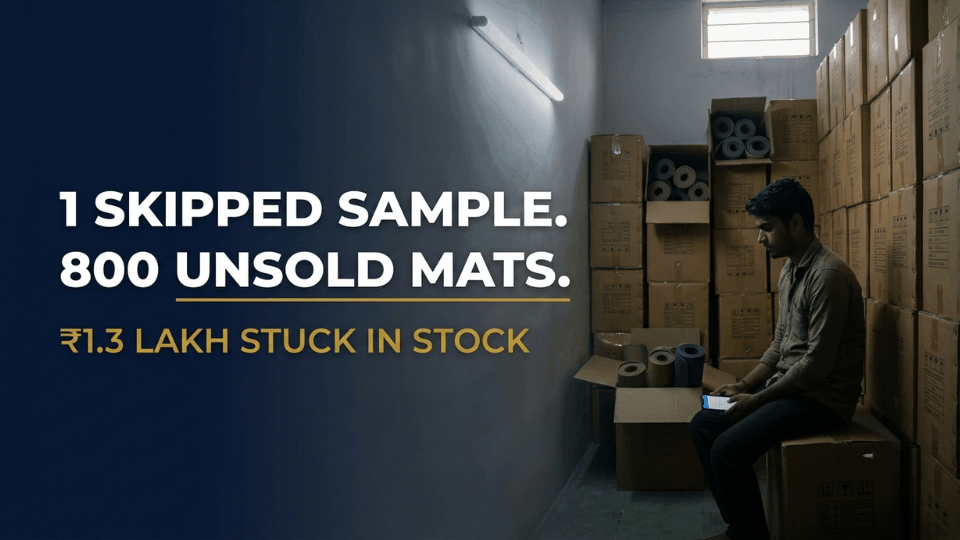
For an FBA seller, a bad batch doesn’t sit quietly in a warehouse. It goes live, gets returned, and collects reviews that outlast any fix. Harpreet Gill from Jalandhar learned this with 800 yoga mats that smelled strongly of chemicals. Returns hit 18% in the first month, his rating slid to 3.6 stars, and he paid removal fees on ₹1.3 lakh of unsellable stock.
Where Sampling Fits in Your Sourcing Journey
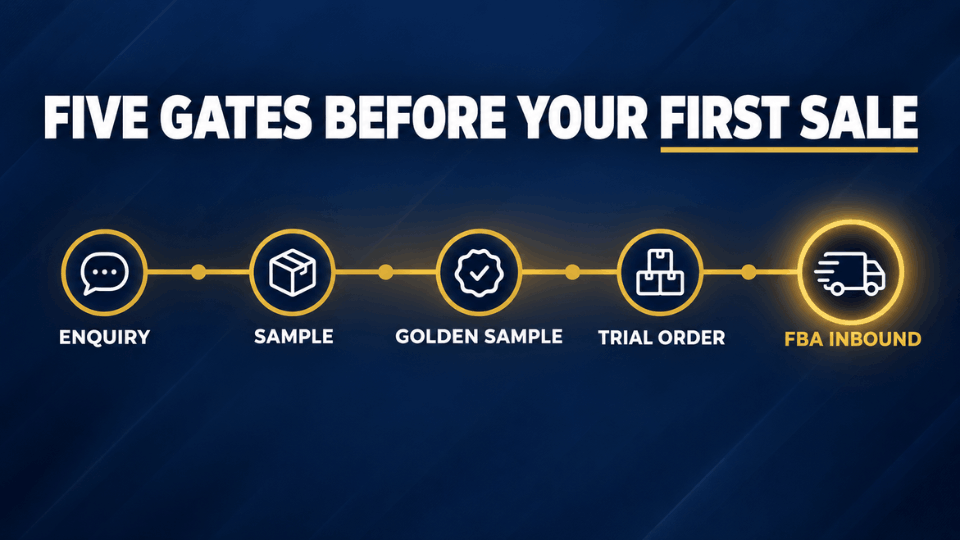
Think of sourcing as four gates: supplier enquiry, sample, trial order and FBA inbound. Most new sellers treat the sample as a formality, but it’s the gate that decides whether the other two should happen at all.
Before the Sample Arrives: Set Your Pass/Fail Standard
Write a One-Page Spec Sheet First
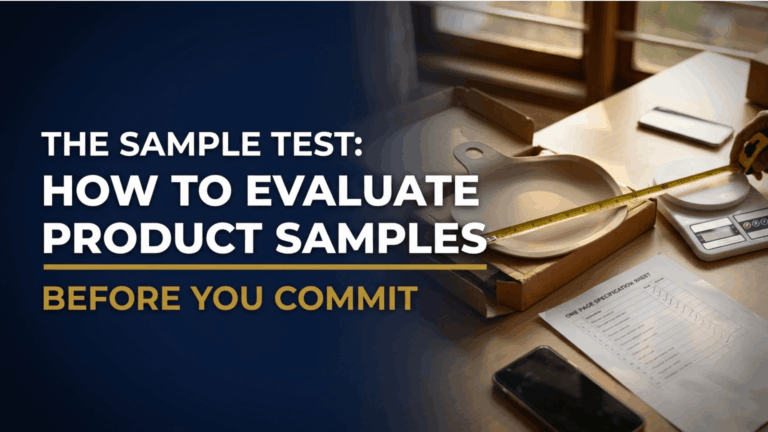
Before you ask for a sample, decide what “good” means on paper: dimensions, material, weight, colour, finish, packaging and target landed cost. Send the same sheet to every supplier. Without it, you’ll judge samples on mood, and the most confident salesperson wins.
Order From 2–3 Suppliers, Not One
One sample tells you whether a product is acceptable. Three tell you what good looks like at your price. Faisal Qureshi from Hyderabad ordered bamboo cutting boards from three suppliers for ₹2,400. The cheapest looked fine alone, but beside the other two it was visibly thinner and rougher.
Requesting IndiaMART Samples Without Getting Ignored
Many IndiaMART suppliers prioritise buyers who look serious. When you request IndiaMART samples, share your GST number, brand name and a realistic first-order quantity. Some send samples free, some charge, and some won’t send anything until they’ve verified your business. A supplier who won’t send a sample at any price has told you enough.
Get the Sample Fee Adjusted Against Your Bulk Order
Paying for samples is normal, since free samples are sometimes hand-picked showpieces. Ask, in writing, for the fee to be adjusted against your first bulk order. Genuine suppliers usually agree, and the request itself signals that you’re serious.
How to Evaluate Product Samples: The 7-Point Checklist
Measure It Against Your Spec Sheet
Open the parcel with your spec sheet beside you. Measure every dimension, weigh the product on a kitchen scale, and check the material against the quote. A 10% weight shortfall usually means thinner material, which is how suppliers quietly protect their margin.
Use It Like a Customer for 7 Days
A sample that looks perfect on day one can fail on day five, so use it exactly as your customer will. Lakshmi Narayanan from Coimbatore washed a copper bottle sample daily for a week. By day six, the inner lacquer was peeling, a flaw that would have surfaced in hundreds of reviews.
Check Finish, Colour and Smell in Daylight
Tube lights hide colour differences and rough edges. Inspect every surface in daylight, run your fingers along edges and seams, and smell the product straight out of the pack. If it smells of chemicals to you, it will smell worse to your customer.
Use One Product Sample Checklist for Every Sample
Score every sample on the same sheet, 1 to 5 per point, so your decision stays objective. Here’s the product sample checklist:
- Dimensions and weight match your spec sheet within tolerance.
- Materials match the quote, with no cheaper substitutes.
- The product survives seven days of real customer-style use.
- Finish, edges and seams are clean and safe to handle.
- Colour matches the supplier’s photos when checked in daylight.
- There’s no chemical or unusual smell straight out of the pack.
- Packaging protects the product through FBA handling.
A score below 3 on any of the first four points is a rejection, not a negotiation. Point seven needs its own test, which comes next.
The FBA Test: Will It Survive a Fulfilment Centre?
Drop, Shake and Stack It
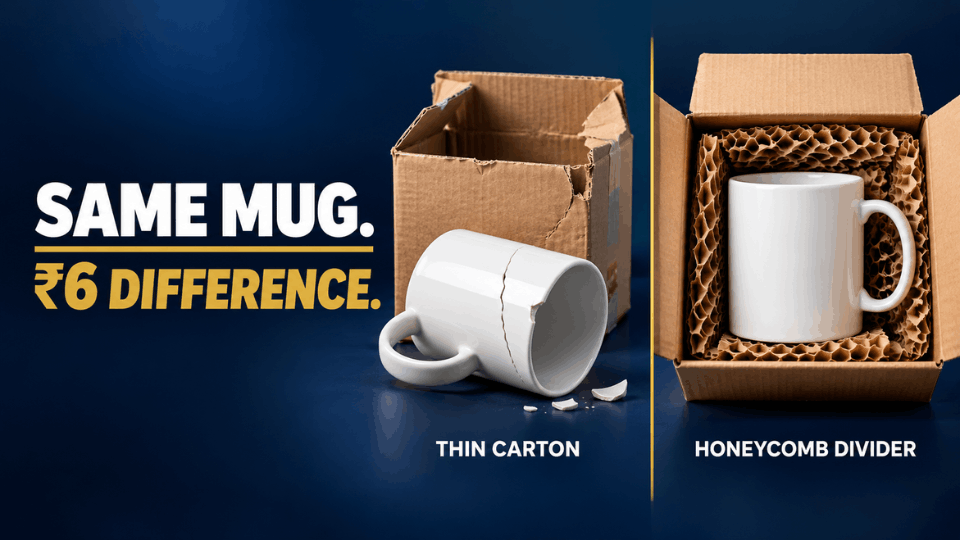
Your product travels from the supplier to you, then to an Amazon fulfilment centre, across racks and conveyors, and finally to the customer. Drop the packed sample from waist height onto each face, edge and corner, shake anything with loose parts, and stack a few kilos on the box overnight. Vikram Rathore from Jaipur dropped six ceramic mug samples and cracked two. Honeycomb dividers at ₹6 more per unit fixed it, far cheaper than a stream of broken-item returns.
Is the Packaging FBA-Ready?
Check that the pack has a flat surface for your barcode label, a carton that doesn’t crush easily, and a clean seal. Prep requirements vary by category, so confirm yours in Seller Central.
Legal Metrology Labelling on the Pack
Packaged products sold in India need declarations such as MRP, net quantity, manufacturer or packer name and address, month and year of manufacture, and consumer care details. Confirm now whether the supplier will print these or whether you’ll need to add a label.
Category Compliance: BIS, ISI, FSSAI
Some categories need certification, such as BIS marks on toys and many electronics, or an FSSAI licence for food. Ask for certificate copies with the sample and verify them on the official portal. Before your first shipment, read our guide to FBA inbound shipment mistakes so the stock you’ve tested doesn’t get stuck at the fulfilment centre.
What to Photograph When You Evaluate Product Samples
The 12-Shot Evidence File
Photograph the sample the day it arrives, before testing. Shoot every face, each seam or joint, the product beside a ruler and on a scale, every label, every flaw and the outer packaging. Those 12 or so shots become your record of exactly what the supplier sent.
Why WhatsApp Photos Aren’t Enough
WhatsApp compresses images, so a slight shade difference or hairline crack can vanish. Keep original files in a folder named by supplier and date. Three months later, a dated original settles a dispute faster than any phone argument.
Shoot a Test Listing Photo
Finally, shoot the sample the way your main image will show it. Nikhil Joshi from Ahmedabad did this with cotton cushion covers and saw his “rust orange” shade turn muddy brown on camera. He switched to a brighter dye before ordering and avoided “colour different from image” returns, one of the leaks covered in how to reduce Amazon return rates. When you evaluate product samples this way, you’re testing your future listing too.
What to Send Back: Feedback That Gets the Bulk Order Right
Numbered, Photo-Annotated Feedback
Suppliers fix what they can see clearly. Write your feedback as a numbered list, one issue per line, with a photo for each and the exact fix you want. “Handle feels weak” gets ignored. “Handle stitching opens at a 4 kg load, please double-stitch” gets fixed.
Put It in Email or the PO, Not Just Chat
Voice notes and scattered WhatsApp messages don’t hold up in a dispute. Ritu Agarwal from Kolkata sent feedback on jute tote bags as three voice notes, and the second sample came back with the wrong handle length. One numbered email later, the third sample was right. Confirm every agreed change in writing, then repeat it in your purchase order.
How Many Sample Rounds Is Normal?
Two to three rounds is normal for a private label product, especially with custom branding. Still rejecting the fourth sample? Check your spec sheet first. If it’s clear and the supplier keeps missing, that’s your answer.
Golden Sample vs Pre-Production Sample: Lock the Standard
What a Golden Sample Is
A golden sample is the approved unit every piece in your bulk order is measured against. It’s not a photo or a description, but a physical product you can hold beside a production carton and say, “This matches, that doesn’t.”
The Pre-Production Sample Is Your Last Checkpoint
The pre-production sample is made with the same materials, moulds and process as your bulk order, while earlier samples are sometimes hand-finished to impress. Insist on seeing it before you release the bulk order. It’s the closest preview you’ll get of what your customers will receive.
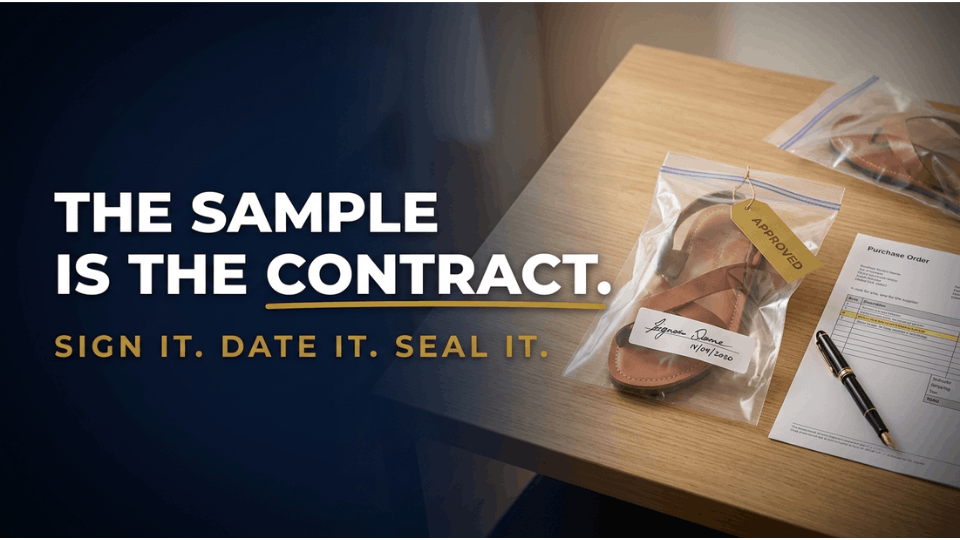
Sign, Date, Seal: Keep One, Send One
Once approved, sign and date the sample, seal it in a bag, and keep one while the supplier keeps another. Write your tolerances down, such as size within 2 mm or no visible shade difference, and reference the golden sample in your PO. Sanjay Patil from Kolhapur did this with leather sandals. When the bulk soles came out 2 mm thinner, the signed sample got 300 pairs replaced without an argument. If you’re also getting custom branding done, our guide on getting products manufactured under your brand is a useful next read.
Supplier Red Flags: When to Walk Away Before the MOQ
Product Red Flags
Walk away when two samples from one supplier don’t match each other, because bulk will be worse. Walk away when the sample fails your FBA test and the supplier won’t fix the packaging, or when compliance documents are always coming “later.”
Supplier Sample Evaluation: What the Process Revealed
Good supplier sample evaluation looks beyond the product. How fast did they reply? How carefully was the sample packed? Did the invoice carry a valid GST number? Did they send what you asked for, or “something similar”? How a supplier handles a ₹500 sample is how they’ll handle your ₹2 lakh order.
The Pressure Signs
Some supplier red flags show up in how they negotiate: demands for 100% advance, promises that “bulk will be better than the sample,” and reluctance to put anything in writing. Deepak Menon from Kochi walked away from a coir doormat supplier who refused to issue a GST invoice, writing off ₹1,800 in samples. That small loss saved him from a far bigger one.
Passed? Make Your First Order a Trial Order
Even a supplier who passes every test deserves a smaller first order. Ask for a trial order below the MOQ, even at a higher unit price, and pay 30% upfront with 70% after inspecting the goods against your golden sample. Check the first carton yourself before anything goes to FBA.
Frequently Asked Questions
Why should I test product samples before placing a bulk order?
Because a sample is the cheapest point to catch a problem. Knowing how to evaluate product samples protects lakhs of rupees in MOQ stock, plus your reviews, return rate and account health. Once bulk stock is live on Amazon, every defect reaches customers and stays visible on your listing.
What is a golden sample in manufacturing?
It’s the approved physical product your supplier must match in bulk production. You sign and date it, keep one copy and give the supplier another. If the bulk order differs, the golden sample is your proof, turning “quality” from an opinion into an agreed standard.
How many suppliers should I request samples from?
Two to three suits most private label products. One sample only shows whether a product is acceptable. Comparing two or three side by side shows what good quality looks like at your price, and gives you a backup supplier if your first choice lets you down.
Is the sample cost adjusted against the bulk order?
Often, yes, but only if you ask. Many Indian suppliers will adjust the sample fee against your first bulk order. Agree this in writing before you pay, and check that the adjustment actually appears on your bulk invoice.
Do IndiaMART suppliers send free samples?
Some do, some charge, and some won’t send anything until they’ve verified your business. Sharing your GST number, brand name and expected order quantity helps. Paid samples aren’t a bad sign, and a supplier who refuses samples at any price is one to skip.
What if my bulk order doesn’t match the approved sample?
Compare the bulk units with your signed golden sample and photograph every difference. Raise the issue in writing, citing the tolerances in your PO. If you held back 70% of the payment until inspection, you have real leverage for replacement, rework or a discount before the stock goes near FBA.
Can I skip samples if the supplier is GST-verified and has good reviews?
No. GST verification proves the business exists, and reviews reflect other buyers’ standards, not yours. Neither tells you whether this product meets your spec, survives FBA handling or matches your listing photos. A verified supplier makes sampling safer, not optional.
Conclusion
Every sample on your desk is a decision point, and the cheapest one you’ll get. Once you know how to evaluate product samples, the routine is simple: measure against your spec, use it like a customer, drop-test it for FBA, and photograph everything. Send back numbered feedback, lock the approved version as your golden sample, and treat your first bulk order as a trial. If the supplier keeps pushing past the warning signs, walk away. A few thousand rupees lost on samples is a lesson; a few lakh lost on bad stock is a setback.
If you want to master the full journey, from choosing the right product to sourcing it well and launching it on FBA, join our 3-Day Amazon Business Training. Your future reviews will thank you.