

The ₹2,600 Question Every New Seller in India Is Asking
Two weeks after launching her premium ceramic cookware on Amazon.in, Prerna Kajal from Coimbatore had been staring at the same number for fourteen straight days. Zero reviews. Her listing was beautiful, her A+ Content polished, her PPC burning through ₹800 a day — yet shoppers were clicking, scrolling to the review section, and bouncing. By week three she was Googling the same phrase thousands of sellers type every month: “Amazon Vine Program India.”
That moment is where almost every review conversation on Amazon India begins. You have a product you believe in, inventory sitting in an FBA warehouse, and one painful truth — products with zero reviews convert at a fraction of products with even fifteen. The Request a Review button alone rarely moves the needle in your first ninety days. The Amazon Vine Program India promises fast, trusted reviews in exchange for a fee.
This guide settles the noise. You will learn the real cost picture, who qualifies, and an honest worth-it framework — not the agency pitch.

What Is the Amazon Vine Program (And How It Actually Works for Sellers)
Amazon Vine is an invitation-only review programme where Amazon hand-picks trusted customers — called Vine Voices — based on the quality of their past reviews. These reviewers receive your product free in exchange for an honest review, which carries a distinct “Vine Customer Review of Free Product” badge that signals vetted feedback to shoppers.
The Vine Voices system explained
Vine Voices are not influencers or paid partners. They are everyday Amazon shoppers with a track record of thoughtful reviews, selected by Amazon’s algorithm based on review consistency and helpfulness votes. In India, the Voices pool is smaller and concentrated in electronics, home essentials, and personal care.
The seller workflow in 6 steps
The amazon vine program for sellers workflow inside Seller Central is straightforward once you qualify:
- Enroll your ASIN through Advertising → Vine.
- Set the number of units, up to thirty per parent ASIN.
- Amazon makes the product visible to Vine Voices after a 24-hour hold.
- Vine Voices browse and request your product.
- You ship the free units through FBA at your own cost.
- Reviewers post honest reviews, usually within thirty days.
What sellers can and cannot control
You cannot influence review content, star ratings, or whether Voices review at all. You cannot message reviewers or remove negative reviews. You can stop enrollment anytime, but claimed units still ship and posted reviews stay live. Vine is a paid visibility experiment, not a controllable lever.
Is Amazon Vine Actually Available in India Right Now?
This is the single most confusing question across the Indian seller community. Short answer: Amazon Vine India is technically live in Seller Central, but access is inconsistent and the programme is not yet a fully open rollout.
The current India status
Vine has a dedicated India page, and the enrollment menu appears under Advertising → Vine for eligible sellers. Indian sellers report wildly different experiences — some see the tab, others find it greyed out, many find it missing. The programme is operational on Amazon.in but eligibility remains restricted. The accurate framing: Vine is in India but in a slow, gated rollout.
The Global Selling workaround Indian exporters use
The other path is Amazon Global Selling. Indian sellers exporting to Amazon US, UK, or EU can access the mature Vine programmes in those countries with fully published fees. This is how most “Indian seller used Vine” success stories actually happen. Karthik Reddy from Hyderabad, who sells leather wallets through Amazon US, paid $200 for thirty units and received twenty-two reviews in forty days — a result unrealistic from the still-gated India programme.
How to check if your account has Vine access
Log in to Seller Central, hover over Advertising, and look for Vine in the dropdown. If you see the enrollment screen, you are in. If the menu item is missing or returns an error, you are not in the active rollout. Access expands in waves — check monthly.
The Real Amazon Vine Cost Breakdown for Indian Sellers
The number you have seen quoted is ₹2,600 per parent ASIN. That is the correct amazon vine enrollment fee for Amazon.in — and it is dangerously incomplete. The true amazon vine cost includes several layers most blogs skip.
Enrollment fee tiers explained
On Amazon.in, the fee is ₹2,600 per parent ASIN, charged seven days after the first Vine review is published — not upfront. On Amazon.com through Global Selling, the tiered structure runs $0 for one to two units, $75 for three to ten, and $200 for eleven to thirty. If zero reviews publish during the ninety-day window, the fee may not be charged at all — but your free units have already shipped.
The hidden costs nobody mentions
Beyond the fee, you cover the free units — manufacturing cost times up to thirty pieces. Add FBA fulfilment on every shipped unit and storage fees while inventory waits to be claimed. For Global Selling, also add international freight, customs duties, and working-capital lockup across ninety days. The fee is non-refundable once triggered — a poor launch can still cost the full ₹2,600.
Who Qualifies — Amazon Vine Eligibility Checklist for Indian Sellers
The amazon vine eligibility rules are stricter than most sellers realise. Requirements split into two buckets — account-level and product-level.
The non-negotiable seller requirements
Your account must be on the Professional Selling Plan — Individual accounts do not qualify. You must be registered on Amazon.in for India Vine, or on the qualifying marketplace through Global Selling. Most importantly, you must hold Amazon Brand Registry approval for the exact brand you want to enroll. The amazon brand registry vine linkage is rigid.
The product-level checklist
The product itself must meet every one of these criteria:
- The detail page must have fewer than thirty published reviews at enrollment.
- The product must be a buyable FBA offer in “New” condition with active inventory at the fulfilment centre.
- The listing must have an image, description, and title — placeholder listings are rejected.
- The product must already be live, not in pre-launch state.
- The product must not be classified as adult, digital, heavy, or bulky.
Miss any one and the enrollment screen throws an error before you can pay.
Why brand registry is the real bottleneck
Brand Registry eliminates roughly eighty percent of would-be Vine sellers. You need an active trademark — filing through the IP India portal, paying around ₹4,500 in fees, and waiting six to eighteen months. Anjali Mehta from Jaipur, who sells handmade home décor, spent eleven months on her trademark before she could consider Vine. Unsure whether your brand needs one? Our guide on whether you need a trademark to sell on Amazon India covers it.
How to Enroll in Amazon Vine — Step-by-Step Walkthrough
Once your account and product qualify, enrollment is mechanically simple. The hard work happens before you click Enroll — because enrolling a weak listing is the fastest way to waste ₹2,600 on negative reviews.

Pre-enrollment listing audit
Before spending a rupee on Vine, your listing must be at its strongest. That means seven optimised images including main, infographics, and lifestyle shots, A+ Content already live, and a title and bullets written to convert. Vine Voices are brutally honest — they will critique poor packaging, confusing instructions, and weak photography in writing. Whatever weakness exists in your listing, Vine will expose publicly for every future shopper.
The enrollment flow in Seller Central
When the listing is ready, how to enroll in amazon vine becomes the easy part. Sign in to Seller Central, hover over Advertising, and click Vine. Enter your ASIN, click Begin Enrollment, and verify the product information. For variation products, choose “All product variations in stock” to give Voices flexibility. Enter your unit count — most sellers go with thirty — and click Enroll.
What happens in the first 30 days post-enrollment
Amazon holds your product for twenty-four hours before making it visible to Voices. Most reviews land between day eight and day forty-five, with the full window closing at day ninety. Monitor everything from the Vine dashboard. For a deeper pre-launch playbook, our guide on better Amazon product photography covers the checklist most sellers skip.
What Actually Happens After You Click Enroll
This is the section most Vine guides skip — and it is the most common question Indian sellers ask. You have clicked Enroll, the fee is locked in, your units are sitting at the FBA centre. What happens next? Is Amazon matching your product with reviewers on autopilot? Will the dashboard show you anything? Here is the honest, step-by-step reality.
The 24-hour silent window
Nothing visible happens for the first twenty-four hours. Amazon holds your product internally before publishing it to the Vine Voices portal. No notification, no email, no dashboard flag — just a quiet wait while Amazon prepares your listing for reviewer eyes.
Why Vine is not on autopilot
Here is the part most sellers misunderstand. Amazon does not push your product to reviewers or assign it to specific Vine Voices. Vine Voices log into their own separate Vine portal and browse hundreds of available products from sellers worldwide. They scroll, filter by category, and request what interests them. If your product does not catch a Voice’s attention, nobody claims it — and Amazon will not force anyone to take it. Low-demand or hyper-niche products can sit unclaimed for the full ninety-day window with zero takers, and you have no way to push that needle.
What you can see in the Vine dashboard
The Vine dashboard inside Seller Central → Advertising → Vine shows five numbers per enrolled ASIN: date enrolled, units enrolled, units still available, units claimed by Vine Voices, and Vine reviews published. Alongside the numbers sits a status label — Awaiting reviews, Reviews in progress, Concluded, Cancelled by seller, or Action required. The Action required state means something is blocking your enrollment (no FBA offer, missing image, more than thirty reviews on the listing), and Amazon pushes these to the top of your dashboard until you fix them.
What you cannot see: who claimed your product, who reviewed it, or which reviewer wrote which review. To read the actual review text, click through to your live product page and look for the “Amazon Vine Customer Review of Free Product” badge. The dashboard gives you the count, not the content.
Review timing after a claim
After a Vine Voice claims your product, expect their review roughly twenty to twenty-eight days later on average — time to receive, test, and write. Some land in week one, others stretch to weeks five and six. Vine Voices have no hard deadline after claiming, so a slow reviewer can keep a unit in review limbo for months. Amazon does not notify you when a review is submitted, suppressed, or removed — the dashboard count is your only signal. Compare it to your live listing every week.
The cancellation trap (one enrollment per ASIN, forever)
This is where many sellers get burned. You can fully cancel a Vine enrollment only before any unit has been claimed. The moment a single Vine Voice claims, cancellation rights end — you can only stop further claims, and the already-claimed units will still ship and their reviews will still publish. Worse, once you cancel or stop, you can never re-enroll that same ASIN in Vine again. One enrollment per ASIN per lifetime, claimed or not, reviewed or not. Treat every Enroll click as permanent.
Is Amazon Vine Worth It? The Honest Decision Framework
The answer to is amazon vine worth it depends entirely on the product you are enrolling and the margin behind it.
When Vine pays off for Indian sellers
Vine works when three conditions stack. First, your product is genuinely strong — confirmed by beta feedback above four stars or repeat orders from paying testers. Second, your margin after all costs is at least thirty-five percent, so ₹840 per review has room to recover. Third, you are in a category competitive enough that the first fifteen reviews unlock real PPC efficiency gains. When all three are true, months-to-ROI stays under six.
When Vine burns cash
Vine destroys budgets when sellers treat it as a shortcut for an unfinished product. If beta testing exposed quality issues you “plan to fix in the next batch,” Vine reviewers will catch every defect and publish it. If you sell a thin-margin commodity at ₹199, ₹840 per review will never recover. And if you are using Vine because you lack a launch strategy, no number of reviews will substitute for missing fundamentals.
The expected review reality check
The typical average rating from Vine reviewers on a quality product sits between 4.0 and 4.4 stars. Anything below 3.8 signals a product problem Vine just made public. Claim rates run fifty to seventy percent, meaning fifteen to twenty-five reviews per enrollment. Zero-review outcomes are real, especially in low-demand niches.
Amazon Vine and other Addons That Work in India
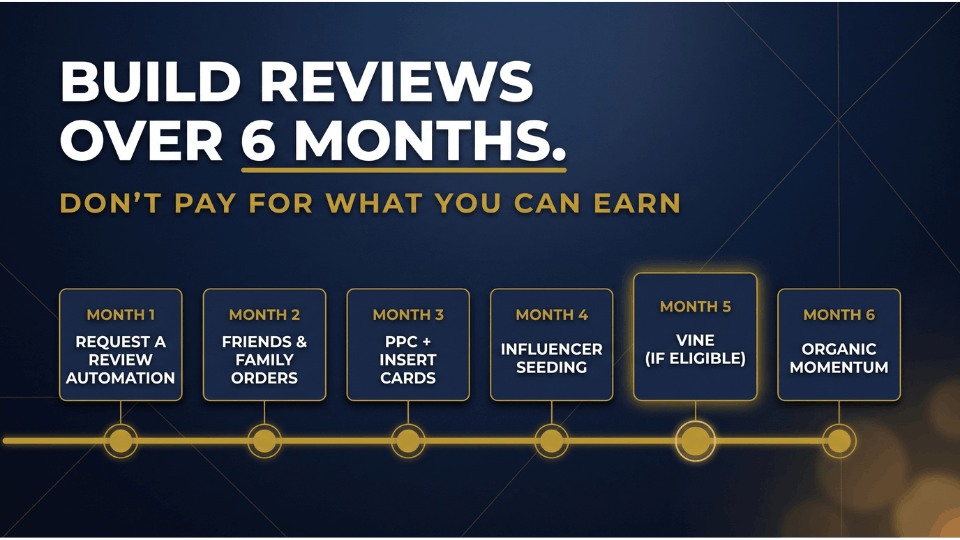
Vine is one tool, not the only tool. While India access remains gated, smart sellers stack alternatives. The right amazon vine alternative strategy often outperforms Vine itself for sellers under thirty reviews.
The free built-in option
Every order you fulfil triggers Amazon’s Request a Review button. Combined with compliant Buyer-Seller Messaging follow-ups, this typically generates a five to ten percent review rate — free, compliant, and compounding across every order. See our guide on how to get product reviews without breaking rules for the full playbook. Rohan Desai from Mumbai automated his Request a Review process and crossed forty organic reviews in three months without spending a rupee on amazon vine reviews india programmes.
Influencer and creator seeding
Sending free product to Amazon Influencers and Indian YouTube and Instagram creators typically costs ₹400 to ₹800 per genuine review when negotiated well. This beats Vine on cost-per-review past the thirty-review threshold, when Vine is no longer eligible. The trade-off is slower coordination and less consistent velocity than a single Vine enrollment.
Insert cards, packaging, and post-purchase experience
Amazon’s policies forbid insert cards that bribe for reviews or filter for positive feedback. What is allowed is a clean insert thanking the buyer and pointing to a QR code linking to a generic feedback or support page. The unboxing moment is the highest-emotion review opportunity you will get. Our breakdown of how packaging inserts boost reviews shows the patterns compliant brands use.
Frequently Asked Questions
Is Amazon Vine available in India?
Amazon Vine is technically live in Amazon.in Seller Central under Advertising → Vine, but rollout is inconsistent — some sellers see the enrollment screen, others find the menu missing. Most “Vine India” success stories actually come from Indian exporters using Amazon Global Selling to access mature Vine programmes in the US, UK, or EU.
How much does Amazon Vine cost for sellers in India?
The Amazon Vine enrollment fee on Amazon.in is ₹2,600per parent ASIN, charged seven days after the first review is published. On Amazon.com through Global Selling, the tiered fee runs $0 for one to two units, $75 for three to ten, and $200 for eleven to thirty. You also cover free units, FBA, and storage.
Is Amazon Vine worth it for new Amazon sellers?
Vine is worth it if your product is genuinely strong, your margin exceeds thirty-five percent, and you are in a competitive category where early reviews unlock PPC efficiency. It is not worth it for untested products, thin-margin commodities below ₹250, or sellers using Vine as a shortcut instead of fixing weak listings.
Who is eligible for the Amazon Vine Program in India?
You need a Professional Selling Plan, Amazon Brand Registry approval for the exact brand, and an FBA product in “New” condition. The product must have fewer than thirty reviews, be live with image and description, and not be classified as adult, digital, heavy, or bulky. Brand Registry is the biggest barrier.
How many reviews can you get from Amazon Vine?
You can enroll up to thirty units per parent ASIN, which sets the ceiling. Typical claim rates run fifty to seventy percent, meaning most enrollments yield fifteen to twenty-five reviews within the ninety-day window. Zero-review outcomes happen in low-demand niches, and you remain responsible for shipped units either way.
Can I cancel my Amazon Vine enrollment?
Yes — stop your enrollment anytime from the dashboard inside Seller Central. However, units already claimed will still ship, and reviews already published remain live permanently. You cannot retroactively remove Vine reviews. Treat enrollment as a one-way door once Voices start claiming.
Will Vine reviews help my product rank for Amazon’s Choice?
Indirectly, yes. Vine reviews lift conversion because shoppers trust the badge, and higher conversion improves your organic ranking, which eventually drives Best Seller and Amazon’s Choice badge eligibility. Not a direct route — Amazon does not award badges based on review type — but a meaningful supporting factor.
Conclusion
The Amazon Vine Program is neither the scam nor the silver bullet it gets painted as. It is a paid visibility experiment that rewards strong products and punishes weak ones brutally and publicly. The real question is not whether Vine works — it does — but whether your product is ready for honest reviewers to test it in front of every future shopper.
If your product is solid, your margin is healthy, and your listing is fully optimised, Vine can compress months of slow review accumulation into a single ninety-day window. If any of those are missing, fix them first. Our 3-Day Amazon Business Training walks through the exact systems Indian sellers use to launch products that earn reviews instead of paying for them.
