
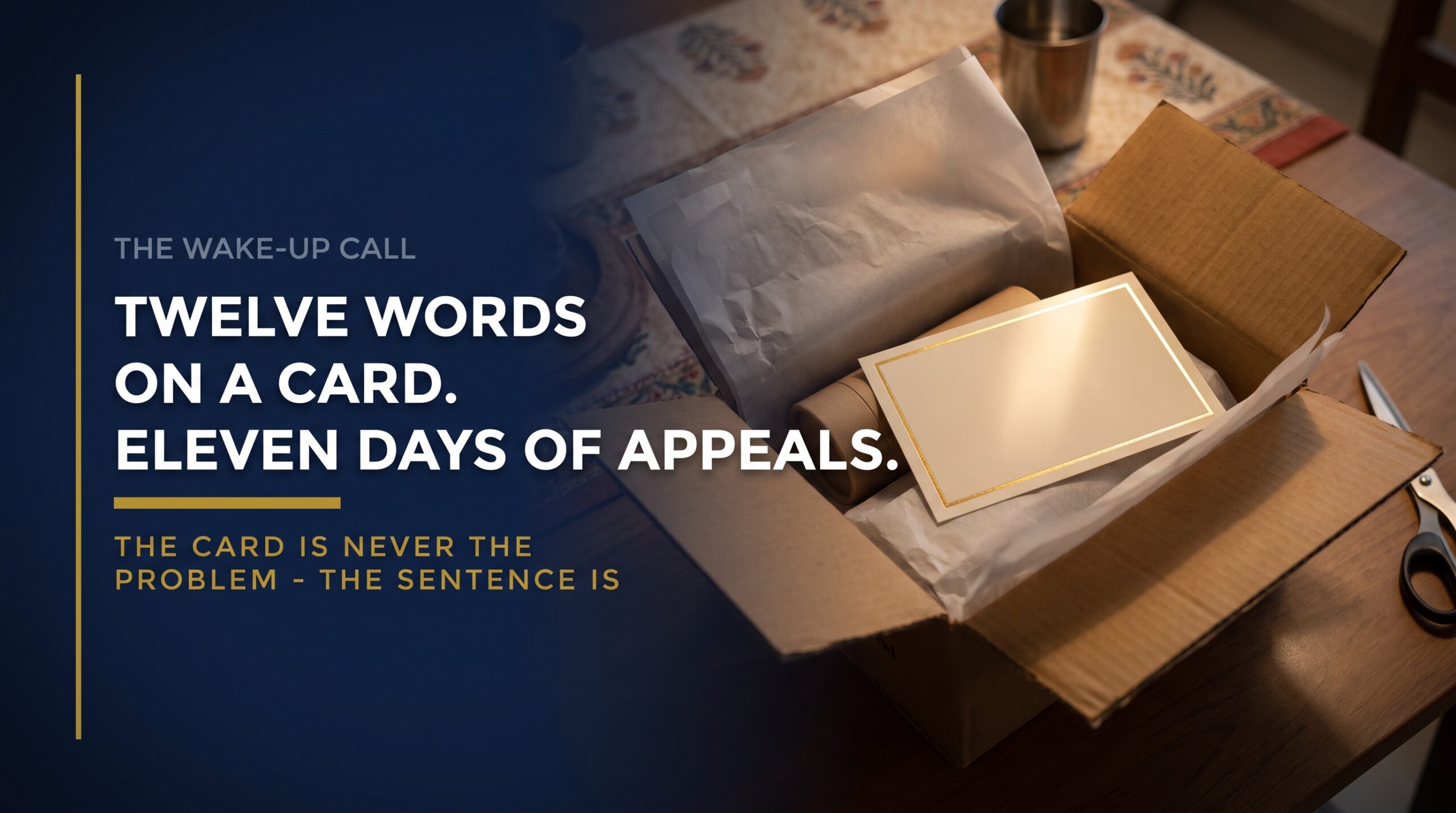
A seller in Coimbatore once told me about the email that ruined his Diwali week. Nothing wrong with his listings, nothing wrong with his stock. A buyer had photographed his insert card — cream board, gold foil, rather lovely — and uploaded it to a review. The card read, “Loved it? Leave us a 5-star review and we’ll send you a gift.” Twelve words, and he spent eleven days writing appeals instead of selling. That’s the thing about the Amazon product insert policy: almost nobody gets into trouble for including a card. They get into trouble for the sentence printed on it. He hadn’t set out to break anything — he’d copied the wording from a video.
So let’s sort this out properly. By the end of this you’ll know what you can safely print, which phrases get accounts flagged, how to structure a card buyers actually read, what printing costs in India at different run sizes, and how to tell whether the card is earning its place in the box at all.
Why Sellers Still Bother With Insert Cards
Think about how little direct contact you actually have with your buyer. Amazon owns the search result, the product page, the messaging thread, the delivery notification. The one moment that belongs entirely to you is the moment the box opens in someone’s living room. Amazon product inserts exist because that moment is the last unmediated conversation you get.
The quiet moment after the box opens
Your buyer has scissors in one hand and low expectations in the other. A card that thanks them by brand name, explains how to get the best out of what they’ve bought, and tells them who to contact if something’s wrong changes the emotional temperature of the entire purchase. It costs less than your packing tape.
What inserts actually influence
Be realistic about the mechanism. A card does not conjure reviews out of thin air. What it reliably does is reduce avoidable returns, catch support queries before they become refunds, and make your brand name stick so the next search is branded rather than generic. Kavita Reddy, who sells stainless steel lunchboxes from Hyderabad, added a care-and-cleaning card to every unit and watched her “damaged or defective” return reason fall from 6% to under 3% across four months. Her lesson: most negative feedback was confusion, not defect.
Where sellers cross the line
The card itself is almost never the problem. Trouble starts with language that tries to buy, steer or filter feedback, or that nudges the buyer off Amazon for their next purchase. Same card, different sentence — that’s usually the entire difference between a quiet quarter and a suspended listing.
Reading The Rules Before You Print Anything
The rules are shorter than people assume. Amazon’s communication and reviews guidelines say you may not offer anything of value in exchange for feedback, may not ask for positive reviews specifically, may not ask buyers to remove or amend a negative review, and may not use packaging to pull buyers off the marketplace for purchases they’d otherwise make there.
The communication guidelines in plain English
Strip out the legalese and you have three sentences. Ask for honest feedback, not good feedback. Give help unconditionally, never in trade. Keep the buying journey on Amazon. Everything else on your card — thank-you lines, usage guidance, support contact, warranty registration, your brand story — sits comfortably inside the policy.
What counts as an incentive
An incentive is anything the buyer receives because they left, or promised to leave, feedback. A gift card for a review is an incentive. A discount conditional on a screenshot of a review is an incentive. A discount printed on every card, given to every buyer, with no mention of reviews anywhere near it, is not. The test is the word “if”. Remove the “if” and you usually remove the risk.
Why neutral wording protects you
Search for neutral review request wording Amazon sellers actually use and you’ll notice it protects you twice over: it keeps you inside policy, and it keeps your review profile believable. Simran Kaur, who sells cotton bedsheets from Ludhiana, rewrote her card to ask only for honest feedback and saw her review rate hold at roughly 2% of orders while her account stayed clean through two policy cycles. Neutral wording, she found, didn’t cost her a single review.
What You Can Safely Say On The Card
Yes, you can ask for a review. That surprises sellers who’ve been told inserts are forbidden outright. What you cannot do is specify the rating, hint at the rating, offer anything for it, or treat negative feedback as something to be intercepted before it reaches the platform.
Words that stay inside the line
Safe wording sounds slightly boring, and that’s the point. “If you have a moment, we’d be grateful for your honest review on Amazon.” “Your feedback, good or bad, helps us improve.” “Reviews from buyers like you help other shoppers decide.” All three ask without steering, and all three keep you clear of the Amazon product insert policy trip-wires.
Phrases that get accounts flagged
Before your next print run, search your existing artwork for the phrasing below — it’s what causes almost every warning I see.
- Any mention of stars, ratings or numbers alongside a request for feedback.
- Any offer of a gift, coupon, refund, extended warranty or prize draw in return for a review.
- Any request to contact you first instead of leaving a negative review.
- Any hint that the buyer can get their next unit cheaper somewhere other than Amazon.
- Any instruction to remove, edit or upgrade a review already posted.
Run your card through that list and most of your risk disappears in an afternoon.
Asking without steering the rating
The trick to how to ask for reviews on Amazon insert card copy is to imagine a buyer who hated the product reading it. If your line still makes sense to that person, it’s compliant. Anil Deshpande in Nagpur tested exactly this on his phone-mount listing, swapping “help us reach 100 five-star reviews” for “tell us honestly how it fits your car.” Over three months his review volume rose slightly and his one-star count stayed flat. Honest asks attract honest buyers, which is the only durable social proof there is.
If you want the full picture — how inserts sit alongside listing quality, review velocity and brand building — join the 3-Day Amazon Business Training and put the card in its proper place in the system.
Discount Codes, Warranties And Free Gifts
Discount codes on inserts are the most misunderstood corner of the policy. You can print one. Sellers do it every day without incident. The only variable that matters is what the buyer has to do to earn it.
When a discount crosses into bribery
An unconditional offer is fine: every buyer gets the same code for their next order on Amazon, no strings, no mention of feedback. The moment the code depends on leaving a review or sending a screenshot, it becomes an incentive and you’re exposed. Keep the discount and the feedback line on separate panels so no reader could reasonably connect them.
Extended warranty registration done right
Warranty registration is legitimate and genuinely useful, especially for appliances and electronics. Point the buyer to a registration page, collect what you need to honour the warranty, and keep that page review-neutral — no prompts, no “leave a review to activate”, no conditional extension. The warranty must reach a buyer who never writes a word about you.
Handling gifts and loyalty offers
Gifts are allowed when they arrive for everyone. A bonus accessory, a recipe booklet, a spare part — all fine as unconditional value. Priya Nair, who sells ayurvedic hair oils from Thrissur, includes a sachet of a second product with every order and mentions it on the card with no review language anywhere near it. Her repeat purchase rate on that second SKU reached 14% within five months. Generosity with no conditions attached turns out to be both compliant and better business than any bribe.
Everything That Belongs On A Good Insert
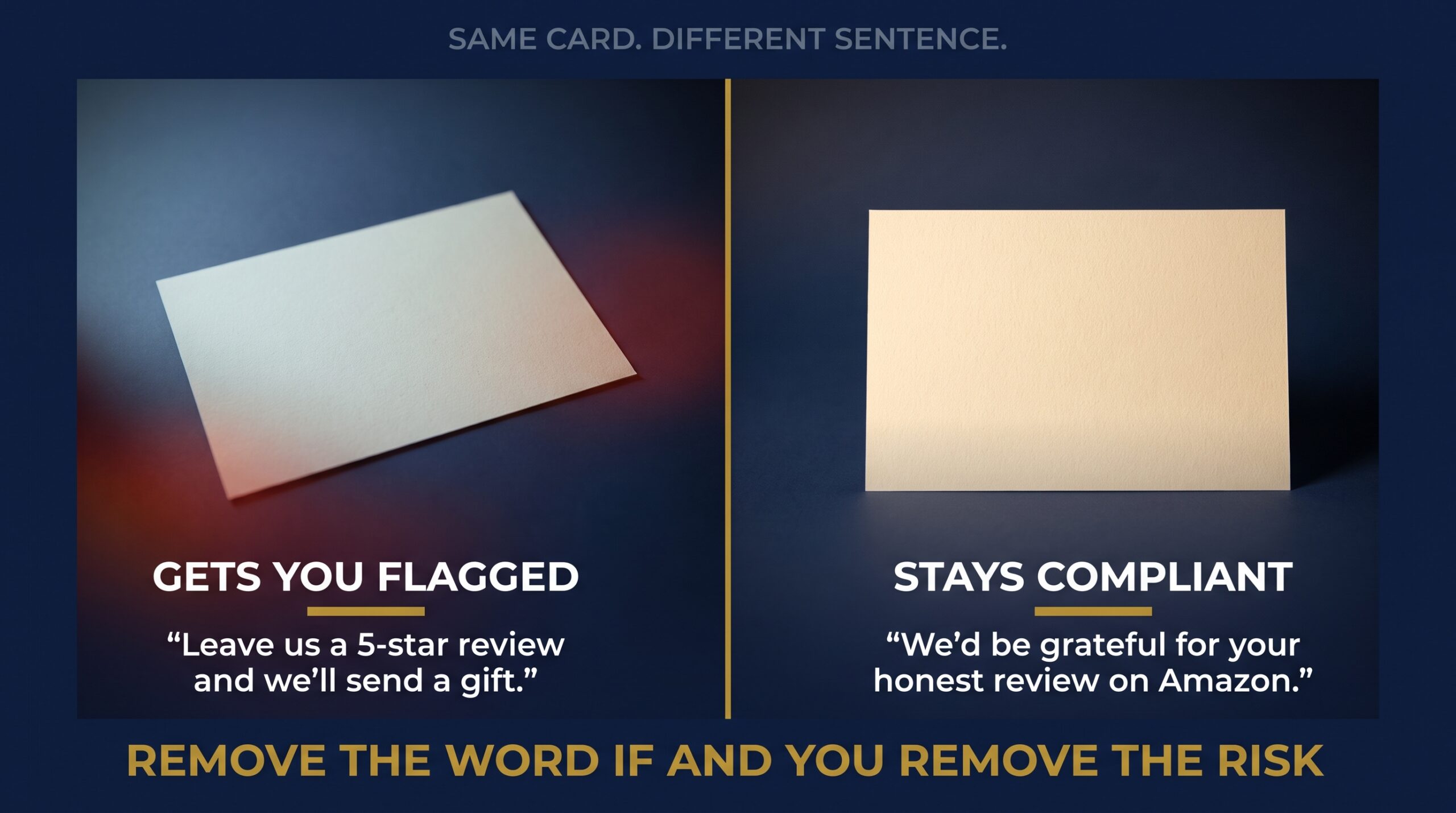
Sellers ask what a product insert card should include, and the honest answer is: less than you want to cram in. A card that tries to do six jobs does none. Treat your Amazon insert card template as one front panel and one back panel, each with a single purpose — the front carries warmth and recognition, the back carries practical help.
The must-have elements
Four things genuinely earn their space. A thank-you line naming your brand, so recall has something to attach to. Usage or care guidance covering the two or three things buyers get wrong. A support contact, email or phone, with a realistic response window. And a neutral feedback line, short and unglamorous.
Optional extras worth the space
Beyond that, a two-line brand story works if it’s true and specific: where you make things, who started it, why. A warranty registration path belongs on anything with moving parts. A QR code to a setup video earns its place when the product needs assembly.
What to cut when space runs out
Cut the social handles, cut the mission statement, cut the second QR code. Vikram Shah, who sells wooden desk organisers from Ahmedabad, reduced his card from eleven elements to five and found his support emails became more specific and far easier to resolve — average handling time roughly halved over two months. Fewer competing messages meant each one actually got read.
Designing A Card People Actually Read
Good packaging insert design for Amazon sellers is less about beauty than about being read in seven seconds by someone standing up, holding a box, with the television on. Every design choice should serve that scenario.
Size, stock and finish choices
A6 is the workhorse size — big enough for real text, small enough to sit flat on the product. A5 suits anything needing assembly guidance. Stick to 250–300 GSM board so the card doesn’t curl in transit; thinner stock reads as a flyer and gets binned. Keep a 3mm bleed and a 5mm safety margin so nothing important gets trimmed. Matt lamination photographs better and resists the smudging gloss suffers from.
Layout, hierarchy and font size
One dominant line, one supporting block, one small-print zone. Nothing below 9pt, and 11pt for anything the buyer has to act on. White space isn’t waste — it’s what makes your support number findable at a glance.
Language, QR codes and scannability
Bilingual cards pay off in plenty of categories: English on one panel, Hindi or the regional language on the other, rather than both crowded onto one side. Place QR codes at least 15mm from any edge and test them under warm indoor light, not on your monitor. Meera Iyer, who sells pressure cooker gaskets from Pune, went bilingual and saw wrong-fit returns drop by about a fifth over the following quarter — comprehension, not design flair, is what an insert really sells.
Design discipline like this is exactly what separates sellers who scale from sellers who stall, and it’s the kind of thinking you’ll work through properly when you take a seat in the 3-Day Amazon Business Training.
What It Costs To Print Inserts In India
The insert card printing cost in India is low enough that money is rarely the real constraint — indecision is. Still, knowing the bands helps you choose between digital and offset without over-ordering artwork you’ll want to change in three months.
Price ranges by finish and quantity
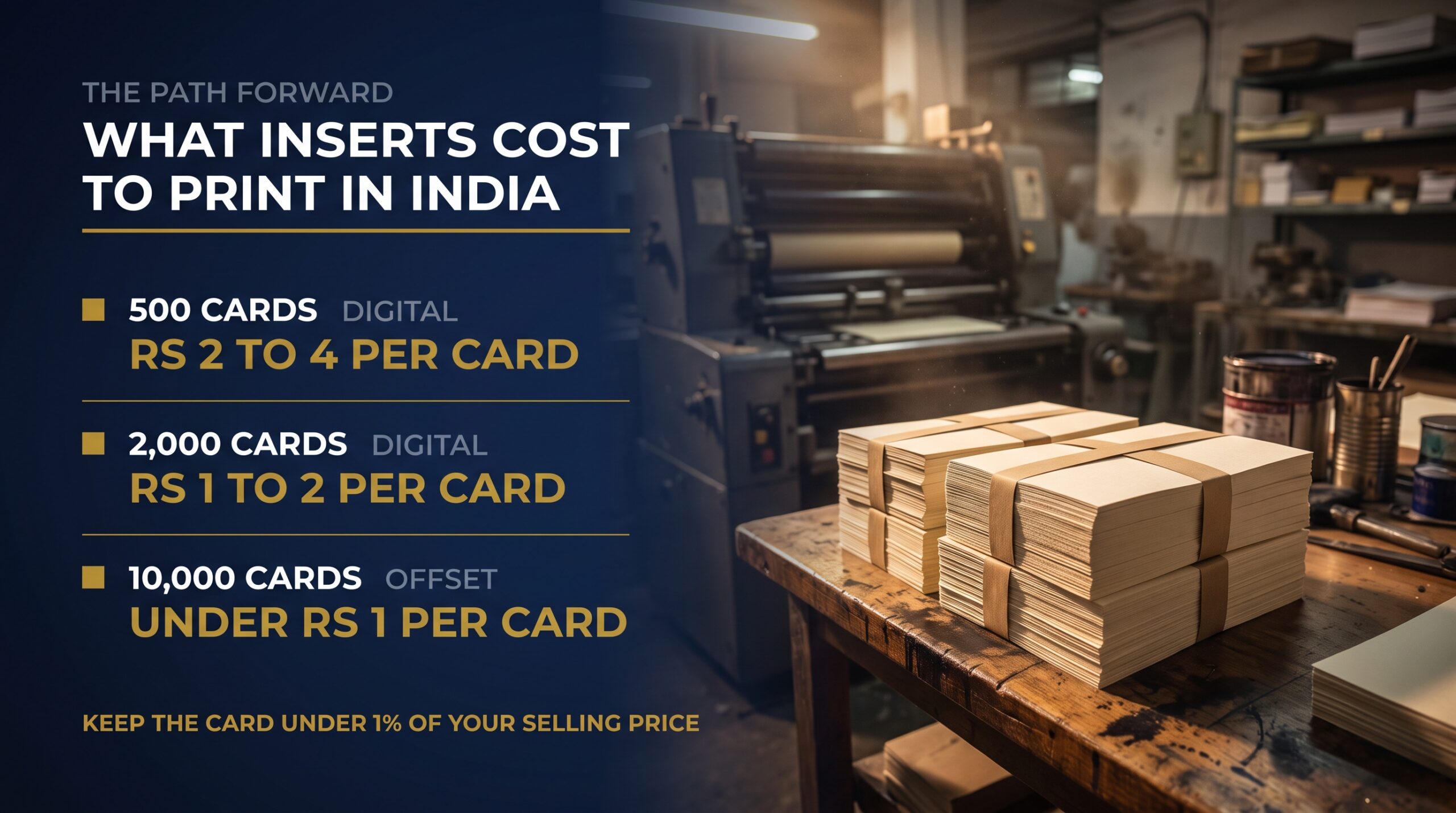
At 500 cards, digital printing on 300 GSM with matt lamination typically lands around two to four rupees per card, because setup dominates. At 2,000 units you’d usually see one to two rupees. At 10,000 units, offset takes over and per-card cost commonly falls under a rupee. Spot UV, foiling and die-cutting each add a layer of cost and a layer of delay.
Local press versus online printers
A local press gives you a physical proof, a human to argue with, and same-week turnaround. Online printers give you cleaner pricing at volume and consistent colour across reorders. Most sellers start local while the wording is still settling, then move online once the artwork stabilises.
Keeping cost per unit sensible
A sane ceiling is 1% of your selling price, or 2% if the card is doing real work like replacing a printed manual. Deepak Agarwal, who sells yoga mats from Jaipur, dropped foil for a two-colour matt card, cut his per-unit insert cost by around 60%, and noticed no change whatsoever in feedback quality over six months. His buyers cared about the words, not the gold.
Testing, Measuring And Staying Compliant
Most sellers print a card, feel good about it, and never check whether it did anything. That’s a shame, because inserts are among the easier things to measure — provided you decide what “working” means before you print.
Tracking whether inserts move the needle
Pick three numbers and watch them monthly: reviews as a percentage of orders, the mix of your support queries by topic, and repeat orders on your brand. If the card is earning its keep, review rate holds or climbs, “how do I use this” messages shift from complaints to questions, and branded searches start appearing in your traffic.
Running a clean variation test
Change one thing per print run — new wording or new layout, never both. Run each version for at least 300 orders before judging it, and note the start date somewhere you’ll find it again. Farhan Qureshi, who sells car care kits from Delhi, tested a usage-guidance card against a plain thank-you card across two runs of 1,000 and cut his return rate by about a third over ten weeks. The version that taught beat the version that charmed.
Audit your card before every reprint
Build the habit: before every reprint, reread your card against current policy language and the flagged-phrase list above. Policies get updated; cards sitting in a carton don’t. A ten-minute check before a reprint has saved more accounts than any appeal letter ever written.
Frequently Asked Questions
What does Amazon’s product insert policy say about review requests?
It permits a request for honest feedback and forbids anything that shapes it. No money, gifts, discounts, warranty extensions or draw entries in exchange for a review. No asking specifically for positive or five-star ratings. No asking buyers to contact you instead of posting negative feedback, and no redirecting future purchases off the marketplace.
Can an Amazon insert card ask a customer to leave a review?
Yes. The request is allowed; only the framing causes trouble. “If you have a moment, we’d appreciate your honest review on Amazon” is fine. The same line with “five-star”, “positive” or an attached reward is not. Test it by asking whether a buyer who disliked the product could still read it sensibly.
What should an Amazon product insert card include?
Four essentials: a thank-you line carrying your brand name, usage or care guidance covering the mistakes buyers commonly make, a support contact with a realistic response time, and a short neutral feedback mention. Add warranty registration if the product needs it. Leave out social handles, mission statements and second QR codes — clutter stops cards being read.
Can you print a discount code on an Amazon product insert?
You can, provided it’s unconditional and redeemable on Amazon. Every buyer gets the same code, no review required, no screenshot, no proof. Keep the offer on a different panel from any feedback line so nobody reads them as linked. The moment redemption depends on a review, it becomes an incentive and you’re exposed.
How much does it cost to print insert cards for small sellers in India?
At 500 cards on 300 GSM with matt lamination, expect roughly two to four rupees each, since setup dominates small digital runs. Around 2,000 units, that usually drops to one to two rupees. At 10,000, offset often takes it below a rupee. Keep the insert under 1% of your selling price.
Can I put my website or WhatsApp number on an insert card?
Support contact details are legitimate — buyers need a route to service, warranty registration and troubleshooting. What you must avoid is any suggestion they should buy from that channel instead: no “order direct and save”, no price comparison, no store link framed as a purchase route. Keep repeat-purchase language pointed back at your Amazon listings.
Do inserts need to be in Hindi as well as English?
There’s no requirement, but in many categories it pays. If your product involves fitting, assembly, dosage or care instructions, a second language prevents misunderstandings that become returns. Put English on one panel and Hindi or the relevant regional language on the other rather than crowding both. Check your buyer locations before choosing.
What happens if Amazon flags my insert card?
You’ll typically receive a policy warning naming the guideline breached, sometimes with a listing restriction while it’s resolved. The fix is procedural: stop shipping the card, quarantine printed stock, correct the wording, and submit a plan of action stating what it said, what it now says, and how you’ll review artwork before every reprint.
Conclusion
An insert card is the cheapest trust asset you own. It reduces confused returns, gives buyers somewhere to go before they reach for the one-star button, and plants your brand name in a memory Amazon’s interface otherwise erases. All of that value hangs on wording that never tries to buy, steer or filter feedback.
So keep the discipline simple. Write neutrally, offer help unconditionally, keep discounts free of conditions, print at a sensible cost per unit, and reread the card against current policy before every reprint. That’s the whole system.
The card is one piece of something larger — listings, reviews, pricing and brand pulling in the same direction. Build that machine properly with us inside the 3-Day Amazon Business Training, and your insert becomes a small confident detail instead of a worry.
