

Last November, Santoshi from Tirupur shipped her first batch of hand-block-printed bedsheets to an Amazon warehouse in New Jersey. She had been selling on Amazon.in for two years, doing steady but unremarkable numbers. Within eight weeks of going live on Amazon US, her monthly revenue more than doubled and she was earning in dollars. That single decision to try Amazon global selling from India changed the trajectory of her business. But Santoshi almost made a costly mistake. She nearly listed the same products on Amazon UK and Amazon UAE at the same time, without understanding how fees, taxes, and competition differ across these three marketplaces. The truth is, each of these markets rewards a different strategy. This guide compares all three; the US, the UK, and the UAE side by side, so you can pick the right starting point, avoid expensive surprises, and build a global brand from India with confidence.
Why Indian Sellers Are Going Global on Amazon in 2026
The $20 Billion Export Milestone and What It Means for You
Amazon's Global Selling programme recently crossed $20 billion in cumulative exports from India, with over 750 million product units shipped across 18 marketplaces since 2015. The target now is $80 billion by 2030. More than 200,000 Indian sellers are registered, from metros like Mumbai to smaller towns like Karur, and the seller base grew 33 percent in the past year alone.
Why US, UK, and UAE Are the Top Three Picks for Indian Exporters
Among the 18 available marketplaces, three consistently stand out for Indian sellers. The US offers sheer volume as the world's largest Amazon marketplace. The UK gives you access to an affluent, English-speaking audience with strong demand for Indian textiles and personal care. The UAE sits closest geographically, with shorter shipping times, lower competition, and a culturally familiar buyer base. Shaiju Aiyappan from Kozhicode started on Amazon UAE last year with Ayurvedic wellness products, specifically because of the large Indian diaspora and English-language listings. Within four months, he was clearing ₹3.5 lakh per month in net profit enough to fund his US expansion the following quarter. Each marketplace has a different cost structure, tax requirement, and competitive landscape. Understanding these differences before committing inventory is the most important step you can take.

What You Need Before You Start; Documents and Registration
IEC, GST, PAN, and AD Code — Your Export Essentials
Before you list a single product internationally, your paperwork needs to be airtight. The foundational document is your IEC code, a 10-digit Importer Exporter Code from DGFT, which takes seven to ten working days to process online. You also need active GST registration with a filed Letter of Undertaking (LUT) to avoid paying IGST upfront on zero-rated exports. Your PAN card, a business bank account, and an AD code from your bank for customs clearance complete the essentials. One detail that trips up many sellers is name matching, if your PAN, GST certificate, and bank account show different business names, Amazon's verification will stall. If you are not sure how GST affects your Amazon business overall, our guide on how GST impacts Amazon sellers in India covers the domestic side in detail.
Setting Up Your Amazon Global Selling Account Step by Step
Registration is straightforward. Create a seller account on Seller Central, submit your KYC documents, and add an international credit card. If you link accounts across regions, Amazon caps your Professional plan fee at $39.99 per month regardless of how many marketplaces you use. Shammah Reddy from Hyderabad set up separate unlinked accounts for the US and UK, paying double fees for three months before discovering the linked account option. Once registered, Amazon's Export Navigator dashboard helps you navigate product-specific compliance and connect with documentation experts.
Amazon US from India — The Biggest Marketplace, the Biggest Competition
Market Size, Seller Count, and What Indian Products Sell Best
Amazon US is the undisputed heavyweight. North America generated $438 billion in revenue for Amazon in 2024, and the US marketplace alone has over two million active sellers. That scale means enormous opportunity; but also fierce competition. For Indian sellers, the categories that perform best include home textiles like bedsheets and pillow covers, apparel basics, health and personal care products, and handcrafted home décor. These categories align with India's manufacturing strengths and meet strong US consumer demand.
Fee Structure — Referral Fees, FBA Costs, and Hidden Charges
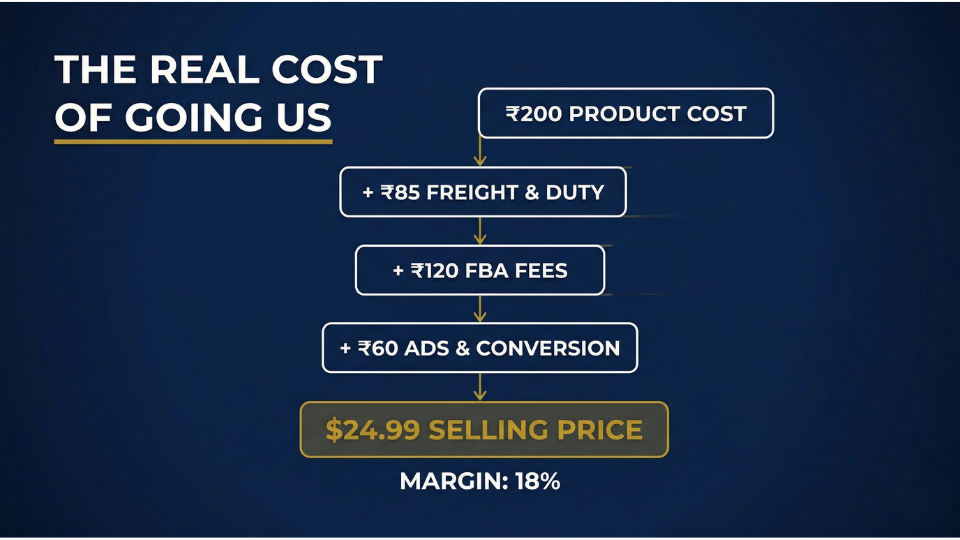
Selling on Amazon US involves layered costs. Referral fees range from 8 to 15 percent depending on category. FBA adds fees for picking, packing, shipping, storage, and returns, varying by product size and weight. Beyond these, factor in international freight, customs brokerage, and Amazon's currency conversion spread. Ankit Menon from Surat shipped leather wallets to the US without calculating his full landed cost. After duties, brokerage, FBA fees, and ads, his margin was just 8 percent. He had to reprice upward and switch to sea freight to make the numbers work. For a deeper breakdown of every fee type, check out our post on understanding Amazon fees.
Tax Obligations — W-8BEN, Importer of Record, and Landed Cost
As an Indian seller, you complete a W-8BEN form (or W-8BEN-E for businesses) during Amazon's tax interview to establish your foreign tax status and prevent a default 30 percent withholding. You also need an Importer of Record for inbound FBA shipments, a customs broker or third-party IOR service. The critical discipline is modelling your landed cost before shipping: cost of goods, freight, duties, brokerage, FBA fees, and currency conversion combined, before setting your price.
Thinking of expanding beyond India? Our 3-Day Amazon Business Training walks you through marketplace selection, compliance, and your first international shipment — step by step.
Amazon UK from India — High Trust, Post-Brexit Logistics
Market Opportunity — Revenue, Traffic, and Category Demand
The UK is Amazon's second-largest European market, generating $37.9 billion in revenue with roughly 400 million monthly visitors. It commands about 30 percent of the entire UK e-commerce market. For Indian sellers, the UK offers a strong English-speaking audience and high demand in categories like home textiles, ethnic fashion, and beauty products. Competition is noticeably lower than in the US, giving well-optimised listings a better chance of ranking organically.
VAT Registration and Post-Brexit Inventory Rules
Here is where the UK gets tricky. Since Brexit, Amazon UK operates as a separate logistics entity from the EU. If you store inventory in the UK using FBA, you must register for UK VAT separately — there is no shortcut around this. Farhan Sheikh from Mumbai expanded to Amazon UK in early 2025 without registering for VAT upfront. Three months in, he received a compliance notice and had to retroactively file returns, which cost him both time and money. VAT registration is not optional if you are using FBA in the UK, and it is best handled before your first shipment arrives.
Fee Comparison with Amazon US
Amazon UK fees follow a similar pattern to the US — referral fees, FBA fees, and optional advertising costs. However, advertising CPC in the UK tends to run lower, which means your marketing budget stretches further. The trade-off is smaller volume. A product selling 50 units daily in the US might sell 10 to 15 in the UK. For many Indian sellers, the UK works best as a second marketplace once you have validated your product elsewhere.
Amazon UAE from India — Lower Competition, Higher Order Values
Why the UAE Is a Natural Fit for Indian Sellers
Geography, language, and culture all work in your favour when selling on Amazon UAE. Shipping distances from India are shorter, which means faster delivery and lower freight costs. Listings are in English, so you skip translation headaches. The large Indian diaspora creates built-in demand for categories like spices, ethnic wear, wellness, and home décor.
Seller Count, AOV, and the Ramadan Sales Spike
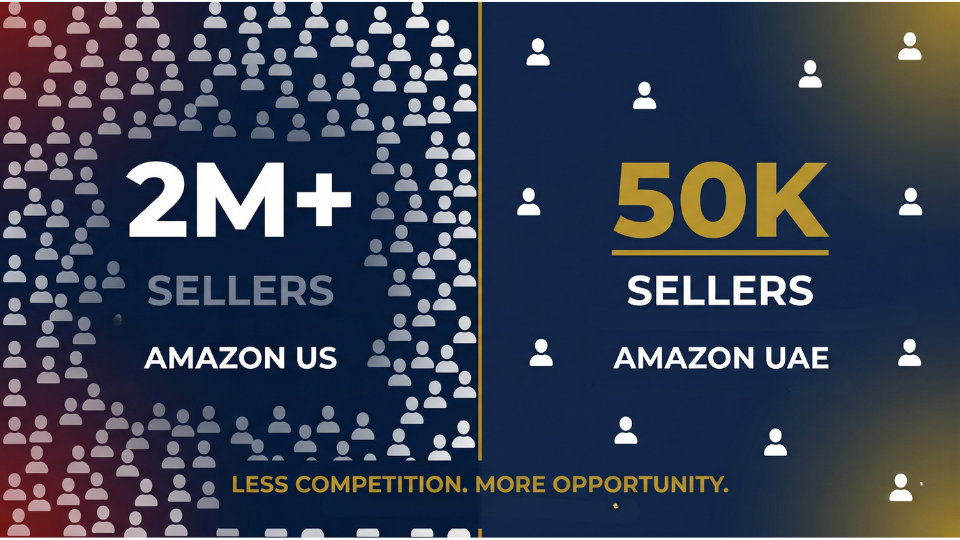
The competitive landscape in the UAE is dramatically different from the US. Amazon UAE has roughly 30,000 to 50,000 active sellers, compared to over two million in the US. The average order value in the UAE reached approximately $102 in 2024, reflecting strong purchasing power. Seasonal peaks are different too — Ramadan, White Friday in November, and UAE National Day in December all drive major sales spikes. Nisha Patel from Ahmedabad sells premium cotton bedsheets on Amazon UAE. She times her inventory shipments to arrive six weeks before Ramadan each year, and that single season now accounts for nearly 40 percent of her annual UAE revenue. If you want to sharpen your approach to seasonal selling, our guide on strategies for selling seasonal products on Amazon applies just as well to international peaks.
UAE VAT, Product Compliance, and Plug-Type Pitfalls
UAE VAT is a flat 5 percent, simpler than the UK's system. However, product compliance can catch sellers off guard. The UAE uses 220V with UK-style Type G plugs. If you sell electronics or appliances, your product must work with UAE voltage and plug type, or you must clearly disclose that an adapter is required. Listing a non-compliant product without disclosure leads to returns, negative reviews, and a damaged seller rating.
Not sure which marketplace fits your product best? In our 3-Day Amazon Business Training, we help you map your catalogue to the right country — so you invest where the returns are real.
US vs UK vs UAE — Side-by-Side Comparison for Indian Sellers
Fees, Fulfilment, and Shipping Compared
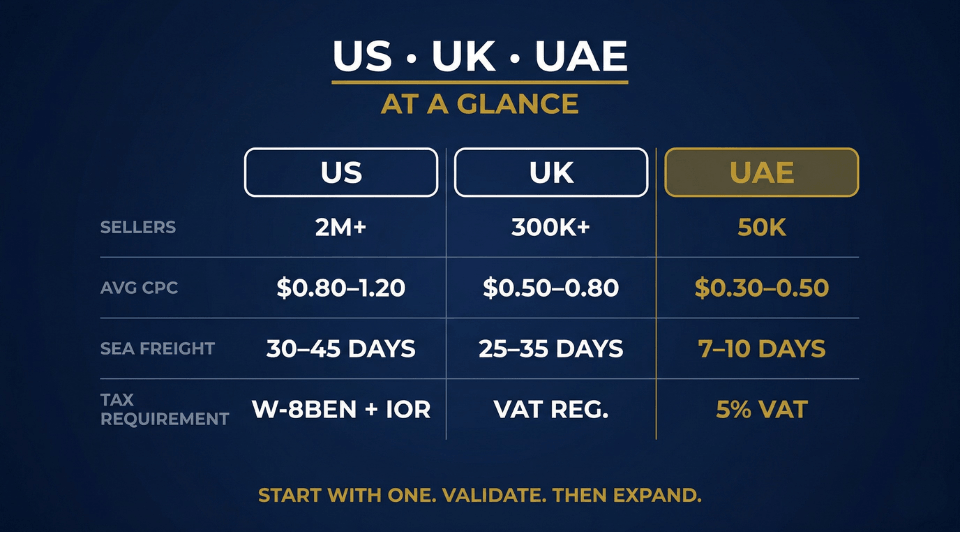
When you line the three marketplaces up, the differences become sharp. The US has the highest FBA costs due to longer shipping distances from India, with referral fees of 8 to 15 percent. The UK follows a similar fee structure but with lower advertising CPC, typically 30 to 40 percent below the US. The UAE has comparable referral fees, but FBA costs tend to be lower for lightweight products, and freight from India is significantly cheaper. Sea freight to the US takes 30 to 45 days. To the UAE, it can be as short as 7 to 10 days.
Competition Level and Ease of Entry
The US is the most competitive, with over two million sellers and established brands dominating most categories. The UK is moderately competitive with stricter post-Brexit compliance demands. The UAE is the easiest to enter, lowest seller count, English-language listings, and fewer regulatory hoops. Average CPC is also lowest in the UAE, often 30 to 60 percent below the US.
Which Marketplace Should You Start With?
There is no universal answer, but a useful framework exists. If your product is lightweight, priced between $15 and $60, and appeals to an audience familiar with Indian goods, start with the UAE. If you have strong margins and budget for a competitive launch, the US offers unmatched volume. The UK works best as a second marketplace after you have refined your approach elsewhere. The golden rule: start with one, validate, then expand. For a broader look at the global selling opportunity beyond these three markets, our post on leveraging Amazon Global Selling to expand worldwide covers the full picture.
Shipping and Fulfilment — FBA vs MFN for Global Orders
How Amazon SEND Simplifies Cross-Border Shipping
Amazon SEND is a cross-border shipping solution for Indian exporters using FBA. Once you create your inbound shipment in Seller Central, a partnered carrier picks up inventory from anywhere in India and handles end-to-end logistics including customs clearance and delivery to the destination fulfilment centre. This removes one of the biggest headaches of international selling. Air freight takes 7 to 15 days, while sea freight runs 30 to 45 days at significantly lower per-unit cost.
When MFN Makes More Sense Than FBA
Merchant Fulfilled Network is worth considering in specific situations — oversized items where FBA fees would eat your margins, seasonal products you do not want stored year-round, or new products you are testing before committing to bulk inventory. Rohit Roy from Coimbatore uses a hybrid approach. He launches new products via MFN to gauge demand with minimal upfront cost. Once a product proves itself with consistent daily sales, he migrates it to FBA for Prime eligibility and faster delivery. This test-then-scale strategy keeps his cash flow healthy and limits risk on unproven items. If you are still weighing the two models, our detailed comparison of Amazon FBA vs FBM breaks down the decision for every scenario.
FAQ
Which is the best Amazon marketplace for Indian sellers — US, UK, or UAE?
It depends on your product and budget. The UAE offers the lowest competition and fastest shipping from India, making it ideal for first-time exporters. The US delivers the highest volume but demands bigger investment. The UK is best as a second marketplace once you have validated your catalogue elsewhere.
What documents do I need for Amazon Global Selling from India?
You need an IEC code from DGFT, active GST registration with a filed LUT for zero-rated exports, PAN card, a business bank account, an AD code from your bank, and an international credit or debit card. Ensure all names match across documents to avoid verification delays.
How much does it cost to sell on Amazon US from India?
The Professional seller plan costs $39.99 per month. On top of that, you pay 8 to 15 percent referral fees per sale, FBA fees based on product size and weight, international freight charges, customs duties, and optional advertising costs. Model your full landed cost before setting prices.
Is VAT registration required to sell on Amazon UK from India?
Yes, if you store inventory in the UK using FBA, VAT registration is mandatory. There is no threshold exemption for non-UK sellers using FBA. Register before your first shipment to avoid retroactive filings and compliance penalties.
Can I sell on Amazon UAE without a US seller account?
Yes. Amazon UAE operates as a separate country-specific account. You can register directly for Amazon.ae through the Global Selling programme without needing a US or India seller account first.
Does Amazon handle customs when I use FBA from India?
If you use Amazon SEND, the partnered carrier handles customs clearance end to end. For shipments outside SEND, you will need to work with a freight forwarder or customs broker who manages the import process at the destination country.
How long does shipping take from India to Amazon US/UK/UAE warehouses?
Air freight takes 7 to 15 days across all three destinations. Sea freight takes 30 to 45 days to the US and UK, and 7 to 10 days to the UAE. The UAE has the fastest and cheapest sea freight route from India.
Can I sell on multiple Amazon marketplaces with one account?
You can link accounts across regions so that your Professional seller fee is capped at $39.99 per month total. However, each region or country requires its own seller account — linked accounts share billing but maintain separate listings, inventory, and compliance.
Conclusion — Start with One Marketplace, Scale with Confidence
Three marketplaces, three different opportunities. The US gives you unmatched scale but demands sharp margins. The UK offers a mature, high-trust audience with lower ad costs. The UAE rewards Indian sellers with proximity, cultural familiarity, and far less competition. The smartest move is not to chase all three at once. Pick the one that fits your product and budget. Validate it. Learn its compliance and buyer behaviour. Then expand from strength, not guesswork. Amazon's $80 billion export target by 2030 is not just their goal — it is your opportunity.
If you are serious about taking your products global, the 3-Day Amazon Business Training gives you the exact roadmap — from registration to your first international sale. Join the next batch and start your export journey.
