

Why Your IPI Score Quietly Controls Your Entire FBA Business
Tanvi Bhatt from Vadodara spent three weeks building stock for the Great Indian Festival. She had forecasted demand, negotiated with her supplier, and lined up a shipment that should have carried her brand through the busiest fortnight of the year. Then, eleven days before the sale, Amazon cut her storage capacity in half. The reason sat in a single number she had never bothered to check: her IPI score had slipped under the threshold, and the platform quietly closed the door right when she needed it open.
That number is the Inventory Performance Index, and it decides far more than most sellers realise. Your IPI score governs how much inventory you can send into FBA, how fast you can scale, and whether your warehouse fees stay reasonable or start to bleed your margins. It is not a vanity metric tucked away in a dashboard. It is the gatekeeper between you and the storage space your business runs on.
The harder truth is that Amazon has tightened its grip in 2026. Limits get enforced faster, surcharges hit sooner, and a score that drifts can trigger capacity cuts within days. Ignore the IPI score and you are flying blind into your biggest sales windows. Understand it, and you hold the controls.

What Is the Amazon IPI Score and How Is It Calculated?
The Amazon IPI score is a number between 0 and 1,000 that measures how efficiently you manage your FBA inventory over time. The higher it climbs, the healthier Amazon considers your account. You will find it near the top of the Inventory Performance page in Seller Central, and it works as a rolling summary of whether your stock is moving the way Amazon wants it to.
The 0 to 1,000 scale, explained simply
Think of the scale as a credit score for your inventory. A low number tells Amazon you are hoarding stock that does not sell, while a high number signals that you stock what buyers actually want and turn it over briskly. Amazon never publishes the exact formula, but it openly names the levers that move the score, which is enough to manage it well.
The four pillars Amazon actually measures
Your score rests on four factors: your excess inventory, your sell-through rate, your stranded inventory, and your in-stock rate. Excess inventory and sell-through carry the most weight, so a warehouse full of slow movers will drag your score down faster than anything else. Each pillar can be improved on its own, which is good news when you need to act quickly.
How often the score updates and why Monday matters
The four underlying metrics refresh daily, but the headline number itself recalculates weekly, usually on a Monday. That cadence matters because a single strong week of clearing excess stock can lift your number noticeably, while a quiet week of no action lets it slide. Checking it once a quarter is how sellers get ambushed.
What Is a Good IPI Score on Amazon? The 400 Line Explained
A good IPI score on Amazon is anything comfortably above 400, but treating 400 as your target is the mistake that catches most sellers off guard. The minimum threshold currently sits at 400, down from 450 in earlier years and a pandemic-era peak of 500. Cross it and you keep your storage privileges. Drift below and the penalties begin.
The score bands: below 400, 400 to 549, and 550 plus
Below 400, you face storage restrictions and overage fees. The 400 to 549 band is the average range, where performance is healthy but there is still room to tighten up. A score of 550 and above puts you in genuinely safe territory with the most breathing room under Amazon’s capacity system. The further above the line you sit, the less any single bad week can hurt you.
Why sitting just above 400 is still risky
Imran Qureshi from Hyderabad learned this the hard way. He ran his electronics-accessory brand at a steady 408 for months and assumed he was fine. Then a slow fortnight pushed his sell-through down, his score dipped to 392 on a Monday recalculation, and he received a capacity-limit notice for the next quarter. A score that hovers a few points above the threshold is not a buffer; it is a warning light. Aim for 550 and you stop living week to week.
What Happens If Your IPI Score Falls Below 400?
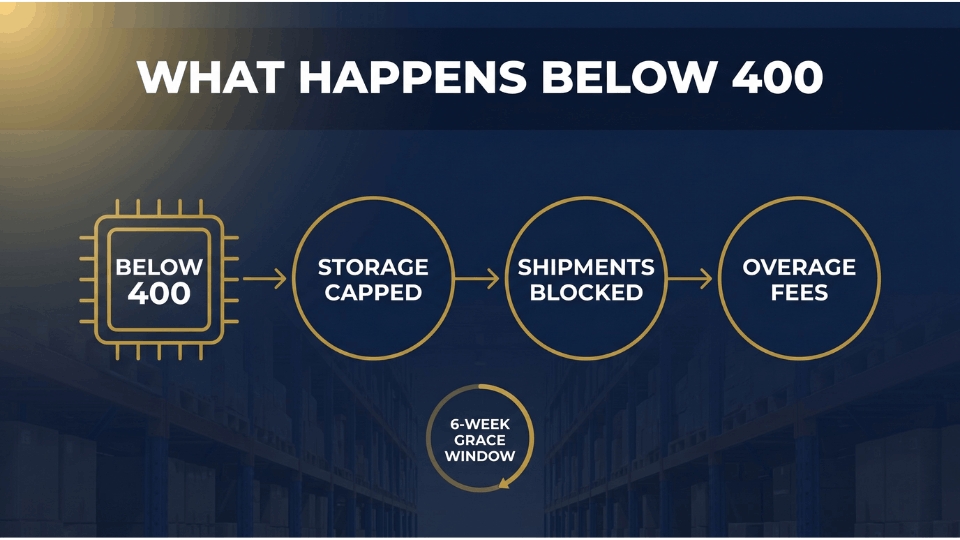
When your IPI score falls below 400, Amazon caps how much inventory you can hold in its fulfilment centres, regardless of how well your products sell. That cap is the real damage. A bestseller you know will fly during Diwali becomes useless if you cannot physically send in enough units to meet demand.
Storage limits, restock caps, and overage fees
Three things happen in sequence. Amazon limits your overall FBA storage volume, restricts how much new inventory you can ship in, and charges overage fees if you exceed the reduced cap. For a brand that leans entirely on FBA, this can choke your supply chain at the worst possible moment and hand your sales to better-prepared competitors.
The six-week grace window you cannot waste
Amazon does not drop the axe instantly. When your score falls below the threshold at a review, you receive a notification and roughly six weeks to climb back above 400 before limits apply for the next quarter. That window is your rescue lane, but only if you act on it. Most sellers who lose capacity were not blindsided by the rules; they simply let the six weeks slip past.
How to check your IPI score in Seller Central
Finding your score takes under a minute. Log in to Seller Central, open the Inventory menu, and select Inventory Planning to reach the FBA dashboard. Your IPI score appears at the top left, and clicking it breaks down the four pillars so you can see exactly which one is hurting you. Make this a weekly habit, not a panic move.
The Four Pillars: How to Improve Your IPI Score
Improving your IPI score is not mysterious once you treat it as four separate jobs, and it sits at the heart of any FBA inventory management strategy. Each pillar responds to specific actions, and fixing the heaviest one first gives you the fastest lift.
Clear excess inventory, the fastest lever
Excess inventory is the single biggest drag on most accounts, and clearing it improves two pillars at once. When you remove slow movers, your excess percentage drops and your sell-through rate rises because the average inventory you hold shrinks. Use the Manage Inventory Health page to spot aged and overstocked SKUs, then liquidate, discount, or create a removal order. Sneha Iyer from Coimbatore cleared eighteen months of dead home-décor stock through Amazon’s liquidation programme and watched her score climb roughly 80 points in three weeks.
Lift your sell-through rate
Your sell-through rate is units shipped over the last 90 days divided by your average inventory held. The fastest way to raise it is to stop overstocking and run targeted promotions on the items sitting too long. Send in one to two months of stock at a time rather than half a year, and your sell-through stays healthy by design.
Fix stranded inventory before it bleeds your score
Stranded inventory is stock that exists in fulfilment centres but has no active listing, so it cannot sell while still occupying space. Amazon flags it on the stranded inventory page, and fixing it is usually a quick listing repair. Clear these weekly and you close a silent leak.
Protect your in-stock rate on top SKUs
Running out of your bestsellers hurts your score and your ranking together. Monitor restock reports, build a 30-day reorder plan around real demand data, and keep your proven winners available without burying yourself in excess. Balance is the whole game.

How to Improve Your IPI Score Quickly (When the Clock Is Ticking)
Sometimes you are already inside the six-week window and need movement now. Speed is possible, but it comes from triage, not magic.
Emergency moves inside the grace window
Start by attacking excess and stranded inventory in the same week. Create removal or liquidation orders for your worst aged SKUs, run aggressive discounts on slow movers to force sell-through, and pause inbound shipments on anything already overstocked. Karthik Reddy from Vijayawada pulled his score from 374 to 431 in under a month by liquidating two dead product lines and discounting a third hard enough to clear it before the quarter closed.
The hybrid FBA and FBM safety net
The smartest long-term fix is a hybrid model. Keep your fast movers in FBA to win the Prime badge and maximum velocity, and route your slower products through FBM so they never weigh on your IPI score. This is also where the difference between FBA and FBM pays off. This protects availability without forcing dead stock into Amazon’s warehouses, and it keeps you off the emergency treadmill entirely.
What This Means for Indian Sellers
The IPI score has always mattered, but 2026 raised the cost of ignoring it for sellers in India specifically.
Storage utilisation surcharge and earlier aged-inventory fees
Amazon now applies a storage utilisation surcharge when you hold more than 26 weeks of inventory, and aged-inventory fees that once waited a full year now begin around 181 days and step up again past 271 days. In plain terms, holding slow stock is more expensive than it has ever been, so it pays to handle long-term storage fees early, and a weak score compounds the pain by capping how much you can hold in the first place.
Festival-season overstock, the hidden IPI trap
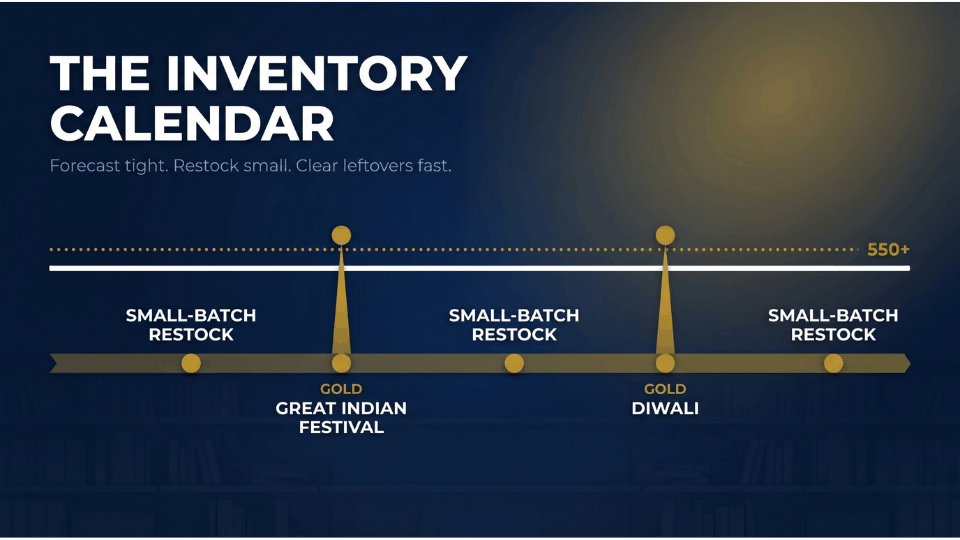
Meghna Saikia from Guwahati fell into the classic trap. She loaded up for Diwali, sold well, then carried the leftover stock straight into a quiet January. Her sell-through cratered, her excess percentage spiked, and her score slid into the danger zone just as she started planning her next launch. The Indian sale calendar tempts every seller to overstock, and a good Great Indian Festival strategy plans the clear-out upfront, but the smart move is forecasting tight, replenishing in small batches, and clearing leftovers within weeks of each festival rather than letting them rot into the new year.
Frequently Asked Questions
What is a good IPI score on Amazon?
Anything above 400 keeps your storage privileges, but a genuinely good IPI score is 550 or higher. The 400 to 549 band is considered average and healthy, yet sitting near the bottom of it leaves no cushion. Aiming for 550 plus gives you breathing room so a single slow week cannot push you below the threshold and trigger limits.
What happens if your IPI score falls below 400?
Amazon caps your FBA storage volume, restricts new inbound shipments, and charges overage fees if you exceed the reduced limit. These restrictions apply for the upcoming quarter and can hit right before peak sales events. You first receive a notification with roughly six weeks to recover before the limits actually take effect on your account.
How is the IPI score calculated?
Amazon does not publish the exact formula, but the score is built from four factors: excess inventory, sell-through rate, stranded inventory, and in-stock rate. Excess inventory and sell-through carry the most weight. The score runs from 0 to 1,000, and reducing unproductive stock while keeping bestsellers available is the surest way to push it up.
How often does Amazon update the IPI score?
The four underlying metrics refresh daily, but your headline score recalculates once a week, typically on a Monday. This means a strong week of clearing excess inventory can lift it noticeably within days, while inaction lets it drift. Checking it weekly rather than quarterly is what separates prepared sellers from blindsided ones.
How can I improve my IPI score quickly?
Attack excess and stranded inventory in the same week. Create removal or liquidation orders for your oldest, slowest SKUs, run sharp discounts to force sell-through, and pause inbound shipments on overstocked items. Removing excess stock is the fastest lever because it lifts both your excess percentage and your sell-through rate at the same time.
Does a new product hurt my IPI score?
Not at first. Products that are up to 90 days old generally do not factor into your IPI score, so a fresh launch that sells slowly in its early weeks will not drag you down immediately. After that 90-day window, however, the SKU begins to count, so plan to build real sell-through before the grace period ends.
Does the IPI score affect ASIN-level restock limits?
Your overall IPI score mainly governs account-level storage capacity rather than individual ASIN limits directly. That said, when your broader inventory health looks weak, individual SKUs can still get capped, so a poor score can throttle even a strong bestseller. Keeping your account healthy protects your winners from collateral restrictions.
Can I sell on Amazon FBA with an IPI score below 400?
Yes, but with reduced capacity and tighter restock limits that make scaling difficult. Your listings stay live and orders keep fulfilling; you simply cannot send in as much new inventory. Use the six-week grace window to recover before the next review locks the limits in.
Conclusion
Your IPI score is not a fee to dread or a rule to resent. It is a scoreboard that tells you, week by week, whether your inventory is working for you or against you. Tanvi lost half her capacity before a major sale because she never looked at that number. You do not have to repeat her story. Check your score every Monday, clear excess stock before it ages, keep your bestsellers in stock, and aim for 550 rather than scraping past 400. Do that and storage limits stop being a threat and become someone else’s problem.
If you want to build the full system behind a healthy account, from inventory rhythm to launches that actually scale, my 3-Day Amazon Business Training walks you through it step by step. Come learn the playbook and run your store with confidence.
