
Last September, Karthik Raman from Coimbatore placed the biggest order of his selling life. He paid a Chennai wholesaler ₹2.4 lakh for a kitchenware range, planning his first FBA shipment for the festive sale. Then Seller Central asked for approval, and his invoice came back rejected. He fixed one detail, resubmitted, and was rejected again.
By the third rejection, five weeks had passed. The sale had started without him, and 40 cartons sat stacked in his godown.
Here’s what nobody told Karthik: brand approval on Amazon India isn’t a verdict on your business. It’s a paperwork check, and paperwork can pass the first time if you know what Amazon reads.
This guide covers the documents Amazon accepts for category and brand approval, the India-specific licences that trip up experienced sellers, and the FBA gates that remain after approval. You’ll also see the rejection patterns that quietly waste weeks.
Brand Approval on Amazon India vs Brand Registry
Most sellers lose their first two weeks applying for the wrong thing. Brand approval and Brand Registry sound like cousins, but they solve different problems through separate forms.
Category, Brand and ASIN: The Three Gates
Amazon can lock a product at three levels. A category gate covers a whole department, such as grocery. A brand gate covers every product carrying one brand name, and an ASIN gate covers a single listing. Clearing one gate doesn’t clear the others, and each may need its own application.
Where Brand Registry Fits (and Where It Doesn’t)
Brand Registry is for brand owners. It uses your trademark to unlock listing control, A+ Content and protection tools. Selling approval is permission to list in a gated category or sell someone else’s brand. If you resell a distributor’s brand, Brand Registry won’t help. If you own your brand, our guide on Amazon Brand Registry in India covers that path.
Sneha Kulkarni from Nashik filed a Brand Registry application for a skincare brand she bought from a Pune distributor. Three weeks later it was declined because she didn’t own the trademark. She applied for brand selling approval instead and was approved in eight days.
Check the Gate Before You Buy FBA Stock
The cheapest approval mistake is the one you catch before paying a supplier. Once inventory is bought, every week of rejections is cash stuck in cartons, and with FBA the clock also runs against your sale window.
Reading the “You Need Approval” Message
Go to Add a Product in Seller Central, search the ASIN and open the listing limitations. If you see “you need approval to list in this brand” with a Request Approval button, you can apply. If the message says Amazon isn’t accepting applications at this time, the door is shut. Don’t buy that stock, however good the margin looks.
Check Every ASIN Before the Purchase Order
Approval for one product doesn’t guarantee the rest of a brand’s range. One ASIN may list fine while its sibling still asks for approval, so run every SKU and variant through the same check before you finalise the order.
Selling Approval Is Not FBA Eligibility
Here’s the trap FBA sellers miss. Sprays, aerosols, alcohol-based liquids and battery products go through a separate dangerous goods review before Amazon accepts them into fulfilment centres. Ask your supplier for the safety data sheet before you pay, because hazmat holds are among the inbound shipment mistakes that delay FBA stock.
Arjun Mehta from Jaipur got approved for a personal-care brand within a week. Then two of his nine SKUs, both aerosol deodorants, were held in hazmat review, leaving ₹38,000 of stock idle for a month.
Amazon Category Approval: Documents by Category
Amazon category approval in India depends as much on Indian law as on Amazon’s rules. Most gated categories want a government licence on top of a clean invoice, matched to the product, the business and often the brand.
Amazon Restricted Categories in India: The Big Four
These are the categories where Indian sellers hit paperwork most often:
- Grocery and gourmet food needs a valid FSSAI licence or registration matching your business details.
- Beauty and personal care can need licences under the Drugs and Cosmetics rules, including registration for imports.
- Electronics like power banks, chargers and adapters need BIS registration under the Compulsory Registration Scheme.
- Toys need BIS certification under the Toys Quality Control Order.
Every category also expects a compliant invoice, covered next. Check each licence’s expiry date before uploading, because an expired licence is an instant rejection.
FSSAI and the Fulfilment Centre Rule
Seller Central asks for your FSSAI licence when you add a Grocery & Gourmet product. For FBA, get food approval in place before you create an inbound shipment, and display your FSSAI number on your seller profile.
BIS Certificates Must Carry Your Brand Name
This catches private-label sellers. If you sell under your own brand, the BIS registration must be in your brand’s name. Your factory’s certificate won’t carry over, even with an authorization letter.
Fatima Sheikh from Hyderabad submitted her manufacturer’s BIS certificate for her own power banks and was rejected. She registered under her own brand, which took seven weeks, then got approved on the first attempt.
Want this on one page? Download our Category Approval Document Checklist and tick off every item before you apply.
Amazon Ungating Invoice Requirements That Pass
The invoice decides most approvals. Amazon ungating invoice requirements look simple, yet small mismatches cause most rejections Indian sellers see.
The Six Checks Every Invoice Must Clear
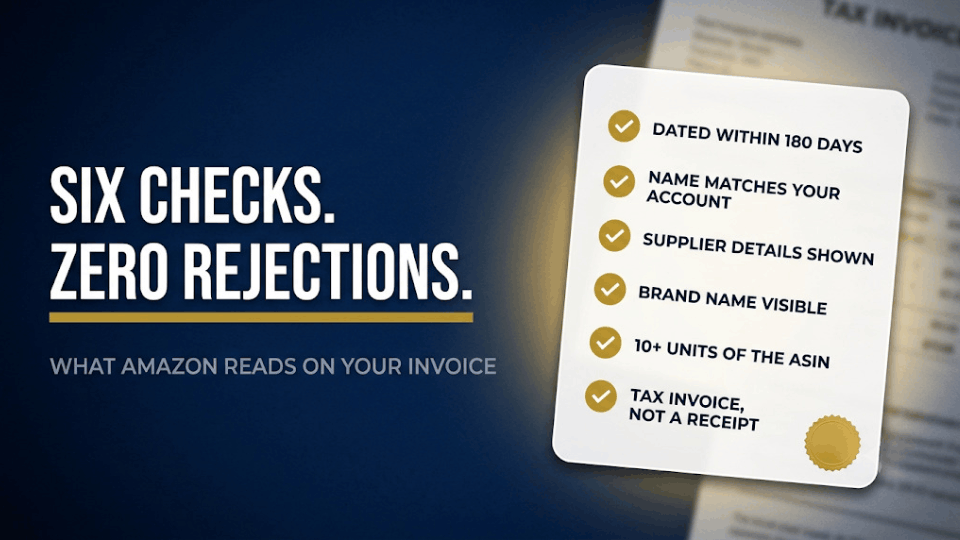
Before you upload, hold your invoice against these six checks:
- It’s dated within the last 180 days.
- Your business name and address match your Seller Central account exactly.
- The supplier’s full name, address and contact details are clearly printed.
- The brand name appears against the products.
- The quantity meets your approval page’s requirement, usually 10 units.
- It’s a commercial tax invoice, not a retail receipt.
Your approval page shows the exact requirement for each brand, so read it before ordering. Some brands ask for more than ten units.
GST Details Indian Sellers Get Wrong
The most common Indian mismatch is legal name versus trade name: your account carries your legal name while the supplier bills your shop name. Make sure the buyer GSTIN is yours, check the supplier’s GSTIN is active on the GST portal, and upload every page, stamped and signed.
Why Retail Bills and Quotations Fail
Retail receipts are the biggest single cause of rejection. A receipt proves you bought something once; a distributor’s tax invoice proves you have a supply chain. Quotations and proforma invoices don’t count either.
Rohit Agarwal from Kolkata was rejected twice because his invoice was billed to “RA Home Store” while his account carried his legal name. His supplier reissued it, and approval came in six days.
Brand Authorization Letter for Amazon: Get It Right
When a brand is tightly controlled, an invoice alone may not be enough. That’s where a brand authorization letter for Amazon comes in.
Who Can Sign It and Who Can’t
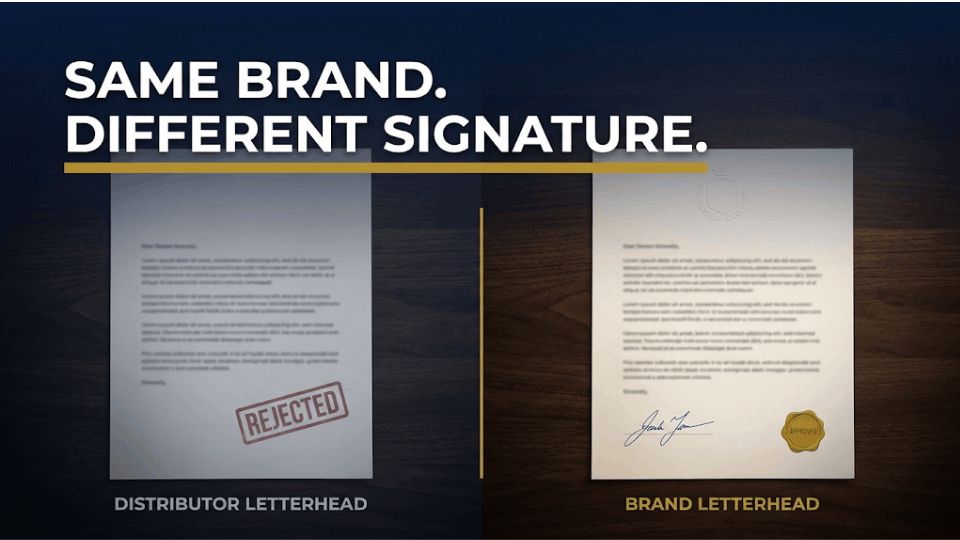
Only the brand owner can authorize you. Your distributor may be genuine and officially appointed, but a distributor isn’t the brand. Amazon may contact the brand to confirm your letter, so never edit, reuse or borrow a letter issued to another seller.
What the Letter Must Say
A strong letter sits on the brand’s letterhead with a date and the signatory’s name, designation and signature. It names your legal business and seller display name, lists the brands or products covered, mentions Amazon.in and states a validity period. It also gives a contact email on the brand’s own domain. If you download a brand authorization letter format online, check it against this list, because generic templates miss half of it.
Formats Amazon Accepts
PDFs and clear scans are standard. A self-declaration only works if you own the brand. An email from the brand’s official domain can also work, shared as a screenshot showing the sender’s address.
Deepa Iyer from Chennai had her first letter rejected because it was on the distributor’s letterhead. The brand’s regional sales manager issued a fresh one from the brand’s domain, and approval landed in five working days.
Rather not draft one from scratch? Use our Brand Authorization Letter Template and the email script we use to request one from a brand’s sales team.
How to Get Brand Approval on Amazon, Step by Step
Here’s how to get brand approval on Amazon without the back-and-forth, then move your stock into FBA cleanly.
Building Your Amazon Brand Approval Documents Pack
Work through these steps in order:
- Confirm the gate for every ASIN you plan to sell.
- Collect the invoice, the brand letter if needed and any category licence.
- Match every name and address against your Seller Central account.
- Scan every page clearly as a PDF.
- Click Request Approval and upload the complete pack in one go.
- Save your case ID and the date you applied.
One complete submission beats three partial ones. Keep your Amazon brand approval documents in one folder so the next application takes minutes.
From Approval to Your First FBA Shipment
Create your inbound shipment only after every ASIN shows as approved. There’s a GST gate too: each fulfilment centre storing your stock must be an Additional Place of Business on your GST registration, or inbound shipments to that state can’t go ahead.
How Long Approval Takes in India
Sellers commonly see a decision in about 7 to 10 working days, though Amazon publishes no official timeline and brand approvals can take longer. For festive sales, apply at least four weeks before your inbound deadline.
Manpreet Kaur from Ludhiana applied five weeks before the Great Indian Festival with her Additional Place of Business already registered. Her shipment checked in on time, and she sold 420 units that month.
Amazon Brand Approval Rejected? Fix It Before Reapplying
Even careful sellers get rejected sometimes. How you respond decides whether it costs three days or three weeks.
The Rejection Reasons That Waste Weeks
If your Amazon brand approval is rejected, the email rarely explains why, so diagnose it against the checklists above. The usual culprits are a name mismatch, too few units of the exact ASIN, an invoice older than 180 days, a distributor’s letter instead of the brand’s, or the wrong category.
Why Resubmitting the Same Documents Backfires
Don’t hit resubmit and hope for a kinder reviewer. Amazon has said that reapplying for the same brand on a new case without new information can trigger an automatic rejection. Every resubmission should add something new, such as a corrected invoice, a brand letter or supplier contact details.
Staying Approved After Your Stock Goes Live
Approval isn’t always permanent. Sellers have reported being gated again after approval, then asked for a much larger invoice. Keep a folder per brand with current invoices, letters and licences, and refresh invoices before they age out. Buy only from brand-authorized distributors, because an authenticity complaint can pull your listing while your stock sits in a fulfilment centre.
Vikram Nair from Kochi resubmitted the same pack four times in six days and was auto-rejected each time. His invoice showed only six units of the ASIN, with the rest across other variants. He topped up to ten and was approved on the next attempt.
Frequently Asked Questions
How do I get brand approval on Amazon India?
Search the ASIN under Add a Product, click Request Approval and upload what Amazon asks for. Usually that’s a recent tax invoice from the brand or an authorized distributor, sometimes with a brand authorization letter. Match every name and address to your seller account, and keep your case ID for follow-ups.
What documents are required for category approval on Amazon?
It depends on the category. Grocery needs FSSAI, electronics under BIS rules need registration in your brand’s name, toys need BIS certification, and some beauty products need drug and cosmetic licences. Almost every category also needs a compliant purchase invoice, and your approval page lists the exact requirement.
Is a brand authorization letter mandatory to sell branded products on Amazon?
Not always. Many brand approvals go through with a valid invoice from the brand or an authorized distributor. Tightly controlled brands also want a letter from the brand owner. When one is needed, get it directly from the brand, never from your distributor.
Why does Amazon keep rejecting my invoice for brand approval?
Usually one detail fails: a name or address that doesn’t match your seller account, too few units of the exact ASIN, an invoice older than 180 days, or a retail receipt instead of a tax invoice. Fix that detail and add something new before you resubmit.
How long does Amazon brand approval take in India?
Many sellers get a decision in about 7 to 10 working days, but Amazon publishes no fixed timeline and some brands take longer. Each resubmission restarts the review, so for FBA stock tied to a sale event, apply at least four weeks before your inbound deadline.
What’s the difference between Brand Registry and brand approval?
Brand Registry gives trademark owners control and protection tools for their own brand. Brand approval is permission to sell a gated brand or category, whether you own the brand or resell it. Owning a trademark doesn’t automatically clear a gated category.
Can I sell branded products bought from a wholesaler on Amazon India?
Yes, if the wholesaler is a brand-authorized distributor and gives you a proper tax invoice. Open-market stock is risky, because the brand can challenge authenticity and Amazon can pull your listing. Ask for proof of the wholesaler’s appointment before a large order.
Do I need anything extra to send approved products to FBA?
Yes. Each fulfilment centre must be an Additional Place of Business on your GST registration, and sprays, aerosols and batteries may need a dangerous goods review. Food also needs category approval before you create the shipment, so sort these out before you book the inbound.
Conclusion
Getting approved on Amazon India isn’t about luck or a contact at Seller Support. It’s about handing Amazon a pack that answers every question before a reviewer asks: the right gate, the right licence, an invoice that matches your account and a letter from the brand itself.
For FBA sellers the stakes are higher. Paperwork delays freeze cash in cartons and push you past the sale windows that make your year. So check the gate before you order, build the pack once and apply early.
If you want help building the whole system, from choosing products to clearing approvals and sending your first FBA shipment, join our 3-Day Amazon Business Training. We’ll walk you through it step by step, so your next approval goes through the first time.
