
Last March, Meenakshi Sundaram from Madurai opened an email that made her stomach drop. Amazon had suppressed four of her best-selling brass pooja lamp listings, and her FBA sales fell by nearly 40% in a single week. Her cousin had quick advice: open a second Amazon seller account in your husband’s name, just as a backup. She had his PAN card on the table and the registration page open before something made her stop.
That pause probably saved her business. Amazon does allow a second seller account in specific situations, but a backup is not one of them. If Amazon connects the two accounts, it can shut down both, including the one that was perfectly healthy.
Most Indian sellers get confused here because the rules sound vague and outdated advice keeps circulating online. Some guides still tell you to apply for permission, even though Amazon stopped running an approval process years ago. This guide explains when a second account is genuinely allowed, the India-specific rules on GST and shared addresses, how linked accounts get caught, and the safe way to open one if you really need it.
Why Indian Sellers Want a Second Amazon Seller Account
Almost every seller who asks about a second Amazon seller account has one of two motives. Either they want insurance against a suspension, or they are launching something new and want it to stand on its own. The first gets people into trouble. The second only works with the right setup.
Is a Backup Account a Good Idea?
It feels logical. If one account goes down, the other keeps the money coming in. Amazon sees it the opposite way, because an account opened to keep selling through a suspension is exactly what its linking systems are built to catch. Instead of insurance, you end up with a second point of failure, since trouble in either account can drag the other one down with it.
Launching a New Brand on Its Own Storefront
Harpreet Gill from Ludhiana sold gym wear through FBA for three years before planning a kids’ activewear line. He wanted a separate storefront so parents wouldn’t scroll past adult compression tights to find toddler track pants. That instinct is reasonable, but a new brand alone doesn’t automatically justify a new account. As you’ll see shortly, the structure of the business behind the brand matters far more than the storefront name.
Can I Have Two Amazon Seller Accounts?
Yes, you can, but only under conditions that are stricter than most sellers assume.
What the Amazon Multiple Accounts Policy Says
Amazon’s Seller Code of Conduct says you may keep only one Seller Central account for each region you sell in, unless you have a legitimate business need for another and all your accounts are in good standing. That last part is the trap. If any one account slips out of good standing, Amazon can deactivate every account you run until all of them are fixed, so your accounts are effectively roped together.
Do You Need Amazon’s Approval?
Not anymore. A few years ago, Amazon stopped processing approval requests for additional accounts, and seller support now tells sellers that anyone with a legitimate business need can open one without permission. That sounds like good news, but it puts the full burden on you. Nobody at Amazon will confirm in advance that your reason is good enough. Faizal Rahman from Kozhikode learnt this the slow way, waiting five weeks on a support case for approval, only to be told Amazon no longer reviews such requests.
How Many Amazon Seller Accounts Can I Have?
There’s no fixed number. Each additional account simply needs its own legitimate reason, its own identity details and a clean health record across everything you operate.
When Is a Second Amazon Seller Account Allowed?
What Amazon Means by a Legitimate Business Need
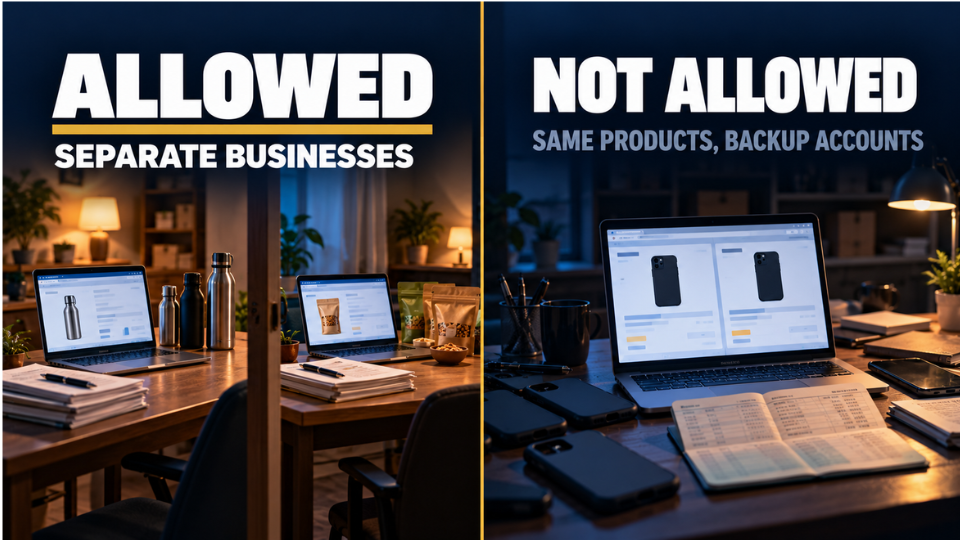
A legitimate business need means you run genuinely separate businesses that each need their own account, not a second shop window for the same operation. Amazon’s own examples include owning multiple brands with a separate business behind each one, and being recruited into an Amazon program that requires its own account.
Ananya Deshpande from Nagpur fits the first case. She sells stainless steel bottles through FBA under her proprietorship, and last year co-founded an organic snacks Pvt Ltd with a partner, its own GSTIN, bank account and warehouse. Two genuinely separate companies justify two accounts.
Reasons That Won’t Pass
A backup after a suspension, extra FBA storage capacity or a second shot at the Buy Box on your own listings will not hold up. Vikram Solanki from Rajkot opened a second account to sell the same mobile covers at a slightly lower price. Within two months, Amazon linked the accounts and deactivated both, holding back about ₹3.2 lakh in disbursements.
Before going further, make sure your current account is spotless, because a second account is only as safe as your first. Our guide to the key metrics to monitor in Seller Central walks you through the numbers Amazon watches and how to keep each one in the green.
India Rules: Same GST Number for Two Seller Accounts?
Why One GSTIN Can’t Run Two Accounts
On Amazon.in, a GSTIN can be linked to only one seller account, and onboarding partners that integrate with Amazon India confirm the same rule. Because your GSTIN is built on your PAN, a proprietor who wants a second account usually needs a separate legal entity behind it. Siddharth Bose from Kolkata found this out mid-registration. He wanted a separate account for his new Darjeeling tea brand, entered his existing GSTIN, and was stopped by an error saying an account with those GST details already existed.
Multi-State GSTINs Belong in One Account
Many FBA sellers register for GST in several states so they can store stock in fulfilment centres there. Those extra GSTINs are added to your existing seller account. They are not a reason, or a route, to open another account.
Proprietorship vs. Pvt Ltd or LLP
If your second business is real, set it up properly as its own Pvt Ltd or LLP, with its own PAN, GSTIN and current account. That paper trail is what proves the two businesses are separate if Amazon ever asks.
Two Amazon Seller Accounts at the Same Address
Family members wanting separate accounts is one of the most common questions on Amazon’s India seller forums. It can work, but a shared address makes Amazon look harder at both accounts.
When a Family Member Wants Their Own Account
Nikhil and Rohan Agarwal from Indore are brothers who run separate businesses, Nikhil in home textiles and Rohan in car accessories. They live in the same family home and, for months, used the same Wi-Fi and the same old desktop to log in to Seller Central. When Rohan’s account was deactivated over late shipments, Nikhil’s account was flagged as related within a week. Neither brother set out to break the rules. They simply left too many links between their businesses.
How to Keep Family Businesses Separate
Separate legal entities and GSTINs are the foundation. On top of that, each account needs its own email, phone number, bank account and payment card, its own devices and internet connection, and ideally its own business or pickup address. If you can’t separate the address, separate everything else and keep documents showing the businesses are independent, such as different ownership, suppliers and bank statements.
How to Open a Second Amazon Seller Account Safely
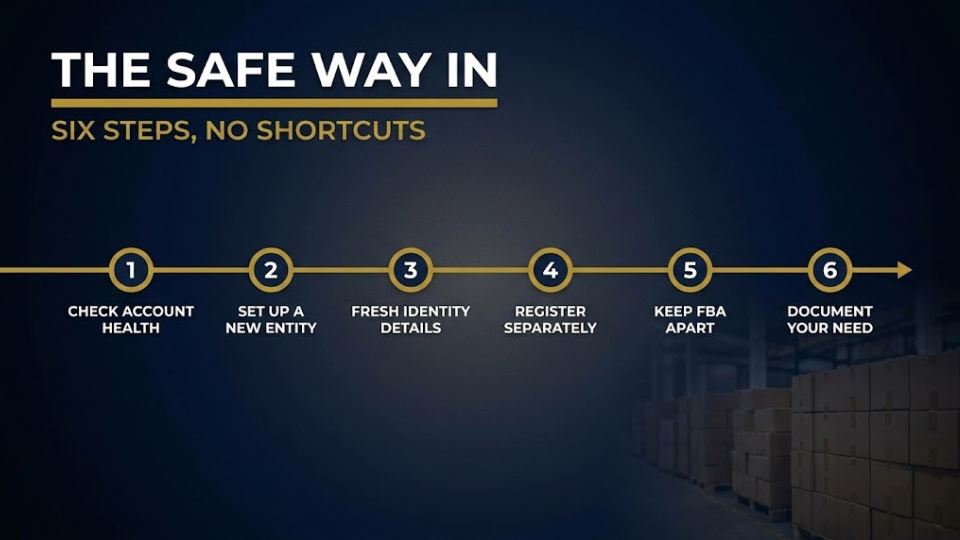
Deepa Varghese from Kochi did this the right way last year when she launched a pet-care brand alongside her established spice business. She spent about six weeks preparing before she filled in a single form, and both accounts have run without a warning since. Here is the sequence she followed:
- Check the health of your existing account first. Clear any open policy warnings and make sure your Order Defect Rate and late shipment rate are well within Amazon’s targets.
- Set up the new business properly. Register the new entity and get its own PAN, GSTIN and current account in the business’s name.
- Prepare fresh identity details. Use an email, phone number and credit card that have never been connected to your first seller account or to any Amazon buyer account.
- Register as a new seller in Seller Central. Sign up with the new business’s details, using a separate device and internet connection.
- Keep FBA operations completely apart. Each account gets its own FNSKU labels, inbound shipments and inventory, and stock can’t be moved between accounts, so plan inventory for each business from day one.
- Document your legitimate business need. Keep a short file with registration papers and bank details showing why the businesses are separate. Some sellers also open a case to put the second account on record, though Amazon doesn’t require it.
If Amazon ever reviews the link between your accounts, this paper trail is your defence. Our guide to avoiding common Amazon policy violations shows you how to keep every account you run safe from the start.
Amazon Related Account Suspension: How Links Happen
How Does Amazon Detect Linked Accounts?
Amazon doesn’t need you to admit anything. Its systems compare data points across accounts, including business and pickup addresses, names, bank accounts, payment cards, phone numbers, the devices and browsers used to log in, and the networks they connect from. One shared detail may not trigger action on its own, but every overlap strengthens the link. The moment one account gets into trouble, its connections are examined.
Hidden Links Through VAs and Agencies
Karthik Raman from Hyderabad never opened a second account. His virtual assistant, however, managed three other clients’ Seller Central accounts from the same laptop. When one of those clients was suspended, Karthik received a related account notice and spent three anxious weeks proving he had no connection to that business. Give team members their own user permissions, ask agencies how they keep client logins separate, and never share your password.
What to Do After a Related Account Notice
Read the notice carefully, because it often won’t name the account you’re linked to. List every person and device that has touched your account, gather documents proving your business is independent, and submit a clear, factual appeal.

Do You Really Need Multiple Amazon Seller Accounts?
For most sellers, the honest answer is no. What they actually need is better structure inside the account they already have, and that is far less risky than a second Amazon seller account.
Run Several Brands From One Account
Sneha Kulkarni from Nashik runs three brands, covering kitchen storage, bathroom fittings and a small home-fragrance line, all from one Seller Central account. Each brand is enrolled in Brand Registry with its own trademark, A+ Content and Brand Store, so shoppers see three distinct brands. Behind the scenes, she tracks one set of metrics, plans one FBA inventory and has only one account to keep healthy.
Use User Permissions and Global Selling
If the real problem is too many people sharing one login, add them as users with limited permissions instead. If you want to reach buyers abroad, Amazon Global Selling lets you sell on other marketplaces through accounts designed to sit alongside your Amazon.in account. Both solve the underlying problem without adding a risky second account in the same region.
Frequently Asked Questions
Can I have two Amazon seller accounts?
Yes, if you have a legitimate business need and all of your accounts are in good standing. A second account opened as a backup, or to sell the same products, breaks the policy and can put both accounts at risk.
Do I need Amazon’s approval to open a second seller account?
No. Amazon no longer reviews approval requests for additional accounts, so sellers with a legitimate business need can register directly through Seller Central. Because nobody pre-approves your reason, keep documents proving the businesses are separate. You can open a case to put the second account on record, but it isn’t required.
Can I have two Amazon seller accounts at the same address?
It’s possible, but risky. A shared address is one of the signals Amazon uses to link accounts, so if one account runs into trouble, the other may be reviewed too. Separate everything else, including the entity, GSTIN, bank account, email, phone, devices and internet connection, and keep proof that the businesses are independent.
Can I use the same GST number for two Amazon seller accounts?
No. On Amazon.in, one GSTIN can be linked to only one seller account. GSTINs from other states are added to your existing account. A genuine second account needs a separate business with its own GSTIN, which usually means setting up a separate legal entity such as a Pvt Ltd or LLP.
How does Amazon detect linked or related accounts?
Amazon matches data points such as addresses, names, bank accounts, payment cards, phone numbers, devices, browsers and internet connections. Each overlap makes accounts look related, and trouble in one account can then spread to the other.
What counts as a legitimate business need on Amazon?
Running genuinely separate businesses, such as different brands owned by different companies, or joining an Amazon program that requires its own account. A backup account, extra FBA storage capacity or a second Buy Box offer on your own listings doesn’t qualify.
Can two of my accounts sell the same products?
No. Listing the same products from two accounts looks like an attempt to control the Buy Box, and it’s one of the fastest ways to get both accounts deactivated. Keep each account’s catalogue, suppliers and FBA inventory completely separate.
Can I open a second account if my first account is suspended?
No. A new account opened while another is suspended will almost certainly be linked and deactivated, and it can damage your chances of reinstatement. Put your energy into a strong appeal for the original account first.
Conclusion
A second Amazon seller account isn’t a shortcut or a safety net. It’s a structural decision that only makes sense when you’re running two genuinely separate businesses. If that describes you, set the new business up properly, keep every login, device, bank account and FBA shipment apart, and document why both accounts exist. If it doesn’t, put that energy into making your one account stronger through healthier metrics, sharper listings and brands that stand on their own.
If you’d like guidance building that foundation, join our 3-Day Amazon Business Training. You’ll learn how to set up, run and scale your Amazon business the right way, so your growth comes from smart structure rather than risky workarounds. Your future self, and your disbursement reports, will thank you.
