
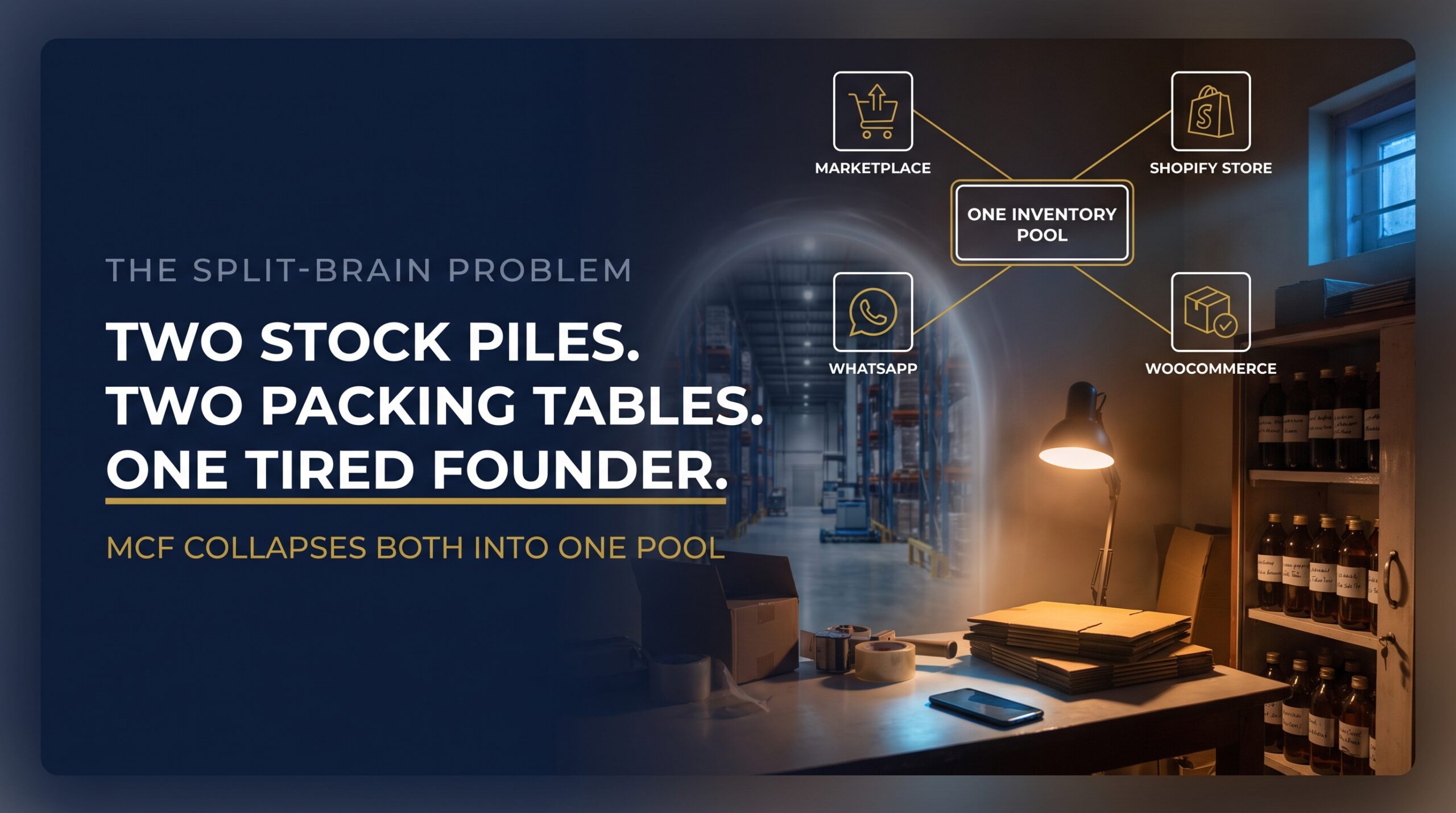
Divya Nagpal’s phone buzzed at 11:40 on a Tuesday night. An Instagram order for two bottles of her cold-pressed hair oil, paid by UPI, address in Guwahati. She was in Jaipur, staring at a cupboard holding forty bottles, while three hundred more sat inside an Amazon fulfilment centre serving her Amazon listings. Two stock piles, two sets of packing material, one very tired founder with a morning drive to the courier pickup ahead of her.
That split-brain feeling is exactly what Amazon MCF India was built to solve. Multi-Channel Fulfilment lets one inventory pool inside Amazon’s warehouses serve every channel you sell on — your Shopify store, your WooCommerce site, another marketplace, a DM that turned into a sale. Amazon picks, packs and ships, and your buyer gets a tracking number without ever visiting Amazon.
The catch is that it is not automatically cheaper or better. It depends on your weight, your margin and your delivery promise. So let’s walk through how it works, what it costs, and how to test it before you bet your operations on it.
What MCF Is and Who It Is Built For
Think of Amazon as two businesses stacked on top of each other: a marketplace and a logistics company. FBA is buying the logistics because you sold on the marketplace. MCF is buying only the logistics, while the sale happens somewhere else entirely.
The Simple Idea Behind the Service
Amazon multi channel fulfillment india means your FBA stock stops being Amazon-only stock. You submit an order with a customer name, address and SKU, Amazon fulfils it from the nearest fulfilment centre, and the parcel travels through the same network that serves Amazon orders. One pool, many storefronts, no splitting units between channels and guessing which one sells first.
Which Sellers Gain the Most From It
The biggest gains go to sellers already running FBA at reasonable volume who have started a D2C store or a second marketplace. Ship ten parcels a day across the country and MCF removes the packing table from your life. Ship two heavy parcels a week inside your own city and it usually will not.
Rohit Bansal, who sells stainless steel lunchboxes from Ludhiana, moved his website orders onto MCF and cut his packing time from fourteen hours a week to under two within a month. His lesson: the first win is time, not money.
Where Your Orders Can Come From
Practically anywhere you can capture an address — Shopify or WooCommerce, another online marketplace, WhatsApp and Instagram conversations, even a phone order from a repeat customer. The channel is irrelevant to Amazon; what matters is that the SKU is in stock and the order is created properly.
How the Fulfilment Flow Works, Step by Step
Follow a single bottle of hair oil through the system and the whole programme stops feeling abstract.
Sending Stock Into Amazon Warehouses
Nothing changes about inbound. You create a shipment in Seller Central, label the units, and send them in under the same FBA prep rules you already follow. Once received, those units sit as one pooled quantity against your FBA inventory. There is no separate MCF warehouse and no reserved bucket to manage by hand.
Creating or Syncing an Order
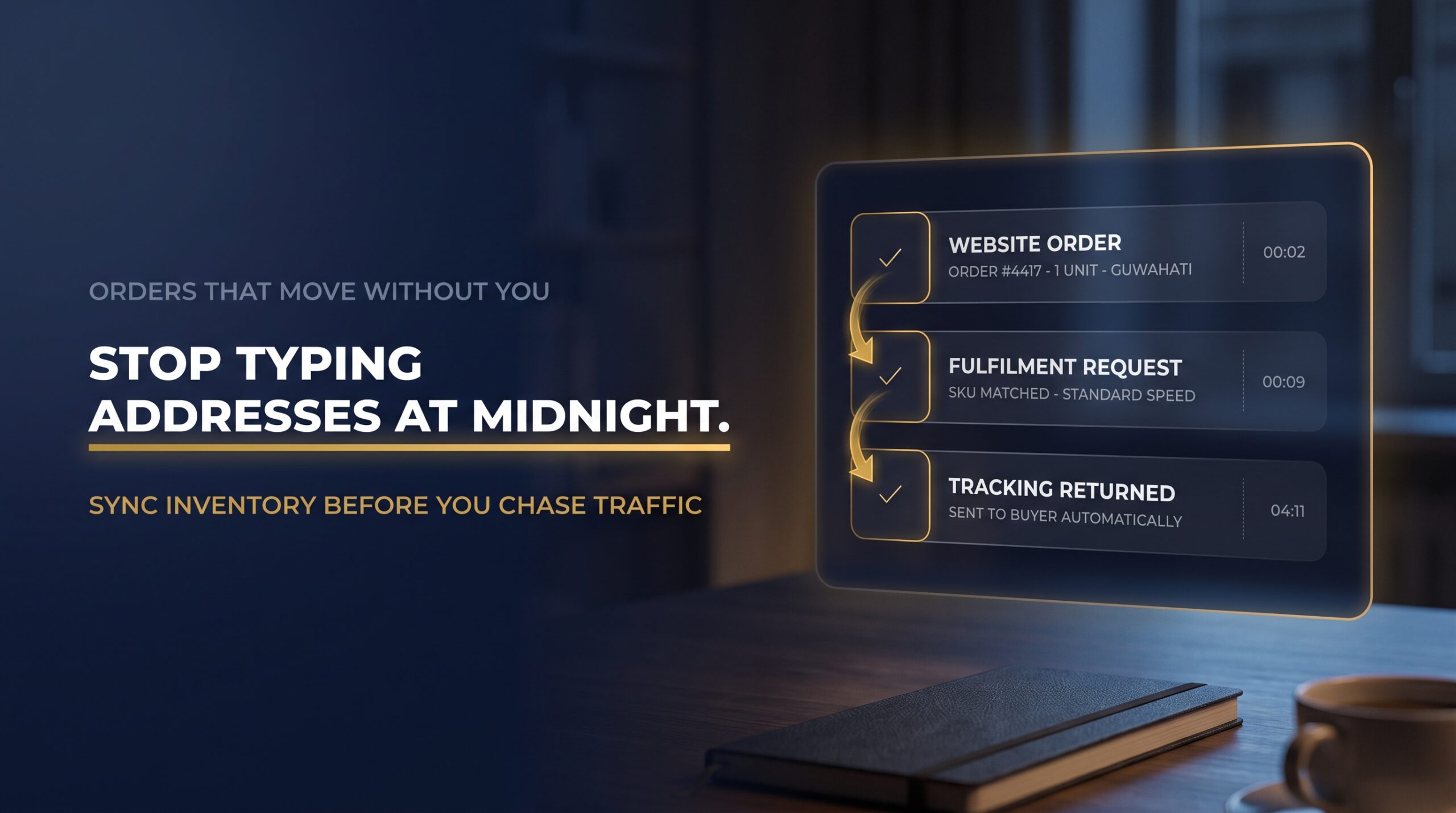
You can raise a fulfilment order manually in Seller Central for one-off sales, upload a file for batches, or let an integration push orders automatically from your store. Manual is fine at five orders a day. Beyond that, typing addresses at midnight becomes the bottleneck, and automation pays for itself in avoided typos and wrong pincodes.
Pick, Pack, Ship and Delivery Speeds
At order creation you choose a delivery speed — standard, expedited or priority — and the fee follows that choice. Amazon then picks, packs, hands the parcel to a carrier and returns a tracking number you pass to your buyer or display on your store.
Ayesha Qureshi, who sells kids’ stationery kits from Hyderabad, tested priority shipping on her Shopify store for a fortnight, watched checkout abandonment drop, then moved most SKUs back to standard once she saw the fee difference across 300 orders. Her lesson: sell speed where buyers pay for it, not everywhere.
MCF Versus FBA: What Actually Changes
Most confusion about the amazon mcf vs fba difference comes from assuming these are two warehouses or two inventory pools. They are not.
Same Warehouse, Different Order Source
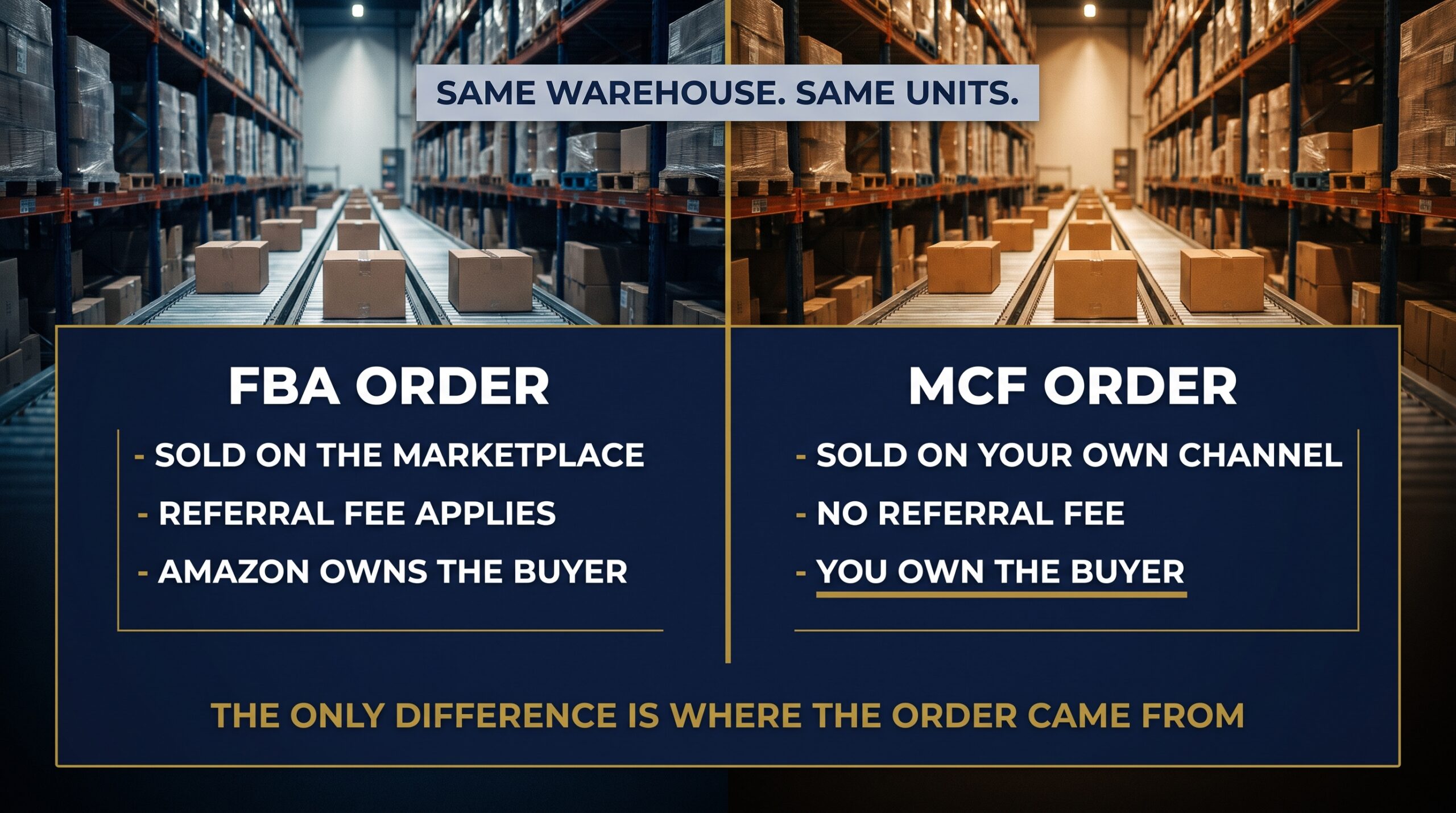
Same fulfilment centres, same units, same pick and pack operation. The only real difference is where the order originated. An FBA order arrives from the Amazon marketplace with a buyer Amazon already owns. An MCF order arrives from you, carrying a buyer you own. The stock does not know the difference.
Fees, Commissions and Who Owns the Buyer
Because the sale did not happen on Amazon, there is no referral commission on an MCF order. You pay a fulfilment fee for the shipment, and the non-transactional FBA charges you already live with — inbound transportation, monthly storage, long-term storage and removals — continue at prevailing rates. You also keep the customer relationship and the repeat-purchase opportunity, which is the quiet reason many brands push hard on D2C.
Running Both Programmes Side by Side
You do not choose one. Most sellers run FBA and MCF against the same pool, so a Diwali spike on the website draws from the units that serve Amazon. The risk is equally obvious: one bad forecast and both channels go out of stock together.
Priya Menon, who sells handmade soaps from Coimbatore, learned that the hard way when a website campaign drained 400 units in two days and left her Amazon listing out of stock for a week. Her lesson: hold a buffer before you run any D2C promotion.
Fulfilment maths sits inside pricing maths, and pricing is where most sellers quietly lose money. To work through your own numbers with someone watching over your shoulder, join the 3-Day Amazon Business Training and build the plan before you scale the orders.
Setting It Up Inside Seller Central
Enrolment is genuinely quick. The delays almost always come from listing and inventory conditions, not the sign-up itself.
Eligibility and Account Requirements
The documented requirements are straightforward: an active Seller Central account, enrolment in FBA, and a live offer on your FBA listings on Amazon.in. Account health and listing health matter too — suppressed listings and stranded inventory will block fulfilment even after you enrol. If you are brand new, create the seller account, get FBA running, then enrol.
Switching the Service On
The short answer to how to enable mcf in seller central india is that existing FBA sellers opt in from the fulfilment settings in a couple of clicks, then place a test order to confirm the flow end to end. Before you go live, work through this sequence:
- Confirm your FBA listings are active with a live offer and healthy inventory quantity.
- Enrol in Multi-Channel Fulfilment from your Seller Central fulfilment settings.
- Create one manual fulfilment order to your own address as a live test.
- Check that a tracking number returns and the parcel arrives within the expected window.
- Only then connect your store or switch on automated order sync.
That test order is not busywork. It surfaces address-format problems and SKU mismatches while the only unhappy customer is you.
Setup Mistakes That Delay Go-Live
The usual culprits are mismatched SKUs between your store and Seller Central, stranded inventory, and restricted items that cannot ship through the network. Nikhil Deshpande in Pune lost eleven days to a single SKU naming mismatch before his first website order dispatched. His lesson: align SKU codes across channels before you touch anything else.
Connecting Your Store and Other Channels
Once MCF is live, the question becomes how orders reach it without you typing them.
Linking Shopify and Similar Platforms
An amazon mcf shopify integration india setup usually runs through an app that watches your Shopify orders, pushes each one to Amazon as a fulfilment request, and writes the tracking number back so your buyer gets a normal shipping notification. WooCommerce works the same way through a plugin. Map your SKUs once, set a default delivery speed, and decide which SKUs are MCF-eligible.
Marketplaces, Social and D2C Orders
Orders from another marketplace can be pushed in the same way, provided that marketplace’s own policies allow external fulfilment. For WhatsApp and Instagram sales, where there is nothing to integrate, a manual fulfilment order takes under two minutes — and it beats driving to a courier drop-off.
Apps, APIs and Order Sync Options
Larger catalogues tend to move to a multichannel order management tool or a direct API connection, which syncs inventory both ways so your store’s stock count falls when Amazon sells the same unit. Sonal Mehra, a home-fragrance seller in Ahmedabad, connected her store in one afternoon and eliminated the overselling that had forced her to cancel roughly 6% of website orders the previous quarter. Her lesson: sync inventory before you chase traffic.
What MCF Actually Costs in India
This is where the decision is really made. Enthusiasm survives contact with a spreadsheet only if your weights and margins cooperate.
The Fee Components Explained
The mcf charges amazon india structure has one transactional piece and several ongoing ones. The MCF fee itself is driven by the dispatched shipment’s weight and the delivery speed you select, published on the MCF rate card in Seller Central. Behind it sit the FBA non-transactional fees: inbound transportation, monthly storage, long-term storage, and removal or disposal when you pull stock back.
Working Out Your Cost Per Order
A sound mcf fees calculation india starts with the rate card for your actual dispatch weight, not your product weight — packaging counts. Add storage cost per unit per month divided across expected monthly sales, add inbound freight per unit, and add a returns allowance. Divide by average order value and you have fulfilment as a share of revenue.
Meera Iyer, who sells ayurvedic teas from Kochi, ran this for one quarter: an average order value of ₹880 against a blended fulfilment cost of ₹126 put her at 14.3% — acceptable, until a heavier gift set pushed the same figure past 24% and she killed it.
Extra Costs Sellers Forget to Add
Payment gateway charges on your own store, GST on fees, the discounted shipping you promise at checkout, and slow-moving stock quietly earning long-term storage charges. Price your D2C offers with all of it visible, or your best-selling SKU becomes your least profitable one.
If your numbers land uncomfortably close to zero margin, that is a pricing and sourcing conversation, not a logistics one — and it is exactly what we work through when you spend three days inside the Amazon Business Training.
Returns, Branding and Buyer Experience
Fulfilment is not finished when the parcel leaves. How returns and packaging feel decides whether that buyer orders again.
How Returns and Refunds Are Handled
For orders from your own channels, you own the customer service relationship. You set the return policy, you talk to the buyer, and you route the return either back into Amazon’s network as returned inventory or to your own address, depending on your configuration. Refunds go through your payment gateway, not Amazon’s, so reconcile carefully during sale periods.
Packaging and Unboxing Limitations
Your parcel arrives in standard Amazon fulfilment packaging — no custom-printed box, no thank-you card, no sample sachet. For a commodity SKU nobody minds. For a gifting or premium brand it is a real trade-off, and some sellers solve it by placing branded inner packaging around the product before sending stock inbound.
Tracking and Customer Communication
Pass the tracking number on promptly and set the delivery window on your store to match the speed tier you actually chose. Arjun Kulkarni, who sells fitness accessories from Nagpur, rewrote his shipping page with realistic timelines and watched “where is my order” tickets fall by about 40% in six weeks. His lesson: accurate promises cost nothing and save everything.

Is Amazon MCF India Worth It for You?
There is no universal answer, only your numbers against your alternatives.
The Numbers That Make It Work
MCF tends to win when dispatch weight is low, average order value is healthy, orders are spread across pincodes far from your warehouse, and volume is steady enough to keep stock turning. It tends to lose on heavy or bulky SKUs, thin-margin commodity items, and catalogues full of slow movers accumulating storage charges.
When a Local 3PL Wins Instead
A local 3PL can be cheaper for slower shipping, more flexible on custom packaging and inserts, and easier for regional concentration. Amazon’s network usually wins on speed, reliability and scalability during spikes. If branded unboxing is central to your positioning, a 3PL may serve you better even at a higher per-order cost.
A 30-Day Test Plan Before Committing
Pick your three best-selling light SKUs, run them through MCF for thirty days on standard speed, and change nothing else. Log actual fulfilment cost per order, delivery times by region, return rate and complaints, then compare against your current setup.
Faizan Ahmed, who sells phone accessories from Delhi, ran exactly this pilot on four SKUs and found MCF was 18% cheaper than his courier on out-of-state orders but dearer within NCR. He now splits by region. His lesson: pilot small, then let the data draw the line.
Frequently Asked Questions
What is Amazon MCF in India and how does it work?
Amazon MCF India is Multi-Channel Fulfilment, which uses your FBA inventory to fulfil orders placed outside Amazon. You store units in Amazon’s fulfilment centres as usual, then submit fulfilment orders from your website, another marketplace or a social sale. Amazon picks, packs and ships at your chosen delivery speed and returns a tracking number for your buyer.
What is the difference between FBA and MCF?
Same warehouse, same units, different order source. FBA fulfils orders placed on Amazon.in, where Amazon owns the buyer relationship and charges a referral commission. MCF fulfils orders from your own channels, where you own the buyer, the pricing and the customer service, and pay a fulfilment fee instead. Most sellers run both against one pool.
How are Amazon MCF charges calculated in India?
The MCF fee follows the dispatched shipment’s weight and the delivery speed you select — standard, expedited or priority — as published on the MCF rate card in Seller Central. The usual non-transactional FBA charges continue alongside it: inbound transportation, monthly storage, long-term storage and removals. For true cost per order, add gateway charges, GST and a returns allowance.
What are the eligibility requirements to sign up for MCF?
Three documented conditions: an active Amazon Seller Central account, enrolment in Fulfilment by Amazon, and a live offer on your FBA listings on Amazon.in. Your listings must be active rather than suppressed, your inventory received and not stranded, and your products eligible to ship through the network. Existing FBA sellers opt in from fulfilment settings in a couple of clicks.
Does Amazon MCF charge a referral fee on non-Amazon orders?
No. Referral fees apply to sales made on the Amazon marketplace. An MCF order was sold on your own channel, so you pay the MCF fulfilment fee for that shipment plus the non-transactional FBA charges tied to holding stock. That is why D2C margins on MCF can look healthier, provided your weight band and delivery speed are sensible.
Can I use MCF if I do not sell on Amazon at all?
Not as a standalone service. The eligibility rules require an active seller account, FBA enrolment and a live offer on your FBA listings, so you need a genuine presence on Amazon.in first. In practice this is rarely a hardship, since most sellers wanting MCF already sell on Amazon and simply want website orders shipping from the same pool.
Is there a minimum order volume to use MCF?
There is no volume gate to enrol, and you can raise a single fulfilment order manually. The economics create a practical floor, though: storage charges accrue whether stock moves or not, so very low turnover makes per-order cost unattractive. Shipping only a handful of orders a week? Run a small pilot before committing the whole catalogue.
Conclusion
Strip away the noise and Amazon MCF India does one thing well: it turns a single inventory pool into delivery capacity for every channel you sell on. No second warehouse, no split stock, no midnight packing table. Your Instagram buyer in Guwahati gets the same network that serves Amazon customers.
Whether that is smart for you is a maths question, not a belief question. Pull your rate card, calculate true cost per order including storage and returns, then run a thirty-day pilot on your three lightest best-sellers and let the numbers decide.
If you would rather build that fulfilment and pricing plan with structure instead of guesswork, come take your place in the 3-Day Amazon Business Training and put the numbers to work.

2 Responses
Great article sir. Thank you for sharing. kindly share more info like this.
MCF is quite exciting to start with. Since I have not started FBA still, I am very much looking forward to start and hopefully enhance growth. Of course my target is not only FBA and MCF but also to reach international level leveraging the power of Amazon.