

Ravi had 3,000 pouches on the press at a printer in Naraina when his phone buzzed. His trademark agent had found an identical mark, already registered in the same class, filed eleven months before him. The pouches were paid for. The labels were designed. The listings were half-built. He had picked a brand name for Amazon seller purposes the way most people do — in an evening, from a shortlist of three, because it “sounded nice” — and now he was facing a rebrand before his first sale.
That story plays out quietly every month across Indian sellers, and almost none of it reaches LinkedIn. The name feels like the fun part, the bit you do between choosing a product and finding a supplier. It is actually one of the few early decisions that is genuinely expensive to reverse.
What follows is a working method: what makes a name stick, how to separate your storefront identity from your brand identity, how to screen twenty ideas down to three, how to run a proper availability check, and what the trademark process really involves before you commit a single rupee to packaging.
Why Your Brand Name Decides More Than You Think
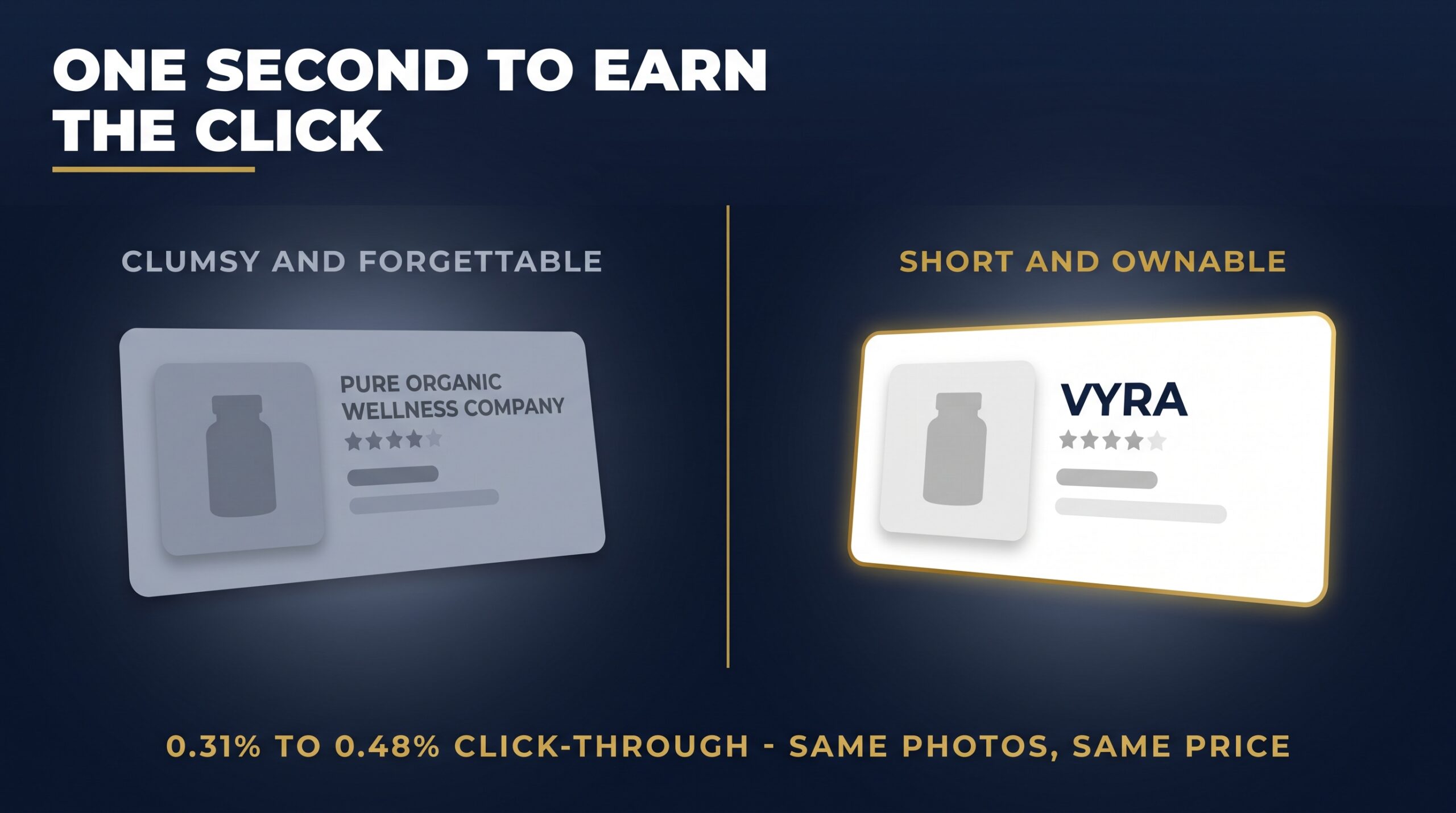
A buyer scrolling search results gives your listing about a second. In that second they register an image, a price, a review count and a word — your brand. That word either sounds like a company that will honour a replacement request, or like a placeholder someone typed at 2am.
Priya Nambiar in Kochi sold stainless steel lunch boxes under a nine-syllable family name for eight months. She switched to a five-letter coined name, kept the same photos and price, and her click-through rate on her main keyword moved from 0.31% to 0.48% within six weeks. Nothing else changed. Her lesson: the name is working in search results whether you planned it or not.
The name is your first conversion trigger
Trust gets built before the detail page loads. Short, clean names read as established; long descriptive strings read as generic. Buyers cannot articulate this, but their clicks show it. A name people can repeat after one exposure gets searched by name later, and branded searches convert far better than cold ones.
What a weak name costs you later
A weak name leaks money invisibly. Customers misspell it and land on a competitor. Influencers get it wrong in captions. Your title burns characters that should have carried a keyword. None of this appears as a line item, which is exactly why it goes unfixed for years.
Renaming mid-journey is expensive
Rebranding after 500 reviews means new packaging stock, new imagery, new A+ content, a fresh filing, and a spell where your old and new identities compete in search. Sellers who have done it describe two to three months of disruption. Fixing the name before launch costs you a weekend.
Seller Name or Brand Name: Know the Difference
New sellers mix these up constantly, and the confusion causes real errors during registration. The amazon brand name vs seller name distinction is simple once you see where each appears. Your seller name is the business identity attached to the account — it shows in the “Sold by” line. Your brand name is the attribute on each listing, sitting above the title on the detail page.
Rohit Malhotra in Ludhiana registered as “RM Enterprises” and launched three brands under it — gym gloves, yoga mats, resistance bands. By month fourteen, 40% of his revenue came from the gloves brand alone, and he could market it independently because buyers never needed to know RM Enterprises existed.
What buyers actually see on a listing
On the detail page, the brand name appears as a clickable link leading to your store. The seller name sits in smaller text near the buy box. Most buyers read the brand and ignore the seller line entirely unless delivery goes wrong. Design accordingly.
When both can be the same
If you plan to build one brand and nothing else, matching them is clean and helps recall. Single-brand sellers in apparel and beauty often do this deliberately. The cost is flexibility — everything you ever sell sits under that one identity.
Changing one without touching the other
Seller display names can be updated in your account settings without touching your listings. Brand names on listings are tied to your Brand Registry enrolment, which is why the brand decision deserves far more care than the seller name ever will.
The Traits That Make a Name Actually Work
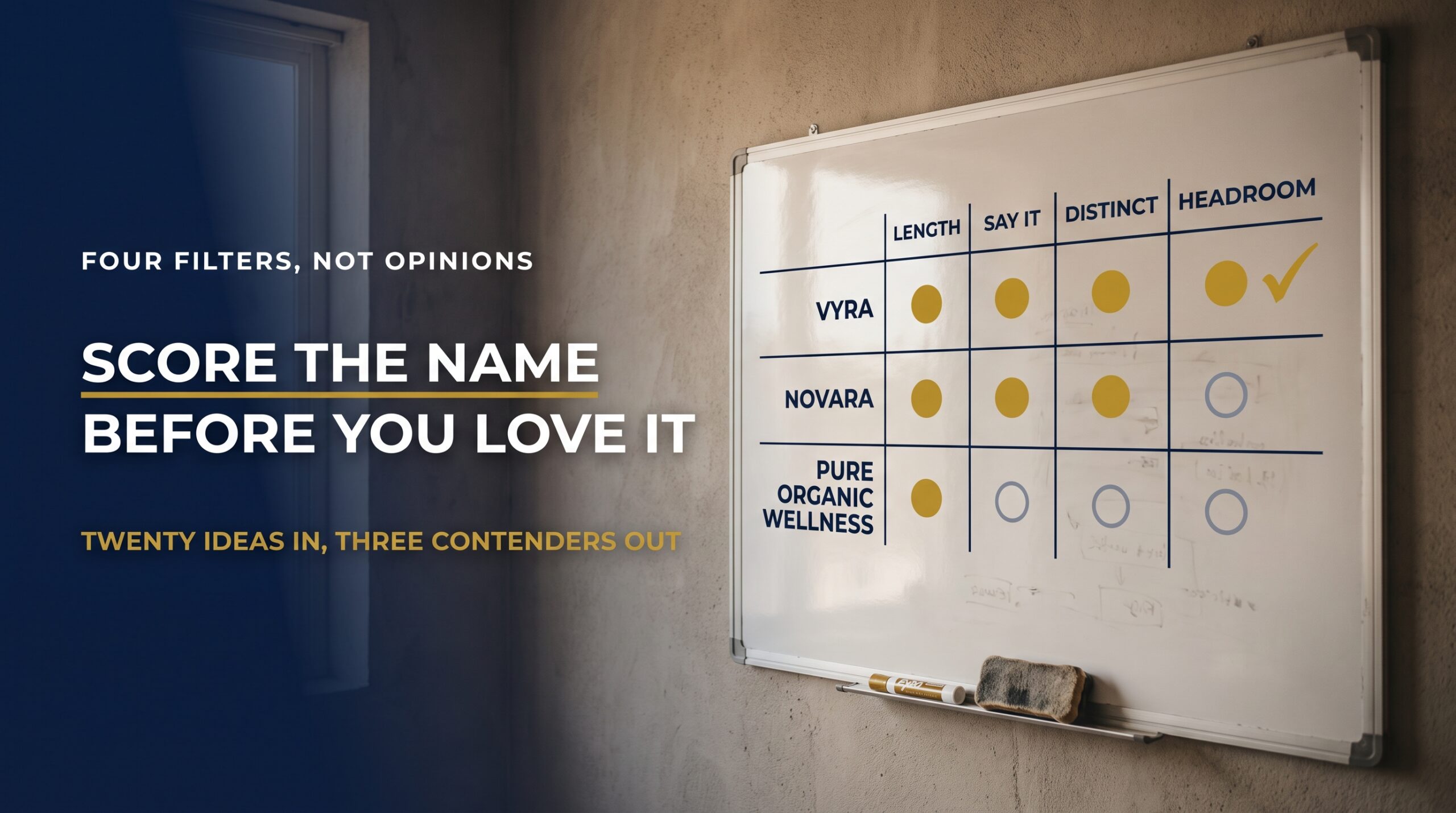
Strip away opinion and how to choose a brand name for amazon comes down to four filters: can someone say it, can someone spell it after hearing it, does it stand out in a results page, and will it still fit when you add products in three years.
Sneha Kulkarni in Pune tested two candidates for her candle brand by reading them aloud to her courier partner over a noisy phone line. One needed spelling out three times. The other was typed correctly first go. She launched with that one, and eighteen months later roughly 22% of her orders come from people typing her brand name directly.
Short, sayable and easy to spell
Four to seven letters, two or three syllables, no silent letters, no awkward double consonants. The brands you already type without thinking almost all sit in that range. Short names also leave title space for keywords that actually drive impressions.
Distinctive beats descriptive
“Pure Organic Wellness” tells buyers what you sell and nothing about who you are. It is crowded, hard to trademark and impossible to own. A distinctive name carries no meaning at first, then absorbs meaning from your products and reviews. Descriptive names stay generic forever.
Room to expand into new categories
A name built around one product traps you. If you sell yoga mats today and want water bottles next year, the name should not fight you. Keep it abstract enough that the category lives in the title, not the label.
A brand needs more than a good word on a label — it needs a product choice, a margin structure and a launch sequence that hold together. If you want that full picture before you commit, join the 3-Day Amazon Business Training and build the plan alongside the name.
Naming Styles You Can Borrow From
Staring at a blank page, style categories help more than inspiration. Most workable brand name ideas for online business india fall into four families, each suiting a different kind of private label.
Imran Qureshi in Hyderabad was stuck for three weeks on names for his leather wallet line, then simply listed twelve ideas per style across four styles — forty-eight options in ninety minutes. The name he launched with came from the blended family, and it cleared his trademark search without a single conflicting mark.
Invented and coined words
Words that do not exist are the safest to trademark and the easiest to own online. The trade-off is that you teach the meaning yourself, which takes reviews and repeat buyers. Best suited to sellers planning several categories under one label.
Real words used out of context
Everyday words borrowed from another world entirely — a bird, a river, a mineral. They feel familiar immediately. The risk is that common words often carry prior registrations in your class, so the availability check matters far more here.
Founder, place and heritage names
Surnames and place names carry warmth and credibility, particularly in food, textiles and handicrafts. Keep it to one word, not three. This is how an unwieldy full name becomes something a buyer can actually repeat back to you.
Compound and blended names
Two words fused, or two halves merged into something new. The search space is enormous, which is why this style produces the highest yield of amazon seller name ideas india that survive both the trademark check and the domain sweep.
How to Run Your Shortlist Through Reality
A name that looks good in a font will not always survive contact with human beings. Before you spend anything on legal checks, put your twenty candidates through screening that costs nothing but an afternoon.
Deepika Rao in Mangaluru tested her final five names on customers at her mother’s pharmacy counter over two days — thirty-one people, one question each. Two names were mispronounced by more than half of them. She dropped both and launched with the clear winner, and in two years of selling not one customer email has misspelled it.
Here is the screening sequence that does the heavy lifting:
- Say each name aloud ten times, leave the room, come back — the ones you stumble on are out.
- Dictate it to your phone’s voice assistant and see what actually gets typed.
- Type it quickly five times and note the misspellings your own fingers produce.
- Read it to someone over a call without spelling it, then ask them to write it down.
- Search each survivor on Amazon with a product keyword to see whether something similar already ranks.
Run all twenty through that and you will usually be left with three or four genuine contenders.
Say it, type it, dictate it
The dictation test catches problems nothing else does. If the assistant hears “Vyra” as “Viera”, buyers searching by voice land somewhere else entirely, and you never find out it happened.
Test with ten strangers, not friends
Friends are polite and already know your business. Strangers give you a first impression, which is the only impression a buyer scrolling a results page will ever have of your brand.
Check meaning in other languages
India gives you a dozen languages where a harmless syllable can mean something unfortunate. Ask people from two or three different language backgrounds before you commit anything to artwork.
Check Availability Before You Fall in Love
This is where most of the heartbreak happens, so do it early. A proper trademark search for brand name india starts on the IP India public search portal, where you can check word marks across classes before anyone has taken your money.
Karan Mehta in Surat ran his shortlist through the database himself and found his favourite name had two live marks in class 25, the apparel class he needed. He moved to his second choice, filed within a fortnight, and had his application number in four days — no objection, no wasted packaging, no delayed launch.
Searching the IP India database
Use the public search tool, choose word mark, and search both the exact spelling and phonetic variants. Phonetics matter more than letters, because a mark that sounds like yours can block you. Search your intended class and any adjacent class you might sell into.
Domain and social handle sweep
Check the .com and .in domains plus Instagram and YouTube handles in one sitting. A name that clears the trademark but has no usable handle anywhere will cost you the moment you start driving off-Amazon traffic.
Reading classes and conflicting marks
Trademarks are granted per class, not universally. A mark in class 30 for spices does not automatically block your class 21 kitchenware. Read the status column too — abandoned and refused marks are not the obstacle live registrations are.

Getting this sequence right the first time is the difference between launching in six weeks and relaunching in six months. Walk through the whole build with guidance when you take the 3-Day Amazon Business Training.
Trademark, Brand Registry and What You Really Need
You do not need a granted registration to start selling under your own label. You do need one to unlock the tools that make branding worth the effort, which is why filing early beats filing “once sales pick up”.
Vikram Reddy in Vijayawada filed his trademark the same week he placed his first supplier order. His application number came through quickly, the registration certificate arrived about sixteen months later, and by then he had spent a year building listings on a name nobody could cheaply challenge. His comment: filing costs a weekend, not a quarter.
Filing status versus registered mark
An application gives you a number, a filing date and priority over anyone filing after you. A registration gives you enforceable rights and the strongest position with Amazon’s brand tools. Start the clock early, because priority runs from the filing date.
What Brand Registry unlocks
Enrolment gives you control of your brand’s listings, A+ content, a Brand Store, Sponsored Brands advertising and brand-level reporting. Eligibility rests on your trademark — registered, or filed through a route Amazon accepts — plus a Professional selling plan and listings in good health.
Typical filing costs and timelines
Government fees are charged per class and are lower for individuals, startups and MSME-registered businesses than for larger companies, so check the current IP India fee schedule before filing. Add professional or agent fees on top. Unopposed applications commonly take twelve to twenty-four months to register.
Lock It In: A Checklist Before You Print Packaging
Once a name survives all of the above, stop deliberating and commit. The final gate is a short private label brand name checklist you run once, in one sitting, before any money reaches a printer.
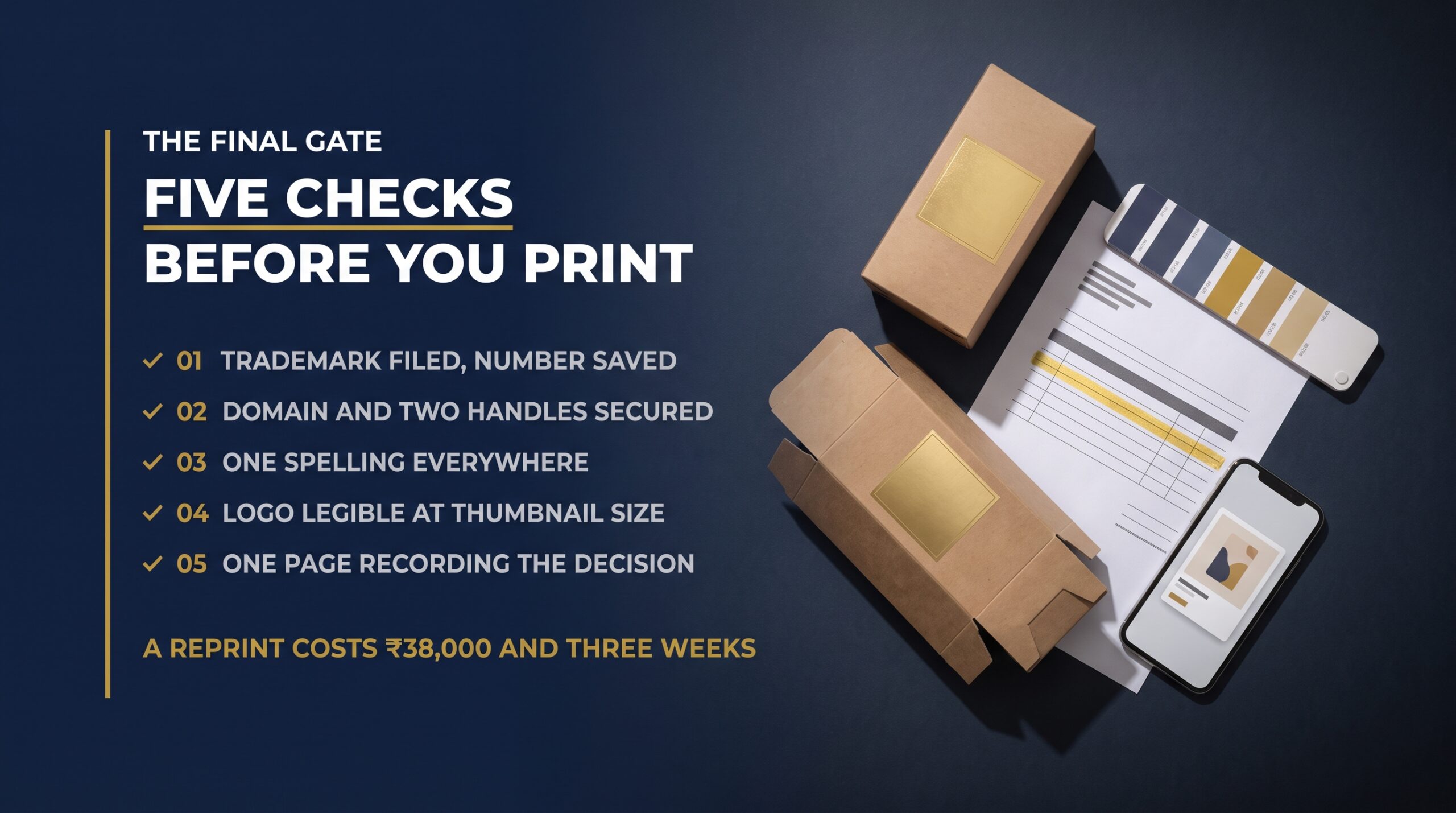
Ananya Bose in Kolkata skipped this and printed 5,000 cartons with a logo unreadable at thumbnail size on a phone. The reprint cost her around ₹38,000 and three weeks of delayed launch. Her rule now: nothing goes to print until the logo has been viewed at 200 pixels wide on a mobile screen.
Work through these before you approve artwork:
- Trademark application filed, with the number saved somewhere you can find it.
- Domain and at least two social handles secured under the same spelling.
- Brand name spelled identically across listings, packaging, invoices and GST records.
- Logo legible at thumbnail size and in single colour for cartons.
- One written page recording the name, the reasoning and the approved spelling.
That page sounds trivial until a designer joins next year and starts guessing.
Legal, digital and listing alignment
Mismatched spellings between your trademark certificate, your packaging and your listing attribute cause slow, irritating verification problems later. Align them now, down to capitalisation and spacing.
Logo, tagline and packaging fit
Test the lockup at three sizes: phone thumbnail, product label, shipping carton. A name that needs a tagline to make sense is usually a name that needs replacing.
Documenting the decision for your team
Record the chosen name, the rejected ones, the trademark class and the reasoning. That single page prevents drift when other people start touching your creative.
Mistakes That Force Sellers to Rename Later
Almost every forced rebrand traces back to one of three avoidable choices. Knowing them is cheaper than learning them.
Harpreet Singh in Amritsar named his water bottle brand one letter away from a well-known sports label. He got 400 units into the market before a complaint landed, his listing came down, and the batch became unsellable stock. He relaunched under a coined name four months later and says the lost quarter taught him more than any course had.
Copying a big brand too closely
Riding on an established mark’s recall feels clever and ends badly. Complaints are easy to file, takedowns are fast, and your account health absorbs the damage. Distance from big brands is protection, not a missed opportunity.
Names locked to one product
“MatMax” is fine until you want to sell blocks and straps. Product-locked names cap your catalogue and force a second brand you never budgeted for. Keep the category in the title, where it belongs.
Ignoring voice search and spelling
If people cannot dictate it, cannot spell it after hearing it, or type it three different ways, your branded traffic scatters. Run the dictation test before you fall in love, not after the cartons arrive.
Frequently Asked Questions
How do I choose a brand name for my Amazon seller account?
Generate twenty candidates across four styles, then filter for length, pronunciation, spelling and category headroom. Test survivors aloud on strangers and by voice dictation. Run the final three through the IP India database and a domain sweep. Whichever clears legally and phonetically wins — do not overthink aesthetics beyond that.
How do I check if a brand name is already taken in India?
Search the IP India public trademark database for word marks, checking exact spelling and phonetic variants across your class and adjacent ones. Then search the name on Amazon with a product keyword, run a Google check, and test .com and .in domains plus social handles. Four clean results means you are in good shape.
Should my Amazon seller name and brand name be the same?
They can be, and for single-brand sellers it helps recall. If you expect to launch several brands, keep the seller name neutral and let each brand stand alone. Buyers mostly read the brand on the detail page, not the “Sold by” line, so the brand carries the marketing weight.
Do I need a registered trademark to use my own brand name on Amazon India?
You can sell under your own label before registration is granted. The trademark unlocks Brand Registry — control of your listings, A+ content, a Brand Store, Sponsored Brands and brand reporting — plus the ability to act on copycats. File early, since priority runs from your filing date, and build your catalogue meanwhile.
How much does it cost to trademark a brand name in India?
Government fees are charged per class, with a lower rate for individuals, startups and MSME-registered businesses than for larger companies. Check the current fee schedule on the IP India portal, since it is revised periodically, and add a professional or agent fee. Budget per class — two categories may mean two filings.
Can I sell on Amazon India while my trademark is still pending?
Yes. Selling under your own label does not wait for a certificate. Save your application number, filing date and receipt, because Brand Registry enrolment and any dispute will need them. Unopposed applications commonly take twelve to twenty-four months, so treat that stretch as ordinary trading time and keep building reviews.
Can I change my brand name after launching my listings?
You can, but it hurts. You lose accumulated recall, reprint packaging, rebuild A+ content and Store pages, and your two names compete in search for a while. Sellers who have done it describe two to three months of instability. If a rename is coming, do it before review counts get significant.
Does my brand name need a matching domain name?
Not for selling on Amazon itself, but you will want one the moment you run off-platform traffic or approach retail buyers. A mismatch between brand and domain confuses customers and weakens branded search. Secure the .in at minimum while shortlisting, and grab matching social handles in the same sitting.
Conclusion
Naming is a one-evening decision with a ten-year shadow. Get it right and every rupee you spend on ads, packaging and content compounds into something you actually own. Get it wrong and you pay in misspellings, lost clicks and a printer’s invoice you cannot use.
So keep it short enough to type, distinct enough to trademark, broad enough to grow into. Run it through the IP India database and a handle sweep before you fall in love with it. File the application this month rather than next quarter, because priority runs from the filing date and waiting improves nothing.
Then build the business the name deserves. Come along to the 3-Day Amazon Business Training and put your product, your margins and your launch plan around the brand you just chose.

5 Responses
சிறப்பு உள்ளது
சிறப்பாக உள்ளது
Well defined and explained
Thanks
Very ueful article.
Very useful article.