

The ₹10 lakh month that ended with an empty bank account
Farhan Qureshi from Hyderabad still remembers the screenshot he sent to his family group. His home and kitchen brand had crossed ₹10 lakh in sales for the first time in a single month, and the dashboard glowed with that beautiful number. Two weeks later, his supplier called asking for an advance on the next production batch, and Farhan opened his bank account to find barely ₹70,000 sitting there. He was, on paper, a successful seller. In real life, he could not pay for his next order.
If you have felt that exact gap, you are not bad at business. You have simply run into the difference between cash flow vs profit on Amazon, the single most misunderstood idea among new sellers in India. Sales is the most misleading number on your entire dashboard. It tells you what moved off the shelf, not what survived the journey into your bank account as money you can actually spend.
This article walks through why that gap exists, where your money quietly disappears, and how the sellers who last learn to read cash instead of celebrating screenshots.

Cash flow vs profit on Amazon: what is the actual difference?
Profit is an accounting number. It is what you earned on paper once you subtract every cost from your revenue. Cash flow is something far more honest: it is the money actually moving in and out of your bank account, on the dates it actually moves. The two almost never line up, and the gap between them is exactly where most Indian sellers get caught.
Profit on paper versus money in the bank
When Anjali Nair from Kochi sold a set of cookware, her accounting software happily recorded the profit the moment the order was placed. The trouble is, that profit was a promise, not a payment. The cash for it would not reach her for another two weeks, while her supplier, her ad bills, and her GST were all waiting in the present. Learning to read your Amazon profit and loss statement is what separates a guess from a real picture of your margins.
Can an Amazon seller be profitable but still have no cash?
Yes, and it happens constantly. A seller can show a healthy profit and loss statement while every rupee of it is locked inside unsold stock, pending payouts, or money Amazon is holding back. Profitability proves your model works. It does not prove you can pay this week’s bills.
Where ₹10 lakh in sales actually goes
Picture Farhan’s ₹10 lakh again. Amazon’s referral and fulfilment fees take a sizeable slice, the cost of goods eats the largest share, advertising swallows more, returns and GST claim the rest. Once you see exactly what Amazon’s fees take, you understand why ₹10 lakh on the screen often clears as a thin sliver of real cash, and even that sliver arrives late.
Why your Amazon seller cash flow never matches your profit
The core villain here is timing. Your profit is recorded the instant a sale happens, but the cash from that sale does not land for many days afterwards. Meanwhile your supplier payments, your ad spend, and your salaries do not pause politely while you wait. Understanding your Amazon seller cash flow means understanding this delay in your bones.
The payout lag, and why suppliers will not wait
Vikram Reddy from Vijayawada learned this the hard way during a festive rush. His sales doubled, his stock vanished, and his manufacturer wanted fresh payment immediately. But the cash for those doubled sales was still sitting inside Amazon, days away from release. He had sold the goods and still could not fund the reorder.
How the Amazon payout schedule in India actually works
Amazon in India typically settles seller payments on a regular cycle, releasing funds for the previous period roughly every seven to fourteen days after delivery. Orders that deliver close to a payout date often roll into the next cycle, which means the money you “made” today might be twenty days away from being usable.
The account level reserve nobody warns you about
On top of the normal lag sits the account level reserve, a portion of your funds Amazon holds back to cover potential returns, refunds, or chargebacks. Sneha Patil from Nashik once saw ₹3 lakh marked as balance but only ₹1.4 lakh available, the rest frozen because a sudden sales spike had triggered a routine review.
The four cash traps that quietly drain growing sellers
Once you accept the timing gap, the next shock is realising that growing faster can make your cash position worse, not better. Four traps do most of the damage, and they often strike at the same time.
Inventory: your biggest frozen asset
The biggest reason for inventory tied up cash flow problems is simple. Every rupee you spend on stock is a rupee you cannot use until that stock sells and the payout clears. A warehouse full of product feels like wealth, but it is really cash in a costume, unavailable the moment you need it.
Why growing sales makes your cash problem worse
This is the cruel twist. When a product starts selling well, the natural instinct is to reorder aggressively, often with extra buffer for expected growth. Imran Shaikh from Bhopal tripled his order on a winning kitchen gadget, only to find that tripling the order also tripled the cash locked up before any of it converted back into money. A disciplined 30-day reorder plan is what keeps this instinct from draining you dry.
Ads and returns: the costs that refuse to wait
Your advertising spend leaves your account daily, long before the sales it generates pay you back. Returns hit twice, taking back the sale and often a refund administration fee with it. Both drain cash on Amazon’s schedule, not yours.

If your cash keeps vanishing despite strong sales, a simple cash-flow map of these four drains will show you exactly where it goes. Building that map for your own catalogue is one of the first things we work through inside the 3-Day Amazon Business Training, so you stop guessing and start seeing.
The cash conversion cycle: the metric that matters
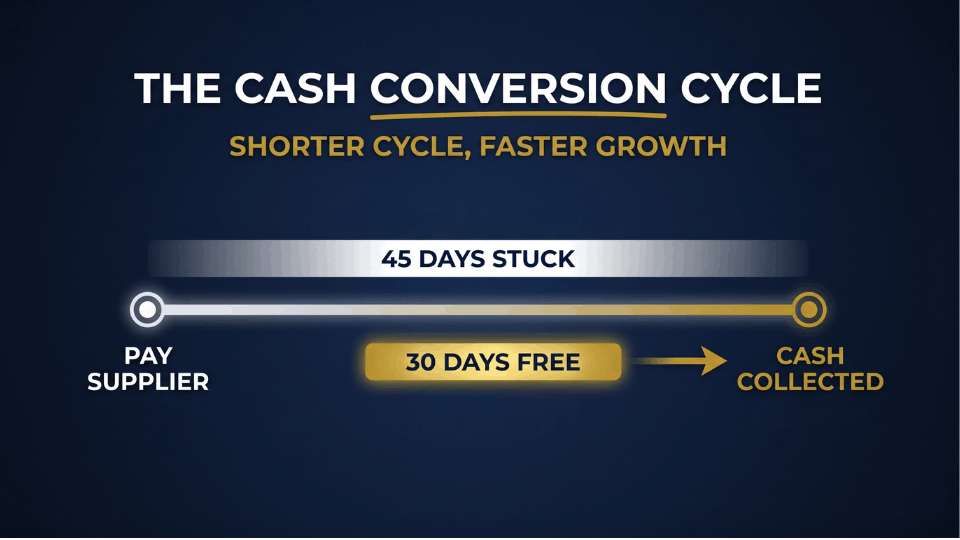
If you track only one new number this quarter, make it your cash conversion cycle. It measures the days between paying for your inventory and finally collecting the cash from selling it. The shorter that gap, the more often your money rotates, and the faster you can grow without running dry.
What is the cash conversion cycle for an Amazon seller?
It is the length of time your cash stays trapped inside the business before it comes back to you as spendable money. For most marketplace sellers it runs somewhere between thirty to ninety days, depending on how fast stock moves and how quickly payouts clear.
The formula in plain language
The cash conversion cycle works out to: days your stock sits, plus days until you get paid, minus days you are allowed to delay paying suppliers. Move any of these three levers in the right direction and you free up cash without selling a single extra unit.
A rupee example you can feel
Say Lakshmi Iyer from Madurai holds stock for sixty days, waits fifteen days for payouts, and pays her supplier on day thirty. Her cash is tied up for forty-five days on every cycle. Shrinking that to thirty days means her money works through the business more often each year, funding growth she could not otherwise afford.
How much working capital do you really need?
Once you understand the cycle, the obvious question follows. How much money do you actually need standing by so a good month never leaves you stranded again? Getting working capital for Amazon sellers right is the difference between scaling calmly and scrambling every fortnight.
How much working capital do you need?
A practical rule is to keep enough to cover the entire gap between paying for stock and getting paid for it, plus a cushion. If your cash stays locked for two months, you need at least two months of buying power available before you can safely reorder.
The reserve buffer that keeps you calm
Beyond the cycle itself, hold a reserve equal to roughly thirty to forty-five days of operating expenses. This buffer absorbs supplier delays, a slow sales week, or a sudden account review, the very surprises that sink otherwise healthy sellers.
A simple formula to size it
A workable estimate is your monthly cost of goods multiplied by your cash cycle in months, then add a safety buffer. Gurpreet Singh from Ludhiana used exactly this before a festive stock-up, and pairing it with a month-by-month revenue plan meant he walked into the season funded instead of frightened.
If you want a worked template to calculate your own number, we build this calculation step by step inside the 3-Day Amazon Business Training, using your real cost of goods and your real payout timing.
Amazon cash flow management: practical fixes
Good Amazon cash flow management is not about finding more money. It is about making the money you already have move faster and work harder. A handful of disciplined habits will do more for your cash than any loan.
You can tighten your position with a few focused moves:
- Prioritise fast-moving SKUs and clear slow stock, because the quicker inventory sells, the sooner your cash returns.
- Negotiate longer or staggered payment terms with suppliers, so your money leaves your account later rather than all at once.
- Stagger your purchase orders instead of one giant buy, keeping a portion of cash free at all times.
- Protect your account health and keep return rates low, which reduces the funds Amazon holds in reserve.
- Build your buffer before you scale, not after the cash crunch has already arrived.
The seller who applies even three of these consistently will feel the difference within a single payout cycle. When Anjali revisited her catalogue and cut two dead SKUs that were eating storage fees, the freed cash funded her next launch without a rupee of borrowing.

Frequently asked questions
Can an Amazon seller be profitable but still have no cash?
Absolutely. Profit is recorded the moment a sale happens, but the cash arrives days later, and much of it stays locked in unsold stock or Amazon’s reserve. A seller can show strong profit on paper while the bank account runs dry, which is why timing matters as much as margin.
Why does Amazon hold my money and how long is the payout in India?
Amazon settles seller funds on a rolling cycle, usually around seven to fourteen days after delivery, to allow time for returns and refunds. It may also hold an account level reserve during reviews or after sudden sales spikes. Funds delivering near a payout date often roll into the next cycle.
What is the cash conversion cycle for an Amazon seller?
It is the number of days your cash stays tied up between paying for inventory and collecting the money from selling it. The shorter the cycle, the more often your money rotates and the faster you can reinvest. Most marketplace sellers run roughly thirty to ninety days.
How much working capital do I need to sell on Amazon?
Enough to cover your full cash conversion cycle plus a buffer of about thirty to forty-five days of operating costs. A simple estimate is monthly cost of goods multiplied by your cash cycle in months, then add safety margin so a slow week never stops your reorders.
Why does growing my sales make my cash problem worse?
Because growth demands more stock, more ad spend, and more reorders, all of which consume cash upfront while the matching revenue arrives later. The faster you grow, the more money sits locked ahead of the payouts, which is how fast-scaling sellers run dry mid-success.
Is cash flow or profit more important for a new Amazon seller?
Both matter, but cash flow keeps you alive day to day while profit proves the model works long term. A profitable business with no cash cannot pay its bills, so early on, protect cash first and let healthy profit compound behind it.
How can I check my real cash position inside Seller Central?
Look beyond the sales figure to your payments and statements view, where you can see available balance, reserved funds, and pending settlements. The free reports inside Seller Central show what you can actually spend today, rather than the headline number that hides the timing gap.
Conclusion: chase cash, not just the screenshot
A ₹10 lakh sales figure is a vanity number until it clears into your bank as money you can spend. The sellers who survive their first big season are not the ones with the prettiest dashboard, they are the ones who learned to watch the cash conversion cycle, hold a buffer, and treat inventory as locked capital rather than wealth. Profit tells you the business can work. Cash flow tells you whether it survives long enough to prove it. If you want to read your own numbers with confidence and build a scaling plan that never leaves you stranded again, join us in the 3-Day Amazon Business Training and turn that screenshot into real, spendable growth.
