

Thursday evening in a Jaipur godown, and Rohit Malhotra is staring at forty cartons stacked against the wall. Seller Central has split his restock into four shipments bound for four different fulfilment centres. Four transporter quotes, four appointment slots, four sets of paperwork, four chances for something to go missing in transit. His packer has gone home. His courier partner wants an answer by morning. This is the exact moment most sellers first hear about the Amazon IXD program and wonder whether it solves the problem or simply moves it somewhere else.
It does solve a real problem, but only for sellers whose volumes and paperwork are already in order. IXD turns many outbound shipments into one and hands the redistribution work to Amazon. The longer answer involves GST registration, additional place of business filings, carton standards and a break-even point not every seller has crossed yet.
What follows is the mechanics in plain language, the eligibility reality, the tax position without hand-waving, and an honest comparison, so you can decide whether to enrol this quarter or wait two more.
What the IXD Programme Actually Means
Rohit eventually enrolled and cut his monthly dispatch work from four shipments to one, saving roughly eleven hours of coordination in the first month alone. His lesson was blunt: this is not a growth hack, it is a logistics simplification, and it pays off only if multiple dispatches were genuinely hurting you.
The full form and the simple idea behind it
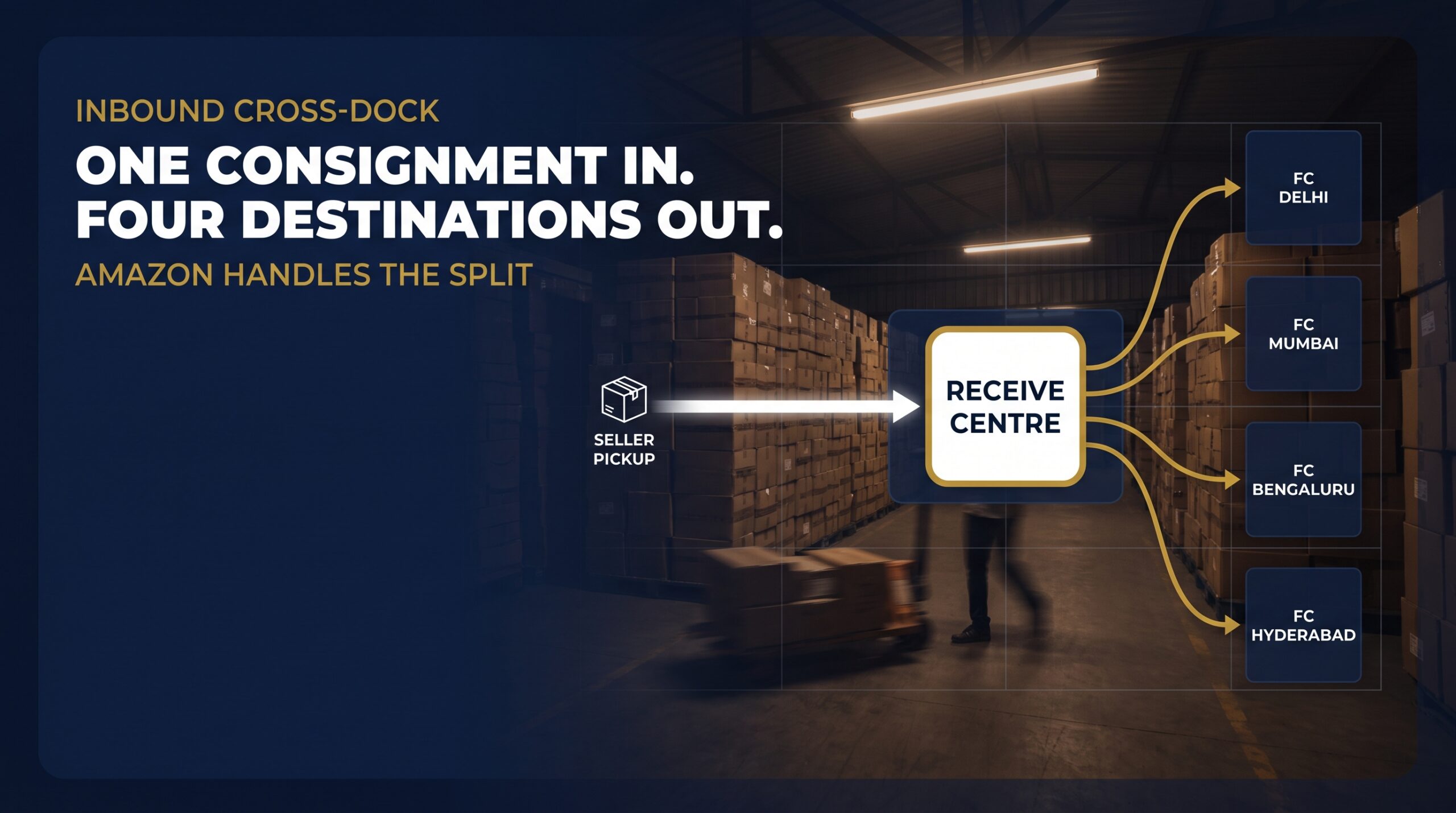
The IXD full form in Amazon terminology is Inbound Cross-Dock. Cross-docking means goods arrive at a facility, get sorted, and move straight out again without settling into storage. You send one consolidated consignment to a Receive Centre, Amazon reads demand signals across the country, and your stock is broken up and forwarded to the fulfilment centres most likely to sell it.
Who Amazon built this programme for
This was designed for sellers dispatching regularly across several regions, not someone sending twenty units a month. If your restocks are frequent, your SKU count is growing and your freight bill is climbing because of split shipments, you are the intended audience. A single slow-moving SKU gains almost nothing.
Where it sits inside Amazon FBA India
You will also see it called the Amazon inventory placement program. The two names describe the same idea from different angles: one focuses on the inbound cross-dock, the other on where stock finally lands. It sits inside FBA, not beside it, so your listings, fees and Prime badge behave exactly as before. The change is upstream, in how goods reach the network.
How a Single Shipment Reaches Many Warehouses
Sneha Kulkarni sells kitchen storage sets from Pune. Before enrolling she averaged five dispatches a fortnight; by her third consolidated consignment she was down to one, and her transporter offered a better per-kg rate because the load was bigger. Consolidation, she tells other sellers, buys you negotiating power that small split loads never will.
From your pickup point to the Receive Centre
You create the shipment plan in Seller Central as usual, and instead of a list of destination fulfilment centres you get a single Receive Centre address. One appointment, one pickup, one manifest. Everything that used to be duplicated four times now happens once.
Sorting, splitting and onward movement
At the Receive Centre your cartons are scanned and re-sorted by destination. Amazon’s forecasting decides how many units head to Delhi, how many to Bengaluru and how many stay near the metro that ordered most last quarter. That onward leg runs on Amazon’s own transport network, at Amazon’s cost.
What changes in your Seller Central workflow
Very little on the surface, which is the point. Your shipment status moves through receiving and then reflects distribution across multiple locations. Watch the restock and inventory performance dashboards as units go live, because stock does not become sellable at every centre on the same day, and that gap matters more than sellers expect.
Receive Centres Versus Fulfilment Centres
Imran Sheikh in Hyderabad lost two days chasing support because he assumed his Receive Centre was holding sellable stock. It was not. Once he understood the difference, he rebuilt his restock timing around it and his out-of-stock days fell from nine a month to two within a quarter.
What a Receive Centre does and does not do
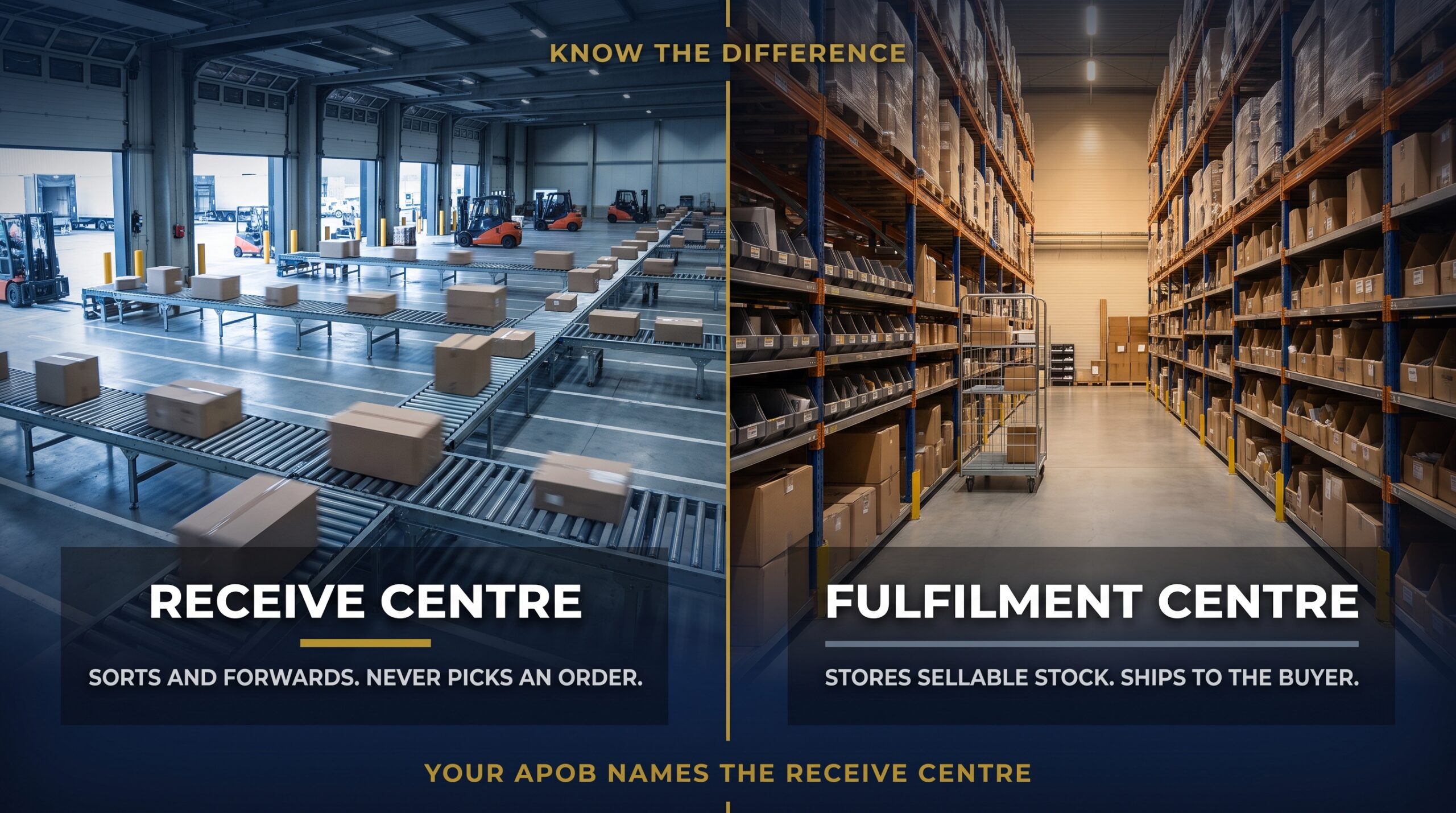
A Receive Centre receives, verifies and forwards. It is a sorting hub, not a storage building, and no customer order is ever picked from it. Think of it as the platform where your consignment changes trains, not the destination printed on the ticket.
How customer orders are actually shipped
Once units reach the fulfilment centres, they behave like any other FBA inventory. Orders are picked, packed and delivered from whichever centre sits closest to the buyer, which is exactly how delivery promises tighten. Nothing in the customer experience signals that your stock arrived through a cross-dock.
Why the distinction matters for your paperwork
Your goods movement documentation names the Receive Centre as consignee, so your invoicing, e-way bill and additional place of business records must match that address, not the downstream fulfilment centres. Mixing the two is the single most common reason sellers get stuck at reconciliation months later.
If operational detail like this is where your business keeps stalling, the systems behind it get taught step by step when you join the 3-Day Amazon Business Training and build the habits before the volume arrives.
Who Can Join and What Amazon Checks
Kavita Nair from Kochi applied twice. Her first attempt was declined on carton standards; after tightening her packing line for six weeks she was approved, and ran her first eight consignments with zero rejected cartons. The checks, she says, are practical rather than mysterious.
Account health and category conditions
The Amazon IXD eligibility requirements start with the basics: an active Professional selling plan, live FBA participation, healthy account metrics and listings free of policy flags. Category matters too, because oversized, hazardous and certain fragile items are usually excluded, since they cannot be safely re-sorted at speed.
Packaging, labelling and carton standards
Everything in your consignment must scan cleanly, first time. That means accurate FNSKU labels, correct box IDs, no mixed-case confusion, and cartons sturdy enough to survive being opened, sorted and reloaded. Receiving checks here run stricter than at a fulfilment centre because sorting is time-bound.
Minimum volume and consistency expectations
Before you enrol, sanity-check yourself against what the programme quietly assumes you can sustain every month:
- Regular restocking, not one large consignment every few months
- Enough units per shipment to justify splitting across multiple regions
- Reasonably predictable sales velocity on your top SKUs
- Clean inventory records with no long-running reconciliation disputes
- Packing capability that meets carton standards every single time
If three or more feel shaky, fix those first. Enrolment is not the hard part; staying compliant month after month is where sellers come unstuck.
GST and APOB Rules You Cannot Skip
Deepak Agarwal, a home textiles seller in Surat, delayed enrolment for five months because his consultant insisted he needed registrations in half a dozen states. When he finally checked with his own CA, the paperwork took under three weeks. Verify the tax position yourself rather than inheriting someone else’s outdated advice.
Why one state registration is usually enough
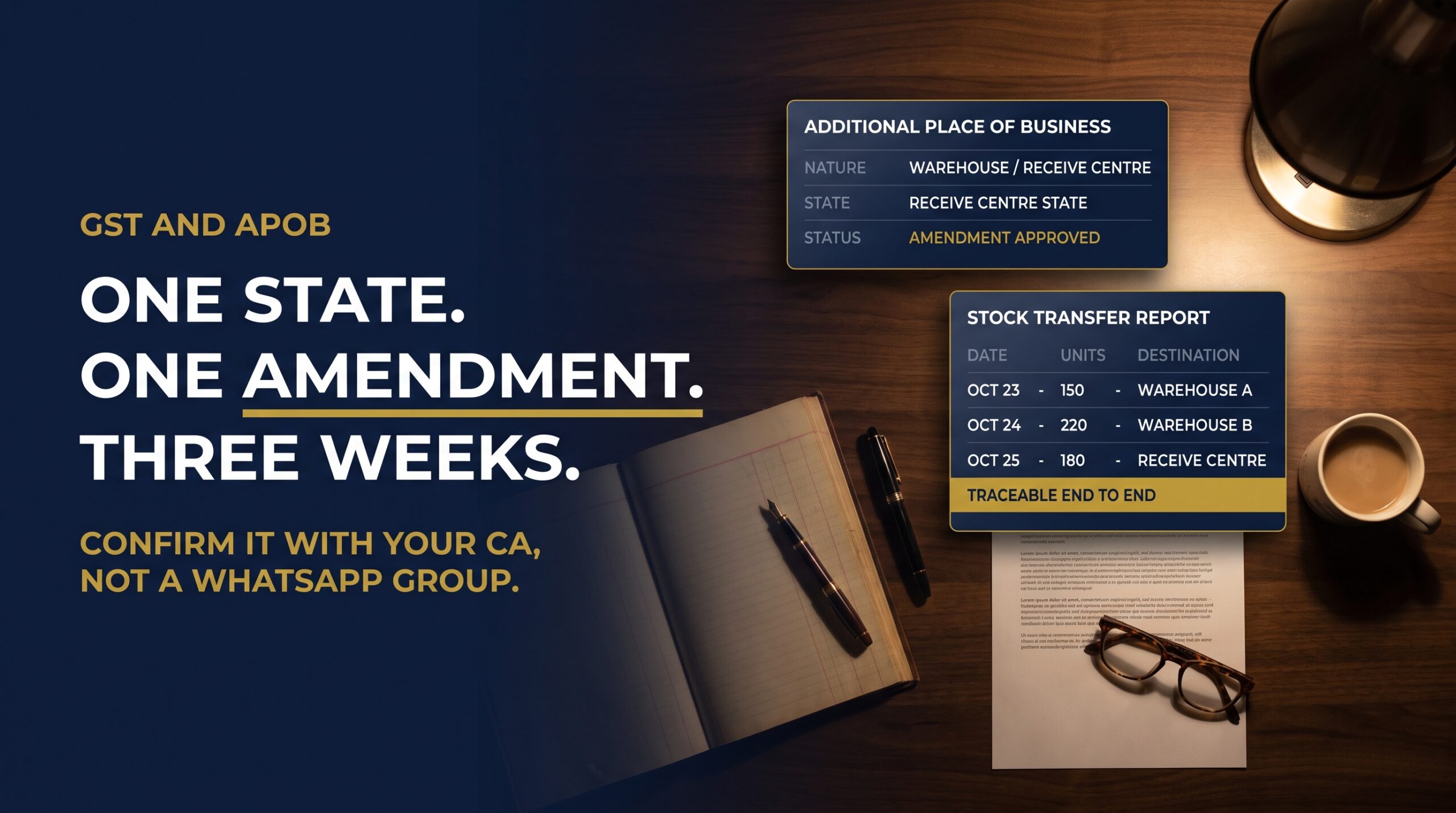
The Amazon IXD GST and APOB requirements are far less frightening than seller WhatsApp groups suggest. Because onward movement from the Receive Centre happens on Amazon’s own account and documentation, the registration burden generally sits with your principal place of business and the Receive Centre’s state. Older guidance mentioning multiple additional states is dated; confirm the current position.
Adding the Receive Centre as a place of business
You add the Receive Centre address as an additional place of business under your GST registration, exactly as you would for any FBA warehouse. Keep the amendment acknowledgement on file, because Amazon may ask for it during enrolment or an audit.
Invoicing, e-way bills and documentation
Raise your stock transfer documentation against the Receive Centre address and generate e-way bills accordingly. Amazon’s stock transfer and GST reports in Seller Central let you trace where units moved and when, which is precisely what your accountant will ask for at quarter end.
IXD Shipments Compared With Regular FBA
Farhan Qureshi runs a mobile accessories brand in Delhi and ran both models for a quarter before choosing. His freight cost per unit fell around 18 per cent under cross-docking, but only once he stopped sending small top-up consignments. The comparison depends entirely on your shipment size.
Number of shipments and freight cost
The core of ixd vs normal fba shipment thinking is consolidation. Standard FBA means several destinations, several appointments and several small loads priced at unfavourable rates. One larger consignment usually earns a better rate per kilogram and cuts handling labour in your own warehouse dramatically.
Transit time and stock-live speed
Regular shipments go straight to a fulfilment centre and go live sooner. Under cross-docking there is an extra sorting and onward leg, so plan for a slightly longer gap between dispatch and sellable stock. Sellers who forget this discover it during a festive spike, which is a painful time to learn.
Control over which regions hold your stock
With direct shipments you have more say over destinations. Under the inbound cross-dock, Amazon’s forecasting decides the split, usually smarter than a spreadsheet guess but occasionally at odds with a regional campaign you have planned. Weigh those three factors against your own numbers before committing.
Getting comfortable with trade-offs like this separates sellers who scale from sellers who stall, and it is exactly what you practise when you take a seat in the 3-Day Amazon Business Training.
The Real Savings and the Hidden Costs
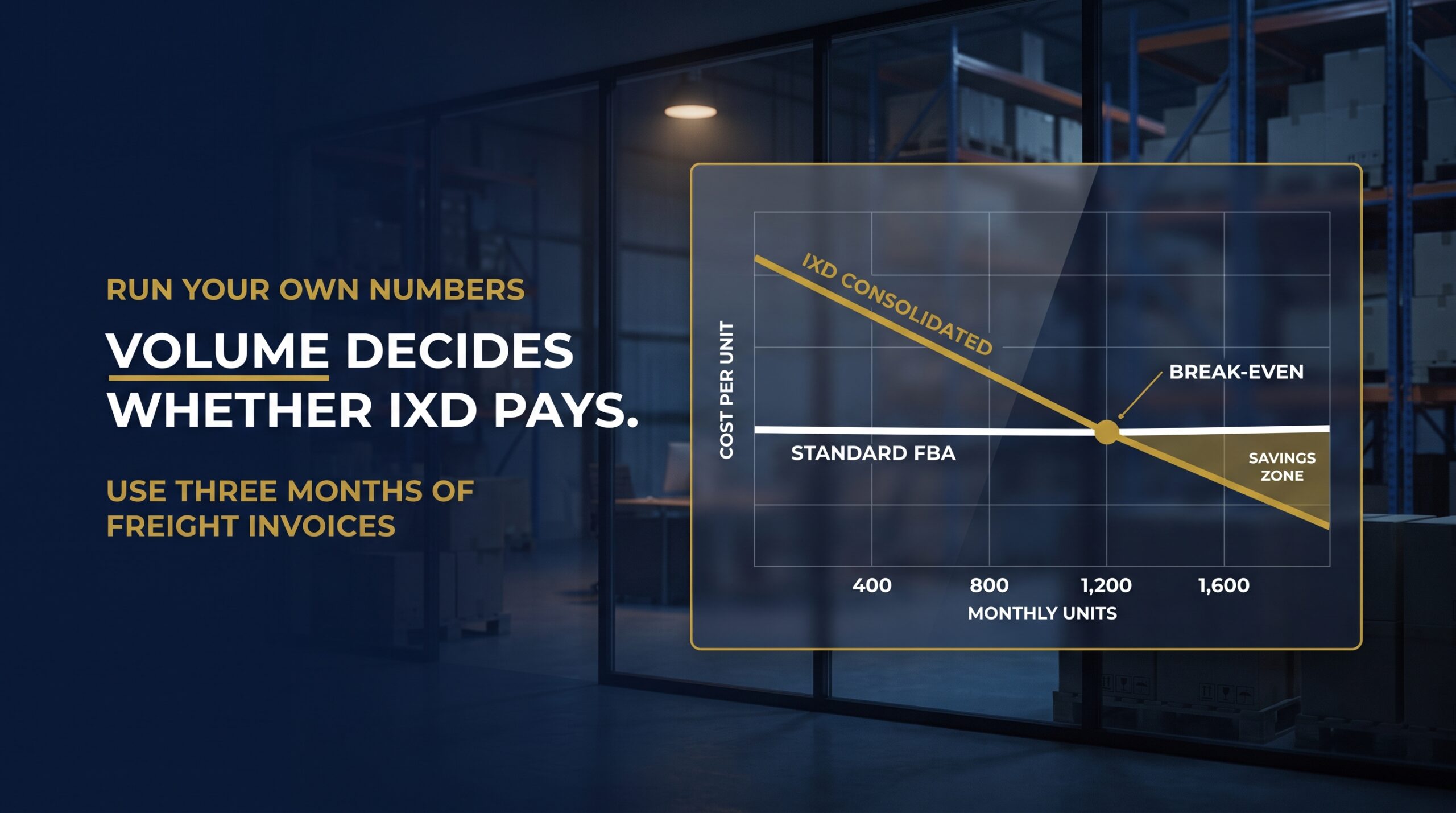
Meenakshi Iyer sells ayurvedic skincare from Coimbatore and calculated her break-even before enrolling. At roughly 1,400 units a month, the savings covered the extra packing effort by week three; at her earlier volume of 400 units, the same maths would have left her worse off.
Where sellers genuinely save money
Savings show up in three places: freight, because one consolidated load prices better; labour, because your team packs and dispatches once instead of four times; and the inter-facility movement itself, which Amazon runs on its own network rather than billing you for separate lanes. Faster regional delivery tends to lift conversion too.
Costs that quietly increase
Stricter carton standards mean better packaging material and more time per box. Your stock spreads thinner across more locations, so you may hold extra buffer inventory to avoid regional stockouts, and that carries storage cost. The additional transit leg also lengthens your cash cycle.
A simple break-even calculation
Add your current monthly freight and internal dispatch labour cost, then estimate the same under one consolidated shipment. If the saving does not clear the added packaging and buffer stock cost comfortably, you are enrolling too early. Run the numbers on three months of real data, not one good month.
Mistakes That Get IXD Shipments Rejected
Arvind Bhosale in Nashik had an entire consignment held at receiving because six cartons carried labels from a cancelled shipment plan. It cost him fourteen days of lost sales on his best SKU, and he now runs a two-person label check before every pickup.
Carton and label errors at the Receive Centre
Faded thermal labels, tape across barcodes, wrong box IDs and reused cartons with old markings are the usual culprits. Sorting at a cross-dock happens against the clock, so anything that does not scan first time gets set aside rather than investigated.
Mismatched quantities and missing documents
If your manifest says 480 units and the carton holds 476, reconciliation begins and your stock sits idle. Count twice, seal once, and make sure your invoice, e-way bill and shipment plan carry the same Receive Centre details and the same quantities.
Poor forecasting after stock is split
Once units are distributed, your national inventory number tells you less than it used to. Watch regional availability instead of the total, and reorder on sell-through per location, so one region does not run dry while another sits overstocked for months.
Should You Enrol Right Now or Wait?
Priya Ranganathan sells stationery from Chennai and deliberately waited two quarters, using the time to clean up her packing process. When she finally enrolled, her first three consignments passed without a single exception, and she has not had a shipment held since.
Signals that you are ready today
You are ready when you restock at least twice a month, when Seller Central regularly splits your shipments across three or more destinations, when your packing team meets carton standards without supervision, and when your GST and APOB records are current and clean.
When staying with standard FBA is smarter
Stay put if your volume is still modest, if you sell a handful of SKUs with unpredictable demand, or if your margins are thin enough that a longer stock-live window would hurt. There is no penalty for waiting and no prize for enrolling early.
A thirty-day plan to test it properly
Spend ten days auditing labels, cartons and documentation. Use the next ten to confirm your GST and APOB entries and model the break-even on real freight invoices. In the final ten, send one consolidated consignment of your steadiest SKU and track every day from pickup to stock going live.
Frequently Asked Questions
What is IXD in Amazon?
IXD stands for Inbound Cross-Dock. Instead of sending separate consignments to several fulfilment centres, you send one consolidated shipment to a designated Receive Centre. Amazon sorts it there and forwards units to the centres where demand forecasting says they will sell fastest. You handle one pickup, one appointment and one set of documents.
How does the Amazon IXD program work for sellers?
You create a shipment plan in Seller Central and receive a single Receive Centre destination instead of multiple fulfilment centres. Label your cartons, book one appointment, dispatch. At the Receive Centre, cartons are scanned, sorted and moved onward. Your inventory then turns sellable across several locations over the following days.
What are the eligibility requirements for the Amazon IXD program?
You need an active Professional selling plan, live FBA participation, healthy account metrics and listings without policy issues. Products must sit in eligible categories, which usually excludes oversized, hazardous and certain fragile items. Amazon also looks for consistent restocking volume and reliable carton and labelling standards, since every unit must scan correctly first time.
Do I need GST registration in multiple states for Amazon IXD?
Generally no. Because onward movement from the Receive Centre runs on Amazon’s own documentation, the obligation usually rests with your principal place of business plus the Receive Centre’s state, added as an additional place of business. Older advice demanding several state registrations is dated. Confirm the current position with your chartered accountant first.
What is the difference between an IXD Receive Centre and a fulfilment centre?
A Receive Centre sorts and forwards; it never picks a customer order. Your consignment arrives, gets verified, split by destination and sent on. A fulfilment centre stores sellable inventory and dispatches it to buyers. For paperwork, that distinction matters, because your invoices, e-way bills and APOB entry name the Receive Centre.
Does joining IXD change my FBA storage or fulfilment fees?
Your standard FBA fee structure continues, since stock still lives in fulfilment centres and is picked and packed as usual. What changes is your inbound freight profile, because one consolidated load prices better than several small ones. Storage costs can creep up slightly if you carry extra buffer inventory regionally.
Can I choose which fulfilment centres my stock is sent to?
Not under cross-docking. Amazon’s forecasting decides the split using regional demand signals, historical sell-through and network capacity. That is usually more accurate than a manual guess, but it means less control if you are planning a region-specific campaign. For precise placement on a launch, use a standard direct shipment.
How long does inventory take to go live under IXD?
Expect a slightly longer gap than a direct shipment, because of the extra sorting and onward transport leg. Units typically turn sellable in waves rather than all at once, with the nearest fulfilment centres going live first. Build that buffer into restock planning, particularly ahead of festive periods and peak-traffic weeks.
Conclusion
The Amazon IXD program rewards a specific kind of seller: one dispatching regularly, packing consistently and keeping paperwork current. Consolidating four shipments into one saves real money on freight and real hours in your warehouse, provided your volume has crossed the point where those savings outweigh stricter carton standards and a marginally longer stock-live window. On tax, the picture is far simpler than the rumours suggest, and your CA can confirm it in a single conversation.
Run your own break-even on three months of freight invoices before you decide anything. And if you want the operational discipline that makes programmes like this genuinely profitable, start with the 3-Day Amazon Business Training.
