
Six months ago, Meera Joshi from Ahmedabad noticed something strange on her own product listing. Right below the buy box on her bestselling neem face wash, a competitor's ad was pulling customers away before they could click “Add to Cart.” She was running Sponsored Products profitably, winning search results, yet losing sales on her own page. The culprit? Amazon Sponsored Display ads — except her competitor was using them, and she wasn't. If you've been running Sponsored Products and feel like there's a ceiling to your visibility, you're not imagining it. Search ads only reach shoppers actively searching. Display ads follow shoppers across Amazon and beyond — product pages, review sections, even third-party websites. This guide covers what Sponsored Display ads are, when to start using them, targeting options for Indian sellers, and how to launch your first campaign without wasting money.
What Are Amazon Sponsored Display Ads?
How Display Ads Differ From Search Ads
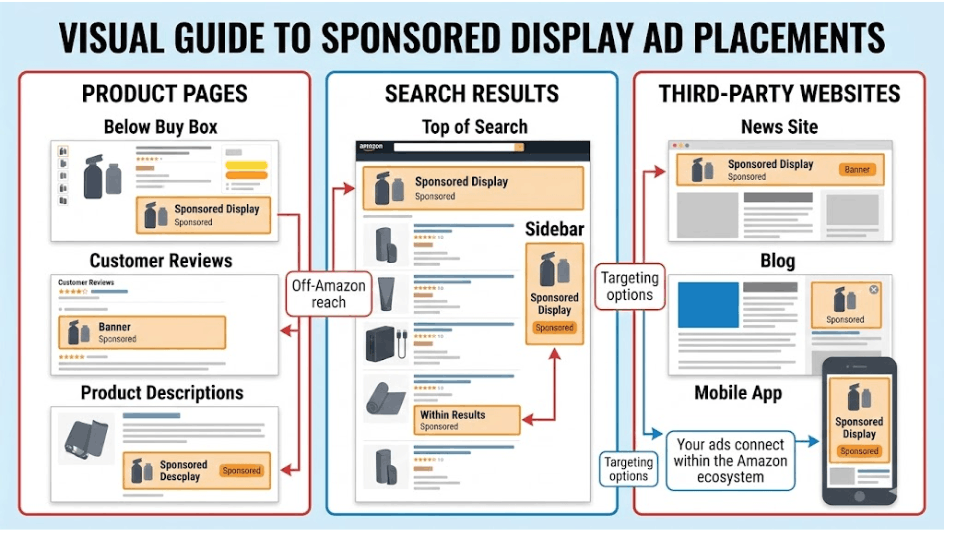
Most Amazon sellers start with Sponsored Products, which works on a simple principle — bid on keywords, show up in search results. Sponsored Display flips this model entirely. Instead of targeting keywords, these ads target shoppers based on their behaviour, interests, and browsing history. Your ads appear on product detail pages, customer review sections, the Amazon homepage, and even off Amazon on third-party websites and apps like Twitch and IMDb.
Think of it this way. Sponsored Products catches a shopper in the moment they're searching. Sponsored Display catches them everywhere else — browsing a competitor's listing, reading reviews, or scrolling through a news site three hours after they looked at your product. Amazon auto-generates the ad creative using your product image, title, rating, price, and Prime badge, so you don't need a design team to get started.
Who Can Run Sponsored Display Ads?
Here's the eligibility piece that trips up many new sellers. You need Amazon Brand Registry to access Sponsored Display. The good news for Indian sellers is that Amazon accepts trademarks registered with India's IP office, so if you've completed Brand Registry, you're set. Professional sellers and vendors in India both qualify. If you haven't registered yet, our step-by-step guide on Amazon Brand Registry in India walks you through the entire process. Meera had completed Brand Registry months before she realised Sponsored Display was available to her. Within a month of launching her first display campaign, impressions on her skincare line jumped by 35%.
Sponsored Display vs Sponsored Products: Key Differences
Targeting — Keywords vs Audiences
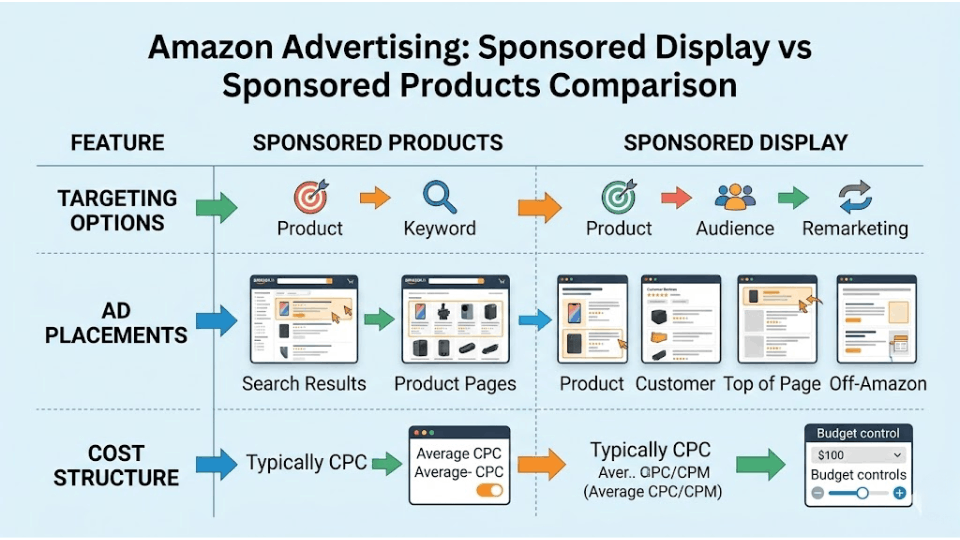
The fundamental difference comes down to how each ad type finds your customer. Sponsored Products relies on keyword targeting and ASIN targeting — you choose the search terms and competitor products you want to show up for. Sponsored Display uses audience targeting — views remarketing, contextual signals, and Amazon's first-party shopping data to find shoppers based on what they've done, not just what they're typing right now.
Where Each Ad Type Shows Up
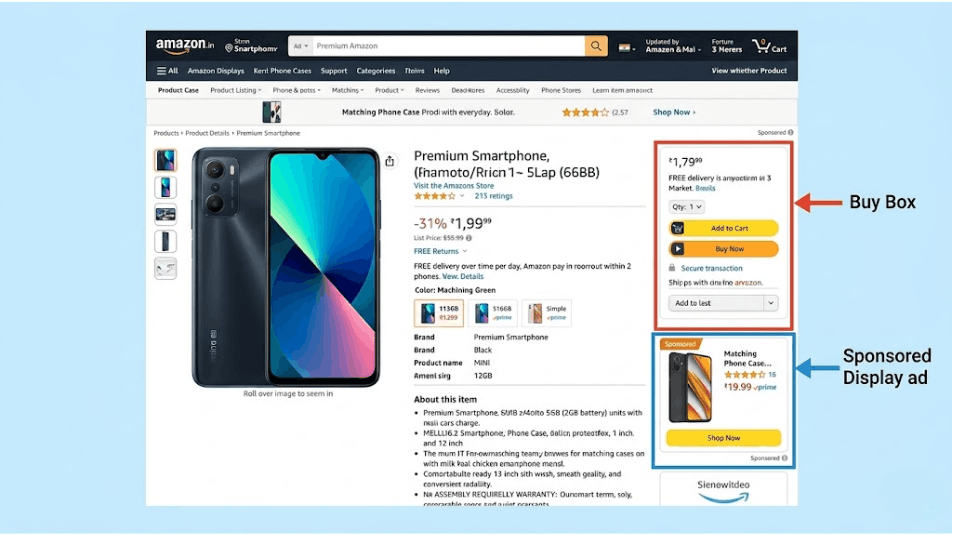
Sponsored Products appear in Amazon search results and on product detail pages — but only within the Amazon ecosystem. Sponsored Display appears on product detail pages, the Amazon homepage, review pages, and crucially, on third-party websites and apps. That off-Amazon reach is the major differentiator — your ads follow shoppers from your product page to cooking blogs, news apps, and entertainment sites.
Cost and Competition
Sponsored Display typically delivers lower cost per click than Sponsored Products because fewer sellers are competing in display auctions. You'll also find two billing options: CPC (pay per click) and vCPM (pay per 1,000 viewable impressions). Vikram Patel from Surat experienced this first hand with his home decor brand. His SP campaigns delivered a 5.2x ROAS, while his SD campaigns came in at 3.1x ROAS. But here's what made the difference — SD brought in 40% of his new-to-brand customers. When he combined both ad types, overall revenue grew faster than either could achieve alone. The lesson is that ROAS alone doesn't tell the full story.
When Should Beginners Start Using Sponsored Display?
The Readiness Checklist
Jumping into Sponsored Display too early is one of the most expensive mistakes a new seller can make. Before you launch your first campaign, make sure you've covered these basics. You need Brand Registry completed. You should already be running profitable Sponsored Products campaigns — if SP isn't working yet, adding another ad type won't fix the underlying problem. Your product listings need to be optimised with strong main images, A+ Content, and ideally 15 or more genuine reviews. And you should have a daily ad budget of at least ₹500–1,000 set aside specifically for testing display ads.
Signs You're Ready to Expand
Beyond the checklist, look for signals in your business. If your SP campaigns are stable but you've hit a growth plateau, display ads unlock a new audience. If competitors keep appearing on your product detail pages, Sponsored Display lets you defend that space. If you're launching a new product and need awareness beyond keyword reach, display ads find shoppers who didn't even know they were looking for your product. Ankit Reddy from Hyderabad learned this the hard way — he launched SD with only 3 reviews and weak images, wasting ₹8,000 in two weeks. He paused, spent two months building reviews to 25 and optimising listings, then relaunched with views remarketing. That second attempt delivered a 4.2x ROAS.
Not sure if your listings are ready? Our guide on creating eye-catching Amazon listings walks you through every element that matters before you spend a single rupee on display ads.
5 Reasons to Use Amazon Sponsored Display Ads
Retarget Shoppers Who Didn't Buy
Views remarketing is arguably the most powerful feature in Sponsored Display. It lets you reach shoppers who viewed your product — or similar products — in the last 7 to 90 days but didn't complete a purchase. These aren't cold prospects. They've already expressed interest, and a well-timed reminder ad can bring them back to convert. For most sellers, this audience converts at significantly higher rates than broad prospecting.
Defend Your Product Pages
Every product detail page on Amazon has ad placements below the buy box where competitor ads appear. If you're not filling that space with your own Sponsored Display ads, someone else will. Running display ads on your own listings is a defensive strategy beginners overlook — and it's one of the cheapest ways to protect traffic you've already earned.
Reach Shoppers Off Amazon
This is where Sponsored Display stands alone among Amazon's self-serve ad types. Your ads can appear on Twitch, IMDb, and thousands of third-party websites and apps. Sneha Iyer from Kochi used this to remarkable effect with her kitchen appliance line. Customers who'd browsed her mixer grinder but left without purchasing started seeing her Amazon retargeting ads on cooking blogs and recipe sites. Her SD campaign converted at 11% — nearly double her Sponsored Products average.
Lower Cost Per Click
With fewer sellers competing in display ad auctions, CPCs tend to be meaningfully lower than Sponsored Products. This makes Sponsored Display an excellent testing ground for audience-based strategies, even on a modest budget.
Sponsored Display Targeting Options Explained
Contextual Targeting (Product and Category)
Contextual targeting — also called product targeting — lets you place your ads on specific competitor ASINs or across entire product categories. Your ad appears on the detail pages of products you choose to target. You can refine further by brand, price range, star rating, and Prime eligibility. This is your offensive weapon — showing up exactly where your competitors' customers are shopping.
Audience Targeting
Audience targeting opens up three powerful segments. Views remarketing reaches shoppers who viewed your products or similar ones within a 7 to 90 day lookback window. Purchases remarketing targets past buyers — ideal for consumables where repeat purchases drive lifetime value. Amazon Audiences taps into lifestyle, interest, and life-event segments built from Amazon's first-party data.
Choosing the Right Targeting for Your Goal
Match your targeting to your funnel stage. For top-of-funnel awareness, use Amazon Audiences or broad category targeting. For mid-funnel consideration, target competitor ASINs with contextual targeting. For bottom-funnel conversions, views remarketing delivers the strongest results. Deepak Malhotra from Delhi split his budget: 60% on views remarketing for his protein powder, 40% on category targeting in sports nutrition. Remarketing drove direct sales; category targeting brought in 28% new-to-brand traffic.
Want to master all three Amazon ad types together? Our guide on scaling your Amazon PPC profitably shows you how to build a full-funnel advertising approach that combines Sponsored Products, Brands, and Display for maximum impact.
How to Set Up Your First Sponsored Display Campaign
Step-by-Step Campaign Setup
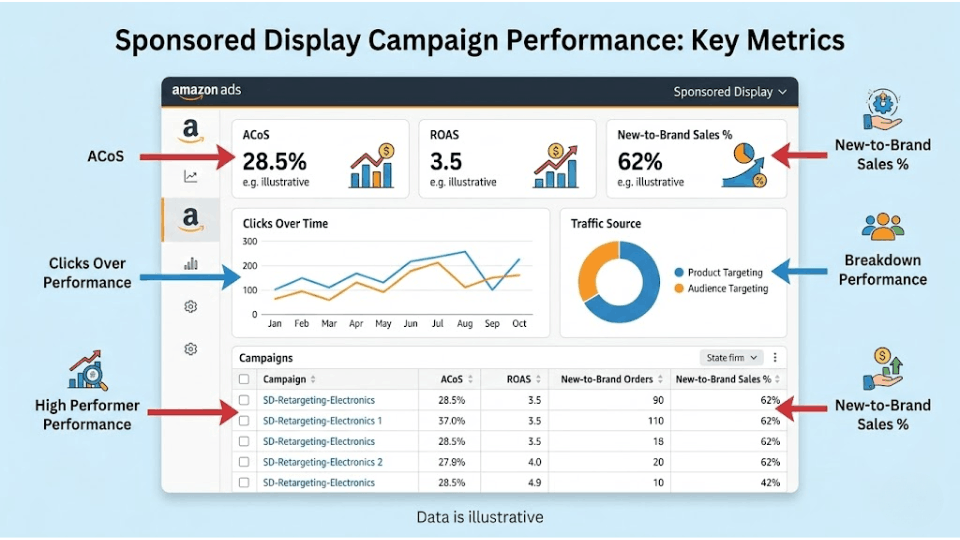
Setting up your first Sponsored Display campaign takes less time than most sellers expect. Log into the Amazon Ads Console, click Create Campaign, and select Sponsored Display. Name your campaign clearly — something like “SD | Views Remarketing | Neem Face Wash” — so you can identify it later. Set your daily budget between ₹500 and ₹800 to start. For bid optimisation, choose “Optimise for Conversions” — this tells Amazon to show your ads to shoppers most likely to purchase, the safest starting point for beginners.
Selecting Products and Creatives
Choose one to three of your top-performing ASINs — products with strong images, good reviews, and competitive pricing. Amazon auto-generates your ad creative from the product detail page, which works perfectly for a first campaign. Once you have performance data, test custom images and brand headlines. If you have a logo uploaded, add it for extra credibility.
Setting Bids and Launching
Start with Amazon's suggested bid amount. Resist the urge to tinker for at least 7 to 14 days — the algorithm needs time to learn. Amazon recommends giving campaigns a full 30 days before making major judgements. Pooja Nair from Bangalore set up her first SD campaign in under 15 minutes using auto-generated creatives, starting at ₹600 per day targeting competitor ASINs in organic skincare. After three weeks, her ACoS settled at 22% — comfortably within her target margin.
Amazon Sponsored Display Cost: What to Expect
CPC vs vCPM Billing
Two billing models are available. CPC charges you only when someone clicks — best for conversion-focused sellers. vCPM charges per 1,000 viewable impressions — best for awareness campaigns. Beginners should start with CPC and “Optimise for Conversions.” Switch to vCPM only when running deliberate awareness campaigns and you understand how to measure their impact.
Typical Costs for Indian Sellers
Amazon Sponsored Display cost in India tends to be lower than Sponsored Products, thanks to less auction competition. Expect CPCs in the range of ₹3 to ₹15 depending on your category and competition. There's no minimum spend requirement, so you can start small and scale based on results. Rohan Gupta from Jaipur budgeted ₹700 per day for his electronics accessories campaign. His average CPC came in at ₹6.40 — roughly 35% cheaper than his SP campaigns. After four weeks of optimisation, he scaled to ₹1,500 per day while maintaining a 19% ACoS.
Common Mistakes Beginners Make With Display Ads
Launching Before Your Listings Are Ready
Sponsored Display drives traffic to your product detail page. If that page has weak images, no A+ Content, or only a handful of reviews, the traffic won't convert — and you'll blame the ad type when the real problem is the landing page. Optimise first, advertise second. If you're not sure where your campaigns are bleeding money, our breakdown of Amazon PPC mistakes that cost you the most is worth reading before you scale any ad spend.
Setting and Forgetting Campaigns
Display ads aren't a “launch and leave” strategy. Review performance weekly. After the first 7 to 14 days, adjust bids on underperforming targets, pause products that aren't converting, and double down on winners. Test remarketing versus category targeting in separate campaigns so you can measure each clearly.
Expecting Immediate SP-Level ROAS
Sponsored Display often works higher in the purchase funnel than Sponsored Products. ROAS may look lower on paper, but the ad is doing different work — building awareness, driving new-to-brand traffic, and retargeting lost shoppers. Kavita Menon from Chennai paused her SD campaigns after just 10 days because ROAS didn't match her SP benchmarks. Six months later, she relaunched with realistic expectations, gave campaigns 30 days, and discovered SD was driving 22% of her new customer acquisition.
FAQ
What is the difference between Sponsored Display and Sponsored Products on Amazon?
Sponsored Products targets shoppers through keywords and appears in search results. Sponsored Display targets shoppers based on browsing behaviour and interests, appearing on product pages, the Amazon homepage, and third-party websites. The core difference is keywords versus audience targeting, and where the ads show up.
Are Amazon Sponsored Display ads worth it?
Yes, particularly for retargeting and brand awareness. While ROAS may be lower than Sponsored Products, display ads reach shoppers that keyword-based ads miss entirely. They're especially effective for defending your product pages from competitors and recapturing shoppers who browsed but didn't purchase.
How much do Amazon Sponsored Display ads cost?
There's no minimum spend. Indian sellers can expect CPCs between ₹3 and ₹15 depending on category and competition. You can also choose vCPM billing for awareness campaigns. Start with ₹500–800 per day and scale based on performance data over at least 30 days.
Do you need Brand Registry for Sponsored Display ads?
Yes. Amazon Brand Registry enrolment is mandatory. Indian sellers can use trademarks registered with India's Intellectual Property office. Once enrolled, you gain access to Sponsored Display along with other brand-building tools like A+ Content and Sponsored Brands.
Where do Sponsored Display ads appear on Amazon?
Sponsored Display ads appear on product detail pages, customer review pages, search results pages, and the Amazon homepage. They also show on Amazon-owned properties like Twitch and IMDb, and across thousands of third-party websites and mobile apps.
Can I run Sponsored Display ads on Amazon India?
Absolutely. Sponsored Display is available in India for professional sellers enrolled in Brand Registry and for vendors. All targeting options including contextual targeting and audience remarketing are accessible in the India marketplace.
What is the minimum budget for Amazon Sponsored Display?
Amazon has no minimum spend requirement for Sponsored Display. You can set any daily budget that works for your business. For meaningful testing, we recommend starting with ₹500–1,000 per day and running campaigns for at least 30 days before evaluating results.
Should I use Sponsored Display or Amazon DSP?
Sponsored Display is self-serve, requires no minimum spend, and is ideal for most sellers. Amazon DSP is a managed-service platform with higher minimum budgets, advanced audience segmentation, and programmatic buying capabilities. Start with Sponsored Display — if you outgrow it, DSP is the next level.
Conclusion
Sponsored Display isn't a magic switch that transforms your Amazon business overnight. But for Indian sellers with strong listings, profitable Sponsored Products campaigns, and a willingness to think beyond search results, it's the missing layer that protects your product pages, recaptures lost shoppers, and puts your brand in places keyword ads simply cannot reach. Start with one campaign, test views remarketing on your best-selling product, and give it 30 days. The data will tell you where to go next. If you want a structured roadmap to build and scale your Amazon business — including advertising strategies that actually work — our 3-Day Amazon Business Training gives you the frameworks, tools, and mentorship to make it happen.
