
Deepika Hegde from Hubballi had never run a brand defence campaign. Her copper bottles shipped through FBA, carried the Prime badge and already ranked first for her brand name. Then one evening she searched her brand on the Amazon app and found a rival’s bottle above hers, tagged “Sponsored”, also on Prime, and ₹60 cheaper. Shoppers looking for her brand were being offered someone else’s product at the exact moment they were ready to buy.
Her first instinct was to bid on her own name that night. Her second was doubt: why pay Amazon for customers who were already searching for her? Both are reasonable, which is why this question splits sellers and agencies alike. This guide shows you when bidding on your own brand protects sales, when it simply buys orders you’d get anyway, and how to tell which is happening to you.
What a Brand Defence Campaign Does for an FBA Brand
A brand defence campaign is any ad you run to hold the space where shoppers are already looking for you. American guides spell it “brand defense”, but the idea is the same. On Amazon India, that space comes in two shapes: the search results for your brand name, and the ad slots on your own product pages.
Branded keywords vs ASIN defence
Branded keyword defence means bidding on searches that contain your brand name. It’s a bigger slice of demand than you’d think: Amazon’s own US data shows about one in five searches includes a brand name. ASIN defence is the second layer: product targeting that places your own products in the sponsored carousel on your listings, so a shopper viewing your bottle sees your matching tumbler underneath instead of a competitor’s.
Why rank and the Prime badge are not a moat
Amazon lets competitors bid on your brand name, and many of them ship through FBA too, so your Prime badge doesn’t set you apart. Mandeep Sandhu from Patiala found this when a larger cookware brand started targeting his brand name and product pages in the same week. His organic rank never moved, yet his branded orders fell by a fifth within a month. Yet the case against defending your name is surprisingly strong.
The Case Against Paying for Your Own Name
Someone who types your brand name already wants your product. If your organic listing sits just below the ad, many of those shoppers would have clicked it anyway. Then the ad didn’t win the sale; it only moved it from the free column to the paid one.
What the eBay experiment found
The best-known test comes from eBay. Researchers switched off its branded search ads and found traffic stayed almost unchanged, because shoppers clicked the organic link. eBay stopped bidding on its own name and saved more than fifty million dollars a year. But eBay is one of the most recognised names online and faced little competition on its brand terms, which is rarely true for an Indian FBA brand.
Why your ROAS on brand terms flatters you
Brand defence campaigns usually look like your best performers, with high click-through rates, low CPCs and strong conversion. Abhishek Tiwari from Prayagraj had one showing 11x ROAS on his herbal hair oil, until he noticed that his total sales never moved when he raised its budget. Every extra rupee relabelled organic orders as ad orders. Watch total sales and TACOS rather than ACOS instead; together they show whether ads grow the business or just take credit for it.
When Brand Defence Campaigns Earn Their Keep
Brand defence campaigns become valuable the moment someone else competes for your shoppers, and on Amazon India that happens far more often than it did for eBay. These studies ran on Google, but the logic carries over to Amazon.
Competitors are already on your brand searches
An analysis of branded search experiments across many brands found that competition was the biggest factor. Among brands facing heavy competition on their own terms, 82% saw a significant lift from branded ads, against 35% of brands facing little. Rutuja Patwardhan from Satara saw this when two yoga-mat sellers began bidding on her brand name. She launched exact-match branded ads and won back most of her lost orders within three weeks, at a CPC of around ₹4.
Your brand is smaller than you think
A second study tested branded ads for Edmunds, a large US car-research site far smaller than eBay. With ads off, only about half of that traffic came back through organic links, and the researchers believe much of the rest went to rivals bidding on the name. Most Indian private-label brands are smaller still.
Sale events and new launches
During the Great Indian Festival and Prime Day, competitors spend heavily on every high-intent search, including yours, and a new ASIN has no rank to fall back on. Our Brand Defence Audit Sheet helps you record these checks before your next campaign review.
When You’re Just Buying Orders You Already Had
Not every brand defence campaign is protecting something. Some are simply an expensive habit, and a campaign that cannibalises sales looks identical to a protective one in your ads dashboard.
The signs your branded ads cannibalise organic sales
Search your brand name on Amazon in a private window. If no competitor ads appear, your products fill the first row organically, and your campaigns already win most of the top-of-search ad space on your brand terms, there’s little left to defend. Another warning sign: branded ad sales climb while total sales stay flat, which means credit is moving rather than demand growing.
Repeat buyers inflate branded results
Consumable brands are the most exposed. Faisal Siddiqui from Aligarh sells whole spices that customers reorder every month, often by typing his brand name. His Sponsored Brands campaign on brand terms showed just 12% of orders as new-to-brand, meaning nearly nine in ten buyers had already purchased from him in the past year. He cut his branded bids by 40%, watched total sales hold steady for a month, and moved the savings into generic keywords that win new customers.
The FBA Blind Spot: Stockouts and the Featured Offer
Here is the part most brand defence advice skips, and it matters most to FBA sellers. Your own ads only run when your product is the Featured Offer, the offer with the Add to Cart button. Competitors’ ads on your brand name run regardless.
Your ads switch off when FBA stock runs out
When an advertised product goes out of stock, Amazon automatically pauses it in your campaigns. Your brand search page then becomes a showroom for rivals at the exact moment loyal customers come looking for you. That’s another reason to build a 30-day reorder plan.
A hijacker on your listing pauses your ads too
The same rule applies when another seller wins the Featured Offer on your listing. Your Sponsored Products ads stop serving, while Sponsored Brands ads keep running whoever holds the offer, so you may pay for clicks that end in someone else’s sale. If this keeps happening, remove the hijacker from your listing first.
Restock windows need extra defence
Prakash Gowda from Belagavi sells handmade leather sandals. A delayed inbound shipment before Diwali left him out of stock for 11 days, and his brand search showed only rival ads throughout. Now he raises branded bids for two weeks after each restock to win those shoppers back.
How to Measure the Difference Before You Cut
A few checks and one careful test will tell you which camp you’re in.
Check your branded search page first
Search your brand name and top branded phrases on the mobile app and desktop, and note every competitor ad around your listings. Then open the Brand impression share dashboard under Insights and Planning in your ads console, which shows how much top-of-search ad space on your brand terms your campaigns win. The search term impression share report shows the same for individual terms.
Read Search Query Performance for brand terms
Filter the Search Query Performance report to queries containing your brand name and check your share of clicks and purchases. Unlike ad reports, it covers every branded search, not just ones your ads touched. If your brand captures nearly all the purchases on its own name, there’s little leakage to stop.
Run a holdout test without hurting your rank
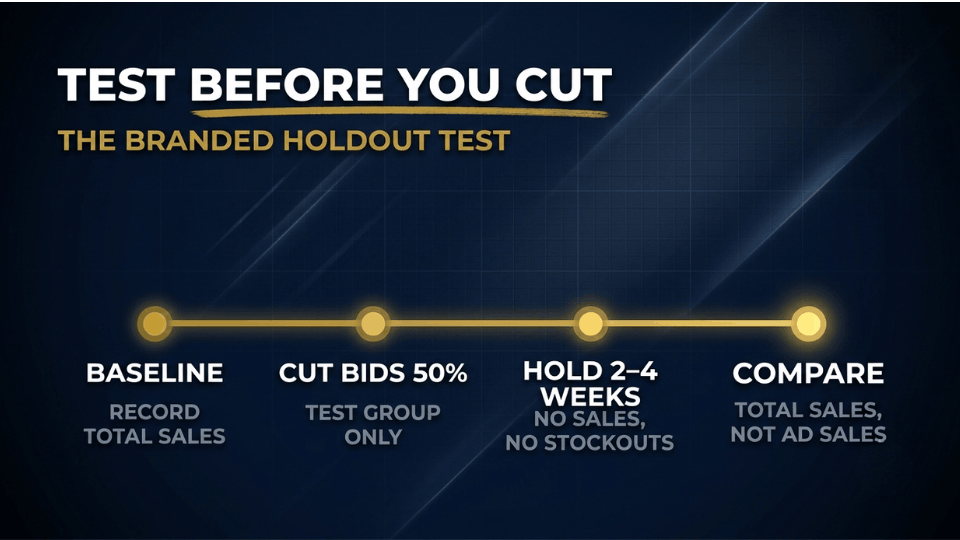
Organic rank responds to sales velocity, so switching off every branded ad at once can weaken your rank and exaggerate the ads’ value. A safer design works like this:
- Pick two similar groups of products with established rank and healthy FBA stock, keeping one as your control.
- Cut branded bids by half on the test group rather than pausing them.
- Run the test for two to four weeks, away from sale events, with prices and other campaigns unchanged.
- Compare total sales for both groups against their baseline, not ad-attributed sales.
- Restore full bids straight away if competitors start taking your branded clicks.
Bikash Rai from Darjeeling ran this test on his tea range. Total sales in the test group dipped by less than 2% while branded spend halved, so he kept the lower bids.
Setting Up Brand Defence Campaigns on Amazon India
If your checks show real leakage, build a tight, cheap, readable brand defence campaign.
Exact-match brand terms, misspellings and Hinglish
Create a separate Sponsored Products campaign called “SP | Brand | Exact”. Use exact match on your brand name, brand plus product type, and the ways Indian shoppers actually type it, including misspellings and Hinglish search terms. Add your brand terms as negatives in generic campaigns so branded orders don’t flatter them. Branded CPCs are usually a fraction of generic ones, so start modest and set a walk-away bid.
Own-ASIN targeting on your detail pages
Next, build a product targeting campaign that places your own ASINs on your listings, pairing a bestseller with a newer launch, or a product with its natural add-on. Revathi Sundaram from Kanchipuram paired her silk sarees with matching blouse pieces. The extra spend paid for itself through bigger baskets, and competitor ads on her pages became noticeably rarer.
Sponsored Brands for the top banner
With Brand Registry, Sponsored Brands on your brand terms claims the top banner of the results page. Send broad brand searches to your Brand Store and specific ones to the matching product. Amazon also offers reserve share of voice in India, booking top-of-search Sponsored Brands placements on branded keywords at a fixed upfront price, though only heavily contested terms justify it. Our Branded Campaign Setup Template has the naming, keyword groups and negative list ready to copy.
How Much Should You Spend on Your Own Name?
Industry reports suggest many brands put around a fifth of their ad budget into branded terms, and some go well beyond half. The right figure depends on how much pressure your brand terms are under.
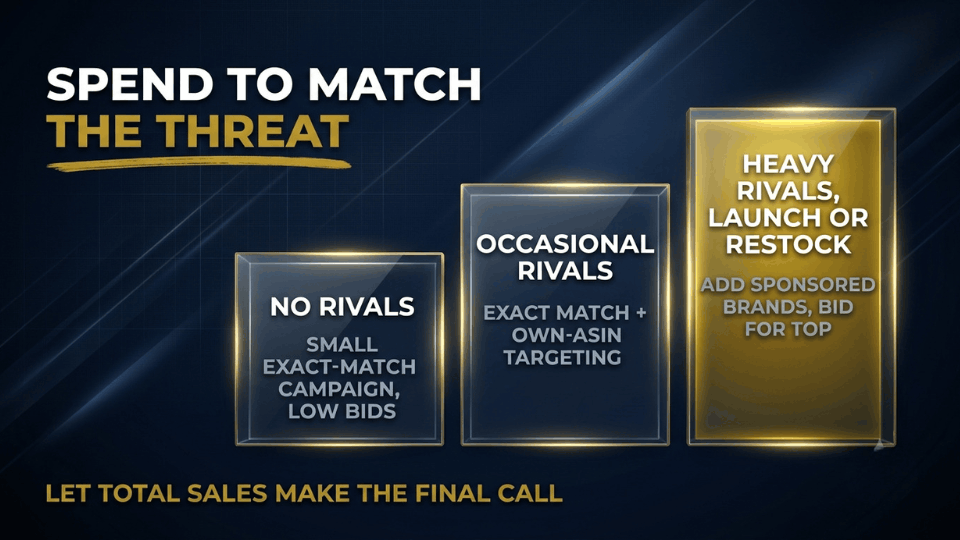
A simple budget rule by situation
Match your spend to the threat level your checks revealed:
- No competitor ads and strong organic dominance: keep one small exact-match campaign with low bids, mainly to stay visible and raise the price for any rival.
- Occasional competitor ads: run exact-match Sponsored Products plus own-ASIN targeting on your top listings, keeping branded spend to a modest share.
- Heavy competition, a launch or a fresh restock: add Sponsored Brands, bid firmly for top of search, and accept a larger branded share until the pressure eases.
Kritika Saxena from Gwalior found 45% of the ad budget for her educational toys sitting in branded terms, with no competitor ads in sight. She trimmed it to about 15%, moved the rest into category keywords, and grew total monthly sales by 18% over the next three months.
Review it before every big sale
Competitors come and go, so repeat your branded search check every month and rerun your holdout test every few months, plus a fresh check before each big sale event, when rivals bid hardest.
Frequently Asked Questions
Should you bid on your own brand name on Amazon?
Yes, if competitors appear on your brand searches or product pages, or your brand is still small and easy to confuse with rivals. If nobody competes on your terms and you already own the first row organically, keep a small, low-bid campaign and run a holdout test before spending more.
Do branded ads cannibalise organic sales?
They can. When no competitor ads appear on your brand searches, many shoppers who click your ad would have clicked your organic listing anyway. The giveaway is ad sales rising while total sales stay flat. A holdout test on a small group of products shows how much branded spend genuinely adds sales.
What is a brand defence campaign on Amazon?
It’s an ad campaign that targets your own brand name and product pages so competitors can’t easily take those placements. It usually combines exact-match Sponsored Products on brand terms, product targeting of your own ASINs and, if you’re brand registered, Sponsored Brands ads at the top of branded search results.
Should I target my own ASINs with Sponsored Products?
Usually yes, if you sell more than one related product. Targeting your own ASINs fills the sponsored slots on your listings with your products instead of a competitor’s, doubling as cross-selling. Pair complementary items and check the extra orders cover the spend. With a single product, the benefit is purely defensive.
How do I know if competitors are bidding on my brand name?
Search your brand name on Amazon in a private window, on mobile and desktop, and look for sponsored products from other brands. Then check the Brand impression share dashboard and the search term impression share report. Low impression share on your own brand terms usually means someone else is winning those auctions.
Do my ads stop when my FBA stock runs out?
Yes. Sponsored Products ads only show when your product is the Featured Offer, and out-of-stock products are paused automatically. Competitors’ ads on your brand name keep running, so a stockout hands them your branded shoppers. Keep a reorder buffer on bestsellers, and raise branded bids for a week or two after restocking.
Do I need Brand Registry to run brand defence campaigns?
Not for the basics. Any professional seller can bid on their brand name and target their own ASINs with Sponsored Products. Brand Registry unlocks Sponsored Brands, the Brand impression share dashboard, Brand Analytics and new-to-brand metrics, which make defence and measurement far easier. If you sell under your own brand, enrol early.
How long should a branded holdout test run?
Two to four weeks suits most sellers, and shorter is safer on Amazon, because organic rank responds to sales velocity and a long dip can hurt it. Pick a quiet period with healthy FBA stock, away from sale events, keep prices and other campaigns stable, and compare total sales against your baseline.
Conclusion
Bidding on your own brand name is neither automatically smart nor wasteful. It depends on who is standing between you and your shoppers. When competitors sit on your brand searches and listings, a tight brand defence campaign keeps customers you’ve already earned. When nobody is competing, it mostly pays Amazon for orders that were coming anyway.
So keep your FBA stock healthy, check your branded search page, read your Search Query Performance data, and test before you touch your budget. Then let total sales, not ROAS, make the final call.
To build this judgement into every part of your Amazon business, from product choice to ads that genuinely grow profit, join our 3-Day Amazon Business Training where we work through decisions like this step by step.