
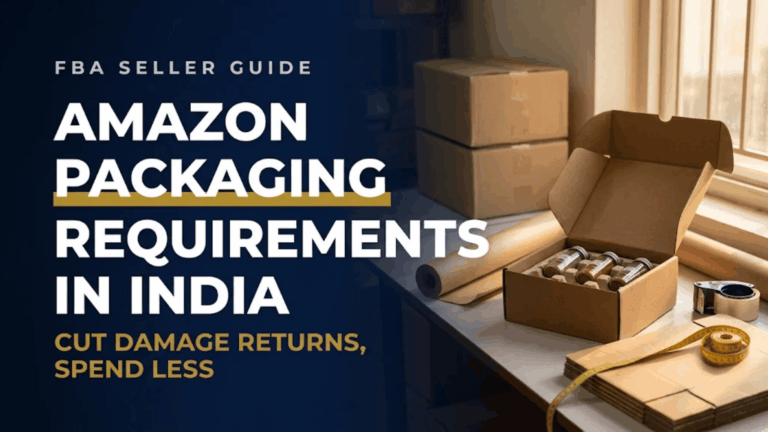
Last October, Ananya Joshi from Indore opened her FBA returns report and found 19 glass spice-jar sets sent back during the Great Indian Festival, every one marked “arrived damaged.” Amazon graded them customer damaged, so there was no reimbursement: 19 refunds, 19 lost units and two fresh 1-star reviews in her busiest month.
Her first thought was the one most new sellers have: isn’t packaging Amazon’s job under FBA? Partly. Amazon stores, picks, delivers and handles returns for you. But the box your product travels in is still yours, and that is where Amazon packaging requirements in India start to matter.
Ananya didn’t quit FBA. She fixed her box, and her damage returns fell within a month. This guide shows you the same path: the rules Amazon actually enforces, a drop test you can run on your own floor, how to right-size boxes so you stop paying for air, and where your filler money quietly leaks.
FBA Ships It, but Your Box Takes the Hits
FBA takes the heaviest work off your plate, and for most Indian private-label sellers it is the right way to sell. The catch is a quiet one. Fulfilment centres are built to move products fast, not to repackage them, so the protection you send in is often the only protection the order gets.
Does Amazon Repack Your Product Under FBA?
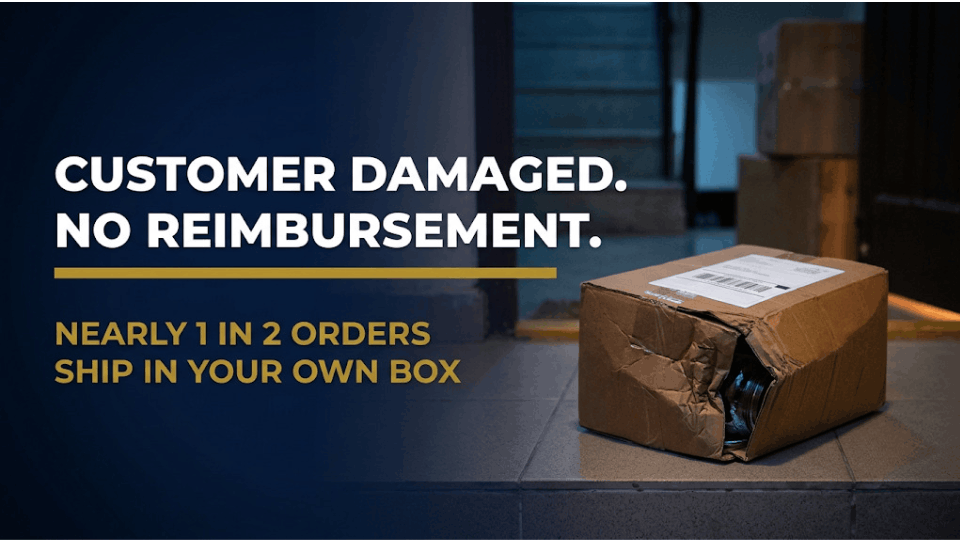
Often, it doesn’t. Amazon says nearly one in two orders (47.5%) from its India fulfilment centres now ship with reduced or no added packaging, many in the original box with just an address label. Tech accessories, homeware, home improvement products, shoes and luggage are the usual candidates. Your retail box is frequently the shipping box, so it has to survive a delivery van, a sorting hub and a doorstep on its own.
What Customer-Damaged FBA Returns Really Cost You
Amazon reimburses units it damages in its warehouses or delivery network. When a return is graded customer damaged, though, no reimbursement is processed. You absorb the refund, lose the unit and often collect a bad review too.
Gurpreet Sandhu from Jalandhar learned this with steel water bottles shipped in thin printed cartons. He assumed Amazon would add an outer box. Dented bottles kept coming back for six weeks until he switched to a stiffer carton with a moulded insert, and the dents stopped.
Amazon Packaging Requirements India: The Rules That Matter
You don’t need to memorise the whole manual. A handful of Amazon packaging requirements in India decide whether your stock is received smoothly and whether it reaches customers in one piece.
Amazon FBA Packaging Requirements for Each Unit
Every boxed unit should be six-sided, with flaps that stay shut and walls that hold their shape when pressed. Polybagged products need a visible suffocation warning, and for apparel the bag should not extend more than 7.5 cm past the product. Glass, ceramics and anything breakable go in a solid six-sided box, wrapped individually, because Amazon may drop-test them.
FBA India Carton Weight Limit and Box Rules
Amazon’s FBA India shipment manual caps each carton at 15 kg unless a single unit weighs more, and anything over 15 kg needs a “Heavy Weight” label. Use sturdy corrugated cartons; the manual cites regular slotted cartons, B-flute and 200BH burst-strength boxes as examples. Fill gaps with air pillows, full paper sheets, sheet foam or bubble wrap. Loose thermocol peanuts and shredded paper are not allowed.
Brief Your Supplier Before They Ship to the FC
Many Indian manufacturers ship straight to the fulfilment centre, so these rules have to reach them in writing. Salman Ansari from Moradabad learned this when his brass décor supplier packed 20 kg cartons stuffed with shredded paper. He spent a weekend repacking 300 units before the pickup. Now every purchase order carries a one-page packaging spec.
Run Amazon’s 3-Foot Drop Test Before You Ship
The cheapest packaging test you’ll ever run costs five units and twenty minutes.
What Is Amazon’s 3-Foot Drop Test?
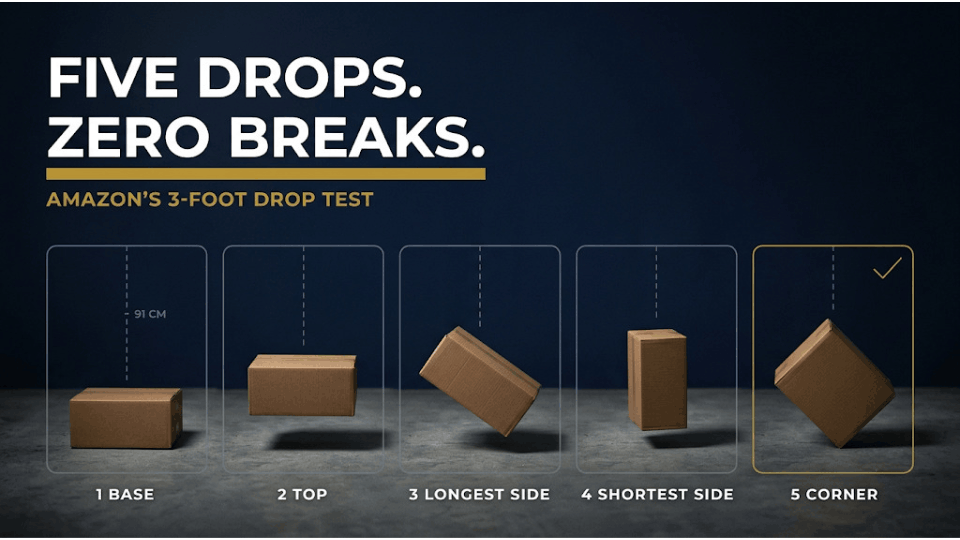
Amazon India’s own guidance says a packed unit should survive a 3-foot drop onto a hard surface without breaking, five times over: flat on its base, flat on its top, on its longest side, on its shortest side and on a corner. It matters most for fragile items, liquids and boxes with perforated sides, but it’s a sensible check for anything you sell.
A Five-Drop Test You Can Run in 20 Minutes
Run this before your first inbound shipment, and again whenever your packaging or supplier changes:
- Pack five units exactly as they will ship, with the same box, insert, filler and tape.
- Mark 91 cm (3 feet) on a wall above a concrete or tiled floor.
- Drop each unit five times in order: base, top, longest side, shortest side, then a corner.
- Shake each unit hard for a minute and listen for rattles or loose parts.
- Open every box, photograph any crack, dent or leak, and note which drop caused it.
Kavitha Subramanian from Madurai ran this on her ceramic mugs and watched a handle snap on every corner drop. Moulded-pulp corner pieces at ₹4 each fixed it, and her damage returns fell from 7% to 2% over the next two months.
What to Fix When a Box Fails
Fix the spot that failed, not the whole box. A crushed corner needs corner protection, while a crushed box needs stiffer board, so move from 3-ply to 5-ply only when the walls cave in. A rattle means the product is moving, which is a fit problem rather than a filler problem.
Want all of this on one page? Download our FBA Packaging and Drop-Test Checklist. It covers the unit rules, the carton rules and a five-drop log you can hand to your team or supplier.
Right Size Packaging Before Amazon Charges You for Air
Oversized boxes cost you twice. You pay for extra board and filler, then you pay higher fees for the space the box takes up.
How Volumetric Weight on Amazon India Works
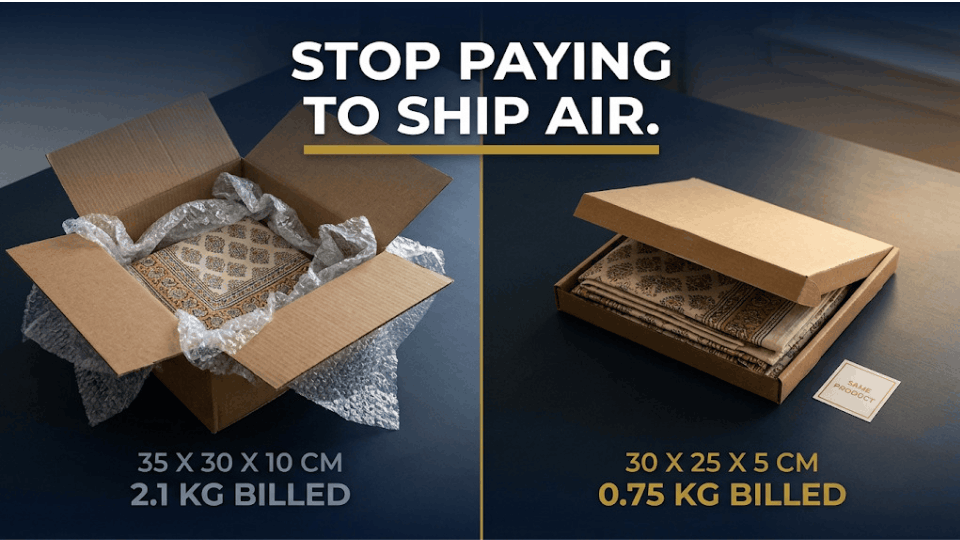
Volumetric weight in kg is length × width × height in centimetres, divided by 5,000. Amazon charges its shipping fees on volumetric or actual weight, whichever is higher. A 400 g cushion-cover set in a 35 × 30 × 10 cm box is billed as 2.1 kg, which means you’re paying to ship air.
Can a Smaller Box Actually Protect Better?
Usually, yes. Damage comes from movement, and a snug box stops the product sliding into its own walls. Leave just enough room for cushioning: a centimetre or two for sturdy items, more for glass. Then rerun the drop test, because a smaller box only counts if it still passes.
Update Your Dimensions Before Amazon Measures
FBA fees follow the weight and dimensions Amazon holds for your item package, so check your catalogue after any redesign. Nandini Rao from Hyderabad moved her cushion covers into a 30 × 25 × 5 cm mailer, just 0.75 kg volumetric. That saved her about ₹30 per order across 900 monthly orders, roughly ₹27,000 a month.
Cut Packaging Filler Material Spend Without Risk
Filler is where good intentions turn into waste. Most sellers add more when damage scares them, and that extra money buys nothing.
Which Fillers Does FBA Accept?
Stick to large, solid dunnage: air pillows, full sheets of kraft paper, sheet foam and bubble wrap. Loose thermocol and shredded paper are out for FBA cartons. Inside your product box, a die-cut corrugated or moulded-pulp insert often beats three layers of wrap, because it locks the product in place and packs faster.
What Should Ecommerce Packaging Cost in India?
One Indian packaging guide puts basic packaging at ₹5–15 per unit and standard branded packaging with bubble wrap at ₹15–30. Proper cushioning rarely costs more than ₹5–15 an order. Compare that with one damage return, where you lose the refund, the unit and sometimes a review. Spending ₹8 more to prevent a ₹600 loss isn’t overspending; spending ₹8 on filler for an oversized box is.
Standardise Box Sizes and Buy in Bulk
Pick three or four standard box sizes that cover your catalogue and buy them in bulk from a local corrugated supplier. Vikram Thakkar from Ahmedabad sells skincare in glass bottles. He swapped three layers of bubble wrap for a die-cut insert and cut packaging from ₹26 to ₹17 per unit, with no rise in damage. If you also add a card inside the box, our guide to packaging inserts covers what Amazon allows.
Reduce Damaged Returns on Amazon With Your Returns Data
Your returns data already tells you which products are breaking. Most sellers never open it, yet it’s where every plan to reduce return rates begins.
Read the FBA Customer Returns Report
Download the FBA customer returns report from Seller Central and sort it by ASIN, return reason and disposition. Damage reasons clustered on one SKU point to packaging, while “defective” points to the product or supplier. Packaging matters more in some categories than others; in electronics, poor packaging can drive 20–30% of returns through impact damage.
Reshma Pillai from Thrissur found that most of her damage returns came from one glass dropper bottle with a loose cap seal. A ₹2 shrink band fixed a problem she’d blamed on couriers for months.
Does Packaging Affect Your Amazon Rankings?
Not directly, because Amazon doesn’t score your box. But damage feeds the signals it does weigh: returns, star ratings and reviews that say “arrived broken.” Fewer damaged arrivals protect your conversion rate, and conversion is a big part of what keeps you ranked.
To make your fixes stick, use our Supplier Packaging Brief template. It’s a fill-in spec sheet for box size, board grade, insert, filler and drop-test results that you attach to every purchase order.
Your 30-Day Plan to Meet Amazon Packaging Requirements
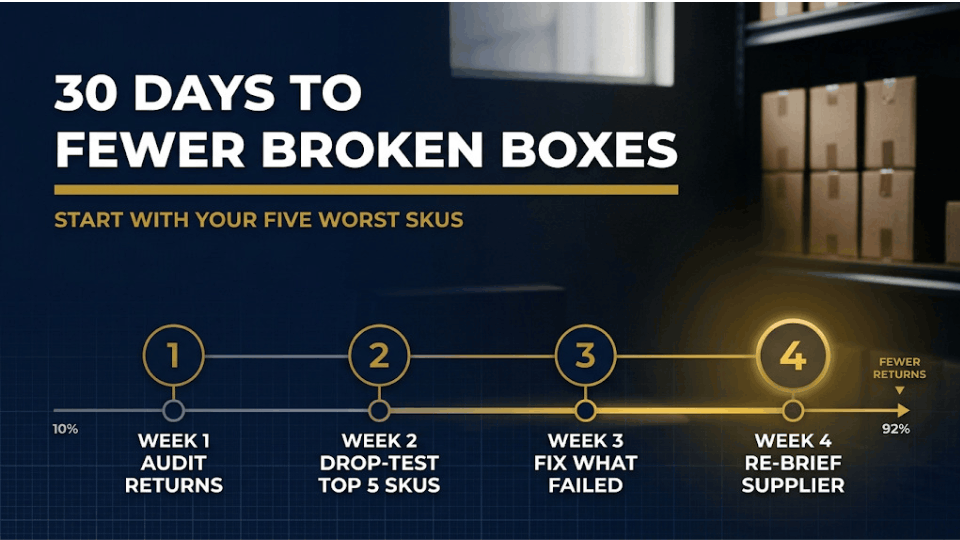
You can fix most packaging problems in a month without pausing sales. Start with your five worst SKUs for damage returns, because that’s where the money leaks.
Weeks 1–2: Audit Returns and Drop-Test Top SKUs
In week one, pull 90 days of returns data, list those five SKUs and measure each current box to work out its volumetric weight. In week two, run the five-drop test on each and photograph every failure, so you know exactly what breaks and why.
Weeks 3–4: Fix, Re-Measure and Re-Brief
In week three, fix only what failed: add corners, swap in an insert or move to a snugger box. Rerun the drop test and check your dimensions in Seller Central. In week four, send the revised spec to your supplier, ship one test inbound and track damage returns on those SKUs for six weeks.
Harish Gowda from Mysuru ran this plan on his kitchen storage jars in August and halved his damage returns before the festive rush.
Frequently Asked Questions
Does Amazon FBA include packaging for my product?
Amazon packs FBA orders, but it often uses your own box. Nearly half of orders from Amazon’s India fulfilment centres ship with reduced or no added packaging, sometimes with just an address label. Treat your product packaging as the shipping box and make sure it can survive delivery on its own.
What is Amazon’s 3-foot drop test?
It’s a check that your packed unit survives five drops from 3 feet onto a hard floor without breaking: flat on its base, top, longest side, shortest side and a corner. Amazon India applies it to fragile items, and it’s a smart test for any product you sell.
How can I reduce volumetric weight charges without risking damage?
Shrink the box, not the protection. Measure your product, leave just enough room for cushioning and use an insert to hold it still. Then rerun the drop test. A snug box usually protects better than a big one, and it brings your volumetric weight down at the same time.
Does Amazon reimburse customer-damaged FBA returns?
Usually not. Amazon reimburses units damaged in its fulfilment centres or by its delivery network, but returns graded customer damaged typically aren’t reimbursed. If you believe a unit was damaged in transit, open a case with photos and order details. Better packaging remains the more reliable fix.
Does packaging affect Amazon search rankings?
Indirectly. Amazon doesn’t rank your box, but damaged arrivals lead to returns, low ratings and negative reviews. Those hurt your conversion rate, and conversion strongly influences organic rank. Good packaging protects the signals that keep your listing visible.
What is the carton weight limit for FBA India?
Amazon’s FBA India shipment manual limits cartons to 15 kg unless a single unit weighs more, and cartons over 15 kg need a “Heavy Weight” label. Lighter cartons are also safer for handlers and less likely to crush the boxes stacked beneath them.
Where can I buy packaging material in India?
Local corrugated box makers in hubs like Delhi NCR, Mumbai, Ahmedabad, Surat and Bengaluru usually beat online prices once you order in bulk. B2B marketplaces help you compare quotes. Ask for samples, drop-test them with your product and only then place a large order.
How much should I spend on packaging per unit?
Most Indian sellers spend ₹5–30 per unit, depending on the product and branding. The right number is whatever stops damage at the lowest cost. If one extra rupee of protection prevents a ₹500 return, spend it. Money spent filling an oversized box is the part to cut.
Protect the Box, Protect Your Margin
FBA does the heavy lifting on storage, delivery and customer service, and for most Indian sellers it’s still the smartest way to grow. Your share of the work is the box. Make it meet Amazon packaging requirements, prove it with five drops, size it to the product and stop paying for filler that protects nothing.
Ananya’s spice jars now ship in a snug box with a pulp insert, and this year’s festive returns looked nothing like last year’s. Your returns can follow the same curve.
If you want to build an Amazon business where operations like this are planned from day one, join our 3-Day Amazon Business Training. We’ll walk you through building a profitable Amazon brand, step by step. Your customers, and your margins, will thank you.
