
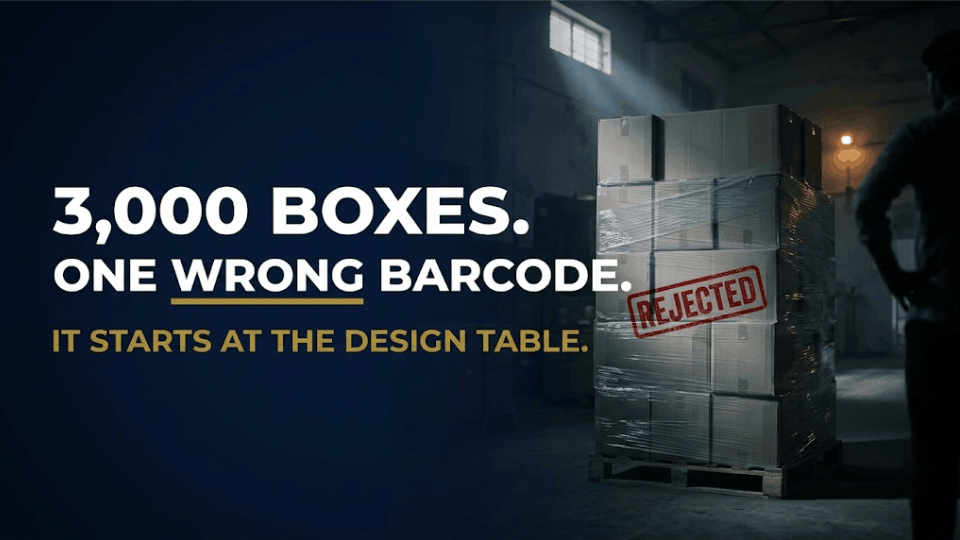
Arjun Menon from Thrissur had 3,000 printed boxes stacked in his godown, ready for his copper bottle launch. Each carried a barcode for Amazon India that he had bought for ₹1,500 from a website promising “Amazon-ready” codes. Then Seller Central rejected his listing. The code didn’t trace back to his brand in the GS1 database. Arjun had to register with GS1 India, wait for genuine codes and reprint every box. His launch slipped by five weeks.
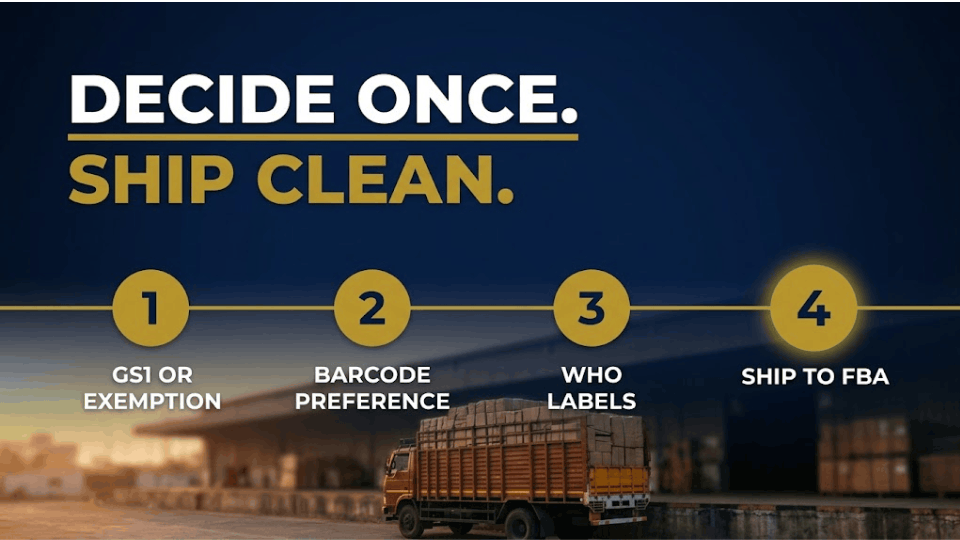
Here’s the frustrating part: nothing went wrong at the warehouse. The mistake happened months earlier, at the design table. Getting barcodes right is really three separate decisions, and they come in a fixed order. Should you buy GS1 codes or apply for an exemption? Should FBA track your stock by the manufacturer barcode or an FNSKU? And who prints and sticks the labels? This guide walks through all three in plain English, so your packaging goes to print only once.
Three Codes, Three Jobs: EAN, ASIN and FNSKU
Most barcode confusion comes from sellers treating every code as “the barcode.” They aren’t interchangeable, and mixing them up is exactly how boxes get reprinted. Think of the EAN as your product’s Aadhaar, one identity that works everywhere. The ASIN is the shelf tag inside Amazon’s store. The FNSKU is the locker key that proves a particular unit belongs to you.
What Is an EAN Code for Amazon?
An EAN-13 is a 13-digit global product number, also called a GTIN. It identifies what the product is, and it works on Amazon, Flipkart, in supermarkets and in export markets. Codes issued by GS1 India start with 890. When you create a listing, Amazon uses this number to check that the product genuinely belongs to the brand you’ve entered.
FNSKU Full Form and What It Actually Tracks
FNSKU stands for Fulfilment Network Stock Keeping Unit. It doesn’t describe the product. Instead, it tells Amazon’s warehouse whose unit this is, and it means nothing outside Amazon. Amazon-generated FNSKUs usually start with X00, while commingled stock uses the ASIN itself, starting with B0.
Where the ASIN Fits In
The ASIN is Amazon’s catalogue number for a product detail page, and many sellers can share one. You never stick it on a box. Pooja Agarwal from Indore printed ASIN barcodes on her first batch of steel lunch boxes, and the whole batch needed relabelling. Once she understood the three jobs, every later decision became simpler.
First Decision: GS1 Barcode or GTIN Exemption?
Every new listing needs a product ID, usually a barcode for Amazon India, unless Amazon has approved you to list without one. That leaves you with two legitimate paths, and the one you pick shapes everything that follows.
Is a GS1 Barcode Mandatory for Amazon?
Not in every case. Amazon needs either a valid GS1-issued GTIN or an approved GTIN exemption. What it won’t accept is a code that doesn’t belong to your brand, because Amazon checks product IDs against the GS1 database. If your product already exists on Amazon under another brand, you list against that ASIN using the brand’s own code.
When GTIN Exemption on Amazon India Makes Sense
Exemption works well if you own the brand, make products by hand or in small batches, or want to test one product without plans for offline retail. You apply through Seller Central for a specific brand and category. The brand name must match your packaging exactly, and real photos showing the brand printed on the product help approval.
The Trade-Off That’s Hard to Undo
Exemption saves money today but can cost you later. Offline retailers, quick-commerce platforms and other marketplaces usually ask for EANs, and some sellers report that a listing created under exemption can’t simply have a GTIN added afterwards.
Faisal Qureshi from Kanpur chose exemption for his leather wallets. Eight months later, a retail chain wanted to stock them, which meant registering with GS1 and reprinting packaging. If growth beyond Amazon is part of your plan, GS1 is usually cheaper in the long run.
Getting a GS1 Barcode for Amazon India, Step by Step
If you’ve chosen GS1, the process is fully online. Only the brand owner can apply, so if a factory makes products for you, the registration belongs in your company’s name, not theirs. Here’s the sequence:
- Apply on the GS1 India website in your business’s name as the brand owner.
- Upload a request letter on your letterhead along with your GST registration certificate.
- Pay the registration and subscription fees for your turnover band.
- Receive your company prefix, which usually takes 7–10 working days.
- Allocate one GTIN to each product, size and colour in GS1’s DataKart portal, using your exact brand name.
Once the numbers are allocated, hand the barcode files to your packaging designer. Only then should artwork go to print.
GS1 India Registration Fees and the MSME Subsidy
Fees depend on your annual turnover and the number of barcodes you need, and GS1 India revised its fee structure in October 2025. Use the calculator on the GS1 India website rather than figures quoted elsewhere. If you’re a micro manufacturing enterprise, check the MSME barcode subsidy. It reimburses up to 80% of fees for the first three years, capped at ₹50,650.
Why Reseller Barcodes Get Your Listings Removed
Cheap codes are usually recycled numbers registered to another company. Amazon can reject listings that use them or remove them later, after you’ve built reviews. GS1 India also states that it doesn’t appoint agents or intermediaries.
Matching Your Brand Name on GS1 and Seller Central
Most “GTIN does not match brand” errors are simple mismatches. Lavanya Iyer from Chennai spent two weeks with Seller Support before spotting one extra space in her GS1 brand name. Keep the brand and manufacturer fields identical in both places.
If you’d like to settle these choices in one sitting, download our Barcode Decision Checklist. It’s a one-page sheet to fill in before you brief your packaging designer.
FNSKU vs Manufacturer Barcode: The FBA Choice
Once your listing is live, FBA asks a second question: how should Amazon track your inventory? You set this in Seller Central under Settings, then Fulfilment by Amazon, in the FBA product barcode preference.
How Stickerless Commingled Inventory Works
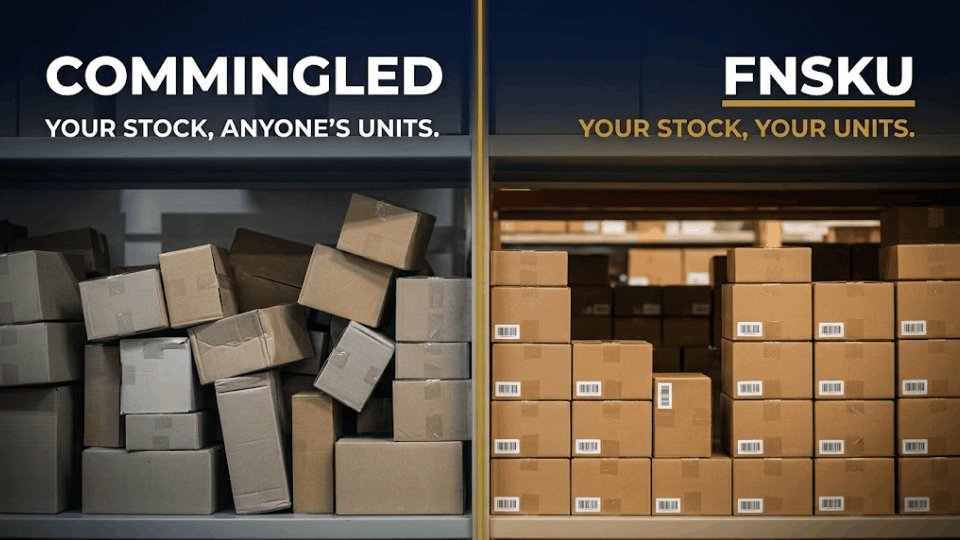
With the manufacturer barcode option, Amazon scans the EAN already printed on your box. Where commingling applies, your units can be pooled with other sellers’ units of the same ASIN. Amazon ships whichever unit is closest, so a buyer could order from you and receive someone else’s stock. Any complaint still lands on your account.
Why Private-Label Sellers Should Default to FNSKU
Choosing the Amazon barcode means every unit carries an FNSKU tied to your seller account. Your stock stays separate, lookalike units can’t slip into your orders, and returns trace back to the right seller. The extra labelling effort is small next to that protection. The manufacturer barcode only makes sense when you’re the sole seller and your own GS1 EAN is on the pack.
Your Barcode Preference Is Locked per SKU
Set your preference before you create the SKU. Once a SKU is created as commingled, it stays commingled, and switching means creating a new SKU.
Rohit Malhotra from Delhi learned this after shipping resistance bands without FNSKU labels. A cheaper lookalike under the same ASIN drew complaints about snapping bands, and the feedback landed on his account. He moved to new FNSKU-labelled SKUs within a month.
Who Prints and Sticks the FNSKU Label?
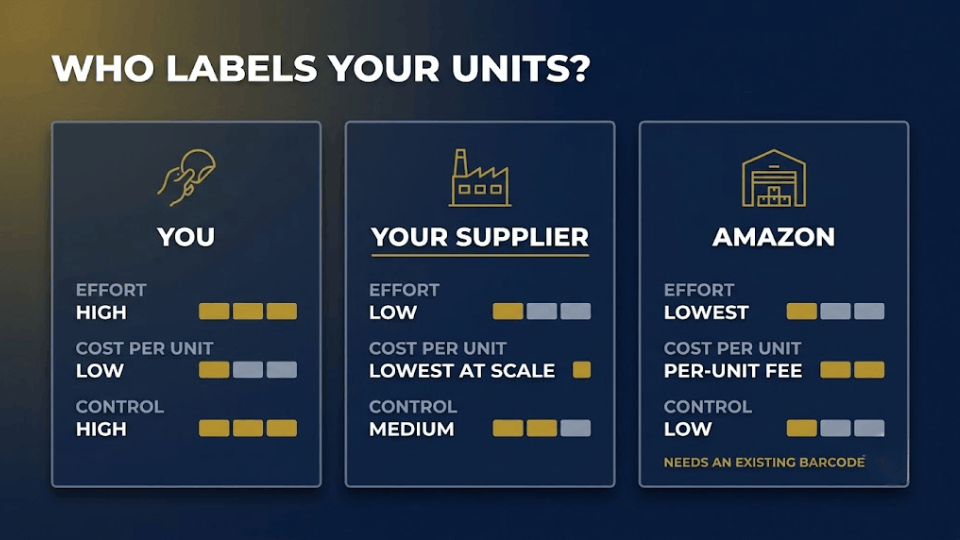
With FNSKU chosen, who actually puts a label on every unit? The answer depends on your volume and where your goods are made.
You Label It in Your Own Warehouse
This is the simplest route for first launches and small batches. Print labels from Seller Central on a thermal or laser printer, using the label size Amazon specifies. Each label must fully cover any other barcode on the unit, so the scanner reads only the FNSKU.
Your Manufacturer Applies It Before Dispatch
At scale, this is usually the cheapest option per unit. Send the FNSKU label PDF with a written brief showing exactly where the label goes, and ask for a photo of a labelled unit before dispatch. It also lets goods travel straight from factory to fulfilment centre.
Amazon’s FBA Label Service and Its Catch
Amazon can label units for a per-unit fee, but only if each unit already carries one scannable barcode linked to the ASIN. Unbarcoded goods won’t qualify. Availability and fees change, so check the current Amazon.in fee schedule before relying on it.
Kavya Hegde from Mangaluru shifted labelling to her towel supplier in Erode. It saved her two packing days every month and removed the need to rent extra storage space.
To make that handover painless, grab our Supplier Labelling Brief. It’s a ready-to-send message that tells your manufacturer exactly where and how to apply FNSKU labels.
Designing Packaging That Works With Your Barcodes
Most trouble with a barcode for Amazon India can be prevented on the artwork itself. Before your designer finalises the box, plan where every code and sticker will sit.
Where to Print the EAN on Your Box
Put the EAN on a flat panel, with dark bars on a light background. Avoid seams, folds and curved edges, which make scanning unreliable at the fulfilment centre.
Leave Room for an FNSKU Label
Your FNSKU sticker will cover the EAN, so reserve a clear zone around it. Make sure the sticker can’t hide the MRP, net quantity or other Legal Metrology declarations that Indian packaging must display.
Transparency Codes and Other Stickers
If you’re enrolled in Transparency, its code must not cover or be covered by any other label. Plan its position alongside the EAN and the FNSKU zone from the start.
Manoj Patil from Nashik found his FNSKU stickers covering the MRP block on his spice boxes and had to relabel the batch by hand. His next print run included a marked label zone. For problems that show up only after goods reach the fulfilment centre, our guide to common inbound shipment mistakes covers the next stage.
Barcode for Amazon India: Your 3-Decision Map
Put the three decisions together and your barcode for Amazon India setup falls into one of three patterns.
If You’re Launching Your Own Brand
Register with GS1 India, choose FNSKU as your barcode preference, and have your supplier apply labels before dispatch. This setup also prepares you for offline retail and other marketplaces without reprinting anything.
If You Resell Another Brand’s Products
Use the brand’s existing GTIN and list against its ASIN. Never assign your own code to someone else’s product. Choose FNSKU so your stock stays separate from other resellers.
If You’re Testing With One Product
A GTIN exemption, FNSKU labels and labelling at home keep costs low. Once the product proves itself, register with GS1 before your next print run.
Sameer Khan from Bhopal settled all three questions before briefing his designer for his first brass planter. His listing went live within twelve days, with no reprints.
Frequently Asked Questions
Is a GS1 barcode mandatory to sell on Amazon India?
Not always. Amazon needs either a valid GS1-issued GTIN or an approved GTIN exemption for your brand and category. If the product already exists on Amazon under another brand, you list against that ASIN using the brand’s code. What Amazon won’t accept is a barcode that doesn’t belong to your brand, such as recycled codes from resellers.
What’s the difference between an FNSKU and a manufacturer barcode?
A manufacturer barcode, such as an EAN, identifies the product everywhere it’s sold. An FNSKU is created by Amazon and identifies which seller owns a particular unit inside FBA warehouses. Two sellers can share one EAN, but each gets a different FNSKU, which is why FNSKU labels keep your stock separate.
Can I sell on Amazon India without a barcode?
Yes, if Amazon approves a GTIN exemption for your brand and category. It suits own-brand, handmade and small-batch products. Apply through Seller Central with real photos showing your brand on the product. If you plan to sell offline later, GS1 codes from the start save rework.
Who applies the FNSKU label: me, my supplier or Amazon?
Any of the three. You can label units yourself, have your manufacturer apply labels before dispatch, or use Amazon’s FBA Label Service where available. Amazon’s service only works if each unit already carries one scannable barcode linked to the ASIN, so unbarcoded goods must be labelled by you or your supplier.
Can I use cheaper barcodes from resellers instead of GS1 India?
It’s risky. Reseller codes are often recycled numbers registered to another company, so they won’t match your brand in GS1’s database. Amazon can reject the listing or remove it later, after you’ve built reviews. GS1 India is the only authorised issuer of Indian 890 barcodes and doesn’t appoint agents.
Do I need a separate barcode for each size and colour?
Yes. Every variation is a distinct product, so each size, colour and pack size needs its own GTIN. Reusing one code across variations causes listing errors and inventory mix-ups. Count your variations before registering with GS1, because your subscription covers a fixed quantity of codes.
Does a combo pack or bundle need its own barcode?
Yes. A bundle sold as one unit is a new product and needs its own GTIN or exemption, plus its own FNSKU for FBA. Cover the individual items’ barcodes so the warehouse scans the bundle as one unit, and mark it clearly as a set so it isn’t separated.
Do I need an FNSKU if I use Easy Ship instead of FBA?
No. FNSKU labels are only for stock stored in Amazon’s fulfilment centres. With Easy Ship, you hold the inventory and Amazon collects each order from you, so no FNSKU is needed. You still need a valid GTIN or GTIN exemption to create the listing in the first place.
Conclusion
Choosing a barcode for Amazon India looks like paperwork, but it’s really a set of launch decisions. Pick your product ID, choose how FBA tracks your stock, and decide who labels each unit, all before the artwork goes to print. Get those three right and inbound shipments become routine. Get them wrong and you pay in reprints, relabelling and lost weeks.
If you want to set up the rest of your FBA launch with the same clarity, from product selection to listings and ads, join our 3-Day Amazon Business Training. You’ll work through each stage alongside other Indian sellers and leave with a plan you can act on. Your packaging budget, and your launch date, will thank you.
