
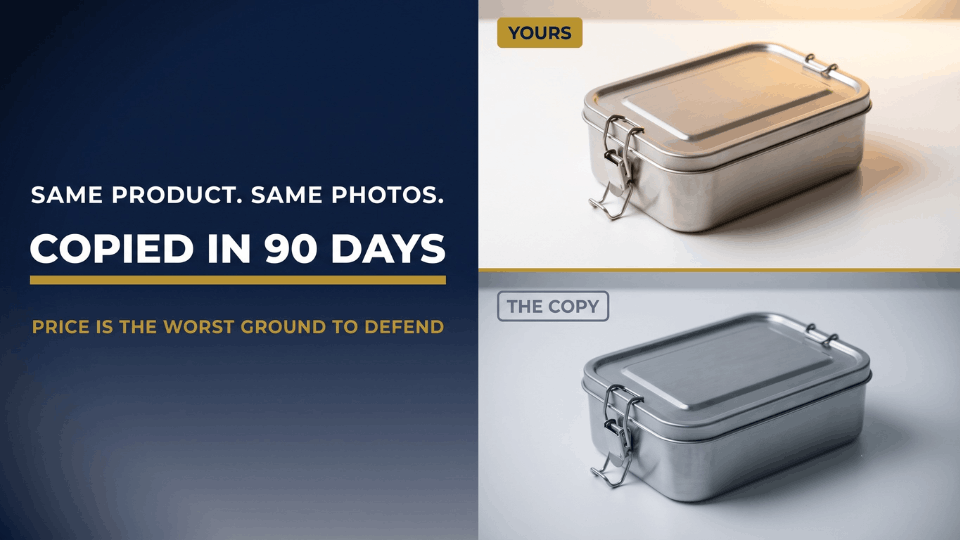
Kavya Reddy from Hyderabad spent fourteen months turning a stainless steel lunchbox into a real brand. Good photos, 430 reviews, a 4.4 rating, roughly ₹6 lakh a month in FBA sales. Then last March, three listings appeared that looked almost exactly like hers — same silhouette, same lifestyle shots, priced ₹80 lower. By June her conversion had slipped from 11% to under 7%, and her ads were buying clicks for shoppers who scrolled down and bought the copy.
The uncomfortable truth is that nothing she had built was actually hers. Photos can be re-shot. Bullets can be rewritten in an afternoon. Price can always be undercut by someone with thinner margins and less patience.
An Amazon product bundling strategy is the exception. When your listing is a combination of products only you own, a competitor cannot copy it without building your entire catalogue first. This guide covers how bundles and multipacks work for private label sellers in India, what the policy allows you to do, and how to get your first one live in 30 days.
Why Copycats Catch Private Label Sellers Faster Than Fees Do
The copy cycle runs on a 90-day clock
Anirudh Menon from Kochi launched a bamboo toothbrush set in January and had it ranking on page one by April. By July, four sellers were running the same product from the same supplier. He had spent ₹2.4 lakh warming up his main keyword with PPC; they spent nothing and rode the traffic he paid for. The pattern repeats across almost every category on Amazon.in, in the same order every time — photos first, then bullets, then price.
Why better images and more reviews only buy you time
Most sellers respond by improving exactly the things that got copied. Sharper infographics, a lifestyle video, a harder push for reviews. All of it helps conversion, and all of it sits on a public detail page — replicable by anyone willing to spend two weeks and a modest budget. Reviews slow a copycat down. They do not stop one.
Price is the worst ground to defend. The moment your differentiation is a number, you are in a fight with whoever is most desperate to make rent. Bundling moves the fight somewhere a competitor cannot follow you — into your own catalogue.
Amazon Bundle vs Multipack: The Difference That Counts
What Amazon counts as a bundle
Amazon treats a bundle as a new product made from several different products sold together as one offering, carrying its own identifier. The items have to be genuinely complementary — each should enable or improve the use of the others. A yoga mat, a strap and a block is a bundle. A yoga mat and a phone charger is not, however good the discount looks.
What counts as a multipack
A multipack is quantity of the same item: three of the same toothbrush, or your serum in a pack of two. Amazon handles this as pack quantity rather than as a bundle, and it normally lives as a variation under your existing parent listing — our guide on parent-child variations on Amazon covers when to split and when to merge.
Sneha Bhosale from Nashik lost six weeks to that distinction. She listed a four-pack of her own kitchen scrubbers as a “bundle”, picked up a listing quality flag, and only got it resolved after rebuilding it as a pack-size variation. Once corrected, the four-pack became 38% of her brand’s revenue within two months.
These are not competing options. Bundles solve a use case; multipacks solve replenishment. Most private label brands should eventually run both.
What the Amazon Bundling Policy Actually Restricts
The rule that shut down everyone except brand owners
Amazon’s updated bundling policy restricts combining products from different brands unless you own all of them. That single change ended an entire business model — the sellers who assembled snack boxes, grooming kits and gift hampers out of other people’s brands lost the ability to list them.
If you sell private label, read that again, because it is unusually good news. You own every brand inside your bundle by definition. The rule that removed a large chunk of your competition left your version of the tactic completely intact.
Where private label sellers still need to be careful
Consumables carry the tightest enforcement — grocery, health, beauty, baby and pet supplies. Farhan Qureshi from Lucknow assumed his protein supplements were safe because every item was his own brand, then found the category needed extra approval before he could list a repackaged set. Two lakh rupees of printed cartons sat in his warehouse for nine weeks.
Check three things before you commit to packaging: the current policy page in Seller Central, any category restriction on your product type, and whether your combination needs its own identifier. Ten minutes of reading is cheaper than a purchase order you cannot use.
Why Bundling Is the Cleanest Anti-Hijacker Move You Have
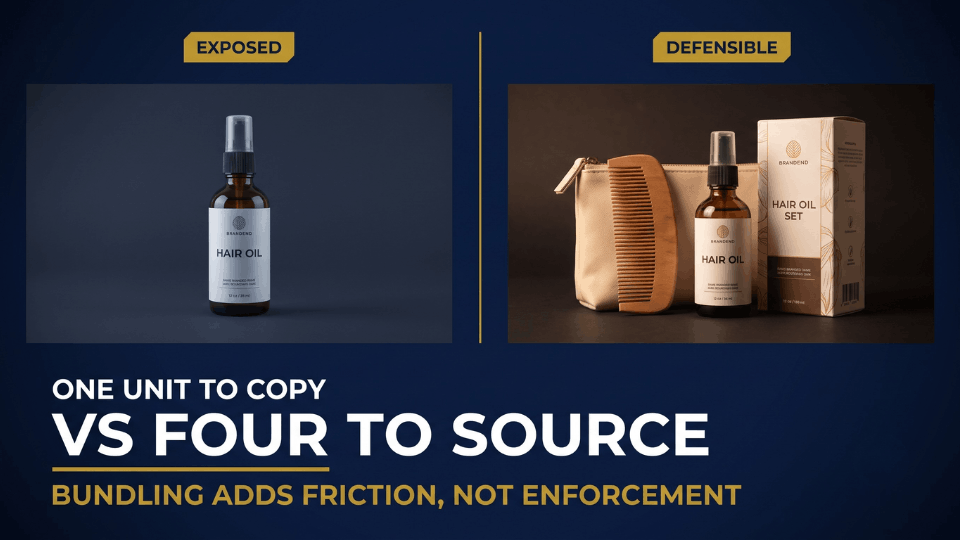
A hijacker on a single-SKU listing needs one unit of one product to make their offer look plausible. On a three-item branded bundle they need all three items, in your exact quantities, in packaging close enough to your main image to survive the first customer complaint. Most of them simply move on to an easier ASIN.
Deepika Nair from Coimbatore was hit twice in one quarter on her standalone hair oil bottle. She rebuilt the offer as a bottle, wooden comb and travel pouch set, with her brand printed on all three components. Nine months later, that bundle ASIN has had zero unauthorised offers, while the standalone bottle listing was hijacked again in December.
Be clear about what this does and does not do. Bundling adds friction; it is not enforcement. A determined counterfeiter with capital will still copy a bundle if the revenue justifies it, so keep your trademark, Brand Registry and monitoring active underneath. Our guide on protecting your listing from hijackers covers removal when friction is not enough.
Build Your Amazon Product Bundling Strategy Step by Step
How to create a bundle on Amazon Seller Central
Eligibility comes first. Your brand needs to be enrolled in Brand Registry, every ASIN in the combination must belong to that brand, and each one needs active FBA inventory in New condition. Parent variation SKUs are not eligible — only standalone ASINs. If you are not enrolled yet, start with our Amazon Brand Registry setup guide.
After that, the build is short:
- Pick your anchor product — the item shoppers already search for. Everything else in the bundle supports it.
- Choose two to four complementary items that complete an obvious job for the customer, not just items you want to clear.
- Create the outer packaging and generate a fresh identifier and FNSKU for the bundle as a single sellable unit.
- Build a new listing with its own title, bullets and images, with the hero image showing every component together.
- Send it into FBA pre-assembled, since Amazon does not bundle loose units on your behalf.
Expect two to three weeks from decision to live listing with a reliable packaging supplier.
Setting up an Amazon multipack listing
A multipack is simpler. It becomes a pack-size variation under your existing parent, so it inherits your review base and keyword history instead of starting cold. The outer pack carries one barcode and one FNSKU — never label the individual units inside.
Combo pack selling on Amazon India: the compliance bit
This is where Indian sellers get caught. A combo pack is a retail package in its own right, so the outer carton needs its own declarations under the Legal Metrology packaged commodities rules — MRP, net quantity, the packer or importer details and consumer care contact. Vikram Rathore from Jaipur had a festive gift set pulled three days before Diwali because the outer sleeve carried only his logo. Confirm the current requirements before you print, not after.
Amazon Virtual Bundles in India: Live, and Barely Used
What a virtual bundle actually does
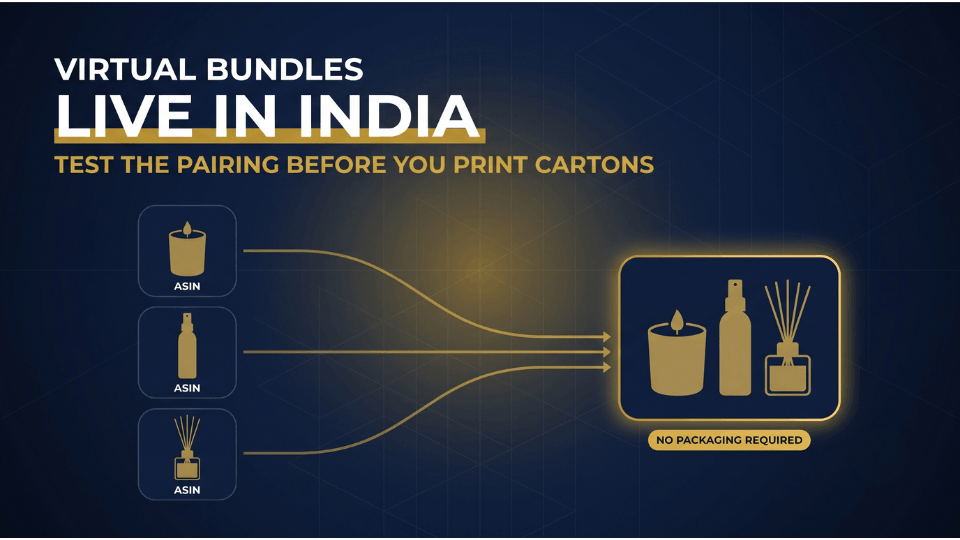
A virtual bundle groups two to five of your existing FBA ASINs onto a single detail page without any physical packing. The customer buys one offer; Amazon picks each item from the inventory you already hold. No cartons, no new shipment, no stranded stock if it fails.
Virtual bundles on Amazon India are already switched on
Most guides online still say this tool is US-only. That is out of date. Amazon has confirmed that brand owners managing brands in its India stores can group registered brand ASINs into virtual bundles and sell them together at a discount. You will find it in Seller Central under Brands.
The limits worth knowing before you rely on it
The tool is FBA-only and Brand Registry-only. If any single component runs out of stock, the whole bundle goes unavailable. Your first selected ASIN acts as the anchor and drives keyword relevance, so choose your best-ranking product for that slot.
Meghna Das from Guwahati tested five virtual bundles across her home fragrance catalogue. Four went nowhere. The fifth — a candle plus matching room spray — did 60 units in its first month, and she committed to physical packaging only once that data existed.
Bundle Pricing That Holds Its Margin
The one hard rule
Your bundle price must sit at or below the combined price of its components. Price it above that sum and you lose Buy Box eligibility, which makes the listing effectively invisible. Amazon’s own guidance is that the bundles which perform best carry a visible discount, not a token one.
The rupee maths that makes bundles worth it
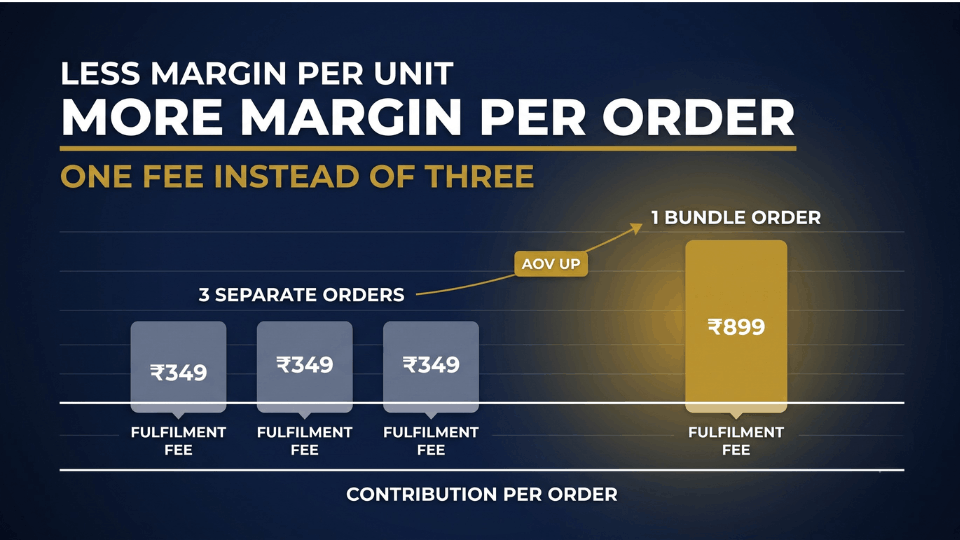
Say your soap bar sells at ₹349 and a three-pack goes out at ₹899. Per unit you have given up ₹49. In return you collect one fulfilment fee instead of three, one pick-and-pack instead of three, and one customer acquisition instead of three — worth reading alongside our breakdown of the real costs of selling on Amazon. That is how sellers increase average order value on Amazon without spending a rupee more on ads.
Harpreet Singh from Ludhiana moved his AOV from ₹512 to ₹1,180 across four months by adding two multipack sizes and one gift bundle. His margin per unit dropped by roughly 9%. His contribution margin per order rose 61%.
What happens to your single-unit sales
Some single-unit volume will shift into the bundle. That is not a leak, as long as contribution per order climbs. Keep the single unit live regardless — it is your trial size, and it feeds the bundle later.
Your 30-Day Amazon Product Bundling Strategy Plan
Days 1–10 — find the pairing that already exists. Open your Business Reports and Brand Analytics and look at what customers buy alongside your hero product. The combinations already appearing in real baskets will outperform anything you invent in a meeting.
Days 11–20 — test it virtually. Build two or three virtual bundles around your best-ranking ASIN. Zero packaging cost, zero inventory risk, and roughly a month of real conversion data.
Days 21–30 — commit to the winner. Take the bundle that actually sold and move it into physical packaging, or launch it as a multipack variation if quantity rather than combination drove it.
One live bundle by day 30 is the goal. Not five.
Frequently Asked Questions
What is the difference between a bundle and a multipack on Amazon?
A bundle combines different complementary products into one new offering with its own identifier. A multipack is several units of the same item, handled as pack quantity and usually listed as a variation under your parent ASIN. Bundles serve a use case; multipacks serve replenishment.
Do I need Brand Registry to create a bundle on Amazon?
For virtual bundles, yes — enrolment is mandatory and every ASIN must belong to that registered brand. Physical bundles do not strictly require it, but without Brand Registry you lose the enforcement tools that make a bundle worth defending.
Are Amazon virtual bundles available in India?
Yes. Amazon has confirmed that brand owners managing brands in its India stores can create virtual bundles from registered brand ASINs — look under Brands in Seller Central. Older articles still describing the tool as US-only are out of date.
Does bundling protect your listing from hijackers?
It raises the cost of copying you, because a hijacker must source and package every component rather than one item. Treat it as friction rather than protection, and keep your trademark, Brand Registry and monitoring active underneath.
How do you price an Amazon bundle?
Price at or below the combined price of the individual items — going above that costs you Buy Box eligibility. Aim for a discount the customer can actually see, then check that your contribution margin per order rises even though margin per unit falls.
Can you bundle products from two different brands you own?
For a physical bundle, yes, provided you genuinely hold the rights to both. Virtual bundles are stricter — every component must sit under one registered brand, so you cannot mix two of your own brands there.
Does a combo pack need its own barcode in India?
Yes. The outer pack is the sellable unit, so it carries its own identifier and FNSKU while the units inside stay unlabelled. It also needs Legal Metrology declarations, including MRP and net quantity for the pack as a whole.
Do virtual bundles work with Sponsored Products ads?
Support has historically been limited, with Sponsored Brands the more reliable route for bundle ASINs. Check current eligibility in your campaign manager before building a launch plan that depends on paid traffic.
Conclusion
Competitors copy products all the time. They rarely copy catalogue structure, because copying a bundle means funding an entire product line just to reach your starting line. That asymmetry is the whole point.
Start with what your data already shows, and price the result properly using our guide on deciding your product’s selling price. Find the two products customers keep buying together, test the pairing virtually while it costs you nothing, and only then spend on cartons. One bundle that survives a month of real traffic teaches you more than five built on instinct.
If you want the full system behind this — product selection, listing architecture, pricing and defence — that is exactly what we build with sellers inside the 3-Day Amazon Business Training . Come and build a catalogue nobody can screenshot their way into.
