

Ritika Bhandari from Jaipur spent three weeks getting her price right. She built the spreadsheet properly — landed cost from her Moradabad supplier, referral fee, FBA fee, packaging, ad spend, and a 22% margin she could actually live on. The number came out at ₹1,300, and she listed her brass planters at exactly that.
Six weeks later she was converting at 6%. A competing brand with the same review count, similar photos and a nearly identical product was converting at 11%. Their price? ₹1,299. One rupee — and that one rupee is what pricing psychology on Amazon is built to explain.
Ritika had solved the maths problem and ignored the perception problem. Her costing sheet told her what she could afford to charge. It told her nothing about what that number would make a buyer feel in the two seconds before they scrolled past her listing.
This post is about those two seconds. Charm pricing, anchoring, decoys and bundle maths — the persuasion layer that sits on top of your costing and decides whether the price you calculated ever converts.
Pricing Psychology on Amazon Starts Before the Number
Most sellers treat pricing as a single decision. You work out your costs, check three competitors, pick a number that clears your margin, and move on to keywords. That decision is necessary — and it is only half the job.
Why costing and persuasion are two different jobs
Costing answers a question about you: what can this business survive on? Persuasion answers a question about the buyer: does this number feel fair, cheap, premium or suspicious? ₹1,300 and ₹1,299 are identical to your P&L. To someone scanning eleven results on a phone during a lunch break, they are not the same number at all. If you have not locked down the costing side yet, read our guide on how to decide your product’s selling price first — everything below assumes you already know your floor.
The unfair advantage private label sellers have
As a private label seller, you own the ASIN. Nobody is fighting you for the Buy Box on your own listing, so no repricer is undercutting you by ₹2 every four hours. You set the MRP, the List Price, the coupons, the bundles, and the way your variations sit on the page. Every lever in this post belongs to you alone. A reseller can only match a price. You get to frame it.
Charm Pricing in Rupees: Does ₹499 Really Beat ₹500?
Charm pricing is the oldest trick in retail and still the most reliably tested. It is why D-Mart, Domino’s and Amazon itself price the way they do.
Left-digit bias and the rupee threshold
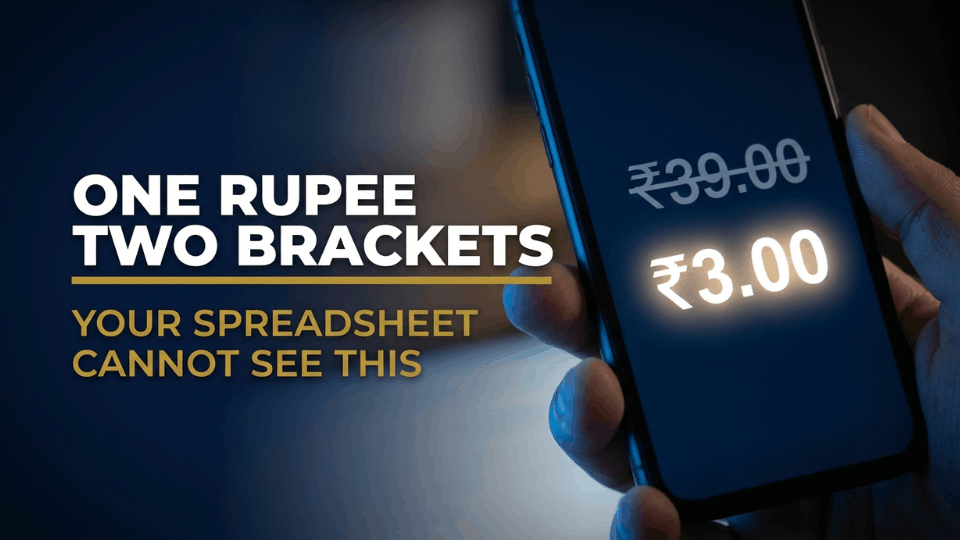
Your brain reads a price left to right and commits to the first digit before it finishes the rest. ₹499 gets filed under “four hundred something”; ₹500 gets filed under “five hundred.” The real gap is one rupee, the perceived gap is a hundred. This is left digit bias, and it holds up outside the laboratory — studies of real retail data consistently find most prices end in 9. Indian retail has no decimals in practice, so it works at the ₹9, ₹99 and ₹999 level. Moving ₹1,997 to ₹1,999 achieves nothing; you never crossed a threshold. Moving ₹2,010 to ₹1,999 drops the product into a cheaper bracket entirely. Audit your catalogue for SKUs sitting just above 500, 1,000, 2,000 or 5,000 and bring them below — often the fastest way to increase your Amazon conversion rate in India without touching your listing copy.
When 9-endings actively hurt your brand
Amazon psychological pricing has a ceiling, and premium brands hit it fast. Arjun Menon from Kochi priced his cold-pressed ayurvedic face oil at ₹2,999 for a year while competing on craft against mass-market brands. Last October he moved it to ₹3,200. Conversion held steady and his margin per unit improved by roughly ₹190. A 9-ending shouts discount; a round number signals confidence. If your positioning is quality, do not undercut it with a price ending that says bargain bin.
Before you rewrite anything, get your fee structure and true landed cost into one place. Our Amazon pricing and fee worksheet gives you that floor in twenty minutes, so every change below sits on real numbers.
Price Anchoring on Amazon and the Strikethrough Trap
If charm pricing is a nudge, price anchoring on Amazon is a shove. It is the strongest visual persuasion element on a detail page, and most sellers cannot get it to appear.
Why Amazon decides whether you get a strikethrough
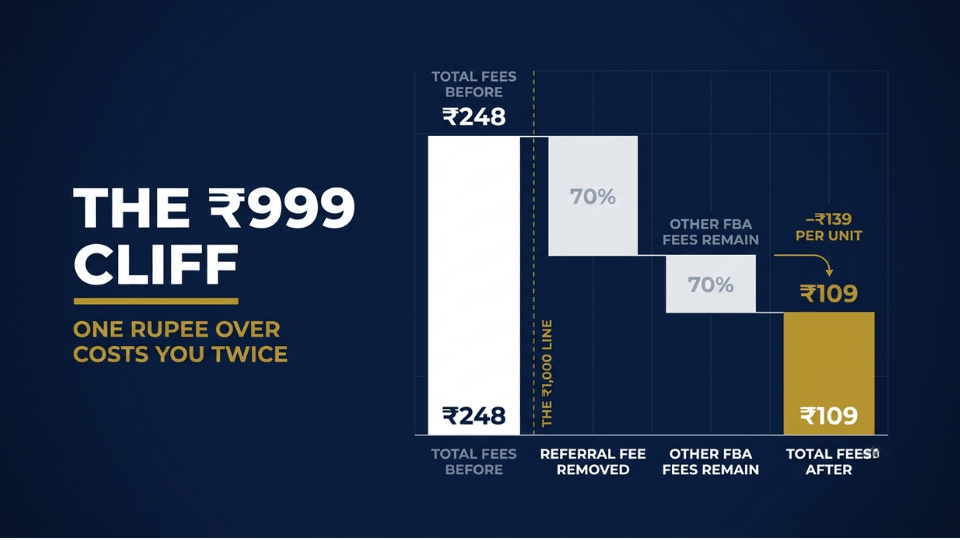
Anchoring comes from Tversky and Kahneman: the first number a person sees becomes the reference point for every number after it. ₹1,499 alone is a price to be judged. ₹2,199 struck through beside ₹1,499 is a saving to be claimed. But Sneha Kulkarni from Nashik set a sale price on her cookware range, waited a week, and nothing crossed out. Setting a sale price does not create an Amazon strikethrough price. Amazon displays one only when it validates a reference price — your suggested List Price, or a Typical Price it calculates from real sales history — and in April 2026 it tightened those criteria considerably. Listings that lose the strikethrough have historically seen materially lower conversion, and rebuilding takes roughly ninety days of clean sales.
Building an anchor that survives from day one
The classic mistake is launching low to buy early reviews, then raising the price. That teaches Amazon you are a ₹899 product, and the reference price follows you for a quarter. Launch at your target price and create the discount separately — coupons, time-bound deals, or one of the structured Amazon deal formats. Your reference price stays put while the buyer still sees a reason to act today.
MRP vs Selling Price on Amazon India: Your Anchor
Every Indian seller trips over Amazon’s four price fields at some point, and the confusion costs real money, because two of them control your anchor.
Four numbers, and only two the buyer sees
MRP is the statutory maximum retail price, mandatory on packaged goods in India and set by you as the brand owner. Your Price is what you charge. Sale Price is a temporary reduction. List Price is Amazon’s reference field, usually aligned to MRP. Amazon list price vs selling price matters because the buyer sees only two things: the price they will pay, and whatever strikethrough Amazon decides to display above it. The rest is backend plumbing.
The line you do not cross
Because you own the brand, you set your own MRP — and this is where sellers get greedy. Devendra Rathore from Indore set the MRP on his resistance bands at ₹1,999 while intending to sell at ₹649, purely to manufacture a permanent “68% off” badge. It worked for four months, until a customer complaint triggered a review and he spent six weeks defending that number. Inflating MRP to fabricate a discount is not a clever hack — in India it is a Legal Metrology exposure sitting on top of an Amazon fair-pricing one. Use one honest test: could you defend this MRP to a consumer forum?
Decoy Pricing: Let Your Own Range Steer the Choice
Decoy pricing is the quietest tactic in this post and the one your competitors cannot counter, because the whole comparison happens inside your own listing.
Why the middle option wins
Given three options, buyers avoid the cheapest because they assume it is compromised, and avoid the most expensive because they assume they are overpaying. The middle benefits from both comparisons. Add a third option to a two-option choice and you can move demand deliberately, without changing a single product or spending a rupee more on ads.
Building a decoy inside your variation family
Farhan Qureshi from Ahmedabad sells insulated steel bottles and wanted volume on his one-litre unit, which carries his best margin. How you structure parent-child variations decides whether this tactic is even available to you. He had two sizes: 500ml at ₹649 and 1L at ₹799. Buyers kept picking the 500ml, because ₹150 felt like a real jump. In February he added a 750ml at ₹749. He barely sells any — that was never the point. The 750ml exists so the buyer’s comparison becomes 750ml versus 1L, where ₹50 more for another 250ml is obviously the smarter buy. Within eight weeks, the 1L went from 31% to 58% of his mix.
Amazon Bundle Pricing Strategy: The Maths of a Deal
A good Amazon bundle pricing strategy does two jobs at once. It raises average order value, and it hands the buyer an anchor you built yourself.
Virtual bundles and the 10-15% rule
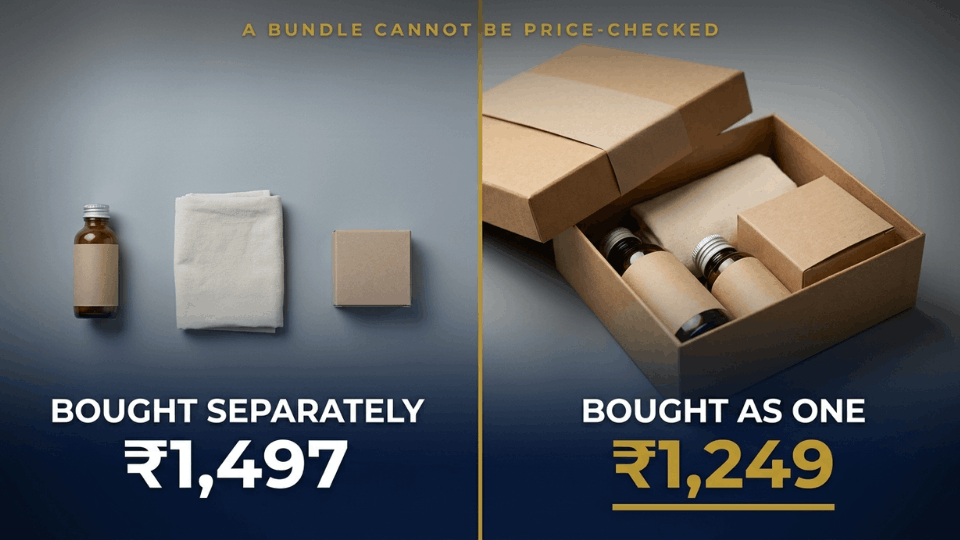
Amazon virtual bundles in India let brand-registered sellers group two to five complementary FBA products into one listing without physically packing anything. Inventory pulls from existing FBA stock, setup lives under the Brands tab in Seller Central, and the listing goes live within a day — no new SKU, no kitting cost, no inventory risk. The pricing is where sellers slip. Say three items sell standalone at ₹399, ₹549 and ₹299, a total of ₹1,247. Price the bundle at ₹1,099. The buyer sees a ₹148 saving, roughly 12%, which reads as a real deal rather than a rounding error. State that standalone total in your bullets. It is the anchor, and it makes the buyer compare your bundle against buying separately rather than against a single item.
What actually deserves to be bundled
Kavya Iyer from Coimbatore bundled her steel filter coffee brewer with a coffee pack and jaggery sachets as a complete morning kit. Starter kits and consumable pairings work because they match how the customer already thinks about the purchase. Two unrelated bestsellers stapled together does not.
If you want bundle structures that work in Indian categories, our virtual bundle planning template maps out the pairings, the pricing maths and the bullet copy that makes the saving visible.
Coupon vs Price Drop: Same Discount, Different Result
Two sellers offer the same ₹100 off. One cuts the price, one adds a coupon. They get very different results, and the difference is worth understanding before your next promotion.
A coupon is visible before the click
A price drop is invisible until someone lands on your detail page. A coupon badge appears underneath your price in the search results grid, where it wins attention from shoppers who have not clicked anything yet. The Amazon coupon vs price drop decision is really about where in the funnel you want your discount to work, and our guide on coupons vs deals vs Prime discounts breaks down which format suits which goal.
Raise the price, then couponise
Nikhil Barman from Guwahati sells pet grooming supplies and ran a permanent ₹749 price on a ₹899 product. Three months in, Amazon’s reference price had drifted down to meet his selling price and his strikethrough disappeared. He moved the listing back to ₹899 and ran a ₹150 coupon instead. Same money in the buyer’s pocket, same margin for him — but the badge pulled clicks, the reference price recovered, and a coupon feels earned in a way a low price never does. A standing discount quietly becomes your normal price. A coupon stays an event, and events can end without punishing you.
Testing Pricing Psychology on Amazon Without Damage
Everything above is testable, and testing it badly is how sellers talk themselves into believing pricing psychology on Amazon does not work.
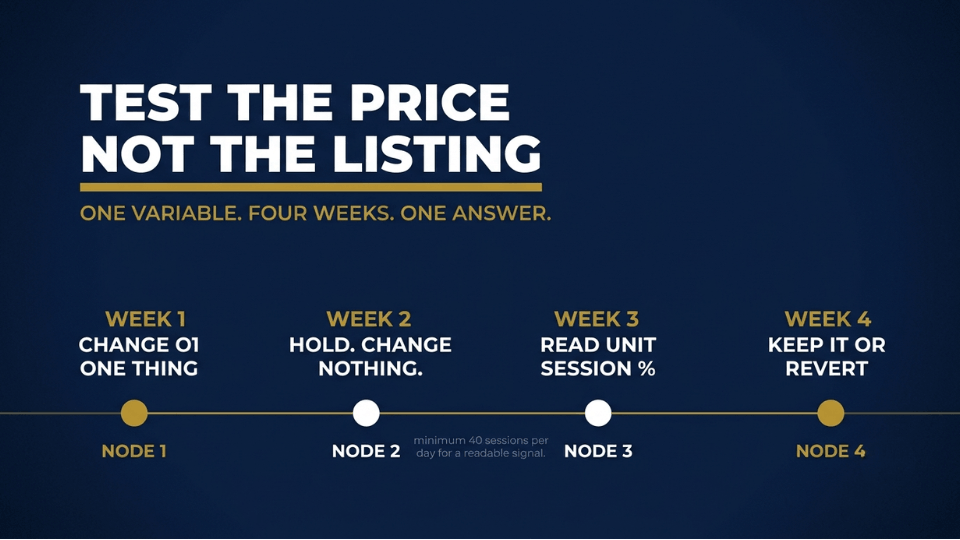
One variable, one SKU, fourteen days
Meghna Pillai from Thiruvananthapuram changed a price, added a coupon and launched a bundle in the same week, then spent a month unable to explain why her margin fell while her units rose. Change one thing, on one SKU, for at least fourteen days. Then watch the right numbers: session-to-purchase conversion, units per order, contribution margin per unit. Total sales will lie to you — a 20% price cut that lifts units 15% looks like growth and is a loss.
A 30-day sequence you can start on Monday
Work through it in this order, because each step protects the next:
- Week one — audit every SKU for threshold pricing and drop the ones sitting just above a round number.
- Week two — review your MRP and List Price for credibility, and fix anything you could not defend.
- Week three — build one virtual bundle, with the standalone total stated plainly in the bullets.
- Week four — replace one standing discount with a coupon and watch your click-through rate.
Give the cycle a full month before you judge it, and keep a log of what changed and when. The sellers who compound results here are the ones who can still tell you in November what they changed in July.
Frequently Asked Questions
Does ₹499 really convert better than ₹500 on Amazon India?
In most mass-market categories, yes, because ₹499 crosses a mental threshold and gets filed as “four hundred something.” The effect is strongest on impulse and mid-value products, and weakens or reverses on premium items where a round number signals confidence. Test it on one SKU rather than assuming it applies to your whole catalogue.
Why isn’t my strikethrough price showing on my listing?
Because setting a sale price does not create one. Amazon displays a strikethrough only when it validates a reference price — your suggested List Price, or a Typical Price it calculates from real sales history. If you have sold at your current price for months, Amazon treats that as your real price and there is nothing to cross out.
What’s the difference between MRP, List Price and Your Price on Amazon India?
MRP is the statutory maximum retail price you must display on packaged goods in India. Your Price is what you charge. List Price is Amazon’s reference field, usually matching MRP, and it is what may appear crossed out. The buyer sees only the effective price and any validated strikethrough.
Should I lower my price or add a coupon instead?
Add the coupon in most cases. A coupon badge shows in search results and wins clicks before anyone reaches your page, while a price cut stays invisible until they arrive. A coupon also protects your reference price, whereas a standing low price gradually becomes your new normal.
How do I price a bundle so it looks like a deal without killing my margin?
Price it 10-15% below the combined standalone total. Three items at ₹399, ₹549 and ₹299 total ₹1,247, so a bundle at ₹1,099 reads as a genuine saving. Under 8% feels like a rounding error; over 25% trains buyers to wait for discounts and eats the margin gain that made bundling worthwhile.
Can Amazon suppress my listing for a misleading discount?
Yes. If Amazon judges a displayed discount misleading — usually because the reference price does not reflect prices you have genuinely sold at — it can suppress the deal or the strikethrough. In India, an inflated MRP also carries Legal Metrology risk sitting entirely outside Amazon’s own policies.
Should premium products use round prices instead of ₹__9 endings?
Usually yes. A 9-ending signals value and discount, which works against you if your positioning is craft, quality or heritage. Round numbers read as considered and confident. If you compete on ingredients or design rather than price, test a round figure on one SKU and watch margin per unit.
How long should I run a pricing test before trusting the result?
Minimum fourteen days, and longer if your product has weekly demand swings. Change one variable on one SKU at a time, and judge the test on session-to-purchase conversion and contribution margin per unit — never on total sales, because a price cut almost always lifts units while shrinking what you keep.
Conclusion
Ritika’s number was never the problem. Her costing was sound and her planters deserved to sell. What she was missing was the layer between a correct price and a convincing one — the threshold her price sat on, the anchor she never built, the bundle she never made.
That layer sits entirely in your hands as a private label seller. Nobody competes for your Buy Box, and nobody else decides how your price is framed. Spend one focused month on the sequence above and you will learn more about your buyers than another quarter of ad spend would teach you.
If you want to build the brand foundations that make premium pricing credible in the first place, our -Day Amazon Business Training walks you through it step by step. Your margin, and your conversion rate, will thank you for it.
