
Ramesh Nayagam from Kodaikanal had been staring at the same screen for eleven minutes. His seller account was approved. His supplier in Rajkot had quoted him on stainless steel water bottles. He had opened the listing form, chosen the category, written a title he was proud of, and hit a field with two words next to it: Brand Name.
He typed “Generic.” It felt safe — he wasn’t a brand, just one man with a laptop and forty thousand rupees. Fourteen months later, with 380 reviews and a product on page one, he learned those seven letters could never be changed. Not edited. Not upgraded. Ever.
The private label vs generic Amazon question gets treated like a preference, something you drift into. It isn’t. It’s a decision with a door that locks behind you, and almost nobody makes it knowing that. By the end of this post, you’ll know which side of that door you belong on.
The Fork Every Indian Amazon Seller Hits in Week One
Nearly every seller meets this fork in week one, and nearly every seller walks past it without noticing.
The question that gets skipped, not answered
You’re busy with what feels urgent — GST registration, your supplier’s minimum order, whether your photos are good enough. The brand name field looks like paperwork. Nobody says “you are now choosing your business model for three years.” The form asks, you give the answer that takes least thought, and Amazon records it as permanent.
Why the internet fails you here
Search this and you’ll drown in American advice. Costs in dollars. Minimums built around Alibaba containers. Timelines assuming six weeks of sea freight. None of it survives contact with a seller in Coimbatore who can drive to her manufacturer in ninety minutes and order 200 units instead of 2,000. The maths is different here, and pretending otherwise has cost Indian sellers real money.
What this post will actually settle for you
Not which model is “better” — that has no answer without knowing your capital and patience. What it settles is what each choice costs, what it locks, and which one fits you.
Private Label vs Generic Amazon: What You’re Actually Choosing
Most sellers use these terms loosely and end up comparing things that aren’t opposites.
Generic: selling a product with no name on it
Generic means what it sounds like — a plain white t-shirt with no logo on the fabric and none on the tag. You sell the object itself, competing on price, delivery speed, and whether your photos beat the other six sellers offering the identical thing.
Private label: the same product, with your name and your control
Private label means taking a product a manufacturer already makes, applying your specifications and branding, and selling it as yours. You didn’t build a factory — you built a brand. The bottle may leave the same line as your competitor’s, but the name, packaging, and pricing are yours.
White label vs private label — the difference that trips people up
White label products are generic items made for many retailers to rebrand. Private label products are made to your specification, exclusively for you. Most new sellers start nearer white label and evolve as volumes justify custom tooling.
Where reselling branded goods fits into the picture
A third path gets confused with both: buying someone else’s brand wholesale and reselling it. You’re not the brand and not generic — you’re a distributor, sharing one listing with everyone holding the same authorisation.
Selling Generic Products on Amazon India: The Honest Case
Here’s where most posts quietly cheat. They frame generic as the beginner’s mistake, then spend two thousand words justifying the conclusion they started with. That’s no use to you, because for a real number of sellers, generic is the right answer.
Can I sell on Amazon India without a brand name?
Yes. You can list under “Generic” with no trademark and no Brand Registry. Amazon India permits it, thousands of sellers operate this way, and some make good money. Anyone telling you it’s forbidden is selling you something.
How to sell without brand name on Amazon — the mechanics
Create a listing, choose your category, enter “Generic” in the brand field, and apply for a GTIN exemption if you lack barcodes. You’ll be live in days rather than months. That speed is the entire appeal — and it’s a real advantage, not a consolation prize.
Four situations where generic is genuinely the right call
Generic earns its place when you’re testing whether demand exists and don’t want to spend ₹80,000 finding out. It earns it in true commodities — packing tape, basic cables, plain cloth — where nobody has ever cared about the name. It earns it when cash flow matters more than equity, and when you want to learn the platform at low stakes.
Seller example: validating before committing
Priya Nair from Coimbatore listed a generic silicone kitchen tool in March, spent six weeks and ₹12,000 learning what actually converted, then committed ₹80,000 to a branded version of the same category. She calls that six weeks the cheapest education she ever bought.
The One-Way Door: Why This Choice Isn’t Reversible
Now the part that changes everything — and the part Karthik learned too late.
What Amazon’s generic brand name Amazon listing policy locks
Amazon’s policy is explicit: once “Generic” is set as the brand name, it cannot be changed. Not by you, not by seller support, not by escalation. To sell that product under your own name later, you must build an entirely new listing — even though the item in the box is identical.
Starting from zero: what a rebuild costs you in reviews and rank
The implication is brutal. A new listing means zero reviews, zero sales history, zero ranking. Every rupee of PPC you spent climbing to page one stays attached to a listing you’ve abandoned. Karthik’s 380 reviews still sit on his generic ASIN. His branded listing started at nothing, and it took seven months and ₹1.4 lakh in ads to return to where he already was.
Do I need a trademark to sell private label on Amazon India?
Strictly, no — you can sell under an unregistered name. But without a registered trademark you can’t join Brand Registry, and without Brand Registry your catalogue is exposed. Our guide on whether you need a trademark to sell on Amazon India covers this properly — read it before you source anything.
The Brand Registry gate and what sits behind it
Behind that gate sits A+ Content, Sponsored Brands, Brand Analytics, and the power to stop other sellers editing your own listing. Our walkthrough on setting up Amazon Brand Registry in India covers the process and the mistakes that stall it. Generic sellers get none of it. That isn’t a small feature gap — it’s most of the modern Amazon toolkit.
Amazon Private Label Investment India: The Real Number
Every article you’ll find prices this in dollars, and every one is wrong for you. The Amazon private label investment India actually demands looks nothing like the $3,000-8,000 American blogs quote, because domestic sourcing changes the arithmetic.
How much investment is required to start private label on Amazon India?
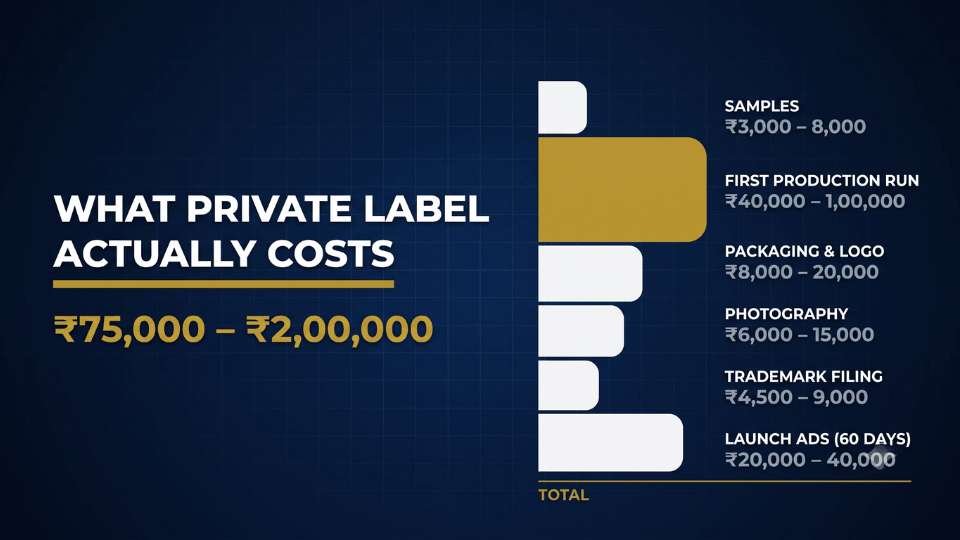
Realistically, ₹75,000 to ₹2,00,000 for a first product done properly. Samples from two or three suppliers run ₹3,000-8,000. A first production run at Indian MOQs — often 100-300 units, not Alibaba’s 500-1,000 — lands between ₹40,000 and ₹1,00,000. Packaging and logo design, ₹8,000-20,000. Photography, ₹6,000-15,000. Trademark filing, ₹4,500-9,000 per class. Sixty days of launch ads, ₹20,000-40,000.
Why domestic sourcing changes the maths
Sourcing from Rajkot, Tiruppur, Noida, or Ludhiana means no customs, no 45-day freight, no import duty, no container-sized minimums. You can visit the factory. Order 150 units. Fix a defect in a week instead of a quarter. Indian sellers consistently underestimate how structural this advantage is — our guide on sourcing products from IndiaMART shows how to find and vet these suppliers.
The capital floor: below this number, don’t start
Below roughly ₹60,000 you can genuinely afford to lose, don’t launch private label. Not because it can’t work, but because you’ll run out of inventory or ad budget inside sixty days — exactly when ranking momentum is hardest to build and easiest to lose. Undercapitalised private label isn’t a slow start. It’s a failed one.
Amazon Reselling vs Private Label: Margins, Timelines, Ownership
Set the models side by side on the three axes that decide your outcome.
The margin gap and why it compounds
Reselling and generic typically run 10-20% net margins. Private label runs 25-40%. On one sale that gap looks academic. Across 400 units a month for two years, it separates a business that funds its own growth from one that can never afford a bigger order.
Speed vs equity: the trade nobody quantifies
Generic gets you live in days. Private label takes 8-16 weeks — sourcing, sampling, branding, photography, launch. Beginners price the money and ignore the time, then panic in week six when nothing has shipped. Decide now whether you can sit through that wait without losing your nerve.
What you own at the end of year two, in each case
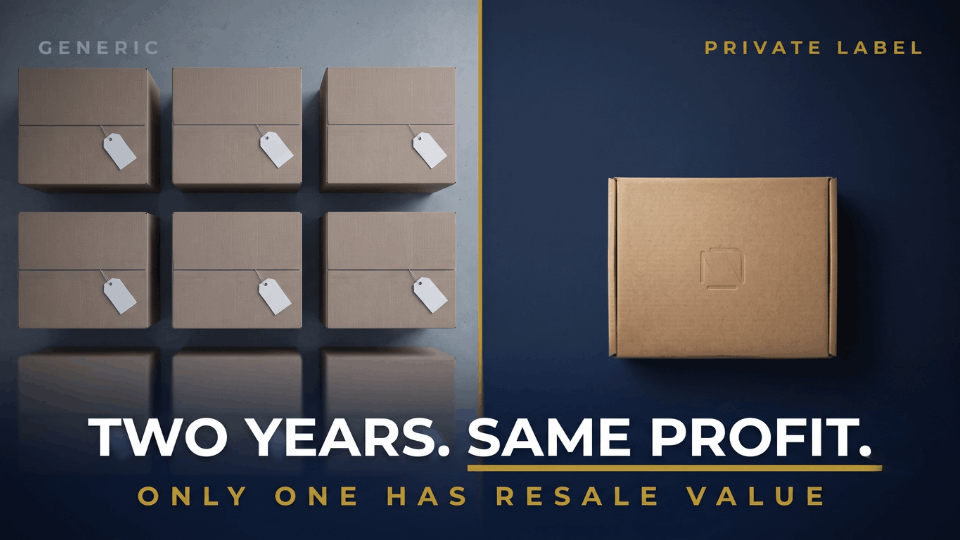
A generic listing is a job that pays while you work it. A brand is an asset with a sale price. Rakesh Agarwal from Jaipur ran generic listings for two years, cleared ₹90,000 a month, and went to sell in 2025. The valuation came back at effectively nothing — no trademark, no Brand Registry, nothing a buyer could take possession of. Two profitable years, zero enterprise value.
Is Private Label Worth It for Beginners? The Four-Question Filter
So — is private label worth it for beginners? It depends on four things, answered honestly rather than aspirationally.
Is private label better than reselling for beginners?
Not universally. It’s better for beginners with capital and patience, worse for those with neither, because it turns a manageable learning curve into an expensive one. Generic teaches you the platform cheaply. Private label teaches you the platform while also teaching you sourcing. If capital is your constraint, our breakdown of starting Amazon selling with ₹1,00,000 or less maps what’s realistic at that level.
The four questions, answered honestly
Work through these before you spend anything:
- Do you have ₹75,000 or more you could lose entirely without damaging your life?
- Can you survive 90 days with no revenue from this product, without borrowing?
- Are you willing to learn sourcing, quality control, and supplier negotiation?
- Is this a business you intend to own in three years, or an experiment?
Three or four honest yeses means private label. Two or fewer means start generic, deliberately, with your eyes open.
If you scored low: how to go generic on purpose
Going generic on purpose is a strategy. Going generic by accident is a trap. Do it on a product you never intend to brand — a genuine commodity — so the locked listing costs you nothing later. Leave your brandable category untouched until you can fund it properly.
If you scored high: what week one looks like
Secure the name first. Search IP India, file the trademark, then talk to suppliers. For the full sequencing from product selection through launch, our deeper material on the blog walks each stage in order.
Private Label vs Generic Amazon: Your Decision, Made This Week
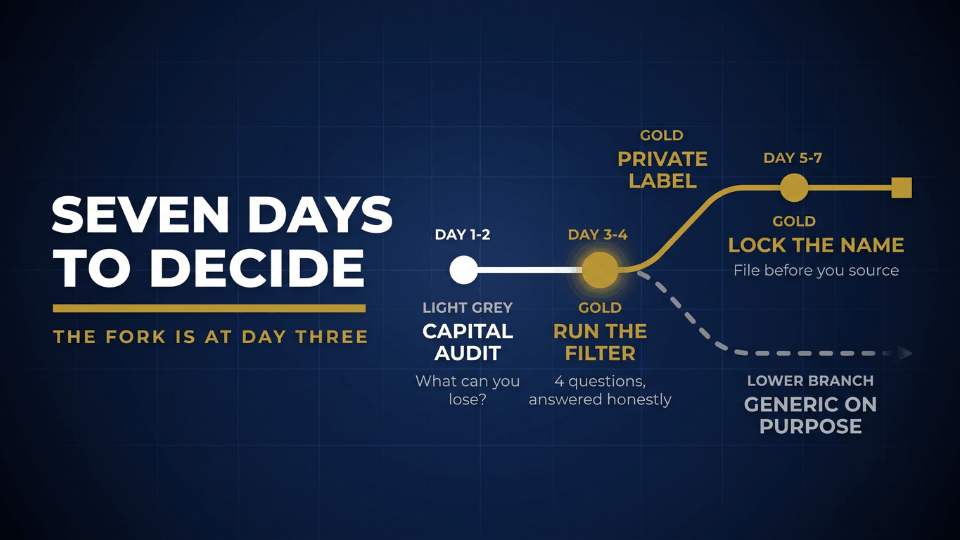
You don’t need three months for this. You need seven days and some honesty.
Day 1-2: the honest capital audit
Write down what you can actually lose. Not what you have — what you can lose. That one number removes most of the ambiguity before you consider anything else.
Day 3-4: run the filter, pick the lane
Answer the four questions without flattering yourself. Anjali Deshmukh from Nashik did this in an afternoon last year, scored two out of four, chose generic on a phone-accessory commodity, and revisited nine months later with ₹1.1 lakh saved. She now runs a registered brand. The filter didn’t tell her no. It told her not yet.
Day 5-7: lock the name before you touch a supplier
Going private label? Pick it carefully — our guide on choosing the perfect brand name is worth an hour before you commit. Then file the trademark this week. Every month you wait is a month someone else can register the name you’re building visibility for.
The cost of not deciding
Indecision is itself a decision, and it defaults to generic — because the form is right there and “Generic” is easy to type. And generic, as you now know, defaults to permanent.
Frequently Asked Questions
Can I sell on Amazon India without a brand name?
Yes. Amazon India lets you list under “Generic” with no trademark and no Brand Registry, and you can apply for a GTIN exemption if you lack barcodes. It’s fast and legitimate. The catch is control — anyone can list against you, and brand-only tools stay locked. Fine for commodities, risky for anything you hope to build on.
Is private label better than reselling for beginners?
Only if you’re capitalised for it. Private label offers roughly 25-40% margins and a sellable asset; reselling offers 10-20% and immediate cash flow. With ₹75,000 you can afford to lose and 90 days of patience, private label wins. Without both, reselling teaches you the platform without the expensive lesson attached.
How much investment is required to start private label on Amazon India?
Budget ₹75,000 to ₹2,00,000 for a first product — samples, a 100-300 unit domestic run, packaging design, photography, trademark filing, and sixty days of launch ads. Domestic sourcing keeps this well below the dollar figures American guides quote. Below ₹60,000 of genuinely disposable capital, wait.
Do I need a trademark to sell private label on Amazon India?
Not to list, but effectively yes to build. Without one you can’t join Brand Registry — no A+ Content, no Sponsored Brands, no protection against others editing your listing. File early; the application number alone starts the clock and protects the name you’re investing in.
What is the difference between white label and private label?
White label products are generic items a manufacturer makes for many retailers to rebrand. Private label products are made to your specification, exclusively for you. Both let you sell under your own brand, but private label produces something competitors can’t order off the same shelf.
Can I change my listing from Generic to a brand name later?
No. Once “Generic” is set, Amazon locks it permanently. Branding that product means a completely new listing from scratch — no reviews, no sales history, no ranking — even though the physical product is unchanged. This is the single most expensive thing sellers learn late.
Can I start generic and switch to private label once I have profits?
You can switch models, not listings. It works if you go generic on a commodity you never intended to brand, then launch private label as a separate product with a clean listing. It fails if you build fourteen months of equity into a generic ASIN and try to carry it across.
Is private label still worth starting in India in 2026?
Yes, arguably more than before. Domestic manufacturing keeps improving, tariff pressure on Chinese goods has pushed sourcing toward India, and Indian buyers increasingly trust homegrown brands. The bar is higher than in 2020 — you need a real product and real capital — but so is the ceiling.
Conclusion
Go back to Karthik, eleven minutes into a blinking cursor. The lesson was never that private label beats generic. Plenty of sellers make excellent money without ever registering a brand, and Priya’s six-week experiment saved her from an expensive mistake.
The lesson is that one of those doors opens both ways and the other doesn’t — and Karthik didn’t know which was which until the choice was fourteen months behind him. You know now. That already puts you ahead of most sellers converting dollar figures in their head.
Whichever lane you pick, pick it on purpose. And if the filter pointed you toward private label, our 3-Day Amazon Business Training walks you through executing that decision properly — sourcing, branding, and launch, in the right order. The door only locks if you’re not looking at it.
