

The Return That Costs You Twice
Last September, Naveen Reddy from Hyderabad shipped a ₹4,200 power bank to a prepaid customer and felt good about it. Three days later the return showed up: same box, same weight on the label, except inside was a brick of folded newspaper. By the time he opened it, Amazon had already refunded the buyer. Naveen wasn’t careless. He was simply on the wrong side of a system that pays first and asks questions later, and that gap is exactly where Amazon return fraud lives.
Here is what makes refund abuse so brutal for sellers in India: it costs you twice. First you lose the product, often a high-value unit that can’t be resold. Then you absorb forward shipping, return shipping, the refund fee, and on a bad month a Seller Cancelled Return Rate fine on top. The good news is that abuse follows patterns, and patterns can be spotted, documented, and fought.
Why Amazon refunds the buyer before you inspect the return
Amazon is built customer-first, and that philosophy shows up most painfully in returns. For most categories the platform issues the refund the moment a return is scanned into the courier network, long before the parcel reaches you. The side effect is that an opportunist can return an empty box, a swapped unit, or nothing recognisable at all, and still walk away refunded while you’re left holding an unsellable mess.
The real margin maths
Run the numbers once and the urgency becomes obvious. On that ₹4,200 power bank, Naveen lost the unit cost, both shipping legs, the commission and refund fee, and the resale value of an item now gone. A single fraudulent return on a thin-margin product can wipe out the contribution from eight to ten honest sales. That’s not a rounding error. That’s your month.

Why FBA Pays the Buyer Before You See the Box
FBA is built customer-first, and the refund timing reflects that. When a buyer requests a return, Amazon places the sale funds on hold, sends the prepaid label, and inspects the unit only after it physically arrives at the fulfilment centre. For most categories the buyer is made whole long before anyone checks the box.
That speed is great for buyers and fine for honest returns. The problem is the opportunist who returns an empty parcel, a swapped older unit, or nothing at all, and still walks away refunded. Shalini Nair, who runs a homeware label out of Kochi, hit three versions of this in one festive season, recognising the third only because the first two had taught her the pattern.
The reason this matters so much for FBA sellers specifically is that you never touch the return. You don’t open the box, weigh it, or see the condition. Amazon does all of that on your behalf, which means your only window into what went wrong is the data Amazon hands back to you in your reports. Learn to read that data and you can spot a bad return without ever holding it; ignore it and the loss vanishes into your monthly settlement, looking like a normal cost when it isn’t.
What Amazon Actually Owes You (And What It Doesn’t)
Before you chase a single rupee, you need to know which losses are recoverable, because filing for the wrong ones wastes your time and burns goodwill with Amazon. Not every painful return is claimable, and the sellers who recover the most fight only the battles they can win.
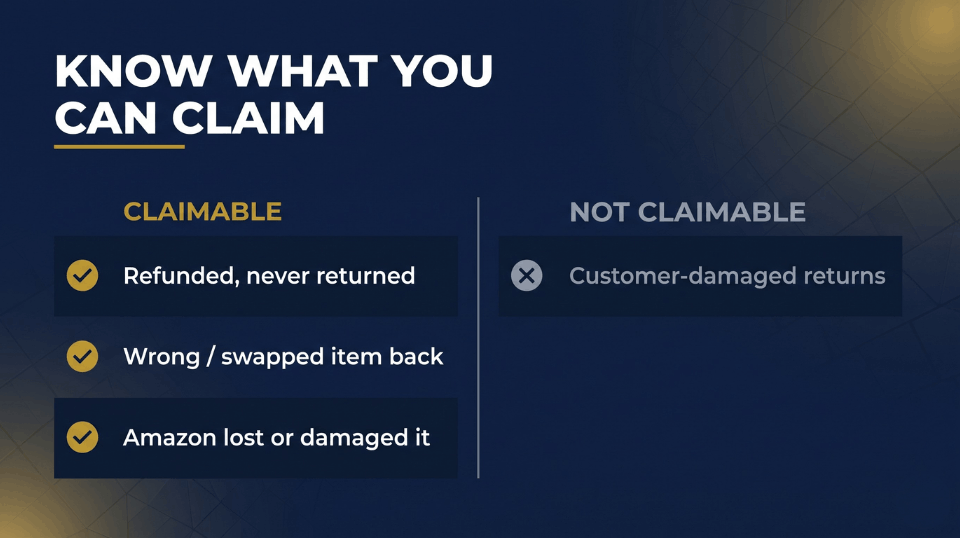
You can realistically claim three situations. The first is when a refund was issued but the unit was never returned to your inventory within the window. The second is when a materially different or wrong item came back, the classic switcheroo where the buyer keeps your new product and ships back a dead one. The third is when Amazon’s own staff lost or damaged the unit during handling or transfer. In all three, the loss was outside your control, which is the test Amazon applies.
Here’s the catch worth tattooing on your forehead. Customer-damaged returns are usually not reimbursed. If a buyer opens, uses, or damages the item and sends it back unsellable, Amazon generally treats that as a cost you carry, not something it pays for. Mohammed Arif, a kitchenware seller in Lucknow, wasted weeks filing cases for plain customer damage before he understood the line, and his approval rate only climbed once he stopped. Knowing what Amazon owes you is half the skill; finding it is the other half.
Reading Your FBA Customer Returns Report Like a Detective
Your reports are a confession written in data. For FBA, three do the heavy lifting, all under Reports, then Fulfilment, in Seller Central. The FBA Customer Returns Report shows every returned unit with its order ID, ASIN, return reason, and crucially its disposition, whether the unit came back sellable, unsellable, or never arrived.
The skill is matching that against two other reports. The Reimbursements Report tells you which losses Amazon has already paid you for automatically, so you don’t double-file. Manage FBA Inventory shows you what physically sits in your stock right now, the backbone of any healthy FBA inventory system. When a refund appears in returns but there’s no matching reimbursement and no unit back in inventory, you’ve found money owed.
Four fields tell you almost everything you need. The return reason clusters reveal whether you have a listing problem or an abuse problem, since scattered “defective” claims on a sturdy product rarely add up. The disposition field flags units marked unsellable or not received. The time-to-return shows intent, because a return filed hours after delivery on a product that takes days to test is a red flag. And repeat buyer or ASIN patterns expose the serial returner working across your listings. Read these together and the genuine losses separate cleanly from the recoverable ones.
If you’d rather not wrestle pivot tables every fortnight, we built a free FBA Reimbursement Checker on our tools hub. Drop in your two reports and it instantly flags the orders that look unclaimed. It runs entirely in your browser, so your data never leaves your laptop.
The 15-Day Audit That Protects Your Margins
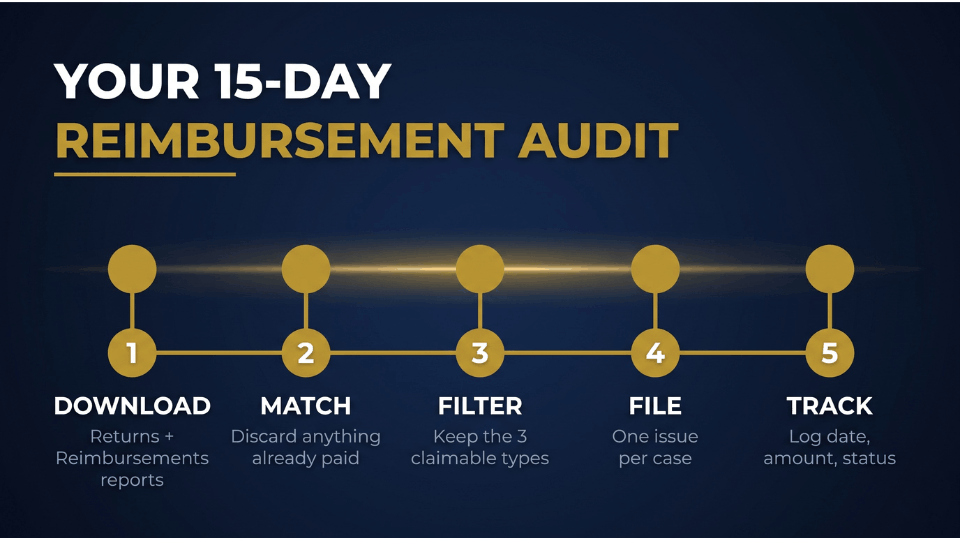
Recovery isn’t a one-time rescue mission, it’s a habit. In India the FBA reimbursement claim window is roughly 60 days from the verified delivery or refund date, which means a monthly audit already leaves your oldest cases half-expired. A fortnightly rhythm is the sweet spot, about thirty minutes every fifteen days.
Harpreet Singh from Ludhiana recovered a meaningful chunk of a bad quarter purely by turning this into a calendar event he never skips. Here is the exact loop he runs:
- Pull the last 45 to 60 days of the FBA Customer Returns Report and the Reimbursements Report, and keep Manage FBA Inventory open alongside.
- List every refunded return as a candidate, noting order ID, ASIN, and disposition.
- Match each candidate against the Reimbursements Report by order ID or FNSKU, and discard anything already paid.
- Filter what remains down to the three claimable types only, never-returned, wrong-item, or Amazon-damaged.
- File a case for each qualifying order, then log it in a simple sheet with the date filed, amount expected, and status.
Next cycle you start by checking which previous cases paid out, then repeat from the top on the fresh window. That’s the entire system, and done every fifteen days it turns return fraud and FBA error from a silent leak into a managed line item you control.
Filing an FBA Reimbursement Case That Gets Approved
A claim isn’t won by who’s right, it’s won by who can prove it cleanly. For FBA, you’re not using the SAFE-T menu, you’re opening a case through Seller Central support under the customer returns reimbursement category, or following the claim path inside the Customer Returns Report itself. The principle is simple: one issue per case, stated plainly, backed by the report line that proves it.
Vandana Iyer, who ships fragile décor from Chennai, lifted her approval rate sharply once she stopped writing vague essays and started quoting the data. Her cases now read like evidence, not complaints: the order ID, refund date, ASIN, and a single clear sentence such as “refund issued, no unit returned to inventory within the eligibility window, no reimbursement on record.” When a wrong item comes back, she states that the returned unit differs from what was shipped and attaches what the report shows.
The discipline that separates winners is knowing when to stop. Some low-value losses cost more in time than they’ll ever return, so chasing them only clutters your queue. Escalate the high-value, well-documented cases hard, appeal a wrong decision once with sharper evidence, and let the small ones go without guilt. A handful of airtight claims beats a flood of weak ones every single time.
Why Your Payout Looks Smaller Than It Should
Here’s a change that catches sellers off guard. Since early 2025, Amazon calculates many reimbursements on your estimated product cost, not your selling price. So that ₹4,200 power bank might come back reimbursed closer to its manufacturing cost than its retail value, and on a high-margin product the gap can sting.
Ritika Agarwal from Jaipur learned this the hard way when a batch of approved claims paid out at roughly a third of what she expected. The policy had simply shifted under her feet. The fix is unglamorous but powerful: know your true per-unit costs, keep accurate cost records for every SKU, and when Amazon asks you to submit your cost data, do it promptly and precisely.
Here is a free Amazon
Sellers who supply clean cost documentation get reimbursed closer to fair value, because Amazon isn’t guessing low on their behalf. Those who ignore the request are stuck with Amazon’s own estimate, which almost always lands at the bottom of the range. Treat your cost records as part of your reimbursement system, not an accounting afterthought.

Preventing Return Fraud Before It Reaches Your Account
The cheapest loss to handle is the one that never happens. You can’t stop a determined scammer, but you can make your listings a harder target, and prevention protects more margin than any claim ever will. The best part is that none of it touches Amazon’s policies on incentives or reviews, so you stay completely safe without hurting your account health.
Start with listing accuracy, because precision kills the “not as described” excuse before it’s filed. Replace vague claims with exact dimensions, materials, and real sizing guidance, so an apparel buyer can’t hide behind a fit complaint and an electronics buyer can’t claim surprise. Honest listings don’t just cut genuine returns, they remove the cover that abusers rely on. If you want to go deeper on the legitimate side, our guide on reducing your Amazon return rate pairs perfectly with everything here.
Next, deter the swap-and-return crowd with visible serial-number tracking and tamper-evident packaging on high-value units, so a buyer knows the item they send back will be checked against the one you sent. Combine that with a disciplined fortnightly audit and you close the loop entirely: fewer fraudulent returns get attempted, and the ones that slip through get caught and claimed. That shift, from absorbing losses to managing them, is what protects your margins through every festive rush.
Frequently Asked Questions
Can FBA sellers file a SAFE-T claim?
No. SAFE-T claims are only for seller-fulfilled orders, meaning Easy Ship and Self-Ship. If you run FBA, the SAFE-T menu won’t help you. Your recovery path is the FBA reimbursement process: audit your Customer Returns and Reimbursements reports, then open a case for any refund where the unit was never returned, came back as the wrong item, or was damaged by Amazon.
How do I claim an Amazon FBA reimbursement for a bad return?
Go to Reports, then Fulfilment, and download the FBA Customer Returns Report and the Reimbursements Report. Find refunded returns that were never restocked or came back as a different item, and confirm Amazon hasn’t already paid you. Then open a case in Seller Central referencing the order ID, ASIN, refund date, and the specific report line that proves the loss. Keep it to one issue per case.
What is the FBA reimbursement claim window in India?
For India FBA customer-return claims, you generally have about 60 days from the verified delivery or refund date. That tight window is exactly why a fortnightly audit beats a monthly one, because waiting a full month leaves your oldest eligible cases close to expiry. Build the audit into your calendar so no claimable loss ever quietly times out.
Does Amazon reimburse customer-damaged FBA returns?
Usually not. If a buyer opens, uses, or damages an item and returns it unsellable, Amazon typically treats that as a cost you carry. Reimbursement is realistic only when the unit was never returned, a materially different item came back, or Amazon’s own staff lost or damaged it. Filing for plain customer damage tends to get rejected, so focus on the three recoverable types.
Why is my FBA reimbursement smaller than my selling price?
Since early 2025, Amazon calculates many reimbursements on your estimated product cost rather than your retail price, so payouts can feel low on high-margin items. The defence is to keep accurate per-SKU cost records and submit your cost data whenever Amazon requests it. Sellers who supply clean documentation get reimbursed closer to fair value, while those who don’t are stuck with Amazon’s lower estimate.
How often should I audit my FBA account for reimbursements?
Every 15 days is the sweet spot for Indian sellers, given the 60-day claim window. A fortnightly thirty-minute audit catches losses while they’re still claimable and keeps the workload tiny. Pull your two reports, match them, filter to the recoverable cases, file, and log each one. Monthly works in a pinch, but you’ll lose older cases to the window before you spot them.
Does a high return rate hurt my account health?
Yes. Amazon treats return rate as a quality signal, so consistently high returns can suppress listings, reduce Buy Box eligibility, and trigger account health warnings. Most categories should stay under ten percent, ideally under five. Separating genuine dissatisfaction from fraud protects both your margins and your ranking, which is why prevention through accurate listings matters as much as recovery through reimbursements.
Can I report or block a buyer who keeps abusing returns?
You can’t directly block a buyer, but you can report clearly abusive ones through Seller Central. This rarely reverses your individual loss, yet repeated flags contribute to Amazon’s enforcement against serial offenders over time. Keep a private log of problem buyers and the ASINs they target, so when a pattern emerges you can audit and file faster on every fresh hit.
Conclusion
You will never scare off every scammer, and chasing that goal will only exhaust you. What you can do is stop the quiet bleeding. The FBA sellers who thrive on Amazon India aren’t the ones who never get hit, they’re the ones who audit every fortnight, claim what Amazon genuinely owes, keep clean cost records, and let the small losses go so they can win the big ones.
That single shift, from victim to systematic operator, is what keeps your margins intact through every festive rush. If you’re ready to build that operator’s mindset across your entire Amazon business, our 3-Day Amazon Business Training walks you through the exact systems step by step. Your inventory, and your bottom line, will thank you.
