

A few months before the festive rush, Meera Nair from Kochi placed her first big inventory order: 500 units of a bamboo kitchen organiser she was sure would sell. She had a decent product and a clean listing. What she did not have was a single hour of amazon competitor research behind the decision. Six weeks later, 430 units still sat in a fulfilment centre while three rival listings she had never studied quietly took every sale.
Meera’s mistake was not the product. It was launching blind into a category she had never taken apart. The sellers beating her were not smarter or richer. They had simply done the homework she skipped. They knew the keywords buyers typed, the price shoppers expected, and the complaints that pushed people toward rival products.
Here is the good news. You can do that same homework in about sixty minutes, before you spend a single rupee on stock. This guide is a timed, repeatable teardown that turns a competitor’s success into your blueprint.
Why one hour of competitor research beats guessing
Most sellers treat research as something they will get to later, once the product is live and the numbers look wrong. By then the money is spent and the lessons are expensive.
The real cost of launching blind
When you skip research, you borrow time from your future self at a brutal interest rate. Arjun Reddy from Hyderabad learned this with a yoga mat launch. He copied a price from one listing, ordered 300 units, then discovered buyers cared far more about thickness and grip than price. His listing mentioned neither. Returns climbed, his rating slipped to 3.6 stars, and he spent the next quarter clawing back trust he could have kept from day one.
What reverse-engineering actually means
Reverse-engineering a competitor does not mean copying them. It means studying a product that already works, asking why, and then doing it better. The winning listings in your niche are free market research that someone else paid for, and there is a fuller playbook on staying ahead in Amazon’s competitive landscape. Every keyword they rank for, every review they collect, every price they test is data you can read in an afternoon, on purpose, instead of paying for the same lessons later in lost sales.
Is it legal to reverse engineer an Amazon product?
Before you start, be clear about the line between smart and shady, because Amazon takes intellectual property seriously.
Studying public information is completely fair. A competitor’s keywords, pricing, images, bullets, and reviews are visible to any shopper, and analysing them is what a sensible business does. This is the heart of legitimate amazon competitor analysis, and nobody can penalise you for it.
What crosses the line is copying protected assets. Lifting a rival’s exact copy, using their brand name or trademark, or cloning a patented design can get your listing pulled and your account flagged. Sneha Patel from Surat found this out when she copied a competitor’s bullet points almost word for word. The brand owner, enrolled in Amazon Brand Registry, reported her, and her listing was suppressed within days.
The safe approach is simple. Learn from what works, then express it in your own words, images, and improvements. Out-execute the competition, do not impersonate it. Treating their listing as a teacher rather than a template keeps you on the right side of every Amazon policy while still giving you the full advantage of their data.
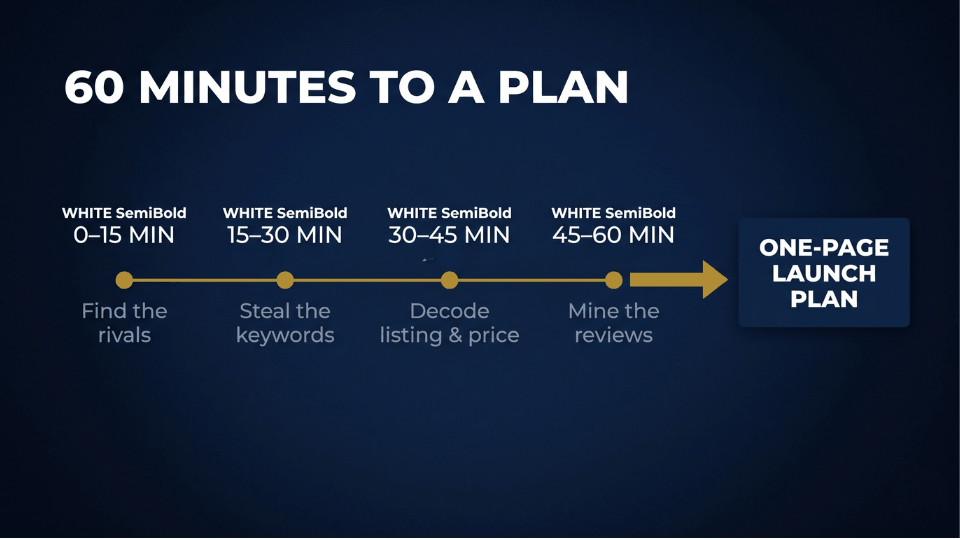
Minutes 0-15: Find the right competitor to study
Your hour starts with a decision most sellers get wrong: choosing who to study. Pick the wrong competitors and you will optimise for the wrong battle.
Where smart competitor analysis begins
Your true competitors are not the products that simply look like yours. They are the ones fighting for the same keywords and the same buyer. Search the main term a customer would type, then look at who owns page one. Note the listings that also appear under “Customers also viewed” and “Frequently bought together”, because Amazon is telling you which products share your audience.
Picking the three ASINs worth your hour
You do not need to study twenty listings. Three is enough. Choose products with strong sales signals: a healthy Best Sellers Rank, a steady stream of recent reviews, and clear overlap with what you plan to sell. Grab each product’s ASIN, the ten-character code in the URL that starts with B0. Karthik Iyer from Chennai narrowed his power-bank research to the three best-selling rivals in his price band and finished in under an hour, instead of drowning in fifty tabs.
Minutes 15-30: Find your competitor’s keywords
This is where competitor research stops feeling abstract and starts handing you a shopping list of exactly what to put in your listing.
What a reverse ASIN lookup actually is
Normal keyword research starts with a keyword and looks for products. A reverse ASIN lookup flips that. You start with a competitor’s ASIN and work backwards to uncover every search term driving traffic to that listing. These are real terms from actual buyer behaviour, not guesses, covering both the organic keywords a product ranks for and the paid terms it bids on.
How to find competitor keywords on Amazon
Amazon does not hand out this data directly, so you use a tool that estimates it. Paste a competitor’s ASIN into a reverse ASIN tool and you get a list of keywords with search volumes. Sort by volume, then watch for high-volume terms your own draft listing is ignoring, the same instinct behind using data to outsmart your competition in Brand Analytics. Those gaps are where easy sales hide.
Building one keyword map from three rivals
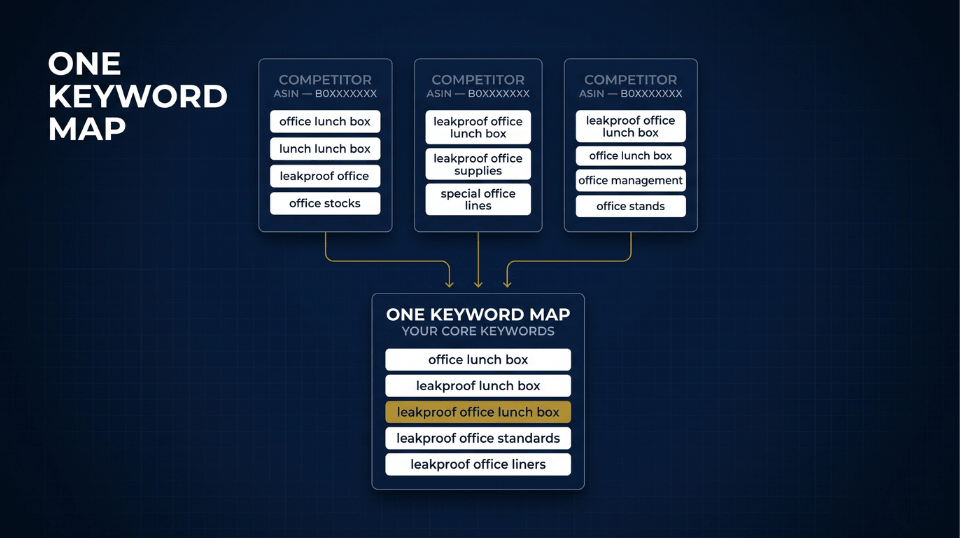
Run all three ASINs and merge the results, removing duplicates. The keywords that appear across multiple competitors are your core terms, the ones every serious player targets. Fatima Sheikh from Lucknow did this for a steel lunchbox and found “leakproof office lunch box” was driving traffic to all three rivals, yet appeared nowhere in her own title. Adding it lifted her impressions within a couple of weeks. One caution: only borrow keywords that genuinely fit your product, because Amazon’s algorithm punishes clicks that never convert.
Before you move on, capture what you find in one place. A simple teardown sheet with columns for keywords, price, gaps, and your angle keeps the next thirty minutes sharp instead of scattered.
Minutes 30-45: Decode their listing and pricing
With keywords in hand, the next fifteen minutes are about understanding why shoppers click buy on their listing and not yours.
Reading the title and bullets like a strategist
Open each competitor listing as a buyer, then again as a strategist. The keyword at the front of the title is the term they most want to rank for, and the first two bullet points usually carry the benefits buyers care about most, so study how rivals write bullet points that actually convert. If every rival leads with “BPA-free” or “12-month warranty”, that is your market telling you what reassurance it needs before it trusts a purchase.
What their images and pricing are really doing
Images sell more than copy does. Vikram Bose from Kolkata realised his main image was a plain shot on white, while all three rivals used lifestyle photos in a real Indian kitchen. He swapped his hero image and his click-through rate climbed within the month. Study their pricing the same way. Look beyond the sticker price at coupons, bundles, and quantity discounts, because the real offer shapes the buyer’s sense of value. If three rivals sit between ₹699 and ₹799 with a coupon, pricing at ₹999 with no offer is a quiet way to lose before you start.

Minutes 45-60: Mine the reviews for your gaps
The final fifteen minutes are the most valuable, because this is where competitors hand you the exact reasons to choose your product over theirs.
Go to each rival’s reviews and filter for one, two, and three-star ratings. Ignore the praise and read the complaints, because every recurring frustration is a gap you can fill. If buyers keep writing that a strap snapped or the instructions confused them, you have found your differentiation for free. This is how to spy on amazon competitors without spending anything, since the reviews are public and brutally honest.
Ananya Desai from Ahmedabad did this before launching a travel bag. Reading her top competitor’s reviews, she noticed dozens of complaints about a flimsy zip. She sourced a sturdier one, said so plainly in her bullets and images, and built her early reviews around durability. Within two months her listing was converting better than the rival she studied, on a smaller ad budget, because she had solved a problem buyers were already complaining about. Your competitors’ worst reviews are the raw material you need to use customer feedback to improve your product, and your best product brief.
If review reading feels slow, keep three prompts beside you: what broke, what confused, what disappointed.
Tools to spy on Amazon competitors, free and paid
You can run this entire teardown without paying for anything, and you can also speed it up with software once you are selling seriously. Both paths work, so match the tool to your stage.
Free reverse ASIN tools and manual methods
When you are starting out, the manual method costs nothing. Reading listings, comparing prices, and mining reviews by hand gives you most of the insight you need. For keywords, a free Amazon reverse ASIN tool or browser extension will give you a usable sample of competitor terms without a subscription. The free lookup limit is often enough for a first pass on three ASINs. Harpreet Singh from Ludhiana built his entire first launch on free checkers and manual review mining, and upgraded only once the product was profitable.
When a paid tool earns its cost
Once you are managing real inventory and ad spend, paid tools save hours and sharpen accuracy. Options like Helium 10, Jungle Scout, and SellerSprite give you fuller keyword data, tracking, and merged multi-ASIN analysis in seconds. For Indian sellers, most of these price in dollars and add GST, so treat the subscription as a cost that should pay for itself. The tool matters less than the habit. A disciplined seller with free tools beats a lazy one with a premium dashboard every time.
Turn your competitor research into a launch plan
Sixty minutes of research only matters if it changes what you do next. The goal is a single page you can act on, not a folder of screenshots you never reopen.
Your one-page teardown, summarised
Pull everything into one view: the core keywords every rival shares, the price band buyers expect, the strongest images in your niche, and the top three review complaints. Add one line for your angle, the single thing you will do better than everyone you studied. That page is your launch brief, built entirely from what the market already proved it wants.
What to act on first
Do not fix everything at once. Start with the changes that move fastest: get your core keywords into your title and bullets, match or beat the expected price with a smart offer, and upgrade your main image to match the best in your category. Meera Nair, from our opening story, eventually ran this teardown on a second product. She launched into a category she understood, priced it where buyers expected, and sold through her first order before the festive season ended. Same seller, same budget, very different result, all because she spent one hour first.
Frequently asked questions
How do I analyze my competitors on Amazon?
Identify the three listings that rank for your main keyword and share your buyer. Then work through four things in order: their keywords via a reverse ASIN lookup, their title and bullet structure, their pricing and offers, and their reviews. The complaints there usually point straight to your easiest opportunities.
What is a reverse ASIN lookup and how does it work?
It starts with a competitor’s product code instead of a keyword. You paste their ASIN into a tool, and it estimates every search term driving traffic to that listing, organic and paid, with search volumes. It shows the exact keywords buyers use, so you can add the relevant ones to your own listing.
How do I find my competitor’s keywords on Amazon?
Amazon does not publish this data, so you use a reverse ASIN tool. Paste your competitor’s ASIN, sort by search volume, and look for high-volume terms missing from your listing. Running three competitors and merging the lists reveals the core keywords every serious seller in your niche targets.
Is it legal to copy or model a competitor’s Amazon listing?
Studying public keywords, pricing, images, and reviews is completely legal and smart. What is not allowed is copying protected assets: exact wording, brand name, trademark, or patented design. Learn from what works, then express it in your own words and visuals. Out-execute rivals rather than impersonate them.
Which tools can I use for Amazon competitor analysis?
For free, manual review reading and a limited-use reverse ASIN checker cover the basics. When you scale, paid tools like Helium 10, Jungle Scout, and SellerSprite offer deeper data and tracking over time. Indian sellers should note these usually price in dollars and add GST, so pick the tier that fits your sales.
How often should I run competitor research?
Treat it as a habit, not a one-time task. Run a full teardown before every launch, and a quick check every few months on products you already sell. Markets shift, rivals appear, and prices move, so periodic research keeps your listings competitive instead of slipping behind.
Can I do this without paying for any tool?
Yes. Reading listings, comparing prices, and mining one to three-star reviews by hand costs nothing and delivers most of the insight. Free reverse ASIN checkers give you a keyword sample for a first pass. Many sellers run their first launches entirely on free methods, upgrading only once a product turns profitable.
How many competitors should I analyse at once?
Three is the sweet spot. One gives a narrow view, while ten leaves you drowning in tabs. Pick the three best-selling listings that share your keyword and price band. Their overlap shows what matters most, and the teardown stays inside your sixty-minute window.
Conclusion
The sellers who win on Amazon are rarely the ones with the deepest pockets. They are the ones who refuse to launch blind. One focused hour, spent reading the market before spending on stock, is the difference between guessing and knowing.
You now have the full teardown: find the right rivals, lift their keywords, decode their listing and price, and mine their reviews for the gaps only you will fill. Run it once and it feels like work. Run it before every launch and it becomes your quiet, unfair advantage.
If you want to learn the complete research-to-launch system, with live teardowns and direct guidance, join our 3-Day Amazon Business Training. Bring a product idea, and walk out with a plan built on evidence instead of hope.
