

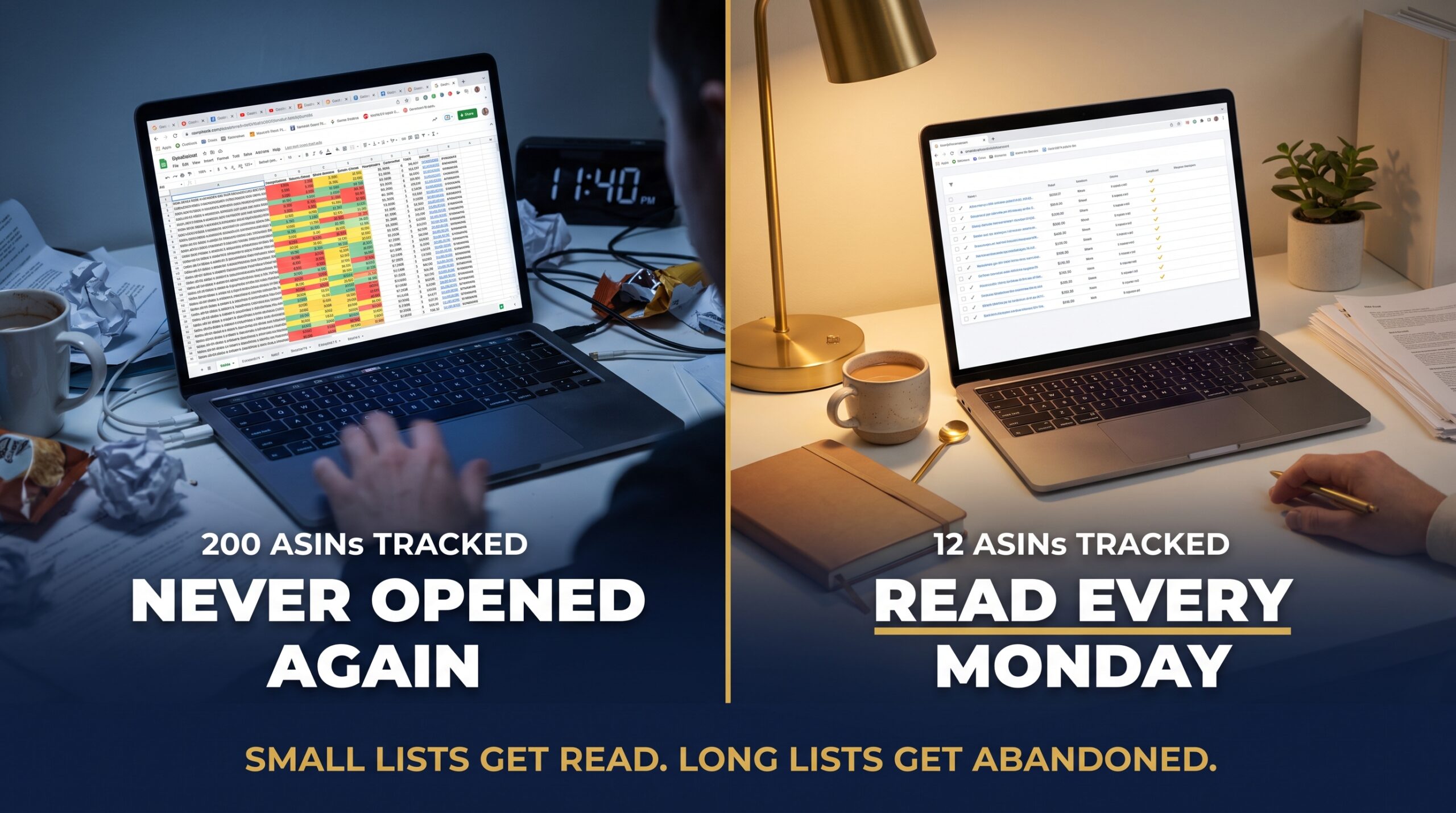
It is 11.40 on a Tuesday night and you have fourteen tabs open, every one of them somebody else’s listing. One rival dropped his price by ₹40 this morning. Another added a video. A third has 900 reviews to your 60, and every scroll feels like a small insult. You shut the laptop with a headache and no decision made.
That is the trap most sellers fall into: confusing surveillance with strategy. Useful amazon competitor analysis is not about knowing everything your rivals do. It is about tracking the small number of sellers whose moves should genuinely change what you do next week — your price, your ad budget, your next purchase order.
What follows is the practical version. You will build a short watchlist instead of a bloated spreadsheet, learn which numbers actually predict your own sales, estimate what a rival ships each month without wild guessing, and set a routine that takes twenty minutes a week. No paranoia, no 200-ASIN tracker you abandon by March. Just a habit that tells you where your next order should go, and the confidence to stop refreshing at midnight.
Why Tracking the Right Rivals Changes Your Sales
Competitor research earns its keep only when it ends in a decision. Every hour you spend should produce a price change, an ad adjustment, a listing edit or a sourcing call.
The cost of watching the wrong sellers
Rohit Malhotra in Ludhiana spent four months benchmarking his ₹799 cotton bedsheets against a national brand selling at ₹2,400. He matched their photography, their A+ layout, their bullet structure — and his conversion rate moved barely 0.4%. When he switched his watchlist to the five sellers sitting beside him in the ₹650–₹900 band, he found two of them out of stock most weekends. Filling that gap lifted his weekend orders by 38% in six weeks. The lesson: benchmark sideways, not upwards.
What a rival’s listing actually tells you
A listing is a confession. The keywords in the title reveal what the seller believes buyers type. The bullet order reveals which objection they think kills the sale. Repeated Q&A threads reveal what the images fail to explain. Read three rivals this way — or reverse-engineer a competitor’s product properly — and you will understand buyer doubt better than any survey could tell you.
Where Indian sellers usually get this wrong
The common mistake is tracking brands instead of ASINs. A brand page tells you nothing about price movement or stock; a specific ASIN logged every Monday tells you when a rival runs dry and hands you a weekend of unopposed traffic. Precision beats breadth, every single time.
How Do I Find My Real Competitors on Amazon?
Your real competitors are not the brands you admire. They are the listings a buyer sees on the same screen as yours, at the same moment, for the same search. That is the only definition worth using.
Start with the search terms buyers actually type
Pull your top ten converting search terms from your Search Term report, then search each one on Amazon.in in an incognito window. The ASINs appearing in the first fifteen positions across three or more of those searches are your true rivals. Answering how to find competitors on amazon really is this simple — you let the buyer’s vocabulary do the selecting instead of your assumptions.
Read the sponsored and organic slots separately
Organic winners have earned relevance and conversion history. Sponsored slots show who is buying their way in, often a newer seller with cash and ambition. Faizan Qureshi in Hyderabad noticed the same two sponsored ASINs on eight of his keywords for three straight weeks, read it as a launch push, and defended his top three terms early — holding his rank through a quarter he expected to lose.
Check Frequently Bought Together and comparison tables
Scroll any strong rival’s page and Amazon hands you its own view of the neighbourhood: the comparison table, the “customers also viewed” carousel, the bundle suggestions. These are algorithmic judgements about substitutability. Note which ASINs recur across several rivals’ pages, because those are the products Amazon itself considers interchangeable with yours.
Sorting Rivals Into Tiers You Can Actually Manage
A list of 200 ASINs is a list you will never open. Tiering keeps the work small enough to survive a busy Diwali week.
Direct rivals, substitutes and aspirational brands
Direct rivals sell essentially your product at a comparable price to the same buyer — watch these weekly. Substitutes solve the same problem differently, like a foam roller against a massage gun, and deserve a monthly glance. Aspirational brands sit two price bands above you; visit them quarterly for ideas, never for pricing decisions.
Building a watchlist of ten to fifteen ASINs
Meenakshi Nair in Kochi ran a 60-ASIN tracker for her stainless steel bottles and gave up by the third week. Cutting to twelve — eight direct, three substitutes, one aspirational — turned a two-hour Sunday chore into eighteen minutes. Within one quarter she had spotted a consistent ₹120 price gap she could occupy, and her units per week rose from 41 to 63. Small lists get read; long lists get abandoned.
Knowing when to drop a seller from the list
Drop an ASIN when it stops appearing in your keyword searches, when it has been out of stock for over a month, or when its price has drifted so far that you would never respond to its moves. Review quarterly and force yourself to remove one. A watchlist that only grows eventually stops being read.
If you want to build your first tiered watchlist alongside people doing the same work in the same marketplace, spend three days on it at the 3-Day Amazon Business Training and walk out with the list already made.
The Metrics That Deserve Your Attention
Track only what changes your behaviour. Five numbers reviewed weekly beat thirty numbers reviewed never, and that principle keeps amazon competitor analysis sustainable.
Price, Buy Box share and stock movement
Log the landed price a buyer sees, coupon included, and note who holds the Buy Box on multi-seller listings. Stock movement matters most: a rival sliding from “In stock” to “Only 4 left” is about to hand you a fortnight of unopposed traffic, and your ad budget should be ready to absorb it.
Review velocity, ratings and question threads
Count new reviews per month rather than total reviews. Arvind Deshpande in Pune tracked velocity across six rivals in pet accessories, spotted a newcomer adding 50 reviews a month against his own eight, and raised bids and follow-up before he lost position — keeping his top-two organic slot through a nine-month fight. Totals tell you history; velocity tells you who is coming for you.
Listing quality, A+ content and image strategy
Look at the sixth and seventh images, not the first. That is where sellers place size charts, in-use context and comparison graphics that answer the objections killing conversions. If four rivals show a scale-reference photo and you do not, that is a one-afternoon fix with a measurable return.
Keyword rank and ad placement footprint
Record where each rival sits for your five most valuable keywords, and whether they also occupy sponsored slots on those terms. A rival dominating both organic and sponsored positions is defending seriously; one holding organic rank with no ad spend is vulnerable to a well-funded push from you.

Estimating What a Competitor Sells Each Month
Everyone wants the sales number, and almost everyone treats the estimate as gospel. Treat it as a range instead, and it becomes genuinely useful.
Reading Best Sellers Rank the sensible way
Best Sellers Rank measures relative velocity within a category, not absolute units, so a BSR of 800 means very different things in Kitchen versus Beauty. What matters is movement. Screenshot a rival’s BSR three times a week for a month: a rank swinging wildly is riding promotions, while a steady rank signals dependable demand you can plan inventory against.
Stock-depletion checks and inventory signals
Add a large quantity of a rival’s product to your cart and Amazon will often reveal available stock. Repeat on the same weekday for four weeks and the difference between readings approximates units sold. Tanvi Shah in Surat used this on three kurta sellers, estimated the leader at roughly 900 units a month, and sized her first order at 400 rather than the 1,200 her supplier pushed — avoiding an overstock she could never have cleared before the season turned.
Sanity-checking estimates before you bet on them
Cross-check every estimate against a second method before signing a purchase order. If tool estimates say 1,500 units and the cart test says 600, trust the lower figure and plan for the gap. Estimates break down badly on variation listings, seasonal spikes and bulk buying, so widen your range whenever any of those apply.
Software That Speeds Up the Research Work
Tools do not replace judgement, but they turn a four-hour manual crawl into a twenty-minute session. That time saving is the entire argument.
What paid research suites do well
Research suites pull sales estimates, revenue ranges, review counts, fulfilment method and listing quality scores straight from a search results page, so you can scan a whole category in minutes. Database filters let you screen by price band, review count and estimated revenue — the fastest route to serious amazon product research for indian sellers who cannot afford a wrong first order.
Reverse-lookup tools for stealing keyword ideas
A reverse asin lookup amazon workflow takes a rival’s ASIN and returns every search term it ranks for, with volume and position. Running helium 10 cerebro competitor keywords across three top rivals and keeping only the terms all three rank for gives you a proven keyword core rather than a guess. Karthik Reddy in Bengaluru rebuilt his backend search terms from that overlap and saw organic sessions rise 27% in five weeks.
Free and low-cost options for new sellers
Before you subscribe to anything, Amazon’s Search Term report, Brand Analytics for registered brands, the autocomplete dropdown and a manual cart test will carry you a long way. Most amazon competitor analysis tools offer limited-use plans; start there, prove you will use the data weekly, then pay. A subscription you open twice a year is a leak, not an investment.
Working through this with someone watching your screen shortens the learning curve considerably — that is exactly what happens when you sit through the 3-Day Amazon Business Training with your own ASINs open.

Keeping an Eye on Prices Without Losing Margin
Price is the one competitor variable that can destroy you in a fortnight. A tracking routine without a rule set just makes you reactive.
Setting alerts for the ASINs that matter
Set alerts on your eight direct rivals only, with a threshold of roughly 5% so small fluctuations do not ping you hourly. A disciplined competitor price tracking amazon seller routine means checking alerts once each morning, not watching a feed all day. Note the change, note whether stock is falling too, and decide once.
Deciding when to match and when to hold
Match only when a rival’s cut holds past four days and your conversion rate has visibly dipped. Most cuts are short promotional bursts that reverse on their own. Shalini Gupta in Kanpur held her ₹649 price through a rival’s ten-day ₹549 push, lost about 15% of units, then regained all of it plus margin when the rival returned to ₹679 — a cut she would have chased and never recovered from.
Protecting margin against a race to the bottom
Calculate a floor price from your landed cost, referral fee, fulfilment fee, storage, returns allowance and minimum acceptable profit, write it down, and refuse to cross it. When a competitor prices below your floor, compete elsewhere — a two-piece bundle, a larger size, a stronger warranty. Losing a sale is recoverable; training buyers to expect an unprofitable price is not.
Turning Research Into Products Worth Launching
The best return on competitor research is not a price change. It is the next product you choose to sell, and the confidence to order enough of it.
Reading review complaints as a product brief
Sort your top five rivals’ reviews by lowest rating and read a hundred of them. Tally the complaints. If “zip broke in two weeks” appears thirty-one times across three brands, you have a product specification written by paying customers, and a phrase you can use verbatim in your bullets.
Spotting gaps in size, bundle and price bands
List every rival by pack size and price on one sheet and the empty squares appear immediately. Nitin Bansal in Jaipur found nine sellers offering single and twelve-piece packs of storage jars but nobody selling a four-piece at the ₹500 mark. He launched that exact configuration and it became 40% of his category revenue within three months — a gap visible only once he mapped the whole grid.
Validating demand before you place the order
Before committing money, confirm three things: consistent demand across at least ninety days of BSR observation, at least two rivals earning meaningful volume so it is not a one-brand fluke, and a landed cost that leaves margin at the prevailing price band rather than a hoped-for premium. Then take your findings to the supplier as specifications, not a wish. Suppliers quote sharper when you arrive with numbers.

Building a Monitoring Rhythm You Will Stick To
Consistency beats intensity. A twenty-minute weekly habit outperforms a frantic ten-hour audit every six months.
Weekly checks versus quarterly deep dives
Weekly, log price, stock status and Buy Box for your eight direct rivals. Monthly, add review velocity and keyword rank. Quarterly, rebuild the watchlist from fresh searches, because the competitive set genuinely shifts. Devansh Patel in Ahmedabad ran exactly this cadence for a year and caught two funded new entrants early enough to defend his rank both times, on roughly eighty minutes of work a month.
A simple dashboard of numbers to log
One sheet, one row per ASIN, one column per week. Record only these:
- Landed price the buyer sees, including coupons and discounts
- Best Sellers Rank in the main category
- Total reviews and average rating
- Stock status, flagged whenever it reads low or unavailable
- Your own organic position on your top three keywords
Everything else is optional. Four months of this sheet will teach you more about your category than any single report, because you see patterns rather than a snapshot.
Reacting to festive sales and new entrants
Tighten to daily checks during the Great Indian Festival, Prime Day and the Republic Day window, when prices move hourly and stock-outs are common. Watch for new ASINs under fifty reviews climbing fast — that is a funded launch, and responding in week two costs far less than responding in week ten.
Frequently Asked Questions
How do I find my real competitors on Amazon?
Search your top ten converting keywords in an incognito window and note the ASINs appearing in the first fifteen results across three or more searches. Those are your genuine rivals. Add the ASINs recurring in comparison tables and “customers also viewed” carousels, since Amazon treats those as substitutes.
Which metrics matter most in an Amazon competitor analysis?
Five carry most of the weight: landed price including coupons, stock status, review velocity per month, Best Sellers Rank movement and keyword rank on your top terms. Each maps to an action — stock-outs mean raise bids, rising review velocity means a serious new rival. Anything that does not change your behaviour is not worth logging.
How can I estimate a competitor’s monthly sales on Amazon?
Use two methods and trust the lower result. Add a large quantity to your cart to reveal available stock, repeat on the same weekday for four weeks, and treat the weekly difference as units sold. Cross-check against BSR-based tool estimates. Plan with a range, never a single confident figure.
Is Helium 10 worth the cost for a small Amazon seller in India?
It becomes worth it once you review data weekly and make decisions from it. If you sell a handful of SKUs and open the dashboard twice a year, the subscription is a leak. Start with limited-use plans and Amazon’s own reports, prove the habit sticks for a month, then subscribe.
How often should an Amazon seller redo competitor analysis?
Weekly for price, stock and Buy Box on direct rivals — twenty minutes is enough. Monthly for review velocity and keyword rank. Quarterly for a full watchlist rebuild from fresh keyword searches, because competitive sets shift faster than sellers expect. During festive sales, move to daily checks, as opportunities close within hours.
Can I do useful competitor research without any paid tool?
Absolutely. Autocomplete shows what buyers type, the cart-quantity test reveals stock, BSR screenshots track velocity, and a hundred one-star reviews give you a product brief no software will write. Brand Analytics adds search and click-share data if you are brand registered. Paid tools save time; they do not replace observation.
How many competitors should I track at one time?
Ten to fifteen ASINs: roughly eight direct rivals, three or four substitutes and one aspirational brand. Fewer than eight and you miss category-wide shifts; more than fifteen and you stop opening the sheet, which is worse than not tracking. Review quarterly and remove at least one ASIN each time.
Is it against Amazon policy to study a rival’s listing?
Reading publicly visible listings, reviews, prices, ranks and Q&A threads is ordinary market research and entirely acceptable. What is not acceptable is manipulating a rival’s listing — fake reviews, false complaints, or clicking their ads to drain budget. Study everything a customer could see, then win on product, listing and service.
Conclusion
Strip it back and the whole discipline fits on one page: a watchlist of twelve ASINs, five numbers logged weekly, a floor price you never cross, and a quarterly rebuild so the list stays honest. Good amazon competitor analysis is not a research project you finish. It is a twenty-minute Monday habit that quietly tells you when to raise bids, when to hold your price, and what to order next.
Start this week. Open an incognito window, search your three best keywords, and write down the ASINs that keep appearing. That single sheet will outperform fourteen midnight browser tabs.
And when you want to practise the full research, pricing and sourcing workflow with your own products in front of you, take your seat at the 3-Day Amazon Business Training and build it properly, once.

4 Responses
thank you aman for this information it is very useful
Yes i am very. Happy. Thanks for information. Aman.
thank u aman very useful one
Insightful