

It is 11:40 on a Tuesday night, and you are refreshing the same search results page for the ninth time. Your product sits at position four. Above it, a competitor listing you know is thinner on quality, thinner on photography, thinner on everything, carries a small orange flag: #1 Best Seller. You have sold well this month. Better than last month. And still that flag is not yours.
Here is the encouraging part about how to get best seller badge on Amazon India: it is not luck, and it is not a paid placement. It is the visible output of a system that counts units, hour by hour, inside a category you may never have chosen deliberately. Once you see the arithmetic underneath it, the whole thing stops feeling like a lottery and starts feeling like a plan you can run on a calendar.
What follows covers how the badge is awarded, how Best Sellers Rank actually works, how Amazon’s Choice differs, and the operational habits that stop both badges slipping away three weeks after you finally win them.
What That Orange Badge Actually Means
The amazon best seller badge goes to the top-selling product inside a specific category or subcategory. Nobody at Amazon signs off on it. It is arithmetic, made visible.
The signal shoppers read in half a second
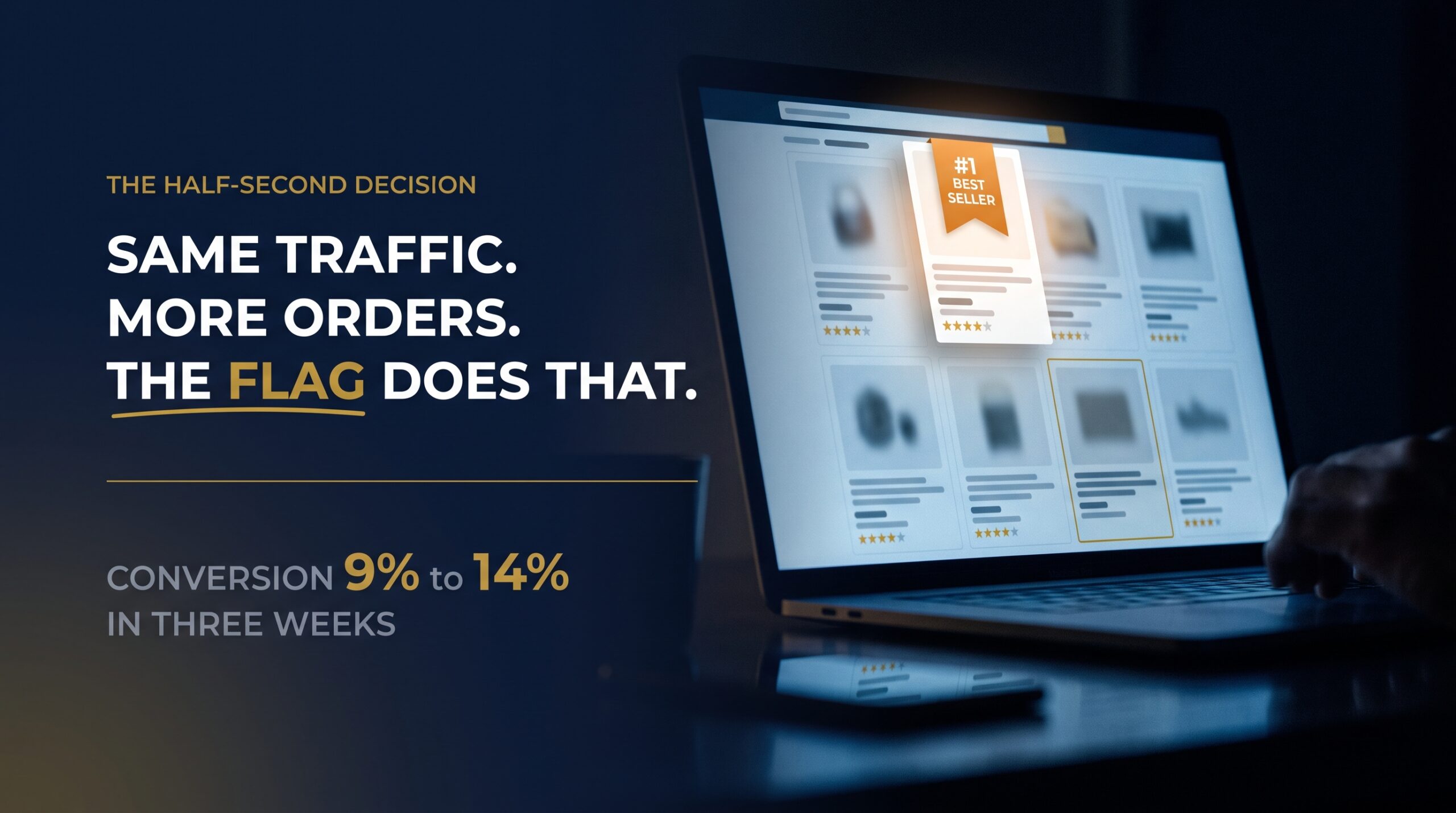
Most buyers on Amazon.in never reach your bullet points. They scan a grid of thumbnails, prices and star ratings, and the orange flag short-circuits that comparison entirely. It tells them other people already made this decision, which is the oldest trust shortcut in retail.
Where the badge appears across the storefront
You will see it in search results, near the title on the product detail page, inside the Best Sellers lists for your category, and on some browse pages. Each placement is another surface where a hesitant shopper gets nudged into clicking rather than scrolling past you.
Why the badge lifts conversion, not just traffic
Priya Nambiar sells cold-pressed coconut oil from Kochi. Her sessions barely moved the month she won the badge in her subcategory, but her conversion rate climbed from 9% to just over 14% in three weeks. Same traffic, more orders. The lesson: the badge works hardest on people already looking at you who could not decide.
How Amazon Decides Who Wins the Badge
There is no application and no seller support ticket that gets you this. Amazon compares unit sales across every product sitting in the same browse node and hands the flag to whoever leads right now.
Sales velocity inside a single category
Units moved matter, not rupees earned. A ₹249 phone holder selling 400 units a week outranks a ₹4,999 appliance selling 30. That is why fast-moving, affordable products dominate badge positions, and why your pricing decision is quietly also a badge decision.
Why the badge is refreshed every hour
Rankings update hourly, so the badge can genuinely appear on your listing at 2pm and vanish by 6pm. Sellers panic at this. They should not. You are watching a rolling snapshot, and consistency across days beats one spectacular afternoon every single time.
The category and subcategory trap sellers fall into
Rohit Bhandari, who sells kitchen storage sets from Indore, spent four months trying to top a broad home category stacked with national brands. He moved the same product into a tighter subcategory that genuinely described it, and the badge landed in nineteen days. The lesson stings: he was never in a fight he could win.
Reading Your Best Sellers Rank Without Panicking
Best Sellers Rank tells you how far you sit from that flag, and it is the most misread number in Seller Central. Here is amazon best sellers rank explained without the mythology.
What BSR is really counting
BSR ranks your product against everything else in a node by recent sales volume, weighted heavily towards the last day or so with a tail of historical performance. Rank #1 in a subcategory is the badge. Rank #14,000 in a giant parent category tells you almost nothing on its own.
Why rank swings wildly overnight
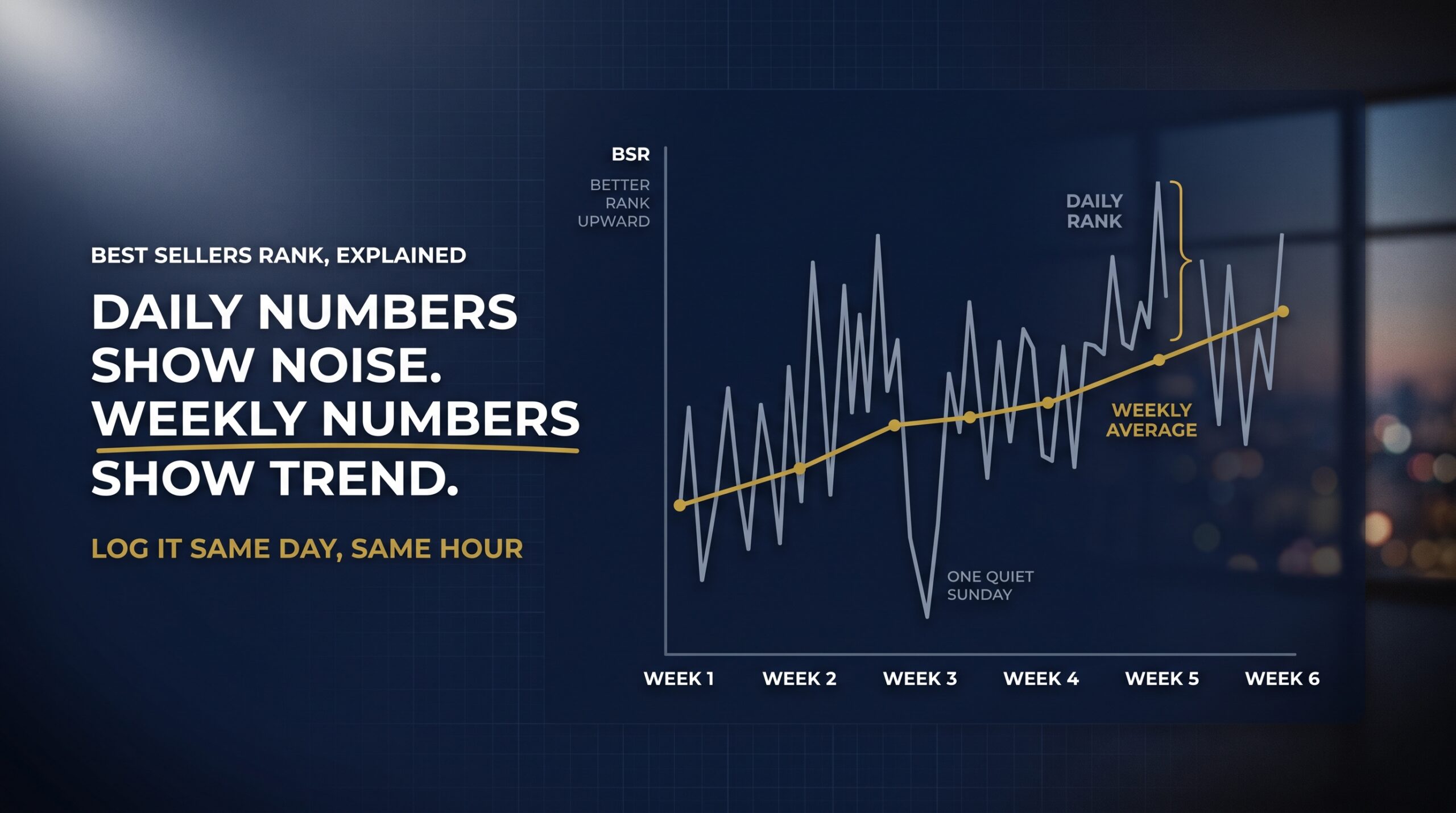
In a slow node, one order moves you thousands of positions, because the products around you are also selling in ones and twos. Sneha Kulkarni in Pune watched her yoga mat BSR fall from 900 to 6,400 overnight, assumed a penalty, and cut her price 18% in a panic. She had simply had a quiet Sunday.
Turning rank into a weekly tracking habit
Log your BSR at the same hour on the same day each week and plot the line. Weekly numbers show trend; daily numbers show noise. After six weeks of data you will know your real position and stop reacting to bad Tuesdays.
If categories, tracking and velocity are starting to feel like a system rather than a scramble, that is exactly what gets unpacked step by step when you join the 3-Day Amazon Business Training.
Picking the Category That Makes You Winnable
Most badge failures are category failures. You are competing in a node so broad that the leaders sell more units before lunch than you sell in a quarter, and no ad budget closes that gap.
Auditing your current browse node
Open your listing and read the Best Sellers Rank block on the detail page. It names your parent category and any subcategories. Then open the Best Sellers list for each and study the top five. If they are national brands with thousands of reviews, that node is not your battlefield this year.
Choosing a narrower subcategory honestly
“Honestly” is doing the work in that heading. Pick the most specific node that accurately describes your product. Faisal Qureshi in Hyderabad moved his beard growth oil from a crowded grooming node into a precise subcategory, and his BSR dropped from five figures to under 200 inside a month.
Fixing miscategorised listings the right way
Correct your item type keyword and browse node through the listing edit page or a category change request, then allow a few days to settle. Do not force yourself into an unrelated node to farm a badge. Amazon reclassifies those listings, and confused buyers return the product.
The Groundwork That Drives Sales Velocity
Velocity is the whole game. Everything below exists to move more units per day, sustained, without wrecking your margin or your metrics.
Pricing that holds margin and still moves units
Price against the current badge holder rather than your cost sheet. Test a 5–8% adjustment for two weeks and watch units, not revenue. If units climb enough to hold your contribution steady, keep it. If not, revert and compete on content instead.
Inventory depth so you never break the streak
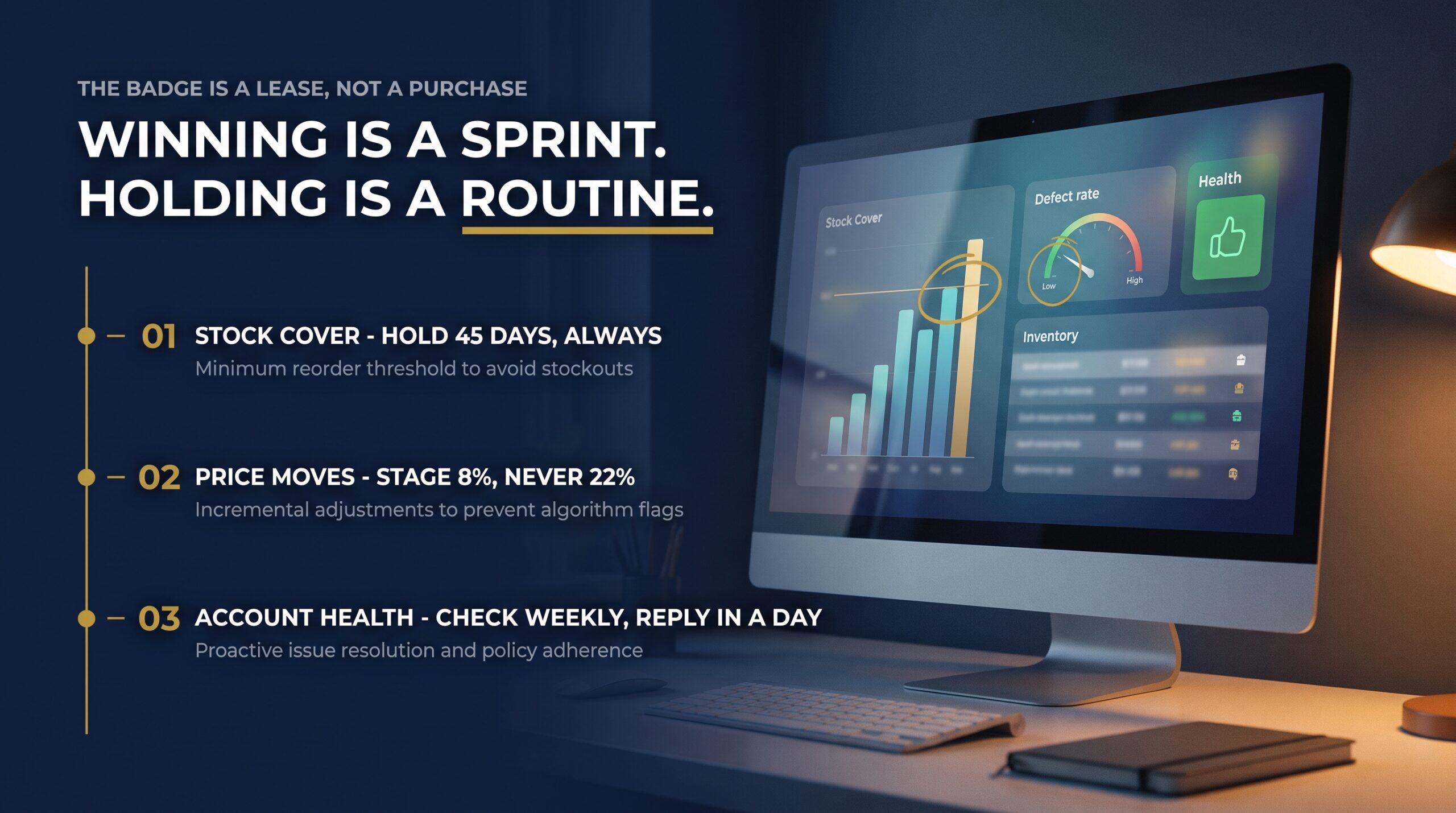
Manpreet Sethi in Ludhiana ran out of his best-selling cotton kurta set for eleven days during a festive rush, lost a badge he had held for two months, and needed seven more weeks to win it back. Hold at least 45 days of cover on anything you are actively pushing.
Listing quality, images and A+ content basics
Seven images with a clear hero shot, a title a human would actually say aloud, bullets answering the top three objections, and A+ content if you hold Brand Registry through a registered trademark. Conversion multiplies every visit you already pay for, making it the cheapest velocity available to you.
How the Amazon’s Choice Badge Is Different
Sellers ask about the difference between Amazon’s Choice and Best Seller badge almost every week, and it resolves quickly once you see it. Best Seller belongs to a category. Amazon’s Choice belongs to a search term.
The keyword-linked nature of Choice
Choice appears when a shopper searches a particular phrase. It can show for “stainless steel water bottle 1 litre” and be absent for “water bottle” on the very same listing. You are not competing with a category here; you are competing for one query.
Rating, review and returns thresholds that matter
Amazon does not publish exact amazon’s choice badge criteria, but the pattern across Indian listings is consistent: strong ratings, usually 4.0 and above, credible review volume, low returns and few negative feedback events. Kavita Iyer in Coimbatore cut returns on her steel lunchboxes from 9% to 3% with a lid-fit diagram, and Choice appeared six weeks later.
Prime, price stability and fast delivery signals
Immediate availability, quick dispatch and a price that has not yo-yoed all month feed the same judgement. FBA makes this easier, because your delivery promise stops depending on whether you are at your desk on a Sunday.
Working both badges properly takes structure, and that structure is what you build during the 3-Day Amazon Business Training.

Earning Amazon’s Choice on Your Best Keyword
Understanding how to get Amazon Choice badge status comes down to one discipline: pick a single search term and become the obvious answer to it for several uninterrupted weeks.
Identifying the search term you can own
Pull your search term report and find the phrase that already converts best, not the one with the fattest volume. Three to five words, specific, clearly describing what you actually sell. That phrase is your target, and everything else is a distraction for now.
Cleaning up returns and negative feedback
Arjun Deshmukh in Nagpur read his last thirty return reasons and found 40% of returns on his LED desk lamp were “not as described”, because his images showed warmer light than the product gave. He reshot two photos, returns halved in a month, and his rating recovered from 3.8 to 4.3.
Keeping price and stock steady for weeks
Set your price, then leave it alone for at least six weeks. Constant repricing and patchy stock make you an unreliable recommendation, and reliability is precisely what this badge signals. Run ads on your one keyword, keep dispatch clean, and let consistency accumulate.
Every Badge Worth Chasing on Your Listing
The amazon seller badges list runs longer than most sellers realise, and chasing all of them simultaneously is a reliable way to earn none of them.
Amazon Fulfilled and Prime indicators
The Prime badge and the Fulfilled by Amazon indicator deliver the highest return available to you, because they change the delivery promise on every listing you own. They are also the simplest to obtain: enrol, ship in, keep stock healthy.
New Release, Climate Pledge and small business tags
These are worth taking if you qualify, and not worth restructuring your business around:
- New Release, awarded to fast-selling recent launches, giving new products an early credibility window
- Climate Pledge Friendly, which requires specific third-party sustainability certifications
- Small Business, tied to your registered seller status rather than anything you optimise
- Amazon’s Choice, keyword-linked and earned through ratings and reliability
- Best Seller, category-linked and earned purely through unit velocity
Which badges to ignore for now
Tarun Saxena in Lucknow spent two months chasing a sustainability certification for his jute bags while his main listing sat out of stock for nine days. Fix Prime eligibility and velocity first. Decorative badges can wait until the money-making ones are locked in.
Why Sellers Lose the Badge and How to Hold It
Yes, you can lose it, and most sellers do. The badge is recalculated hourly against live competition, which makes it a lease rather than a purchase.
Stockouts, the number one badge killer
Zero inventory means zero units, which means zero rank momentum, and a competitor inherits your flag within hours. Set a reorder trigger at 45 days of cover and treat it as non-negotiable through festive quarters, when supplier lead times quietly stretch.
Price hikes and suppressed buy box
A sharp price rise slows units immediately, and losing the Buy Box on a shared ASIN collapses sales while your listing still looks perfect. Rehana Shaikh in Bhopal lost her badge in four days after a 22% overnight increase; a staged 8% rise the next quarter protected both badge and margin.
Review velocity and account health slips
Late dispatches, order defects and a stalling flow of fresh reviews erode the signals under both badges. Check Account Health weekly, answer negative feedback within a day, and keep using the compliant request-a-review route on every delivered order.
Your First 90 Days Chasing the Badge
If you want dates rather than ideas, this is the sequence that works for most sellers approaching the badge for the first time.
Weeks one to four: fix the foundation
Audit your browse node and move if it is wrong. Rebuild images, title and bullets. Push stock above 45 days of cover. Fix your top two return reasons. No ad increases yet, because you would only be pushing paid traffic at a leaky listing.
Weeks five to eight: push velocity
Now open the taps. Run focused ads on your best-converting keyword, test one price adjustment, and hold both steady long enough to read the result properly. Vikram Chauhan in Jaipur followed exactly this order with his brass puja items and hit #1 on day 62, after eight failed months of ads-first effort.
Weeks nine to twelve: defend and expand
Log BSR weekly, watch Account Health, protect stock cover through festive spikes, and only then repeat the sequence on your second product. Winning is a sprint. Holding is a routine, and the routine is what separates the two.
Frequently Asked Questions
How is the Amazon Best Seller badge decided?
Purely by unit sales volume inside one category or subcategory, measured against every other product in that browse node. Amazon recalculates hourly, so the badge moves between listings through the day. Recent sales weigh most heavily. No application, tenure or ad spend qualifies you directly, though ads create the sales that count.
What is the difference between Amazon’s Choice and the Best Seller badge?
Best Seller attaches to a category and rewards raw unit velocity. Amazon’s Choice attaches to a specific search term and rewards satisfaction signals: strong ratings, low returns, steady pricing, availability and quick delivery. You can hold Choice on one keyword while losing it on another, and one product can carry both badges at once.
How long does it take to get the Best Seller badge on Amazon?
For a well-positioned product in a narrow subcategory, six to twelve weeks of sustained velocity is realistic. Broad categories can take a year or stay out of reach at your scale. Node selection decides this more than effort does. Sellers who correct their category first often arrive within three to eight weeks.
Can you lose the Amazon Best Seller badge after getting it?
Quickly, yes. Rankings refresh hourly, so a stockout, a price rise or a rival’s promotion can take it the same day. Running out of inventory is the commonest cause by far. Keep 45 days of cover, stage price increases gradually, protect your Buy Box and review Account Health weekly.
How many reviews and what rating do you need to qualify for Amazon’s Choice?
Amazon publishes no fixed thresholds, so treat every number you read as observation rather than rule. Listings carrying Choice on Indian results usually sit at 4.0 stars or above with enough reviews to look established. Return rate, order defect rate, dispatch speed and price consistency matter at least as much as review count.
Does running ads help you win the Best Seller badge?
Indirectly. Ads do not affect eligibility, but they generate the unit sales that build velocity, and velocity is what the ranking counts. Advertise into a listing that already converts, otherwise you are funding a leak. Concentrate spend on one or two proven keywords and let the campaign run long enough to establish a pattern.
Can a new listing get a badge without any reviews?
A brand-new listing can win Best Seller, because that badge counts sales rather than reviews. New Release is often the more realistic early target for recent launches. Amazon’s Choice is far harder without feedback, since it leans on satisfaction signals. Build reviews steadily through compliant review requests during your first two months.
Do badges transfer if I change my product category?
No. Both are recalculated against the products in your new node, so a change resets your competitive position completely. That is usually welcome news, because most category moves take sellers from an unwinnable parent category into a subcategory they can genuinely top. Allow a few days to settle, then track rank weekly.
Conclusion
Strip away the mythology and the badge is a receipt. It records that you chose a category you could win, kept stock on the shelf, priced with discipline, and gave buyers a reason to convert rather than scroll. Nothing on that list is a hack, which is precisely why it works and why so few sellers see it through.
Winning the badge is the easy half. Keeping it means checking inventory before it turns urgent, staging price rises instead of lurching, reading returns rather than resenting them, and logging rank weekly without flinching at one quiet Sunday.
If you would rather build those habits properly than assemble them from scattered advice, come and build them with us over three days. Then go and take that orange flag.

One Response
Sir
You are a great teacher. U really guide properly it is not to praise you .. really I have seen so many people. As a lawyer I have met so may people . You are among very few people with so much clarity. I’m extremely happy that I got into your workshop.
You sunday spark . And the these you share is simply international level
These kinds of approach is usually a good service amd keep up your team well . So you are good leader.