

Karthik Menon from Kochi remembers the exact moment he almost quit. It was month six. His phone showed the same number it had shown for nine days straight: zero orders. The ₹1.4 lakh he’d poured into inventory was sitting in a Bengaluru fulfilment centre, his ad budget was gone, and his wife had stopped asking how the “Amazon thing” was going. He wasn’t lazy, and he wasn’t unlucky. He was simply standing at the exact spot where most Indian sellers walk away.
If you want to understand why amazon sellers fail in india, you don’t need to study the rare disasters. You need to study month six — the quiet cliff where momentum dies, savings run thin, and quitting starts to feel like the responsible thing to do. This is the story of who stays, and the four habits that separate them from everyone who deletes the app.
The Month 6 Cliff: Why Amazon Sellers Fail in India
The pattern nobody warns you about
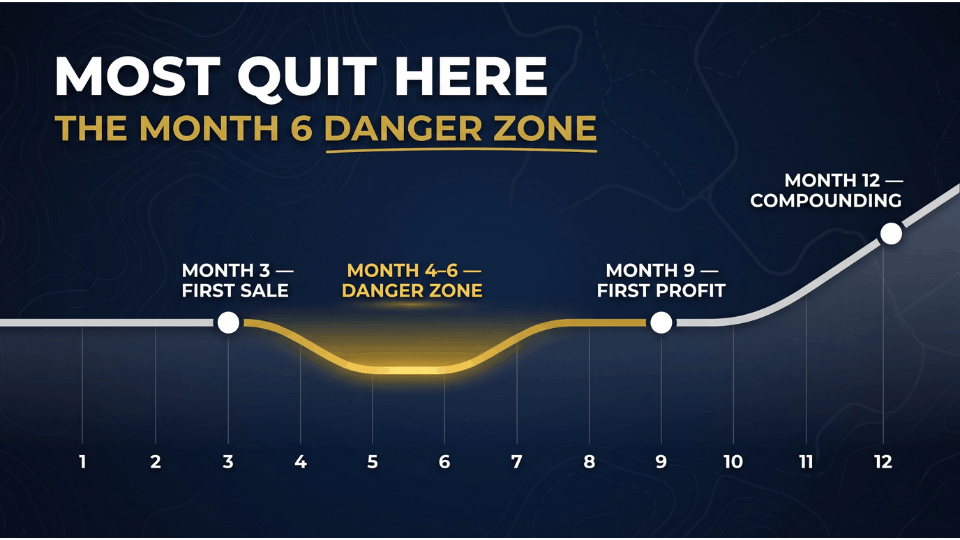
Here’s the timeline almost nobody describes honestly. Your first sale usually lands somewhere around month three. It feels like proof. Then the second month of real selling arrives, the novelty fades, and by month five the graph flattens. By month six, you’re not failing dramatically — you’re just quietly stuck, watching a flat line and doing the math on how much you’ve spent. That flat line, not some catastrophe, is what ends most journeys.
Why do most Amazon sellers quit?
Rarely is it one big blow. It’s a slow bleed. Margins turn out thinner than expected, the ad spend keeps draining, and the savings buffer shrinks week by week. Roughly half of new sellers walk away within their first year, and low margins are the most common reason cited. The decision to quit almost never feels like giving up in the moment. It feels like being sensible.
What percentage of Amazon sellers fail?
The honest range is sobering. Around 64% of sellers report becoming profitable within their first year, but only an estimated 10–20% sustain that beyond the early years. So the real cut-off isn’t month twelve, when the surveys take their snapshot. It’s month six, when the people who never built the right habits run out of patience first.

The 5 Silent Reasons Sellers Fail in India
The mistakes that end most accounts aren’t exotic. They’re quiet, repeatable, and almost always avoidable once you know to watch for them.
Chasing revenue while bleeding margin
The cruellest trap is the “profitable on paper, zero in the bank” listing. Sellers celebrate sales volume while every unit quietly loses money once referral fees, FBA fees, ads, and returns are tallied. Revenue feels like progress. Margin tells the truth.
Picking a “me-too” product in a crowded niche
The headline amazon fba failure rate hides a detail: failure clusters heavily in hyper-competitive categories where ten identical products fight over the same ₹40 of margin. Picking the wrong product in a crowded category is the single most common failure point, and learning how to spot a winner in a saturated market changes your odds entirely.
Treating PPC as the whole strategy
Many new sellers pour their budget into Sponsored Products, see clicks but few conversions, and conclude Amazon “doesn’t work.” Ads are a tool to build organic rank, not a substitute for a listing that actually converts. When the budget runs dry, so does the business.
Running out of cash before the second restock
This one ends more sellers than competition ever does. Money is locked in inventory for months, payouts arrive on a delay, and the second purchase order arrives before the first has fully paid back. Understanding the difference between cash flow and profit is what keeps you solvent here — without a buffer, even a working product can strangle you.
Is Amazon FBA Worth It in India in 2026? An Honest Reality Check
Is Amazon FBA still worth it in India in 2026?
Yes — but the “easy passive income” framing is dead. With 17 lakh-plus sellers competing, higher FBA fees, and account suspensions up roughly 12% year on year, this is now a professional trade, not a gold rush. The opportunity is real and arguably bigger than ever, but it rewards operators, not optimists.
How much money do you need to start?
Enough to survive the learning curve, which most people underestimate. If your budget is tight, it’s still possible to start Amazon selling with ₹1,00,000 or less, but you need a runway for ads, a second restock, and the inevitable mistakes. Meera Joshi from Indore started with just enough for one shipment and no buffer — when her launch needed more ad spend, she had nothing left, and a decent product died of underfunding, not bad strategy.
Is it you, or is it the platform?
This is the question that separates the people who stay. Most month-six failures are fixable execution problems, not a broken marketplace. The platform shifted the rules; it didn’t remove the opportunity. Once you stop blaming Amazon and start auditing your own numbers, the path forward usually becomes obvious.
Habit 1: They Track Profit, Not Revenue
The one number that predicts survival
Sellers who stay obsess over a single figure: net profit per unit after every single cost. Not the gross sale price, not the “₹300 margin” they assumed at the start, but what’s actually left after referral fees, fulfilment, storage, ads, and returns. That number is the heartbeat of the business.
Tracking your margin without a finance background
You don’t need an accountant to monitor your amazon fba profit margin in India. A simple spreadsheet with sale price minus every fee, updated whenever Amazon changes its rates, is enough, and getting comfortable reading your profit and loss statement turns guesswork into decisions. The survivors check it weekly; the people who quit only discover their true margin when the money’s already gone.
Seller example
Anjali Reddy from Coimbatore was running eleven products and losing track of which ones made money. When she finally built a proper cost sheet, she discovered three SKUs were quietly draining her. She cut them, focused on the two that actually earned, and her monthly profit rose even as her revenue fell. Fewer products, more money.

When you’re ready to build a profit-tracking system that actually tells you which products to keep, our 3-Day Amazon Business Training walks you through it step by step — the exact sheet, the exact numbers to watch, and how to act on them.
Habit 2: They Master One Product Before the Next
Why the survivors go deep, not wide
The sellers who last resist the urge to keep launching. Instead of spreading thin attention across a dozen listings, they pour everything into one “hero product” until it’s genuinely winning. Depth beats width because Amazon rewards momentum on a single listing far more than scattered effort across many.
The research discipline that separates them
Before a single rupee goes to a supplier, they check three things: real demand, honest competition, and whether the margin survives all the fees. Vikram Saxena from Jaipur skipped this and ordered 500 units of a product that looked great on Alibaba — only to find twenty identical listings already fighting on price. His second product, chosen with proper research, outsold the first within weeks.
One product, done right
Mastering one listing teaches you everything: keywords, PPC, reviews, conversion. That knowledge then transfers to your next launch, so the second product is easier and the third easier still. The people who quit were usually on their fourth half-finished listing, having never made a single one truly work.
Habit 3: They Treat Listings and Ads as a System
The listing-as-landing-page mindset
Survivors don’t think of a listing as a form to fill in. They build it like a landing page — images, title, bullets, and A+ content all working together to convince a stranger in seconds. Every element has a job. A weak main image undoes a great product, and most quitters never realised their listing was the problem.
Disciplined PPC, not gambling
Ads are run consistently and patiently, long enough to feed organic rank, rather than switched on and off in panic. The goal is to buy early visibility while the listing earns its own ranking. Treated as a slot machine, PPC just burns money. Treated as a system, it compounds.
The weekly feedback loop
The people who stay read their data every week — search terms, conversion rate, ACoS — and make one small adjustment at a time. “Set and pray” is the opposite habit. Small, steady corrections are how a mediocre listing slowly becomes a strong one.

If you want the listing and PPC framework the survivors use — the checklist for images, titles, and ad structure — it’s built into the 3-Day Amazon Business Training so you can apply it to your very next product.
Habit 4: They Play the 18-Month Game, Not the 6-Week One
Patience as a strategy
The single biggest difference is expectation. The people who stay expected a slow start. They budgeted for it emotionally and financially, so month six felt like a checkpoint, not a verdict. The people who quit expected results by week six and read the normal slow climb as failure.
Protecting account health obsessively
One suspension can erase a year of work — your inventory, your funds, and your ranking freeze at once. Survivors guard their metrics carefully, follow the rules even in grey areas, and never gamble their account on a shortcut. Knowing how to recover a suspended seller account matters, but never needing to is the real goal — and with suspensions rising, this discipline matters more every year.
Reinvesting and keeping a buffer
They resist pulling profit out early. Instead, money goes back into inventory and ads, and a hard cash buffer stays untouched for emergencies. Farhan Sheikh from Bhubaneswar nearly quit at month five, kept a small reserve, survived a slow stretch, and crossed his first profitable month at month nine — three months after most people would have stopped.
How to Succeed on Amazon India: Your Survival Map
Months 1–3: Foundation
This stage is product, listing, and first sale. Don’t expect income yet — it typically takes around three months to make your first sale, and that’s normal, not a warning sign. Build the listing properly and learn the basics of PPC. The goal here isn’t profit; it’s a working foundation.
Months 4–6: The danger zone
This is where everyone quits, so this is where you decide differently. Sales feel slow and the spend feels real. Instead of walking away, you audit: Is the margin right? Is the listing converting? Are the ads structured well? Most problems at this stage are fixable in a week if you diagnose instead of despair.
Months 7–12: Compounding
Once the first product works, the new amazon seller tips in India that matter most are about repetition — reinvesting, launching a second product faster, and tightening margins. This is when a stubborn side hustle finally starts behaving like a business, because you survived the cliff that stopped everyone else.
Frequently Asked Questions
What percentage of Amazon sellers fail?
Estimates vary, but only around 10–20% of sellers sustain profitability long term, even though roughly 64% report some profit in year one. Early profit and lasting success are different things. The encouraging part is that most failures trace back to avoidable execution mistakes, not a broken opportunity.
Why do most Amazon sellers quit?
Most quit from a slow bleed rather than a single disaster — thin margins, draining ad spend, and shrinking savings that make stopping feel sensible. The crisis point is usually around month six, when momentum stalls and the money spent starts to feel heavier than the income earned. Sellers who plan for this stage are far more likely to push through.
Is Amazon FBA still worth it in India in 2026?
Yes, for sellers who treat it as a real business rather than passive income. The market is larger than ever, but fees are higher, competition is denser with 17 lakh-plus sellers, and account enforcement is stricter. The opportunity rewards disciplined operators who track margins and play long. It punishes anyone hunting for a quick, effortless win.
How long does it take to make money selling on Amazon?
The first sale usually takes about three months, and consistent profit often takes six to twelve months beyond that. This slow ramp is exactly why so many quit at month six — they expected results far sooner. Treat the first half-year as a learning phase, not a profit phase.
How much money do you need to start selling on Amazon in India?
Beyond your first inventory order, you need a runway for advertising, a second restock, and inevitable early mistakes. Starting with only enough for one shipment is the most common funding error. A buffer that lets you keep advertising through a slow launch matters more than a large opening order, because underfunded products die before they get a fair chance.
Can you restart an Amazon seller account after quitting?
Usually yes — if you simply stopped selling rather than being suspended, your account typically remains, and you can relist and resume. The harder part is rebuilding momentum and ranking, which fade when a listing goes quiet. Many returning sellers do better the second time, bringing hard-won lessons about margins and patience.
How many hours a week do successful Amazon sellers really work?
Less than most beginners assume, but far more consistently. Once a product is established, many run their core operations in a focused handful of hours weekly — checking metrics, adjusting ads, managing inventory. The difference is steadiness, not heroic effort. Quitters worked in frantic bursts; survivors show up in small, regular doses.
Is it too late to start selling on Amazon in India in 2026?
No, but the entry bar is higher than a few years ago. Easy, undifferentiated products no longer win. What works now is proper research, a genuinely better listing, and patience through the early months. If anything, the rising bar thins out casual competitors, leaving more room for sellers willing to do the work.
Conclusion
The difference between the sellers who quit and the ones who build real businesses was never luck, talent, or a secret product. It was four habits practised before month six arrived: tracking profit instead of revenue, mastering one product before chasing the next, treating listings and ads as one connected system, and playing an eighteen-month game rather than a six-week sprint. Month six isn’t a verdict on whether you’re cut out for this. It’s a checkpoint that quietly filters out everyone who never built those habits.
If you’d rather build them from day one than learn them the hard way, the 3-Day Amazon Business Training is where these exact habits are taught, step by step. Stay past the cliff, and the business that everyone else walked away from could end up being yours.
