

It is 11.40 at night and you are staring at a Business Report you would rather not open. Last week your best listing pulled 1,840 sessions. It shipped 29 units. Somewhere between the search results page and the checkout, 1,811 people decided your product was not for them, and your ad spend paid for every one of those decisions. Traffic was never the problem. Persuasion was.
This is where most Indian sellers get stuck, and it is also where the cheapest wins are hiding. Learning how to increase conversion rate on amazon is not about a secret hack or a new tool. It is about understanding the small sequence of doubts that runs through a shopper’s head in the eleven seconds they spend on your page, and answering each one before they scroll away.
Over the next few sections you will learn what your conversion number actually measures, what a healthy figure looks like in Indian categories, the psychological triggers that move a shopper from browsing to buying, and which parts of your listing to rewrite first. Bring one listing with you. By the end you will know exactly what to change on Monday morning.
What Conversion Rate Really Means on Amazon
Most sellers quote a conversion number they have never verified. Before you optimise anything, read the metric the way Amazon calculates it, because the wrong denominator sends you chasing the wrong problem for months.
The unit session percentage explained simply
Amazon calls your conversion rate the unit session percentage: units ordered divided by sessions, shown as a percentage. If 500 shoppers visited your detail page in a week and you sold 40 units, you converted at 8%. Multi-unit orders count, which is why bundle sellers often see unusually strong figures.
Where to find this number in Seller Central
Open Reports, then Business Reports, then Detail Page Sales and Traffic by Child Item. Each ASIN gets its own row with sessions, page views, units ordered and unit session percentage. Set the range to a full 30 days so weekend spikes and weekday lulls average into something you can trust.
Sessions, page views and why they differ
A session is one visitor’s 24-hour window of activity. Page views count every page load, including the same shopper refreshing or returning twice. Meera Nair in Kochi spent a fortnight panicking that her ceramic dinnerware converted at 2%, because she had been dividing orders by page views. Measured properly she sat at 7.4%, and her real blocker was inventory cover, not copy. One corrected formula saved her from rewriting a listing that was already working.
Once your baseline is honest, the next question is whether that number is any good.

What Counts as a Healthy Number in India
Sellers ask what is a good conversion rate on amazon expecting one clean figure. There isn’t one, because a bedsheet buyer and a phone charger buyer behave nothing alike. What you can use is a band, then your own trend line.
Typical ranges across Indian categories
Across most Indian marketplace categories, 5% to 10% is respectable, 10% to 15% is strong, and below 3% signals a real blocker. Consumables such as supplements, snacks and cleaning products often run higher, because the decision is small and repeatable.
Why apparel and electronics behave differently
Apparel sits lower, frequently 2% to 5%, because fit anxiety is genuine and shoppers open six tabs before choosing. Electronics land in the middle, dragged down by spec comparison and lifted by brand familiarity. Holding a high-consideration product to the standard of a Rs 249 kitchen tool only makes you discount for no reason.
Benchmarking against your own past months
Your most useful benchmark is your own ASIN, last month. Arvind Deshpande in Nagpur ignored category averages entirely and tracked his yoga mat listing week by week, moving it from 4.1% to 9.6% over ten weeks with four separate edits. He knew which edit worked because he changed one thing at a time and dated every change in a notebook.
Numbers tell you where to look. Psychology tells you what to fix.
The Six Triggers That Make Shoppers Buy
Amazon buyer psychology sounds academic until you notice the platform itself is built on it. Every badge, timer and suggestion strip exists to shortcut a decision, and your listing can borrow the same mechanics honestly.
Social proof, scarcity and authority at work
Social proof is your review count and star rating persuading before your copy gets a chance. Scarcity is the low-stock line or the countdown on a Lightning Deal. Authority arrives as an Amazon’s Choice badge, a brand store, or a certification mark visible on your packaging image.
Reciprocity, consistency and liking online
Reciprocity works when you give first: a genuinely useful size chart, a care guide in the box, a warranty stated plainly. Consistency means the promise in your title matches the bullets, images and A plus content, so nothing forces a rethink. Liking comes from photography featuring real Indian hands, homes and kitchens rather than borrowed stock shots.
How each trigger shows up on a listing
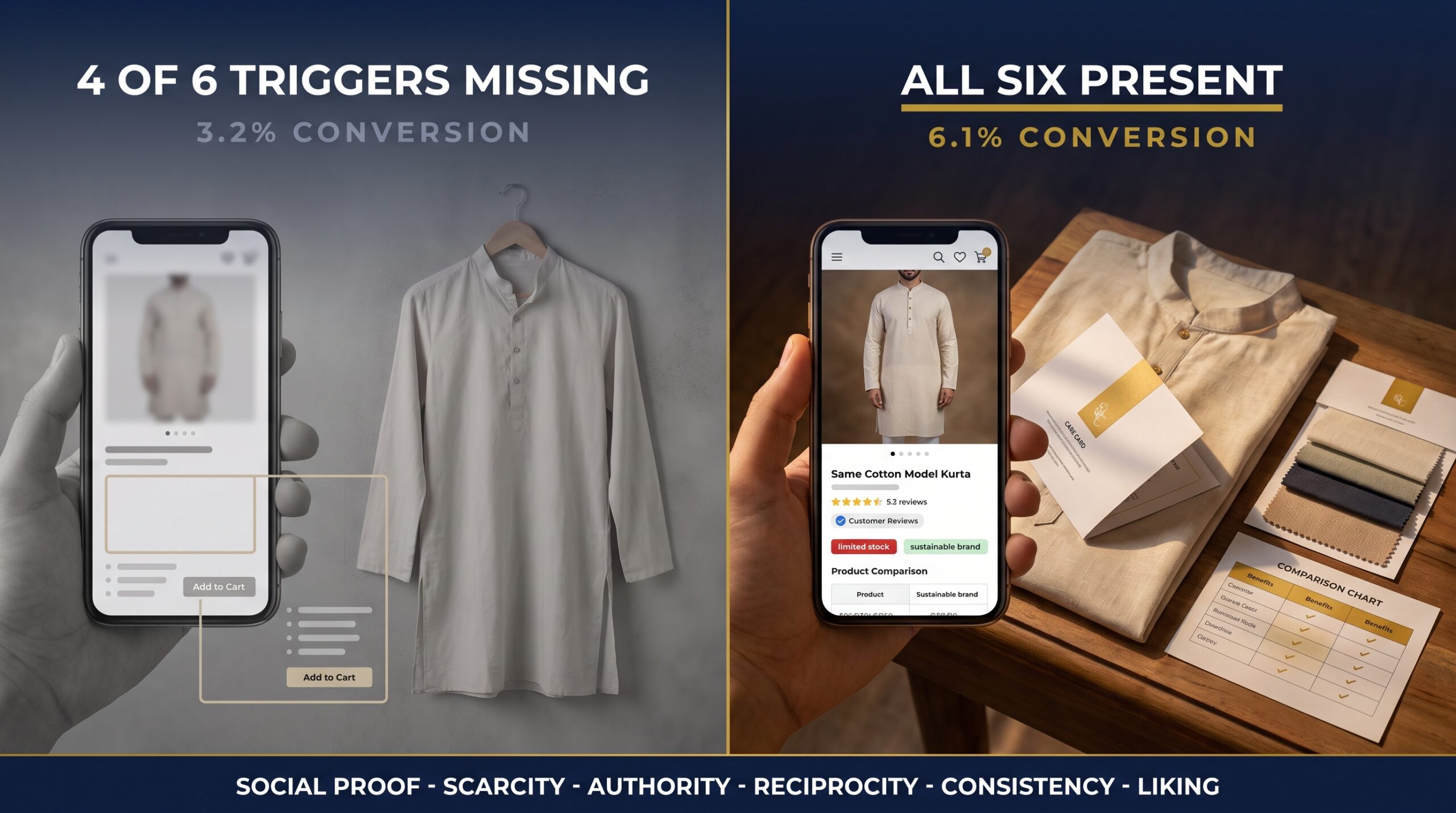
Fatima Sheikh in Hyderabad audited her cotton kurta listing against these six triggers and found four missing. She added a comparison chart, a fabric-weight infographic, a plain returns line and lifestyle shots taken in her own flat. Conversion moved from 3.2% to 6.1% in five weeks, with no price change at all.
If you want to run that trigger audit with someone watching over your shoulder, join the 3-Day Amazon Business Training and bring the ASIN that is bleeding sessions.
How Indian Shoppers Decide Before They Tap Buy
Amazon customer buying behaviour india has its own texture. The shopper is mobile-first, price-aware without being purely cheap, and far more sensitive to delivery and returns reassurance than most sellers assume.
Price sensitivity and the value calculation
Indian shoppers rarely buy the lowest price; they buy the clearest value. A Rs 899 product with visible quantity, a stated warranty and an honest MRP strike-through beats a Rs 749 listing that explains nothing. Anchoring still works, but only when the reference price is real.
Trust signals that matter in tier 2 and 3 cities
Outside the metros, the hesitation is about whether the product is genuine and whether help exists if it isn’t. Brand name in the title, packaging visible in an image, a fulfilment badge and a clearly worded warranty do more than another adjective. Hindi and regional-language terms in your backend fields also catch queries your English copy misses.
The role of COD, delivery speed and returns
Cash on delivery availability, a near-term delivery date and a plainly stated replacement window remove three objections at once. Sandeep Yadav in Jaipur added a returns-and-warranty image in his sixth slot and rewrote one bullet around COD and two-day dispatch. Orders from tier 2 pin codes rose 34% over six weeks.
Now for the uncomfortable diagnosis: plenty of traffic, almost no orders.
Why Your Listing Gets Views But No Orders
High sessions with flat sales is not bad luck. It is a mismatch between what the shopper expected when they clicked and what the first screen actually shows them.
Traffic and intent mismatch from keywords
Rank or advertise on a broad term and you attract shoppers looking for something adjacent to your product. They arrive, see the mismatch and leave in four seconds. Imran Qureshi in Bhopal was paying for clicks on “wireless earphones” while selling a gaming-specific earbud; pausing that term and tightening his match types lifted conversion from 2.8% to 7.9% in three weeks.
Missing answers in the first screen
On a phone, the shopper sees the main image, title, rating, price and delivery date. That single screen must answer what it is, who it is for, what size or quantity, and when it arrives. Anything left unanswered becomes a reason to return to search results.
Price, delivery and variation friction
Broken variation families are a silent killer: a shopper wanting size L lands on an out-of-stock child ASIN and never discovers you have it. Mismatched images across variants, a delivery date a week out and a price that has drifted above competitors all produce the same result. Fix the plumbing before you rewrite a single word of copy.

Images and A Plus Content That Sell Harder
Shoppers read images long before they read bullets. Your gallery is the conversion engine, and a deliberate sequence outperforms seven pretty photos in random order.
Building a seven image sequence that answers doubts
Treat the gallery as a conversation where each slot kills one specific doubt, then check the whole set on a phone at arm’s length.
- Main image: product on white, filling the frame
- Lifestyle shot: the product inside an Indian home or workspace
- Scale cue: product beside a hand or familiar object
- Infographic: three key benefits as short labels
- Detail macro: material, stitching, port or finish
- Contents and size chart: exactly what arrives in the box
- Trust slot: warranty, returns window, certifications
That order moves a shopper from recognition to reassurance without a wall of text.
Lifestyle shots, infographics and scale cues
Lifestyle imagery triggers liking and helps a buyer imagine ownership. Infographics carry claims your bullets cannot fit above the fold. Scale cues prevent the most expensive complaint in Indian e-commerce: smaller than expected.
Using A plus content to handle objections
A plus content, available once you are enrolled in Brand Registry, is where you answer the objections that stall a purchase. Neha Agarwal in Indore rebuilt her storage-basket modules around three real questions from customer messages and added a scale shot. Conversion climbed from 5.5% to 8.9% in a month while returns fell.
If your visuals need a second pair of eyes, you can walk your gallery through the 3-Day Amazon Business Training and rebuild the sequence with feedback.
Reviews, Ratings and the Trust Gap
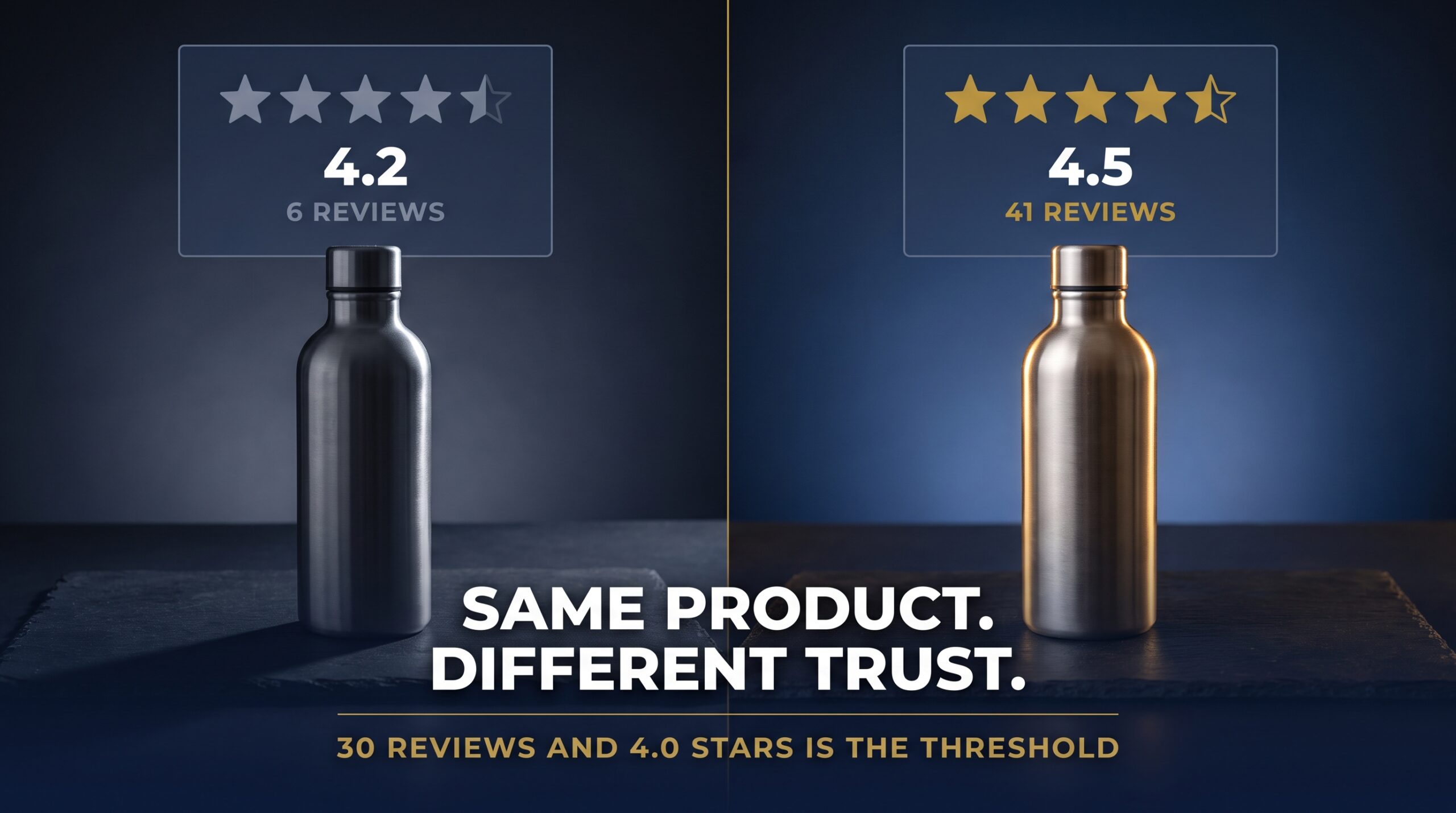
Two near-identical products, one with 41 reviews at 4.5 stars and one with 6 reviews at 4.2. You already know which wins. Reviews are the heaviest single weight on the conversion scale.
How star count and review volume shift decisions
Below roughly 4.0 stars shoppers pause, and below 3.8 many will not scroll further. Volume matters separately: crossing about 30 reviews signals the product exists in the real world. A handful of critical reviews actually raises trust, because a flawless wall of five stars reads as suspicious.
Responding to negative reviews the right way
Read every one-star review as free research, not an insult. If ten people mention the strap, the strap is the problem. Reply publicly and calmly where the category allows, fix the product or the description, and the complaint stops repeating itself.
Compliant ways to grow review velocity
Use the Request a Review button in Manage Orders within the allowed window, keep inserts limited to thanks and usage instructions with no incentive of any kind, and ship on time so the experience deserves a good rating. Vikram Choudhary in Surat did exactly that for two months, moved from 4.1 to 4.5 stars across 90 new reviews, and gained 2.4 percentage points of conversion.
Rewriting Titles and Bullets for Persuasion
Copy is where amazon listing conversion rate optimisation gets practical. You are not writing advertising; you are answering questions in the order they occur to a shopper.
A title structure that survives mobile truncation
Mobile cuts your title early, so front-load it: brand, product type, the one differentiating feature, then size or quantity. “Brand X Steel Water Bottle, 24-Hour Cold, 1 Litre, Leak-Proof” beats a keyword pile-up. Stay inside your category’s character limit and never repeat a term three times.
Turning features into outcomes in bullets
Each bullet names a feature and finishes with what it means for the buyer. “Double-wall steel” becomes “Double-wall steel keeps water cold for 24 hours, so your desk bottle still feels like a fridge at 5 pm.” Lead with three or four scannable words, because nobody reads the middle.
Backend fields and the A plus follow through
Fill search terms with synonyms, common misspellings and the regional-language words you left out of visible copy, then make sure A plus content extends the promise rather than repeating the bullets. Priya Menon in Coimbatore rewrote five bullets as outcomes and refreshed her backend terms; the listing went from 4.6% to 7.8% in four weeks, which is one of the simplest amazon product listing tips for more sales you will ever apply.
Fixing the Moments Where Buyers Drop Off
Some shoppers add to cart and still vanish. Understanding why customers abandon amazon cart lets you recover sales you have already paid to attract.
Cart abandonment causes you can control
You cannot stop someone comparing on another app, but you can stop the avoidable exits: a delivery date that slips, a shipping charge appearing late, COD unavailable on that pin code, or a quantity limit that surprises them. Each is a settings decision, not a copy problem.
Buy Box, stock and delivery date signals
Losing the Buy Box sends traffic to another seller’s offer while you keep paying for ads. Stock-outs reset your momentum and your ranking. Harpreet Singh in Amritsar tightened replenishment so his bestseller never dropped below 21 days of cover, and monthly units rose 26% across a quarter with no new advertising.
Testing changes without guessing
Change one element, wait two full weeks, then read sessions and unit session percentage together. Brand-registered sellers can split test titles, images and A plus content through Manage Your Experiments, which removes the guesswork entirely. Discipline beats intuition here, every single time.
Frequently Asked Questions
What is a good conversion rate on Amazon India?
For most Indian categories, 5% to 10% is healthy, 10% to 15% is strong, and under 3% points to a specific blocker such as pricing, keyword mismatch or thin reviews. Apparel sits lower at 2% to 5% because of fit anxiety. Use the bands as a guide, then judge yourself against your own previous months.
How do I calculate my Amazon conversion rate in Seller Central?
Go to Reports, then Business Reports, then Detail Page Sales and Traffic by Child Item, and read the unit session percentage column for each ASIN. That figure is units ordered divided by sessions. Choose a 30-day window so short spikes do not distort things, and always compare like periods, because festive weeks behave nothing like a quiet July.
Why do shoppers view my Amazon listing but not buy?
Usually the first mobile screen fails to answer what it is, who it suits, what size or quantity, and when it arrives. Broad keywords and untargeted ads also pull in shoppers with different intent. Other frequent culprits are a slow delivery date, a price above comparable offers, weak reviews and broken variation families.
Do product reviews and ratings really increase Amazon sales?
Yes, measurably. Star rating and review volume are the fastest trust signals a shopper has, and most people hesitate below 4.0 stars or fewer than about 30 reviews. A few critical reviews help, because a page of only five stars reads as manufactured. Grow them with the Request a Review button, non-incentivised inserts and reliable delivery.
How do images and A plus content affect Amazon conversion?
Images persuade before your text is read, which is why a deliberate seven-slot sequence beats seven random photos. Lifestyle shots build connection, infographics carry claims, and scale cues prevent the “smaller than expected” return. A plus content, open to Brand Registry sellers, gives you room to answer the objections your customer messages keep repeating.
How long does it take to see results after changing a listing?
Give any change at least seven days, ideally fourteen, before judging it. Amazon needs time to reindex, and a listing with 200 weekly sessions cannot produce a reliable read in 48 hours. Keep a dated note of every edit so you can match movement to cause, and resist changing three things at once.
Does lowering my price always improve conversion rate?
No. Price cuts often lift conversion briefly while destroying margin, and if your real problem is a missing size chart or a 4.0 rating, a discount simply funds the same doubt. Test price only after images, bullets, delivery date and reviews are sorted. Adding visible value frequently converts better than shaving Rs 50.
Should I run ads to a listing that converts poorly?
Advertising a page converting at 2% mostly buys expensive proof that the page is broken. Fix the first screen, the gallery, the reviews and the delivery promise first, then scale spend, because ads amplify whatever the page already does. The exception is a brand-new ASIN, where a small controlled budget teaches you which queries convert.
Conclusion
Conversion is not a mystery; it is a weekly habit. Pull your unit session percentage every Monday, pick the single biggest blocker on one ASIN, fix it, and wait a fortnight to read the result. Sessions tell you whether people arrive. Conversion tells you whether they believe you. Seen that way, how to increase conversion rate on amazon stops feeling like guesswork and starts feeling like maintenance.
Start with the listing that gets the most traffic and sells the least, because that is where one edit pays the most. Then work down the list, one change at a time. If you would rather diagnose your own listing live and leave with a clear order of fixes, come and work through it inside the 3-Day Amazon Business Training.

2 Responses
Nicely structured thoughts. Thanks.
Useful tips for sellers