
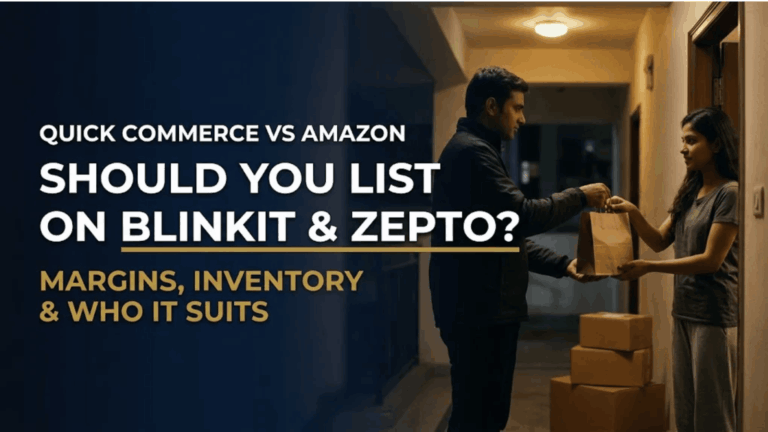
Rohan Mehta from Pune had just closed his best Diwali month on Amazon when the email landed. For the first time, quick commerce vs Amazon stopped being a news headline and became a real decision on his desk. A Blinkit category manager had spotted his roasted makhana and wanted to stock it in dark stores across Pune and Mumbai. Rohan read the email twice and called his wife into the room. Ten-minute delivery, his snacks next to brands he grew up eating, orders from every apartment complex in Baner — it sounded like the break every small brand waits for.
Then the commercial terms arrived, and the excitement turned into a spreadsheet problem. The platform wanted a margin he had never paid on Amazon, stock in its warehouses within two weeks, and an ad commitment on top.
If you sell on Amazon in India, some version of this email is coming for you. In this guide you’ll see how Blinkit and Zepto actually make money from brands, which categories genuinely fit, and how to test the channel without putting your Amazon business at risk.
Quick Commerce vs Amazon: Two Very Different Machines
How Is a Dark Store Different From an FBA Warehouse?
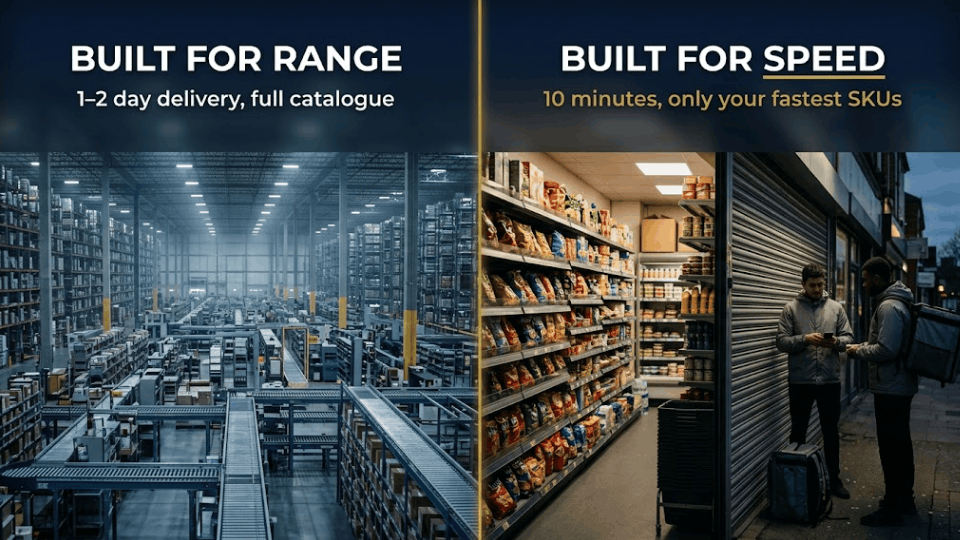
Amazon’s fulfilment centres are built for range. They hold millions of products and deliver across the country in a day or two. A dark store is built for speed: a small warehouse, closed to the public, serving a few kilometres and stocking only what people order most, so a rider can reach a doorstep in minutes. That changes everything for you as a seller. Amazon wants your full catalogue; a dark store wants only your fastest-moving SKUs, spread across hundreds of tiny locations.
Who Are the Players You’d Be Dealing With?
Blinkit, owned by Eternal (formerly Zomato), leads the market. Datum Intelligence estimated it handled roughly 3.4 to 3.6 million orders a day in August 2026, ahead of Zepto at about 2.4 to 2.6 million and Swiggy Instamart at 1.3 to 1.45 million. Flipkart Minutes and Amazon’s own ten-minute service, Amazon Now, are newer and expanding fast. Across six major players, the segment crossed 9.5 million orders a day that month.
Shweta Kulkarni from Nashik learned what this means at her first pitch meeting. She brought all 34 of her spice blends. The category manager picked three. “They wanted the three things people forget to buy before dinner,” she said later.
Why Quick Commerce Is Hard to Ignore in 2026
The Categories Quick Commerce Already Owns
The growth numbers are hard to argue with. A June 2026 report by 1DigitalStack sized India’s digital commerce market at around ₹8 lakh crore, with quick commerce at roughly ₹1.08 lakh crore, about 13.5% of the total. More importantly, it was growing at about 40% a year, more than twice the pace of digital commerce overall.
In some categories, quick commerce has already won. The same report found it captures 94% of online food and beverage purchases, 68% of home care, 61% of personal care and 54% of baby care. Dabur now gets about three-quarters of its online sales from quick commerce. As we saw when comparing Amazon and Flipkart for new sellers, the question is not which platform is bigger, but where your buyer actually shops.
The Metro-Only Catch
Here is the part the pitch decks skip. According to Bernstein research reported in April 2026, India’s 5,700 to 6,000 dark stores served about 2,600 pincodes and roughly 230 million people — around 17% of the population. Quick commerce is a way of life in the top cities and almost invisible outside them.
Mohammed Irfan from Bhopal sells ayurvedic hair oil, and 62% of his Amazon orders come from tier-2 and tier-3 towns. For him, quick commerce would reach customers he barely serves today. Know where your orders come from before you get excited.
Quick Commerce Margins: What Blinkit and Zepto Take
Commission Is Only the First Line
Published seller guides put Zepto’s commission between 8% and 25% depending on category, with several citing 18–22% for D2C brands. Blinkit’s older marketplace commissions sat around 8–20%. Since Blinkit now buys most stock outright, its cut shows up as the discount it negotiates off your price. Treat every figure here as a starting point to confirm with your category manager.
Ads, Listing Fees and the Visibility Tax
A dark store shelf is tiny, so visibility is paid for. Brands describe all-in platform costs from the mid-teens to over a third of revenue once commission, fulfilment, listing charges and ads stack up. Add brand-funded discount events, and your real quick commerce margins can look very different from the term sheet. Our breakdown of when your own D2C website pays off uses the same “full cost per order” lens.
Amazon Just Got Cheaper
The comparison shifted in March 2026. From 16 March, Amazon India removed referral fees on products priced under ₹1,000 across more than 1,800 categories, covering over 12.5 crore products. For most FMCG-style items in the ₹150–₹600 range, your Amazon cost is now mainly fulfilment and ads.
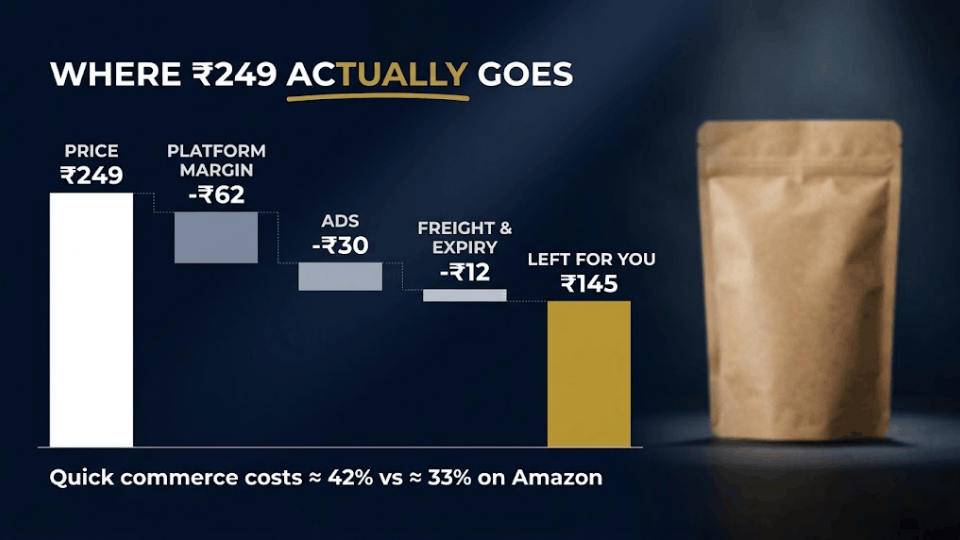
Rohan ran both channels on his ₹249 makhana pack. On Amazon, his fees came to about ₹58 a unit, plus roughly ₹25 in ads — around 33% of the price. On quick commerce, a 25% platform margin (₹62), about ₹30 in ads and ₹12 in freight and expiry losses added up to ₹104, or nearly 42%. Quick commerce cost him ₹21 more per pack, but brought buyers who had never searched for him on Amazon. That trade-off is the real decision.
The Inventory Model: You Become a Supplier
Blinkit Now Buys Your Stock
In late 2025, Blinkit moved from a marketplace to an inventory-led model, and by early 2026 about 90% of its business ran on stock it owns. In practice, you sell in bulk against purchase orders, and Blinkit decides much of what happens on the shelf. That is very different from Seller Central, where you set your own price and promotions.
How Does Zepto Onboarding Work?
To sell on Zepto, you apply through its brand portal, and a category manager drives the process from negotiation to go-live. Expect to show GST, PAN, FSSAI for food and beverage, and trademark proof or a brand authorisation letter. Zepto’s partner page cites onboarding within about 15 business days for qualifying brands, but it is selective and expects you to keep stock levels steady across its dark stores.
The Cash-Cycle Trap
Brands commonly replenish dark stores every 24 to 48 hours. You fund stock across dozens of locations, carry expiry risk, and then wait for the platform’s payment cycle. Run out and your ranking drops; overstock and you face write-offs.
Divya Menon from Kochi pushed 4,000 units of sunscreen into Bengaluru warehouses last summer, then waited 45 days for payment. Meanwhile her Amazon FBA stock ran dry. It’s the same trap we unpacked in cash flow vs profit on Amazon: sales on paper, no money in the bank.
Before you sign any purchase order, map how much stock and cash a dark-store rollout will lock up. Our Inventory Reorder Calculator helps you set reorder points so one channel never starves the other.
Category Fit: What Sells in Ten Minutes
Where Quick Commerce Wins
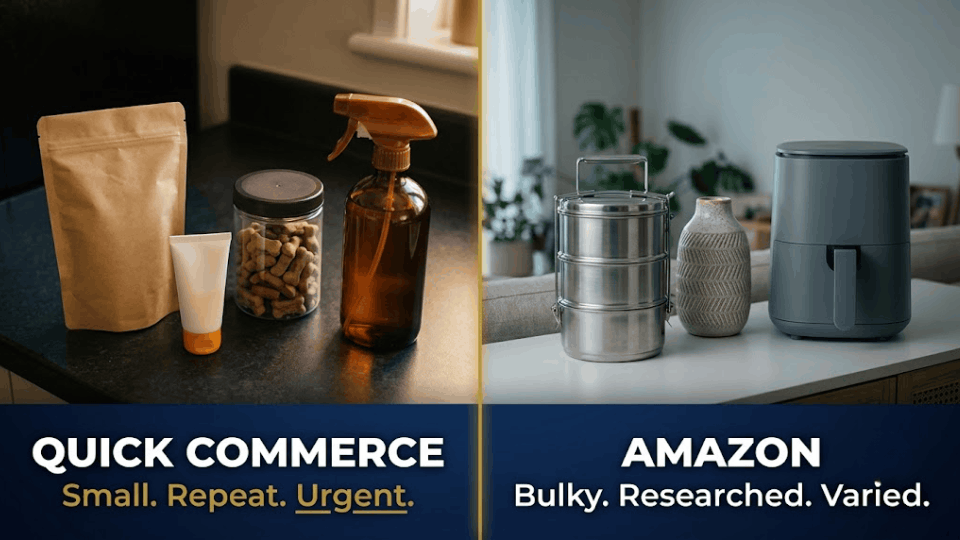
Quick commerce rewards urgency, impulse and replenishment. Snacks, beverages, personal care, baby care, home cleaning and pet food all fit because people buy them often and want them now. Industry playbooks suggest products with roughly 60 to 120 days of shelf life, compact sturdy packs, and price points that slip easily into a small basket.
Vikram Reddy from Hyderabad sells grain-free dog treats. On Amazon, buyers stocked up monthly. On Zepto, orders spiked on weekday evenings when owners realised the jar was empty. Within three months, his top SKU was selling more units in one city on quick commerce than across India on Amazon.
Where Amazon Still Wins
Considered purchases are different. Anything bulky, fragile, expensive or sold in many sizes and colours struggles in a dark store, as do products where reviews and comparison drive the sale. Amazon’s national reach still beats a ten-minute shelf for steel storage, home décor, small appliances and most fashion. If your products sit in that world, our comparison of Meesho vs Amazon for Indian sellers is a more useful next channel to study.
Who Should Sell on Blinkit and Zepto (and Who Shouldn’t)
You’re Ready If…
Quick commerce suits brands, not resellers testing products. Founders who make it work usually tick most of these boxes:
- Your product is a consumable that customers rebuy within weeks, not months.
- Your gross margin is healthy — brands with margins around 70% cope with platform costs, while thinner-margin brands often treat the channel as a loss-making acquisition play.
- You can fund two to three months of stock across warehouses without starving Amazon.
- You have proof of metro demand, with a meaningful share of Amazon orders from cities quick commerce serves.
- Your trademark, GST and FSSAI paperwork is complete.
Tick four or five and a small pilot makes sense. Two or fewer, and Amazon still deserves your next rupee.
Wait If…
Hold off if you are still finding product-market fit, your margins are thin, your customers live mostly outside metros, or your cash is tight. Farah Siddiqui from Lucknow sells herbal teas and said no to her first quick commerce offer. She spent a year building reviews and improving margins on Amazon, then entered Zepto in Delhi NCR with two SKUs. If your growth path points abroad instead, see our Amazon Global Selling from India guide.
Weighing several channels at once? Our Ecom Growth Engine tool helps you map where your next stage of growth should come from before you commit stock.
A 90-Day Plan to Test Quick Commerce Safely
Start With One City and Two SKUs
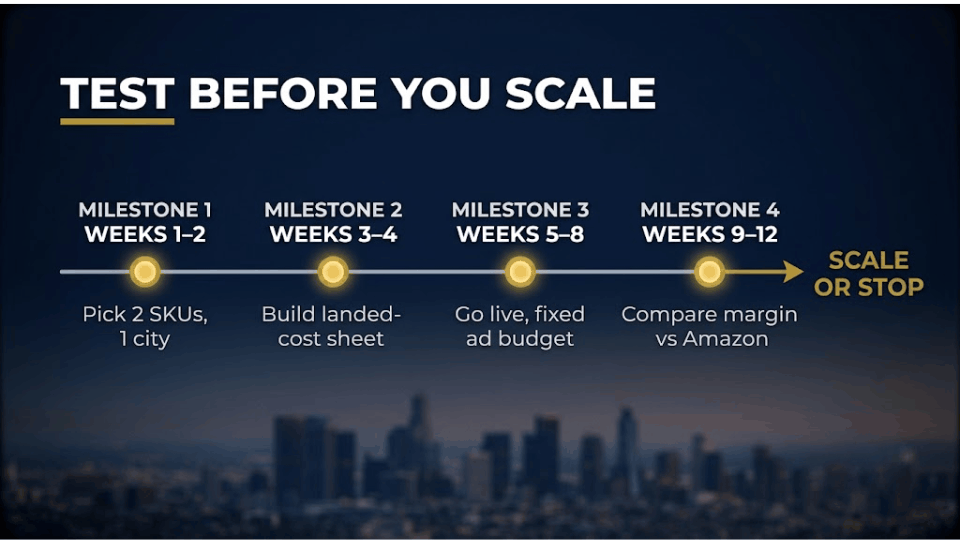
The safest way to sell on Blinkit and Zepto is to treat the first quarter as a paid experiment, not a launch. Here is a simple sequence:
- Weeks 1–2: Pick your two fastest-repeating SKUs and the metro where you already get the most Amazon orders.
- Weeks 3–4: Build a landed-cost sheet per SKU per platform, including margin, ads, freight and expected expiry losses.
- Weeks 5–8: Go live in that one city, set a fixed ad budget, and track availability across dark stores weekly.
- Weeks 9–12: Compare contribution margin per unit against Amazon, and check whether your Amazon sales in that city dipped.
At day 90, you’ll know whether quick commerce adds new buyers or just moves your existing ones to a costlier shelf.
Protect Your Amazon Pricing
Platform discount events can push your quick commerce price below your Amazon price, and buyers notice. Many brands use different pack sizes — a 70g quick commerce pack versus a 200g Amazon pack — so prices are never compared directly. Never let one channel’s promotion undercut another.
Keep an Eye on Amazon Now
Amazon Now has grown from three metros to dozens of cities in 2026, with plans announced for more than 300. How widely FBA sellers can take part is still evolving, so watch Seller Central closely. The ten-minute customer may soon be reachable without leaving Amazon.
Frequently Asked Questions
How do I start selling on Blinkit?
Apply through Blinkit’s seller or brand onboarding portal with your GST, PAN, FSSAI (for food) and trademark or brand authorisation. Since Blinkit now buys most stock itself, expect a commercial discussion on margin and purchase orders rather than a self-serve listing. Approval depends on category fit and demand, so lead with your fastest-moving SKUs and proof of sales.
How much commission does Blinkit charge sellers?
Under its old marketplace model, Blinkit seller commission typically ranged from about 8% to 20% by category. Today, most brands sell stock to Blinkit, so the cost shows up as the platform’s negotiated margin instead. Add ads, listing charges and promotions, and all-in costs can climb well past 25% of revenue. Always confirm current terms with your category manager.
How do I become a seller on Zepto?
Apply through Zepto’s brand onboarding portal and share GST, PAN, FSSAI where needed, and trademark or authorisation documents. A category manager reviews your brand, negotiates margin and guides cataloguing. Zepto cites around 15 business days for qualifying brands. Zepto commission for sellers usually falls between 8% and 25%, depending on category.
Is quick commerce profitable for small brands?
It can be, but only with strong gross margins and fast repeat purchases. Many small brands lose money per order once margin, ads, freight and expiry are counted, and treat the channel as customer acquisition. Run a single-city pilot with two SKUs and measure contribution margin per unit before expanding.
Blinkit or Zepto: which is better for a new brand?
Blinkit has the larger order volume and deeper metro coverage, but its inventory-led model gives you less control over pricing. Zepto is selective but category-manager driven, which can help a new brand get guidance. Pick the platform with stronger demand in the city where your Amazon orders are concentrated, then add the other.
Can I sell on Blinkit without a trademark?
Some guides say GST and PAN are enough, but platforms usually verify brand ownership through a trademark certificate, an application, or an authorisation letter. Without one, you also have little protection against copycats. File your trademark before applying.
Does Amazon have its own quick commerce service in India?
Yes. Amazon Now offers ten-to-thirty-minute delivery of groceries and daily essentials through micro-fulfilment centres. It launched in Bengaluru, Delhi and Mumbai and has expanded quickly through 2026. Seller participation is still evolving, so track Seller Central updates if your products are everyday essentials.
Conclusion
Quick commerce is not a replacement for Amazon. It is a different machine: a tiny shelf, a supplier relationship instead of a seller account, higher all-in costs, and a metro customer who wants it now. For the right product — consumable, compact, high-margin and already popular in a big city — it can open a stream of buyers Amazon never reached. For everything else, Amazon’s lower fees and national reach still make it the smarter home.
Start small, measure honestly, and let the numbers decide. If you want to build a strong Amazon foundation first, join our 3-Day Amazon Business Training and learn how to grow a brand that’s ready for any channel. Your margins — and your sanity — will thank you.
