
Six months ago, Deepak Menon from Coimbatore was spending ₹800 a day on Facebook ads pointing straight to his Amazon listing. His sales were climbing, but he had no idea which ads were actually working. Was it the video creative or the carousel? The audience in Chennai or the one in Delhi? He was flying blind, pouring money into a system that gave him zero feedback. Then he discovered that sellers in the US and UK had a tool called Amazon Attribution that tracked every click, every add-to-cart, and every sale from external traffic. The catch? Amazon Attribution is not available in India. If you sell on Amazon India and drive external traffic, you face the same black box Deepak faced. But here is the good news — there are practical workarounds that give you roughly eighty percent of that tracking power. This guide walks you through three methods Indian sellers are using right now to track external traffic, measure results, and stop wasting ad spend.
Why External Traffic Tracking Matters for Amazon India Sellers
The Ranking Boost Amazon Gives External Traffic
Amazon's algorithm does not just count sales — it pays attention to where those sales come from. When a shopper lands on your listing from outside Amazon and makes a purchase, the algorithm treats that as a stronger relevance signal than an internal sale. This is why sellers who drive external traffic consistently see their organic keyword rankings climb faster than those relying purely on Amazon PPC. If you want to understand the mechanics behind this, our guide on how Amazon's algorithm works and how to rank higher explains the full picture.
Kavitha Rajan from Bangalore experienced this first-hand. She started sending targeted Google Ads traffic to her handmade soap listing last August. Within three weeks, her primary keyword moved from page three to the middle of page one, and her organic sessions doubled without increasing her Amazon ad budget by a single rupee.
The Problem — You Cannot Measure What You Cannot Track
The ranking boost is real, but it creates a dangerous temptation. Many Indian sellers start throwing money at Facebook or Google ads without any way to measure what is actually converting. When you send traffic directly to your Amazon listing, the ad platform sees a click and nothing more. It cannot tell you whether that click led to an add-to-cart, a purchase, or a bounce. Without that feedback loop, your ad platform cannot optimise. You end up paying the same cost-per-click for high-intent buyers and window shoppers alike. The sellers who win with external traffic are not the ones who spend the most — they are the ones who track the most.
What Is Amazon Attribution and Why Indian Sellers Cannot Use It

How Attribution Works in the US/UK (Quick Overview)
Amazon Attribution is a free tracking tool available to brand-registered sellers in the US, UK, Germany, and several other marketplaces. It generates unique tracking tags that you attach to your external ad links. When a shopper clicks that tagged link, Attribution tracks their entire journey — detail page views, add-to-cart events, and purchases — all visible inside Seller Central. The data uses a fourteen-day last-touch window. Sellers in those markets also get the Brand Referral Bonus, which refunds roughly ten percent of the referral fee on every externally-driven sale.
The India Gap — What Is Missing and What It Costs You
Despite some global documentation listing India as a supported marketplace, Amazon Attribution is not accessible to Indian sellers in Seller Central. The Attribution console simply does not appear. This means no tracking tags, no conversion data from external campaigns, and no Brand Referral Bonus. For sellers like Arjun Pillai from Kochi, who was spending ₹1,200 a day on Instagram reels driving traffic to his fitness accessories listing, the absence of Attribution meant he could not tell whether his ₹36,000 monthly ad spend was generating ₹50,000 in sales or ₹5,000. He was profitable overall, but had no idea which campaigns deserved more budget and which ones were bleeding money. This is the reality for every Indian seller driving external traffic today.
Workaround 1 — The Bridge Page + Pixel Method
How the Bridge Page Strategy Works (Step by Step)
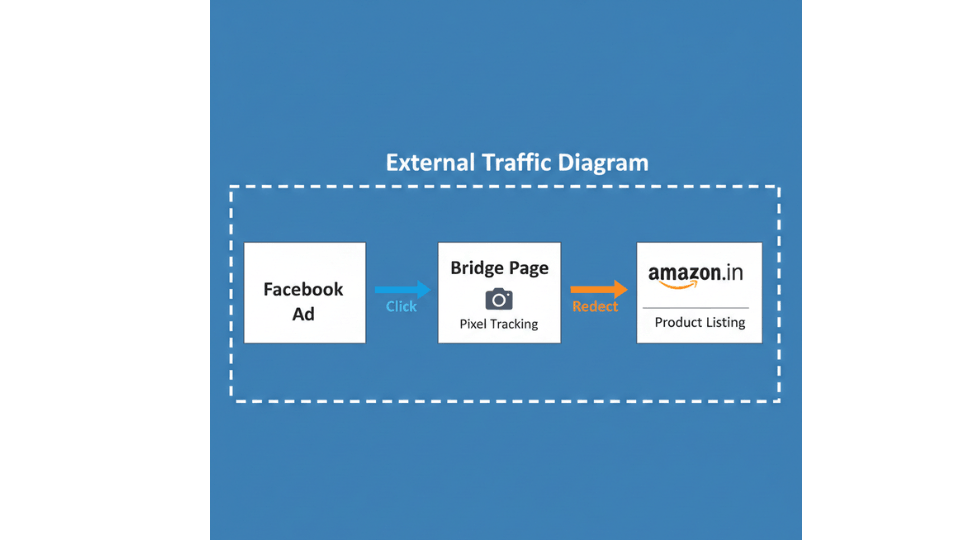
Instead of sending ad traffic directly to your Amazon listing, you route it through an intermediate landing page — a bridge page — hosted on your own domain or a tool like WowFunl. The bridge page displays your product's key benefits, images, and a prominent “Buy on Amazon” button. The critical difference is that this page sits on a domain you control, which means you can install your Facebook Pixel, Google Tag, or any other tracking code on it. Every visitor who lands on your bridge page gets pixeled, and every button click gets recorded.
Setting Up Pixel Events to Optimise Your Ads
Here is where the bridge page method becomes powerful. When a visitor clicks the “Buy on Amazon” button, you fire an “Add to Cart” event through your Facebook Pixel or Google Tag. This tells the ad platform that this particular user took a high-intent action. Facebook and Google can then optimise your campaigns around this event, showing your ads to more people who are likely to click through and hit that button. Meera Sundar from Chennai set this up for her kitchen appliance brand. Within three weeks of switching from link-click optimisation to add-to-cart event optimisation, her cost-per-click dropped by thirty-five percent because Facebook was now finding higher-intent shoppers instead of casual scrollers.
If you want to learn the complete external traffic strategy for Amazon India, including bridge pages, ad setup, and funnel building, register for our 3-Day Amazon Business Training.
What You Can and Cannot Track With This Method
The bridge page method is not perfect attribution — it is a proxy. You can track how many people visited your bridge page, how many clicked the buy button, and you can retarget everyone who visited but did not click. What you cannot track is whether that person actually completed the purchase on Amazon. The click-to-purchase gap remains invisible. That said, this method gives your ad platforms the optimisation signal they desperately need. You can also use UTM parameters on your bridge page links to track which exact ad, audience, or platform drove each visit — something you cannot do on Amazon product pages directly, since Amazon does not support UTM tracking on its domain.
Workaround 2 — Amazon Associates Link for Purchase Tracking
Creating a Dedicated Associates Tag for Each Campaign
This is the closest you can get to actual purchase tracking on Amazon India. Sign up for the Amazon Associates program on amazon.in — it is free and separate from your seller account. Once approved, create a dedicated tracking tag for each traffic source or campaign. For example, create one tag called “fb-carousel-jan” for your Facebook carousel ads and another called “google-search-jan” for your Google Search campaigns. Generate an affiliate link for your product using each tag, and use that link as the destination URL in your ads or on your bridge page button.
How to Read Your Associates Reports to Measure Sales
Every purchase made through your Associates link shows up in your affiliate dashboard, broken down by tracking tag. Log in, check earnings by tag, and match the numbers against your ad spend to calculate an approximate return on ad spend. Vikram Deshmukh from Pune uses separate Associates tags for Facebook, Google, and WhatsApp. He discovered that WhatsApp traffic converted at nearly three times the rate of Facebook, despite costing nothing beyond the time to create broadcast messages. That single insight reshaped his entire budget allocation.
Limitations and Compliance Points to Watch
The Associates method has real constraints. Commission rates on most categories are modest — typically one to three percent — so the earnings themselves are not the point. The point is the data. The attribution window is only twenty-four hours, meaning if someone clicks your link today and buys tomorrow night, that sale may not show in your Associates report. Also be aware of Amazon's Associates terms of service — there are restrictions around using affiliate links inside certain types of paid advertising. Review the current terms before launching campaigns. Despite these limitations, this remains the only method that gives Indian sellers actual purchase data tied to specific traffic sources.
Workaround 3 — Smart Link Tracking With MagicLinkz
Keyword-Embedded URLs and Click Tracking
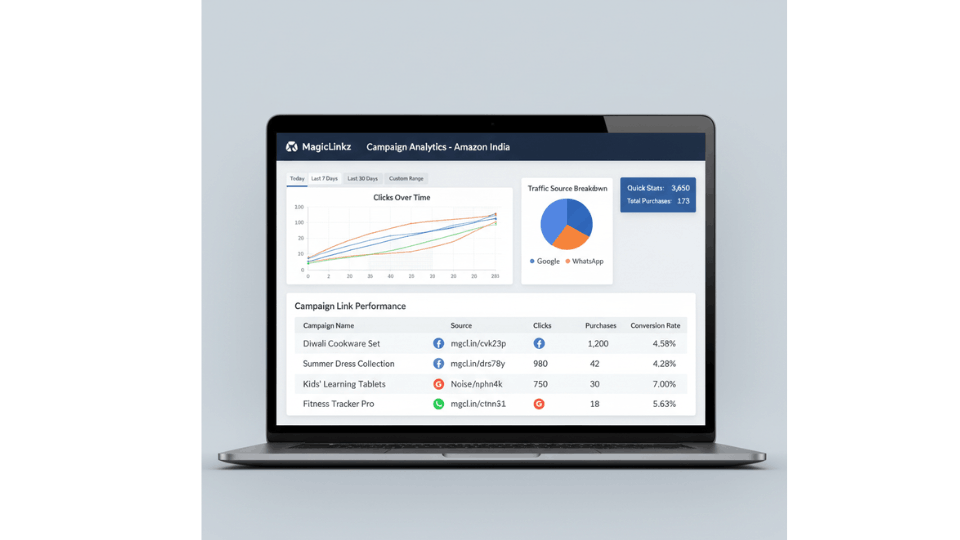
MagicLinkz is a smart link tracking tool built specifically for Amazon sellers in India. It creates Amazon URLs with your target keyword embedded, following the search-find-buy approach that helps Amazon associate your listing with specific search terms. Every click on a MagicLinkz link is tracked in a dashboard, giving you visibility into click volume by link, by day, and by source. You can create separate links for Facebook, Instagram, YouTube, WhatsApp, or any other platform and compare performance side by side.
Adding Facebook Pixel and GTM to Every Link
What makes MagicLinkz particularly useful for the tracking problem is that you can attach your Facebook Pixel ID or Google Tag Manager container directly to each link. When someone clicks a MagicLinkz link, the pixel fires before they land on Amazon. This means you can build custom audiences of people who clicked through to your Amazon listing, retarget them across Facebook and Instagram, and give your ad platforms conversion signals to optimise around. For sellers already running external traffic campaigns, our detailed guide on the best ways to drive external traffic to Amazon listings covers the full strategy from platform selection to creative best practices.
Dynamic QR Codes for Packaging Inserts
Beyond digital ads, MagicLinkz lets you create dynamic QR codes that link to your Amazon listing. Print these on product inserts, packaging, or business cards. Ravi Shankar from Bangalore prints a QR code insert inside every shipment with a message encouraging customers to explore his other products. He tracks scan volume through MagicLinkz and sees a consistent eleven percent scan rate, which drives repeat purchases and cross-sells — all trackable through his dashboard. If you want to learn how inserts can do more than just tracking, read our post on how packaging inserts can boost reviews and customer engagement.
Combining All Three Methods Into One Tracking System
The Stacked Tracking Setup (Bridge Page + Associates + MagicLinkz)
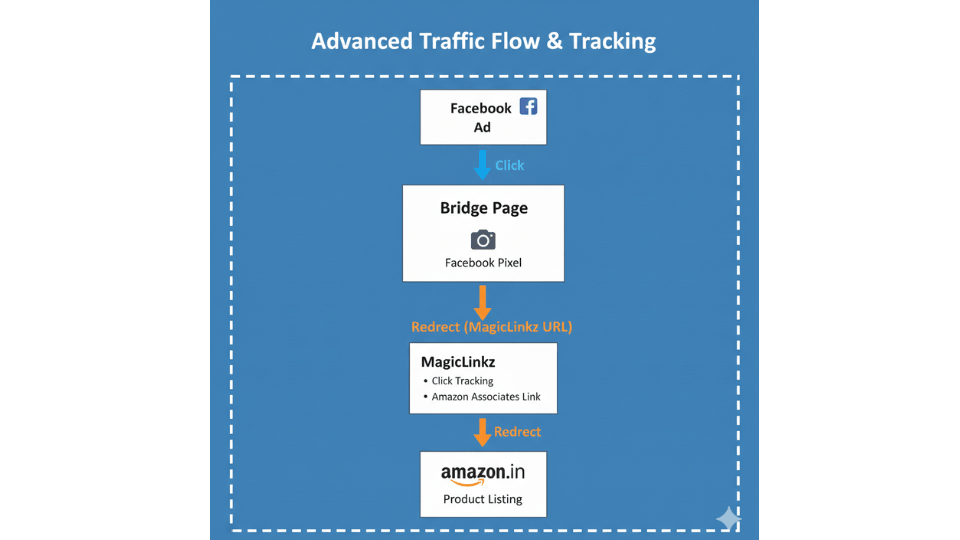
Each workaround covers a different gap. The bridge page gives you ad platform optimisation. Associates gives you purchase data. MagicLinkz gives you click tracking and retargeting. Stack them together and you get remarkably close to what Attribution offers natively. The flow works like this: your Facebook or Google ad sends traffic to a bridge page where your pixel fires. The “Buy on Amazon” button uses an Associates link wrapped inside a MagicLinkz tracking URL. When the visitor clicks, MagicLinkz records the click and fires your pixel event, the Associates link carries them to Amazon with your tracking tag, and any resulting purchase shows up in your affiliate dashboard.
Reading Your Numbers — What to Look At Weekly
Set aside thirty minutes every week to review your stacked tracking data. Check your bridge page analytics for visits and button click rate — this tells you how compelling your page is. Review MagicLinkz click data to compare sources. Pull your Associates report to see actual purchases by tag. Finally, cross-reference with your Amazon Business Reports to see total sessions and orders during the campaign period. Our guide on key metrics to monitor in Seller Central covers the Amazon-side numbers you should be watching alongside your external traffic data.
Nandini Iyer from Hyderabad runs this exact weekly review. Last quarter, she identified that Google Ads were driving twice the purchases of Facebook at half the cost. She reallocated her budget accordingly, and her external traffic profit margin improved by over forty percent within six weeks.
FAQ
Is Amazon Attribution available in India?
No. Despite some global documentation listing India as a supported marketplace, the Attribution console is not accessible in Amazon India Seller Central. Indian sellers cannot create Attribution tags, access conversion reports, or enrol in the Brand Referral Bonus program that depends on Attribution.
How do I track external traffic to my Amazon listing without Attribution?
Use three layered methods: a bridge page with Facebook Pixel or Google Tag to optimise ads, Amazon Associates tracking links to measure actual purchases, and MagicLinkz for click tracking and retargeting pixels. Combining all three gives the most complete picture available to Indian sellers.
Can I use UTM parameters to track traffic to Amazon?
Not on Amazon product pages directly. Amazon does not support UTM parameters on its domain. Instead, use UTMs on your bridge page to track which ad or platform drove each visit, then route visitors from the bridge page to Amazon via a tracked link.
What is the Brand Referral Bonus and does it work in India?
The Brand Referral Bonus gives brand-registered sellers approximately ten percent cashback on sales driven by external traffic, credited against referral fees. It requires Amazon Attribution to function. Since Attribution is unavailable in India, Indian sellers cannot currently access this bonus.
What are the best alternatives to Amazon Attribution for Indian sellers?
Bridge pages with ad platform pixels for optimisation signals, Amazon Associates links for purchase-level tracking, and MagicLinkz for click analytics and retargeting. No single tool replaces Attribution entirely, but stacking these three covers most of the gap.
Can I retarget Amazon shoppers from external ads?
Not directly from Amazon, as the platform does not share visitor data. However, if you use a bridge page or MagicLinkz with pixel tracking, you can retarget everyone who clicked through toward your listing, building custom audiences on Facebook, Google, or Instagram.
Is it worth driving external traffic if I cannot track sales accurately?
Absolutely. External traffic boosts organic rankings, increases sales velocity, and builds brand awareness regardless of tracking. Imperfect measurement is still far better than no external traffic at all. The workarounds in this guide bring you much closer to accurate measurement than most Indian sellers realise.
Does driving external traffic help my Amazon ranking even without Attribution?
Yes. Amazon's algorithm rewards external traffic based on the sales and engagement it generates, not based on whether you have Attribution enabled. The ranking benefit happens regardless of your tracking setup.
Conclusion
Indian sellers face a real disadvantage without Amazon Attribution. But waiting for Amazon to roll it out is not a strategy. The bridge page method gives your ad platforms the optimisation signals they need. Associates links give you the purchase data no other method can. MagicLinkz fills the gaps with click tracking, pixel integration, and keyword-embedded URLs. Stack all three, and you have a tracking system that puts you ahead of ninety percent of Indian sellers who are still guessing. Start with the bridge page — it takes an afternoon to set up — and layer in Associates and MagicLinkz as you scale. If you want hands-on guidance building your external traffic system from scratch, join our 3-Day Amazon Business Training where we walk you through the entire process step by step.
