

Last March, Harshvardhan Rathore from Udaipur shipped 1,200 collapsible silicone lunch boxes into an Amazon FBA fulfilment centre. Demand was steady, margins were healthy, and fifteen other sellers were already selling the same product. Eleven days after going live, his ASIN was deactivated over a design infringement complaint. His stock sat in the warehouse, piling up storage fees, while he tried to work out what a “registered design” even was.
Harshvardhan wasn’t careless. Like most new sellers, he simply didn’t know he had to check patents before selling on Amazon, or how.
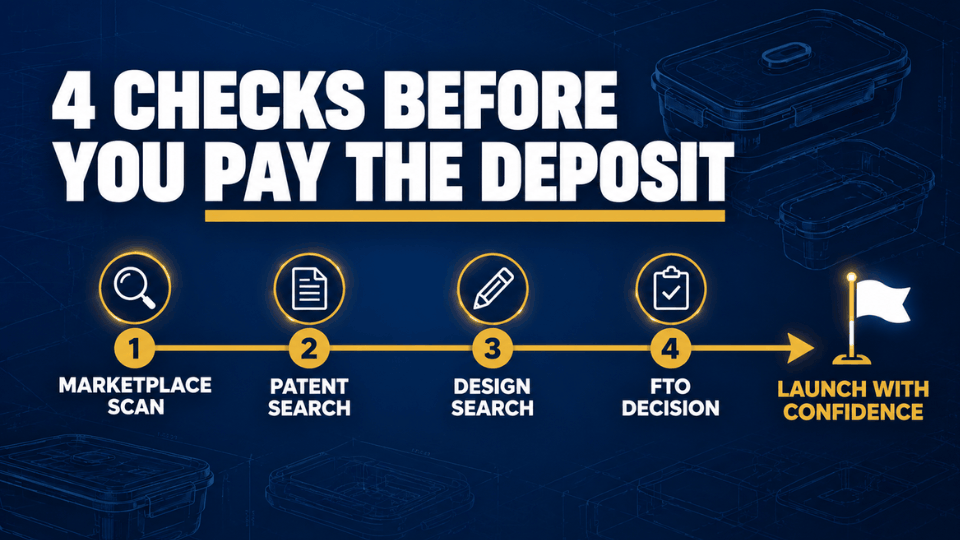
This guide covers the four checks to run before you place an inventory order, the tools Indian sellers can use at no cost, and what to do if a complaint lands anyway. One note: this is practical guidance, not legal advice, so bring in an IP lawyer for big decisions.
Why “Everyone Sells It” Is a Costly Amazon Assumption
The “20 Sellers Can’t All Be Wrong” Trap
When twenty sellers offer the same product, it feels like proof the product is safe. It isn’t. Rights owners choose when to enforce, and they often target the newest or fastest-growing seller first. Other listings surviving tells you nothing about how long yours will.
How Some Sellers Weaponise Design Registrations
Some sellers register a design for a product that has been on the market for years, then file complaints to clear out rivals. Seller forums are full of these stories, including a generic cocktail shaker design used this way. Amazon acts on the registration certificate without judging whether it should have been granted, so the burden falls on you.
What a Takedown Really Costs an FBA Seller
Sneha Kulkarni from Nashik learnt this with a bamboo bathroom organiser. Her listing was deactivated in its second month, just as sales crossed 18 units a day. Her FBA stock was stranded, her PPC campaigns stopped, and her organic ranking slipped away. She paid for a removal order and lost roughly ₹2.4 lakh in festive-season sales.

Design Patent vs Utility Patent: What You’re Checking
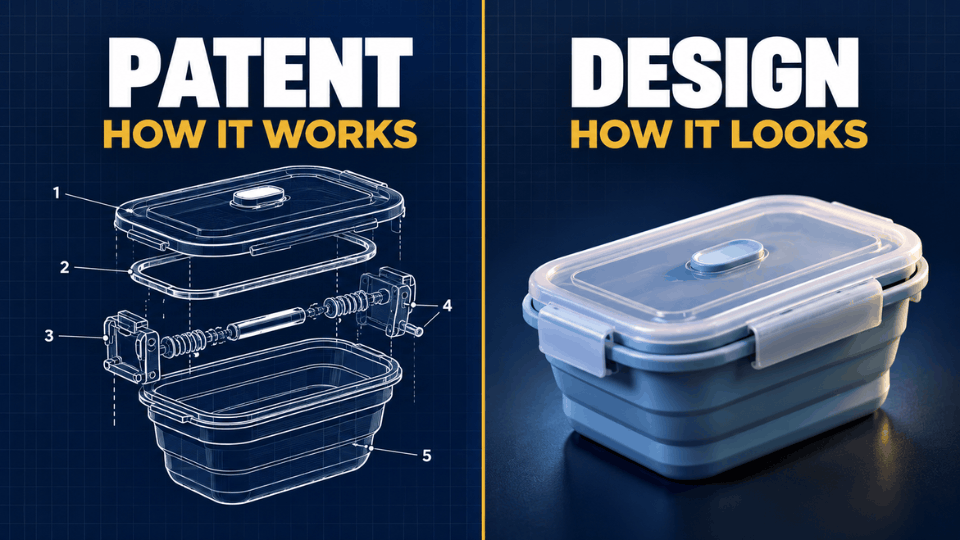
A Patent Protects How a Product Works
A patent covers an invention: a new and useful way something functions. What US sellers call a “utility patent” is simply a patent in India, granted under the Patents Act, 1970, for 20 years from filing. The claims section defines what is protected. If your product does everything a live claim describes, you could be infringing, even if it looks nothing like the drawings.
A Design Registration Protects How It Looks
A design registration covers appearance: shape, configuration, pattern or ornamentation. The Designs Act, 2000 gives 10 years of protection, extendable once by 5 years. Americans call this a “design patent”; Amazon.in complaints usually say “design right.”
Where Trademarks and Copyright Fit (and Don’t)
Your trademark protects your brand name and logo, not your product’s shape or mechanism. Copyright covers your photos, artwork and listing copy. Imran Qureshi from Lucknow assumed his trademark protected the distinctive frame of his LED vanity mirror, and a competitor copied the shape within four months. If you’re still building your brand, start with our guide to trademarks for Amazon India sellers.
Stage 1 – Read the Amazon.in Marketplace First
Look for Warning Signs on Competitor Listings
Start with the marketplace, because it’s quick and costs nothing. Scan competitor images and bullets for “patented,” “patent pending,” “registered design” or a printed design number. Watch for niches where demand is strong but only one brand sells a particular shape or mechanism. That gap is rarely an accident.
Check the Brand’s Website and Packaging
Original brands often print patent or design numbers on the product, box or website. Order a sample from the market leader and inspect every part, especially hinges and moving pieces. Anjali Menon from Kochi found a design number moulded under a rotating spice rack she planned to source, saving herself a ₹3.5 lakh inventory order.
Ask Your Supplier the Right Questions
Your manufacturer may call the product an “open mould” that anyone can buy. Don’t take that on trust. Ask who owns the mould and whether the design came from another brand, and get the answers in writing. It won’t protect you legally, but it shows good faith and reveals how careful your supplier is. Our guide on getting products manufactured under your brand covers these supplier conversations in depth.
Stage 2 – How to Check Patents Before Selling on Amazon
Google Patents Search for Products
Google Patents searches patent offices worldwide, including India, in one go. Use functional words, so “collapsible food container with silicone walls” rather than “silicone lunch box.” Always check legal status, because an expired or lapsed patent can’t stop you.
How to Check If a Product Is Patented in India
Patents are territorial. A US or Chinese patent alone doesn’t block you on Amazon.in, but an Indian patent or pending application can. Search the IP India patent database (InPASS) with the same keywords. Indian patents need annual renewal fees, so some quietly lapse. Vikrant Sood from Chandigarh found a matching patent for a desk cable organiser, saw it had lapsed, and launched with confidence.
If your search turns up no Indian patent or application for your product, you’re clear on patents and can move on to the design check in Stage 3. If it does find a match, check its status. You’ll see one of three results:
- Registered (granted) patent: Don’t launch. The owner can file a complaint or take legal action as soon as your listing goes live.
- Pending application: Don’t launch either. Once the patent is granted, the owner can claim damages going back to the date the application was published.
- Expired or lapsed patent: You can launch, but at your own risk. A patent that has run its full 20 years is free to use, but one that lapsed for unpaid fees can be restored if the owner applies within 18 months.
So with a lapsed patent, check the lapse date first. If that 18-month window is still open, the owner could revive the patent and turn your launch into a problem.
Reading a Patent Claim Without a Law Degree
Go straight to Claim 1, usually the broadest. Break it into parts and ask whether your product has every one. If it does, treat that as a red flag. If an essential element is missing, the risk drops, but that’s where a professional opinion earns its fee.
Selling Abroad Later? Check There Too
If Amazon Global Selling is on your roadmap, add USPTO and EUIPO searches now. Redesigning later costs far more.
Patent checks are only half of validation. Our guide on selecting a winning Amazon product shows you how to confirm demand first.
Stage 3 – Run a Design Registration Search in India
IP India Public Search for Designs, Step by Step
Most complaints against simple home and kitchen products are design-based. Here’s how to search the IP India designs database:
- Open the public search for designs on the official IP India website.
- Search by article name with several variations, such as “lunch box,” “food container” and “tiffin.”
- Narrow the results by design class to stay within your product category.
- Compare each relevant record’s registered drawings with your product.
- Note the registration number, filing date and status of anything close.
Take dated screenshots as you go.
The Coverage Gaps You Must Know About
The portal isn’t complete. Its own disclaimer says records start from April 1997, with 2005, 2006 and 2008 still to be added, and that results aren’t valid for legal proceedings. A clean result is a good sign, not a guarantee.
Fill the Gaps With the WIPO Global Design Database
WIPO’s Global Design Database includes India’s national collection alongside millions of foreign designs. Judge the overall visual impression rather than tiny details, because Indian law asks whether a design is an obvious or fraudulent imitation. Lakshmi Narayanan from Tiruchirappalli found a live registration on a steel tiffin shape this way, switched suppliers before paying her deposit, and launched a different design three weeks later.
Stage 4 – Freedom to Operate Search in India: When to Pay
What an FTO Opinion Covers That DIY Searches Can’t
A freedom to operate search is a professional check of whether you can sell your product without infringing live rights. A patent attorney maps each relevant claim or design against your product, rates the risk and suggests changes. Your searches catch obvious conflicts; an FTO opinion catches subtle ones and documents your decision.
When It’s Worth the Fee
You don’t need one for every product. It’s worth paying for when your order is large, your product is mechanical or electronic, or your searches found close matches. Debashish Ghosh from Kolkata commissioned one before ordering 3,000 portable blenders. The attorney flagged a claim covering the blade assembly, his supplier changed it, and he has sold for eight months without a complaint.
Amazon IP Accelerator India
Need an IP lawyer? Amazon’s IP Accelerator, launched in India in 2021, lists vetted Indian IP law firms on the Service Provider Network. Browsing the listings costs nothing extra, and you agree fees directly with the firm.
Can You Change the Design and Still Sell?
Why Cosmetic Tweaks Rarely Work
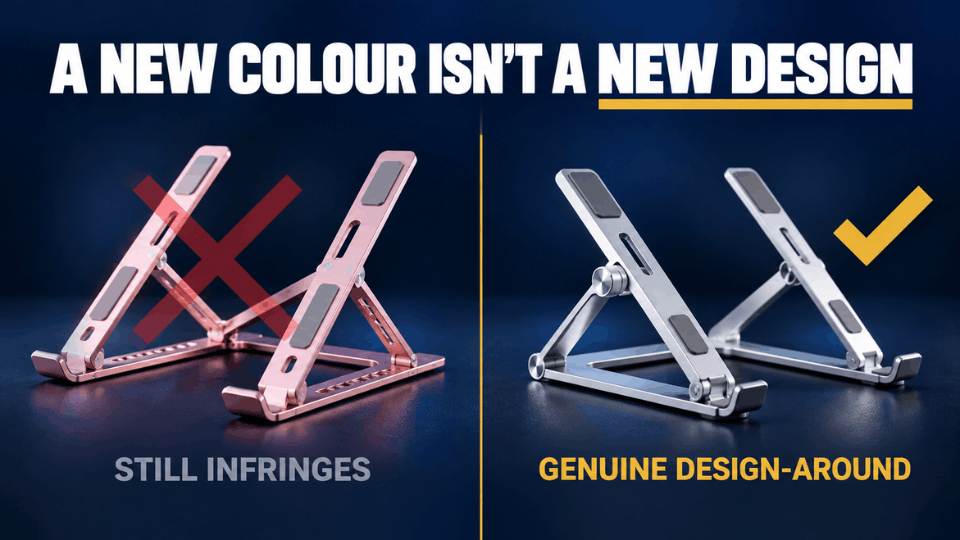
A new colour, your logo or a few millimetres of size rarely change a design’s overall impression. For patents, appearance doesn’t matter at all: if your product still has every element of the claim, it can still infringe.
What a Real Design-Around Looks Like
A genuine design-around changes the features that make the design recognisable, or removes an essential element of the claim. Farhana Sheikh from Hyderabad wanted to sell a foldable laptop stand that matched a registered design. She worked with her factory on a new hinge and leg profile, then had an attorney confirm in writing that it sat outside the registration. It cost six extra weeks and saved the product.
Licensing or Waiting for Expiry
Sometimes the smartest move is to ask. Some rights owners will license a design or patent for a royalty, and others are near the end of their protection. Once a design or patent expires or lapses, anyone can use it.
What to Do If You Get an Amazon IP Complaint
Your First 48 Hours
Open Account Health in Seller Central, find the intellectual property complaints section, and note the complaint ID, the rights owner’s contact details and the exact right claimed. Don’t create a new ASIN for the same product. Amazon treats that as evasion, and it can put your whole account at risk.
When the Complaint Is Valid
If the rights owner genuinely holds the right and your product matches, stop selling. Create a removal order for your FBA stock, ask the rights owner for a retraction or licence, and prepare a plan of action showing how you’ll prevent a repeat.
When Your Product Is Genuinely Different
Sometimes a complaint hits your listing even though your product is different, especially when a rights owner reports every listing in a category. If you made a genuine design change before launch, such as a new shape, hinge or mechanism, you can appeal. A new colour alone won’t carry an appeal, because a design registration protects the shape and a patent protects how the product works.
Build your appeal around evidence. Put the registered drawings or patent claims side by side with photos of your product, and point out each difference. Add your supplier invoices, design files and any attorney opinion you got before launch, like the written confirmation Farhana secured. Send this to the rights owner first and ask for a retraction, which is usually the fastest route. If they don’t respond, submit the same evidence through the complaint in Account Health.
When the Registration Itself Is Invalid
A design must be new when it is filed, so a registration covering a product already sold publicly may be open to challenge. Nikhil Patil from Kolhapur faced this with a brass diya stand. Through a lawyer, he used three-year-old invoices and old listings to get the registration cancelled by the Controller of Designs, then appealed to Amazon. His listing returned after four months.
Our guide to keeping your seller account safe shows how to avoid the policy violations that put it at risk, before any complaint arrives.
Checklist: Check Patents Before Selling on Amazon
The 7-Point Pre-Launch Checklist
Run this checklist before you pay a supplier deposit, not after your stock reaches an FBA warehouse:
- Scan Amazon.in listings and a product sample for patent or design numbers.
- Get a written declaration from your supplier on mould and design ownership.
- Search Google Patents with functional keywords and check each match’s legal status.
- Search the IP India patent database for Indian patents and applications.
- Search the IP India designs database and the WIPO Global Design Database.
- Check expiry and renewal status for anything close to your product.
- Get a freedom to operate opinion if the order is large or matches look close.
Most steps take under an hour, and the whole process costs a fraction of one stranded FBA shipment.
Build a Paper Trail
Save every search as a dated screenshot in one folder per product, with your supplier’s declaration and any FTO opinion. If a complaint arrives, this record helps you respond fast and shows Amazon you did your homework.
FAQ
How do I check if a product is patented before selling it on Amazon?
Look for patent or design numbers on Amazon.in listings, packaging and samples. Then search Google Patents with functional keywords, followed by the IP India patent and design databases, and check each close match’s legal status. For large orders or close matches, get a freedom to operate opinion.
If many sellers already sell a product on Amazon, is it safe for me to sell it too?
Not necessarily. Rights owners decide when to enforce and often target new or fast-growing sellers first. Others may hold licences or simply not have been reported yet. A crowded listing proves demand, not freedom from patents or registered designs.
What’s the difference between a design registration and a patent?
A patent protects how a product works, through claims describing the invention, and lasts 20 years in India. A design registration protects how a product looks, such as its shape and pattern, and lasts up to 15 years. One product can carry both.
Can I sell a patented product if I change its design slightly?
Usually not. Changing the colour, logo or size rarely changes a design’s overall impression, and it doesn’t affect patent claims at all. You need a genuine design-around, confirmed in writing by an attorney, before you order stock.
What happens if I receive a patent or design infringement complaint on Amazon India?
Amazon usually deactivates the listing and records the complaint in your Account Health. If it’s valid, stop selling, remove your FBA stock and seek a retraction or licence. If the registration itself is invalid, challenge it legally first, then appeal to Amazon.
Is a Google Patents search enough, or do I need IP India too?
It’s a great start, but not enough. Its coverage of Indian design registrations is limited. Search IP India’s databases directly, then use the WIPO Global Design Database to fill gaps.
How long do patents and design registrations last in India?
A patent lasts up to 20 years from filing, provided annual renewal fees are paid. A design registration lasts 10 years, extendable once by 5. After expiry or lapse, anyone can use it.
Does registering my trademark protect my product’s design?
No. A trademark protects your brand name and logo, which matters for Brand Registry. It doesn’t stop anyone copying your product’s shape or mechanism. If your product has a distinctive look, consider filing a design registration before launch, while it still counts as new.
Conclusion
Harshvardhan eventually got his lunch boxes out of the warehouse, but the lesson cost far more than the few hours of searching that would have prevented it. Patent and design checks aren’t a legal formality for the end. They belong in product selection, right alongside demand, competition and margins.
Build these four stages into every launch, and your money goes into inventory that can actually sell, not stock stranded in a fulfilment centre.
If you’d like to learn how to validate products end to end, from demand and margins to IP risk, join our 3-Day Amazon Business Training. Your next launch, and your peace of mind, will thank you.
