

Tanvi Joshi from Indore had never heard of Amazon Rufus optimisation, and she didn’t think she needed to. Her copper water bottle ranked on page one for “copper water bottle”, and her rating sat at 4.3 stars. Yet for two straight months, her sessions refused to move. One evening, she opened the Amazon.in app, tapped Rufus and typed the kind of question her customers might ask: a leak-proof copper bottle that fits in an office bag. Three brands appeared in the answer. Hers wasn’t one of them, and one of the three sat on page two of regular search.
That moment captures a big shift happening on Amazon right now. Shoppers aren’t only typing keywords anymore. They’re asking questions, and a ranking no longer guarantees a recommendation. In this guide, you’ll learn how Rufus reads your listing, what Indian shoppers ask it, and a field-by-field plan to make your product the answer.
Why Page-One Rankings No Longer Guarantee Sales
Amazon AI Shopping Assistant: What Changes for Search
For years, Amazon search worked like a matching game. A shopper typed “steel lunch box” and got listings containing those words. Rufus, the Amazon AI shopping assistant, works differently. A parent might ask for a lunch box that keeps dal warm till lunchtime and won’t leak in a school bag, and Rufus reads the intent behind that request. Amazon says more than 250 million customers used Rufus in 2025, with monthly users up 149% year on year.
The 22% Overlap Problem Most Sellers Miss
A Canopy Management analysis found that only about 22% of Amazon’s top search results overlap with the products Rufus recommends. Your listing can hold a strong rank and a fair price, yet still get skipped the moment a shopper asks a question. That hurts, because Amazon has said shoppers who engage with Rufus are 60% more likely to complete a purchase.
Amazon Rufus vs A9: Does Keyword Optimisation Still Matter?
Yes. Keyword search still drives most Amazon purchases, and Rufus works alongside Amazon’s A9 ranking algorithm rather than replacing it. Keywords get your product into the pool, and listing quality decides whether Rufus recommends you from it. Gurleen Kaur from Chandigarh learnt this with her ₹1,499 cotton bedsheets. She ranked on page one for “cotton bedsheet king size”, but Rufus kept suggesting a page-two rival whose listing explained thread count, wash care and colour fastness. Her keywords were fine. Her answers were missing.

How Does Amazon Rufus Work Behind the Scenes?
The Four Sources Rufus Reads Before It Answers
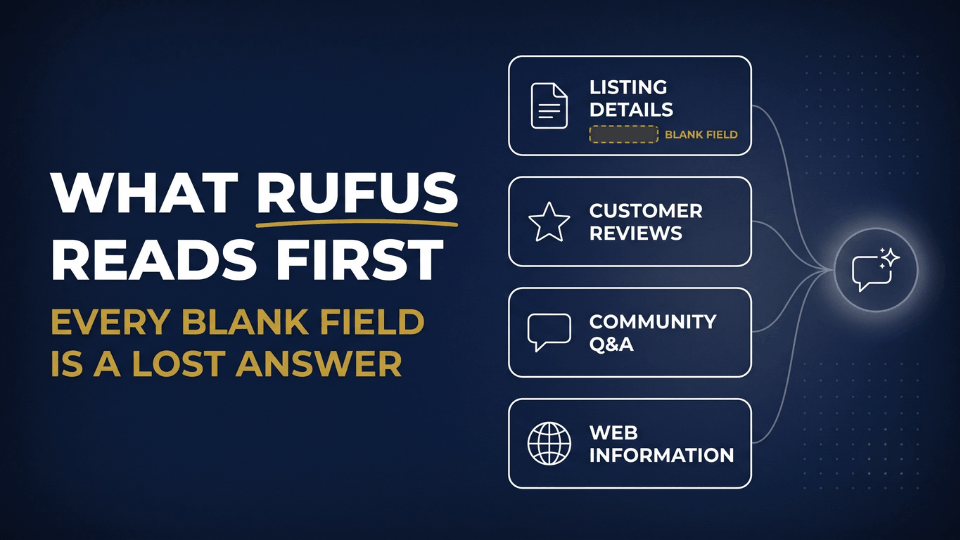
So how does Amazon Rufus work? It starts with what it reads. According to Amazon.in, Rufus is trained on the product catalogue, customer reviews, community Q&As and information from across the web. On your product page, it builds answers from your listing details, reviews and Q&A. Every blank field is a question Rufus can’t answer about you, and when it can’t answer confidently, it recommends someone who gave it better information.
Amazon COSMO Algorithm: The Brain Behind the Chat
You’ll often hear sellers mention the Amazon COSMO algorithm alongside Rufus. In simple terms, COSMO connects products to what shoppers are trying to do, like packing for a Manali trip rather than buying woollen socks. Amazon hasn’t officially confirmed that COSMO powers Rufus, though, so treat it as a useful mental model rather than a rulebook.
How Rufus Decides Which Products to Recommend
Amazon doesn’t publish its rules, but research offers clues. Mars United Commerce and Profitero+ observed that Rufus consistently avoids recommending products rated below 4 stars, regardless of keyword relevance or ad bids. Abdul Salam from Kozhikode found a different kind of gap. A shopper asked Rufus whether his ₹899 cast-iron tawa worked on induction, and Rufus couldn’t confirm. The compatibility attribute was blank, and the answer lived only inside an image.
Amazon Rufus India: What Changes for Indian Sellers
The Questions Indian Shoppers Are Asking Rufus
When Amazon launched Rufus in India, its examples included gift ideas for a wife’s birthday, what you need to make dal makhani, and whether a jacket is machine washable. Shoppers ask about occasions, recipes, use cases and doubts, and rarely about product names. For Amazon Rufus India, your listing must speak to the moment of use, whether that’s a hostel room, a Mumbai monsoon or a joint-family kitchen.
Festive Season Queries: Diwali Gifting and Beyond
As the festive season approaches, gifting questions will sit right alongside your Great Indian Festival sale strategy. Shoppers will ask for Diwali gifts for colleagues or housewarming gifts under ₹1,000, so state gifting context plainly: packaging, who the product suits and which occasions it fits. Nikhil Agarwal from Varanasi added “arrives in a gift box” and “suits mothers, sisters and wedding shagun” to his Banarasi silk stole listing. Within five weeks, gifting-style queries started appearing in his Search Query Performance report.
What the Alexa for Shopping Rename Means for India
Rufus was renamed Alexa for Shopping in the US on 13 May 2026. Amazon’s announcement covered only the US, with no timeline for other marketplaces, and Rufus remains available to all Indian customers in the app and on desktop. Every change in this guide works under either name, because the assistant reads the same listing content.
Before you rewrite anything, find out where you stand. Our Rufus Listing Audit Checklist lists the questions Indian shoppers ask, so you can spot your listing’s gaps in under 30 minutes.
How to Optimise Amazon Listing for Rufus, Field by Field
Noun Phrase Titles That Rufus Can Understand
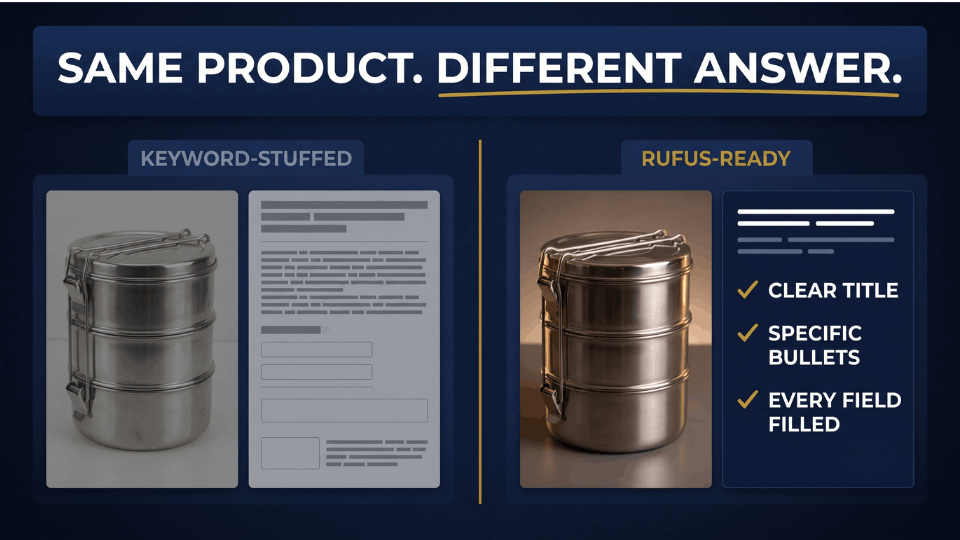
Every plan to optimise Amazon listing for Rufus should start with the title. Compare “Steel Lunch Box Tiffin Leakproof Office School Kids 3 Container” with “Leak-Proof 3-Container Steel Lunch Box for School Kids and Office”. The second is a noun phrase: the product plus clear modifiers describing what it is and who it’s for. It keeps your keywords and reads like a human wrote it.
Bullets That Answer the Shopper’s Real Question
Rufus looks past generic openers like “PREMIUM QUALITY” and searches for specific, verifiable details. Use this pattern when rewriting each bullet:
- Lead with a concrete feature, such as food-grade 304 stainless steel, instead of a vague claim like “best quality”.
- Back it up with a number, such as capacity, dimensions or temperature range.
- Name who it’s for and when they’ll use it, such as school tiffins or long office shifts.
- Answer one common doubt directly, like whether it’s dishwasher safe or leaks when tilted.
Then read your bullets aloud. If one sounds like a salesperson shouting, Rufus will probably treat it as noise. Our guide on writing Amazon bullet points that convert goes deeper on structure.
Backend Attributes: Fill Every Blank Column
Download your Category Listing Report from Seller Central, find every relevant attribute column that’s blank, and fill it with standard values rather than creative ones. Fields like “Specific Uses for Product” deserve real use cases such as “school lunch” or “office tiffin”, not generic words like “kitchen”.
A+ Content and Images as Evidence, Not Decoration
Your A+ modules should answer doubts, not just look pretty. Size charts, comparison tables and “what’s in the box” visuals give Rufus something concrete to work with. Lakshmi Narayanan from Coimbatore rewrote her lunch box title and bullets and filled 14 blank attributes. Over six weeks, her unit session percentage rose from 9% to 11.5%.
Amazon Rufus Optimisation Through Reviews and Q&A
Mine Your 3-Star Reviews for Missing Answers
Your 3-star reviews are the most honest listing audit you’ll get. In Indian categories, the gaps often involve sizing, fabric feel, colour accuracy or power consumption. Read your last 30 middle-rated reviews, note repeated complaints and fix the listing first. A fix in your bullets reaches every shopper, while a review comment reaches only those who scroll.
Write Q&A for the Doubts That Stop a Purchase
Rufus draws on community Q&A when answering product questions, which makes your Amazon Q&A section a direct input for Amazon Rufus optimisation. Focus on the doubts that stop Indian shoppers from buying, such as whether a product handles hard water, runs on inverter backup or fits a standard kitchen shelf. Answer every open question clearly, with numbers wherever possible.
Earn Detailed Reviews Without Breaking Policy
Detailed reviews give Rufus more to work with than “good product” comments. Use the Request a Review button, keep inserts policy-compliant and consider Vine for new launches, but never offer discounts, refunds or gifts in exchange for reviews. Zoya Sheikh from Bhopal noticed several 3-star reviews saying her white cotton kurtas were slightly sheer. She added this to her bullets and Q&A with a suggestion to wear a slip, and fabric-related returns dropped noticeably within two months.
For a head start, grab our Rufus Question Bank, a swipe file of 50 shopper-style questions sorted by Indian category and ready for your audits and Q&A writing.
Rufus Sponsored Prompts: When Ads Join the Conversation
How Sponsored Prompts Borrow From Your Listing
Rufus sponsored prompts, officially called Sponsored Products and Sponsored Brands prompts, are AI-written suggestions that appear inside the shopping assistant. Eligible campaigns are enrolled automatically, and Amazon generates the prompts from your detail pages, Brand Store and campaign data. You can’t write the prompt text or set a separate bid, so your listing content becomes the main lever. Organic optimisation and ad performance now feed on the same material.
Are Rufus Ads Live for Amazon.in Sellers?
In the US, prompts moved from beta to general availability on 25 March 2026. For Amazon.in, don’t assume the feature is active on your account; check your Amazon Ads console and reports. Ananya Das from Kolkata sells ₹1,199 yoga mats. She rebuilt her listing before prompts were confirmed for her account, and her regular Sponsored Products conversion rate still improved from 8% to 10%.
Your 30-Day Amazon Rufus Optimisation Plan
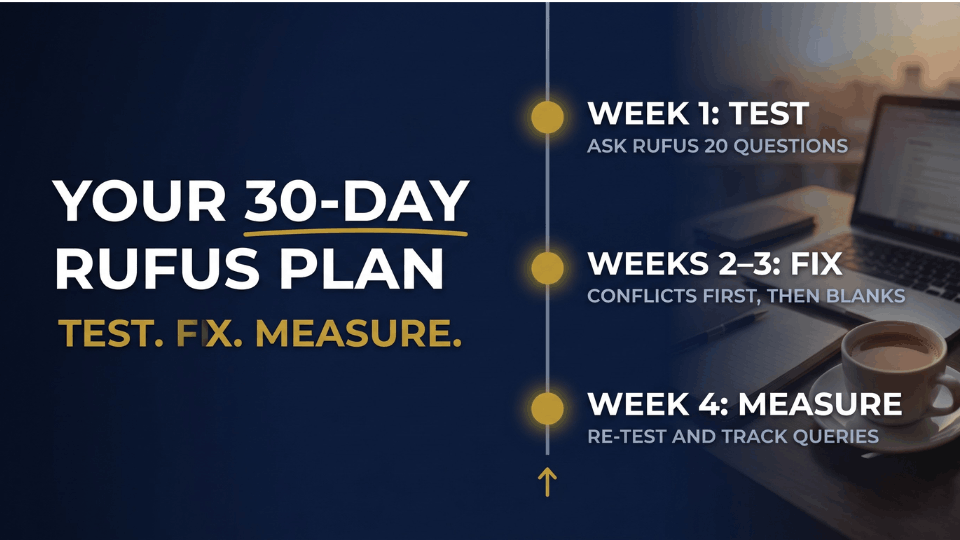
Week 1: Ask Rufus 20 Questions About Your Product
Open the Amazon.in app and ask Rufus 20 questions a real buyer would ask, mixing broad research, comparisons with rivals and specific doubts. Log every answer that’s wrong, vague or leaves your product out. If you can, test from two or three accounts, because Rufus personalises answers based on shopping activity. Karthik Rao from Mysuru did this for his Bluetooth speaker and found 6 of 20 answers were wrong or missing.
Weeks 2–3: Fix Conflicts and Fill the Gaps
Start with your top five ASINs and check whether your title, bullets, attributes and A+ images say the same thing. A bottle listed as 750ml in the title, 1L in the attributes and 700ml in an A+ image confuses shoppers and AI alike. Fix conflicts first, then fill blank fields, then rewrite bullets and Q&A.
Week 4: Measure Your Amazon AI Search Optimisation
Seller Central doesn’t separate Rufus traffic from regular search, so your Amazon AI search optimisation relies on proxies. Watch for longer, question-style queries in your Search Query Performance report and track shifts in mobile sessions. Then repeat your 20 questions. When Karthik re-tested after his fixes, only one answer was still off.
Frequently Asked Questions
What is Amazon Rufus and how does it work?
Amazon Rufus is Amazon’s generative AI shopping assistant, available to all Indian customers in the Amazon Shopping app and on desktop. It answers product questions, compares options and recommends products in a conversation. Rufus draws on the product catalogue, customer reviews, community Q&As and information from across the web, so complete, accurate listings give it more to work with.
How does Rufus decide which products to recommend?
Amazon hasn’t published its rules, but clear patterns have emerged. Independent research observed that Rufus rarely recommends products rated below 4 stars, and thin or keyword-stuffed listings tend to get passed over. Complete attributes, specific bullets, helpful A+ Content and detailed reviews all make it easier for Rufus to match your product to a shopper’s question.
Does keyword optimisation still matter with Rufus?
Yes. Keyword search still drives most Amazon purchases, and Rufus runs alongside it. Keywords help your product enter the consideration set, while listing quality helps Rufus decide to recommend you. The winning approach is readable keyword use: keep your important terms, but place them inside natural phrases that answer real questions instead of stuffing them in.
Is Rufus in India, and is it becoming Alexa for Shopping?
Rufus is live for all Amazon.in customers through the app and desktop. In the US, Amazon renamed Rufus to Alexa for Shopping on 13 May 2026, but that announcement covered only the US market, with no India timeline shared yet. Either way, the listing work you do now carries over, because the assistant reads the same content.
Can I advertise inside Rufus as an Amazon.in seller?
Amazon offers Sponsored Products and Sponsored Brands prompts, which place products inside the assistant’s conversation. Eligible campaigns are enrolled automatically, and Amazon writes the prompts from your listing and campaign data. The format is generally available in the US, so check your Amazon Ads console to confirm availability for your Amazon.in campaigns before planning around it.
Can I see how much of my traffic comes from Rufus?
Not directly. Seller Central doesn’t currently report Rufus traffic separately from regular search. Your best proxies are longer, question-style queries appearing in your Search Query Performance report, along with shifts in mobile sessions. A monthly test of 20 shopper questions about your own product also shows whether Rufus is recommending you more often.
Should I rewrite all my listings at once for Rufus?
No. Start with your top five ASINs by revenue, because that’s where improvements pay back fastest. Audit them for conflicting details, fill blank attributes, then rewrite bullets and Q&A. Once you understand your category’s common questions and see results, roll the same process out across the rest of your catalogue in batches.
Conclusion
Rufus doesn’t reward the seller with the most keywords or the biggest ad budget. It rewards the seller who explains their product best. That’s good news for Indian private-label brands, because most competitors still write listings for a search box, not for a shopper asking a real question.
Your Amazon Rufus optimisation work can start small. Ask Rufus about your own product, fix what it gets wrong, fill every field, and treat reviews and Q&A as data. Do that for your top five ASINs this month, and the rest of your catalogue gets easier.
To build listings, ads and systems that work for both search and AI discovery, join our 3 Day Amazon Business Training. Your next buyer is already asking a question. Make sure your listing is the answer.
