

The One PPC Setting That Quietly Decides Your ACOS
Karthik Menon from Coimbatore ran two Sponsored Products campaigns for his stainless-steel water bottles. Same keywords. Same ₹18 bids. Same daily budget. One campaign held a comfortable 24% ACOS; the other crept past 60% and kept climbing. He spent a week convinced Amazon had a bug. It didn’t. The only difference between those two campaigns was a single dropdown he’d barely noticed during setup — the campaign bidding strategy.
This is the quiet truth about Amazon PPC bid strategies: the number you type as your bid is not always the number Amazon spends. Depending on which of the three strategies you pick, Amazon is allowed to lower that bid, raise it well above what you set, or leave it exactly as is. That one setting decides whether your campaign spends efficiently, overspends, or barely spends at all — and most sellers set it once and never look again.
Structure, negatives, day-parting, and reports all matter. But the bidding strategy is the biggest ACOS lever hiding in plain sight, and this guide breaks down all three so you know exactly which one to use, and when.
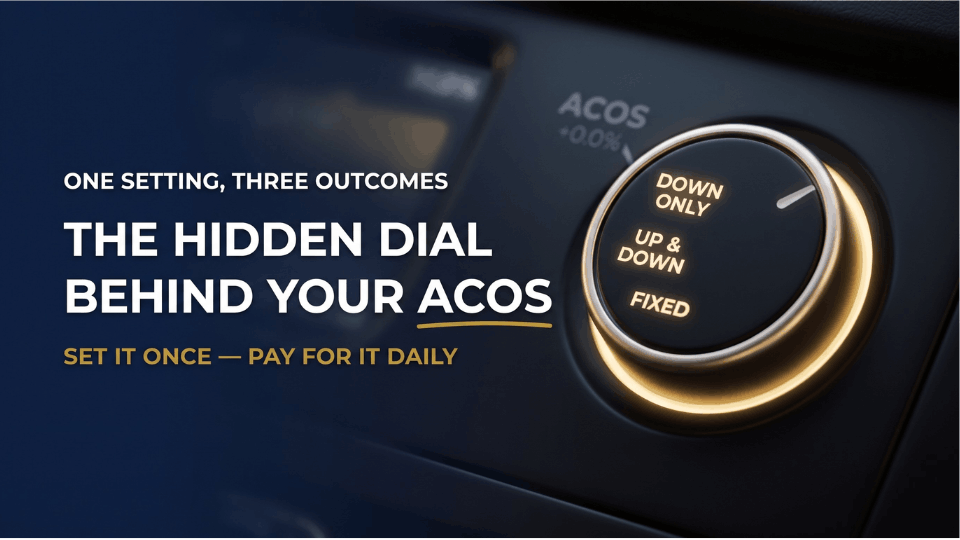
The Three Amazon PPC Bid Strategies, Explained Simply
Before you can choose, you need to understand what each setting actually gives Amazon permission to do. Your keyword bid is only the starting point — the bidding strategy tells Amazon whether it can move that number up, down, or not at all in the live auction. That is why two campaigns with identical bids can behave like completely different animals.
How dynamic bidding on Amazon actually works
Every time your ad is eligible to show, Amazon estimates how likely that particular click is to end in a sale. Dynamic bidding Amazon uses those real-time signals to adjust your bid up or down in the split second before the auction closes. A shopper searching an exact, high-intent term looks valuable, so Amazon may bid harder. A vague, browse-y search looks risky, so it may pull back. You are essentially handing the algorithm a steering wheel — the only question is how much of the wheel.
Down only, up & down, fixed — what each one lets Amazon do
Down only lets Amazon reduce your bid when a click looks unlikely to convert, but never raise it above what you set. Up and down works both ways — it can lift your bid by up to 100% at top of search and up to 50% on other placements, and lower it on weak opportunities. Fixed applies your exact bid every time, no automated adjustment. Farhan Qureshi from Hyderabad only understood this after his up-and-down campaign quietly doubled a ₹22 bid to ₹44 on a term that never converted.
Dynamic Bids Down Only vs Up and Down: The Real Difference
Here is the comparison that trips up the most sellers, because the marketing sounds so appealing. Up and down promises more sales, and technically it delivers them. The catch is what those extra sales cost you. The honest way to settle dynamic bids down only vs up and down is to look at the data, not the sales pitch.
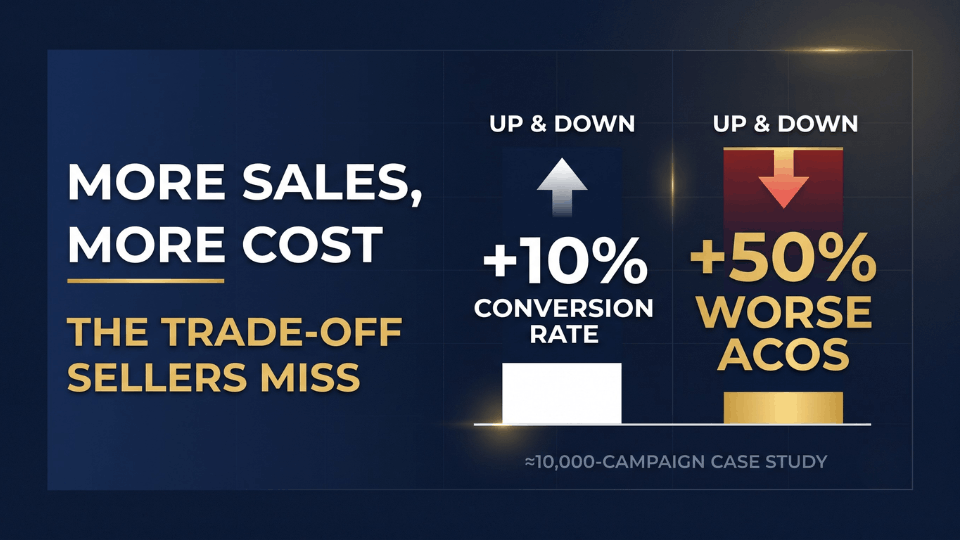
The clearest evidence comes from a large case study that analysed roughly 10,000 campaigns head-to-head. Up and down produced a conversion rate about 10% higher than down only — a real, measurable lift. But ACOS came in roughly 50% worse. Read that again, because it is the whole game: you get a little more conversion and a lot more cost. More sales are not automatically good sales if the price of winning them erases your margin.
The reason is simple once you see it. When you switch on up and down, you give Amazon permission to spend more aggressively whenever it thinks a click will convert. But Amazon’s incentives and yours are not identical — Amazon benefits from more ad spend, while you need profitable growth. So yes, dynamic bids up and down can increase ACOS, and on most campaigns it does. Sneha Pillai from Kochi learned this when her up-and-down campaign lifted sales 12% but pushed ACOS from 28% to 44% in a single month — a trade she immediately reversed.
When Amazon Fixed Bids Actually Make Sense
If down only is the sensible default and up and down is the risky one, where do Amazon fixed bids fit? Fixed is the manual override — you strip out Amazon’s real-time adjustments entirely and your bid is your bid. That sounds limiting, and for everyday profit campaigns it usually is. But there are three specific moments where taking the algorithm out of the equation is exactly what you want.
The first is brand defence. When you bid on your own brand name, conversion is already high and predictable, and you do not want Amazon quietly shrinking your visibility because it decided a click looked “inefficient.” Fixed keeps you dominant on the terms you must own. The second is clean testing — if you are running a placement test or a bid-threshold test, fixed removes the algorithm as a variable so your data actually means something. The third is forcing visibility when down only is being too timid and simply isn’t spending.
Ritwik Sen from Kolkata used fixed bids to defend his brand name during a competitor’s aggressive campaign, holding top-of-search while rivals tried to poach his buyers. He kept it fixed precisely because he wanted spend he could predict to the rupee.
If you want the full walkthrough on how these settings sit inside a well-built campaign, our guide on the only 3 PPC campaigns you need shows exactly how bids, ad groups, and targeting fit together — worth a read before you start testing strategies at scale.
The Best Amazon Bidding Strategy for a New Product Launch
Ask ten sellers the best Amazon bidding strategy and most will say “down only, always.” They are usually right — except at launch, where that reflex quietly kills momentum. This is the single most useful exception to know, and it answers a question almost every new seller eventually asks.
The down-only trap for zero-history products
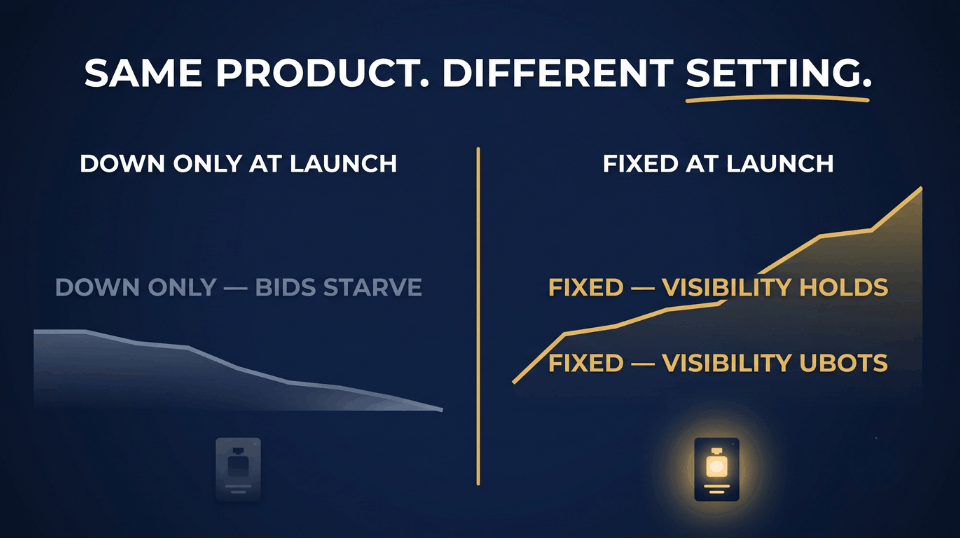
When you launch a brand-new product, Amazon has nothing to work with — no reviews, no conversion history, no proof shoppers will buy. So its algorithm assumes the worst and quietly decides your clicks are unlikely to convert. If you are on down only, Amazon responds by lowering your bids in the background, again and again. You set up clean campaigns, choose good keywords, launch with excitement, and then… almost nothing happens. The campaign is starving itself, and you cannot see it happening.
Why fixed bids are the smarter launch override
This is exactly where the right Amazon bidding strategy for new product launches is fixed bids. Fixed stops Amazon from being cautious — your bid holds firm, your ad actually shows, and you finally start gathering the conversion data the algorithm was waiting for. Meghna Agarwal from Jaipur relaunched a stalled kitchenware listing on fixed bids after three dead weeks on down only. Within ten days she had impressions, her first reviews, and enough data to switch strategies with confidence.
Which Bid Strategy Wins? A Decision Framework by Goal & Stage
So which one actually wins? The honest answer is that none of them wins universally — each wins a specific job, and the sellers with the strongest PPC are the ones matching the lever to the moment. Here is the framework worth memorising.
At the launch stage, use fixed bids to force visibility while your product has no history, or down only if you would rather protect budget and grow slowly. Once you are in the profit stage and want steady, efficient sales, down only is your long-term default — it is the setting that protects margin and trims wasted spend. And once a campaign is genuinely mature — crossed roughly 60 days of history and running at or below your target ACOS — that is the only time up and down earns a test, because now Amazon has real data to bid on.
There is one trap that quietly torches budgets here. Placement modifiers are applied before dynamic up and down, and the two compound. A ₹18 bid with a 900% top-of-search modifier and up-and-down enabled can theoretically balloon into a runaway click cost you never intended. Always calculate your worst-case bid before switching both on together. Aditya Rao from Vijayawada found this out when a stacked setup turned a ₹20 bid into a ₹120 click during a busy sale weekend.
Once you have your strategy set, the next lever is timing and consistency — our guide on scaling your Amazon PPC profitably shows how to review and adjust bids so your chosen strategy stays sharp week after week.

The Mistakes That Sabotage Your Bid-Strategy Tests
Even sellers who understand the three strategies often ruin their own tests, then draw the wrong conclusion. If you are going to compare strategies, do it in a way that produces trustworthy data.
The biggest mistake is running two campaigns on the same keywords to “compare” strategies side by side. All you achieve is two campaigns bidding against each other in the same auction, inflating your own costs. The second trap is comparing an old down-only campaign against a freshly created up-and-down one — the old campaign has months of data and will win regardless of strategy, so the test proves nothing. The clean method is to take one campaign, run it on your current strategy for a fixed two-week window, then switch the setting and measure the next two weeks against the first. Track the right numbers while you do it — our breakdown of key metrics to monitor in Seller Central keeps you focused on the figures that actually signal profit.
Divya Krishnan from Nagpur wasted a month convinced fixed bids beat down only, until she realised she’d been comparing a seasoned campaign to a brand-new one. Once she ran a proper two-week switch test on the same campaign, down only won comfortably — and she stopped overpaying overnight. Give any strategy change 7 to 14 days before you trust the numbers; Amazon needs time to settle.
Frequently Asked Questions
What is the best Amazon bidding strategy?
For most campaigns, dynamic bids down only is the best long-term default — it protects margin by lowering bids on weak clicks while never overpaying above what you set. It isn’t universal, though. Fixed bids win at launch and for brand defence, and up and down suits mature campaigns already hitting target ACOS. Match the strategy to your goal, not to a one-size rule.
What’s the difference between dynamic bids down only and up and down?
Down only lets Amazon lower your bid when a click looks unlikely to convert, but never raise it. Up and down does both — it can lift your bid up to 100% at top of search and 50% elsewhere, and lower it on weak opportunities. Down only protects ACOS; up and down chases more conversions at a higher, often unprofitable, cost.
Which bidding strategy is best for a new product launch?
Fixed bids usually win at launch. New products have no conversion history, so down only makes Amazon assume clicks won’t convert and it quietly starves your bids. Fixed holds your bid firm, keeps your ad visible, and lets you gather the early data and reviews you need. Once the product has traction, you can switch to down only for efficiency.
Does dynamic up and down increase ACOS?
Usually, yes. Case-study data across thousands of campaigns showed up and down lifting conversion rate by around 10% but worsening ACOS by roughly 50%. You are giving Amazon permission to spend harder on clicks it predicts will convert, and those predictions cost you. Only run it on proven campaigns that can absorb the extra spend profitably.
When should you use fixed bids on Amazon?
Use fixed bids in three situations: defending branded keywords where you must stay visible, running clean placement or bid tests where you need the algorithm out of the way, and launching new products where down only would suppress your bids. Fixed gives you predictable, controllable spend — the trade-off is that Amazon won’t help you respond to conversion signals automatically.
Can I change my bid strategy mid-campaign without losing data?
Yes. Changing the bidding strategy on an existing campaign keeps its sales history intact. The mistake is copying a campaign to test a new strategy — copies don’t carry sales history, so the comparison is meaningless. Change the setting on the same campaign and give it 7 to 14 days to settle before judging results.
Does the bid strategy setting apply to Sponsored Brands and Sponsored Display too?
Not identically. The three-way choice of down only, up and down, and fixed is a Sponsored Products setting. Sponsored Brands typically offers fixed and up-and-down options, while Sponsored Display uses different bidding controls tied to its targeting type. Learn the logic on Sponsored Products first, then adapt it to the other formats.
How do I calculate a good starting bid before choosing a strategy?
A reliable starting point is your average order value multiplied by your conversion rate and your target ACOS. That grounds your bid in your actual economics rather than guesswork. From there, the bidding strategy decides how much Amazon can move that number — so set a sensible base bid first, then choose the strategy that fits your goal.
Conclusion
There is no single champion among Amazon’s bidding strategies, and any guide that names one is selling you a shortcut that doesn’t exist. Down only wins the long game as your efficient, margin-protecting default. Fixed bids win the moments that need a firm hand — launches and brand defence. Up and down wins only for proven, mature campaigns ready to scale spend with their eyes open. The seller who quietly beats the competition isn’t the one chasing a magic setting; it’s the one who matches the right lever to the right goal at the right stage.
If you want to stop guessing and build this kind of judgement across your whole Amazon business, our 3-Day Amazon Business Training walks you through PPC, listings, and profit strategy step by step. Come learn the system, and start making every rupee of ad spend work harder.
