
Farhan Qureshi from Lucknow spent three weeks collecting quotes for leather card holders. He had 23 numbers saved on WhatsApp and prices swinging from ₹140 to ₹380, and he still couldn’t tell who owned a stitching machine. A friend finally told him to stop searching online and take a train to Kolkata. In two days he met nine workshops, held real samples, and learned that most of his “manufacturers” bought from the people now sitting across from him.
That is what manufacturing clusters in India do for a seller. Almost every product you might sell on Amazon has a home town, where the raw material, the craftsmen, the trims and the packaging sit within a few kilometres of each other. Our IndiaMART sourcing guide showed you how to search. This one shows you where to look: a city-by-city map for leather, brass and textiles, what to check when you visit, and how to get cluster stock into an Amazon fulfilment centre, the way we do for Fashion Freak, our own accessories brand on Amazon.in.
Where to Source Products in India? Follow the Clusters
If you have ever wondered where to source products in India without paying three layers of margin, the answer is rarely a website. It is usually a town.
What is a manufacturing cluster?
A cluster is a town where one product’s whole supply chain sits side by side. In Tiruppur, the knitting unit, dyeing house, printer and carton maker might share a street, which keeps costs low. The government tracks manufacturing clusters in India too: the DGFT’s Towns of Export Excellence list names Tirupur for hosiery, Kanpur and Ambur for leather, and Jaipur for handicrafts.
Why cluster makers beat online trader quotes
Many “manufacturer” listings are traders who pass your order to a workshop and add their cut. At the cluster, you sit across from the person who runs the machines and see their capacity and quality yourself. Tanvir Ahmed from Hyderabad cut his landed cost on copper bottles from ₹410 to ₹318 after one Moradabad visit, simply by dropping a middleman.
Clusters or wholesale markets: which do you need?
Wholesale markets in India, like Sadar Bazaar in Delhi, sell ready stock in small quantities. Any other seller can buy the same item, so you end up in a price war on one listing. Clusters make your own design under your own brand, with a minimum order quantity. For private label on FBA, the cluster is where you belong.
Leather Clusters in India: Match the City to the Product
Leather is where most new sellers pick the wrong city. Each leather cluster specialises, so the right one means the first workshop you visit already makes your product.
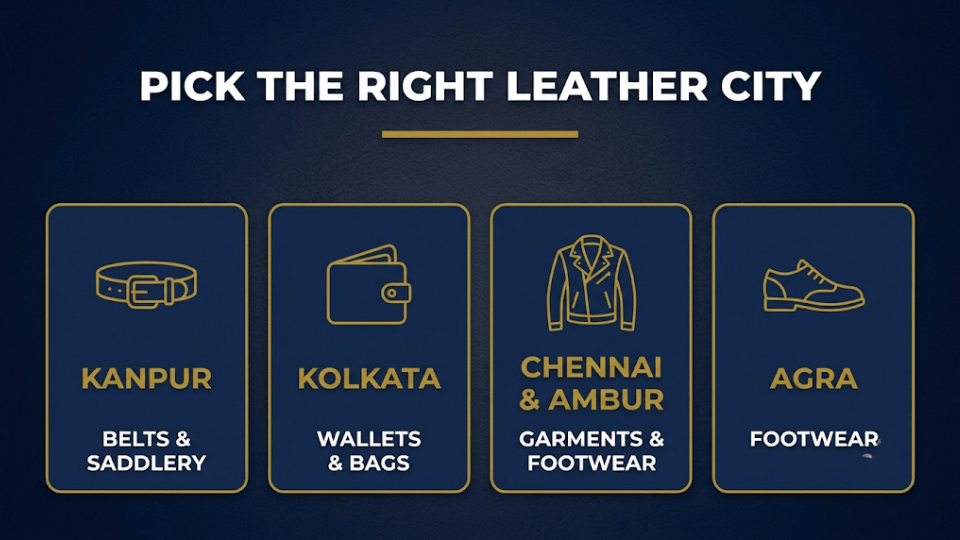
Kanpur: belts, saddlery and heavy leather
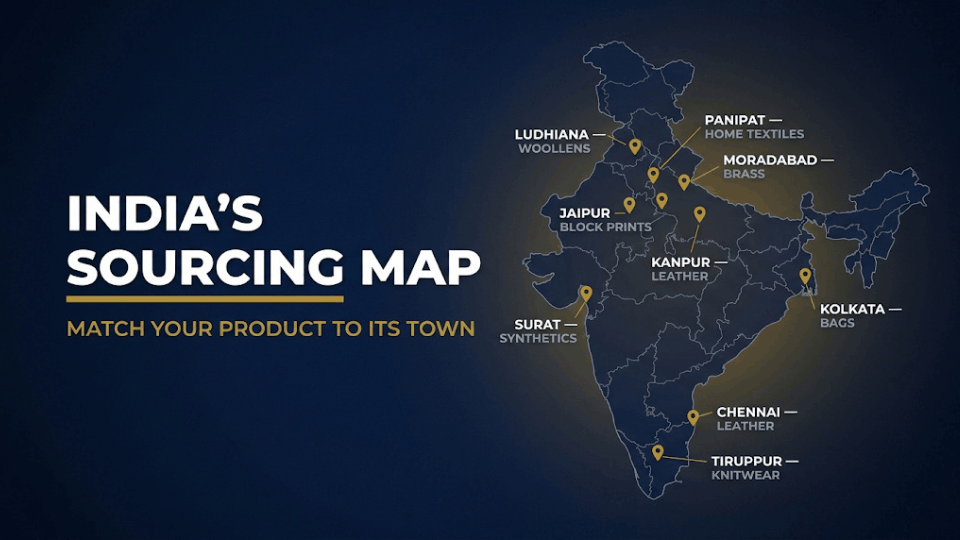
Kanpur answers the quiz question “which city is the leather city of India?” It works mostly with buffalo hides, and its two big clusters, Jajmau and Unnao, supply harness, saddlery, safety boots and finished leather. That makes it strong for belts, riding gear and sturdy bags, and weaker for slim, soft wallets. Gurpreet Sandhu from Amritsar moved his full-grain belts from a Delhi wholesaler to a Kanpur workshop last March. His cost per belt fell from ₹340 to ₹265, and the leather got thicker.
Kolkata: India’s hub for wallets and bags
For wallets, card holders, laptop bags and slings, visit Kolkata first. West Bengal has more than 500 tanneries and over 3,000 leather goods makers, and industry leaders say it drives about half of India’s leather goods exports. Many units sit around the Kolkata Leather Complex at Bantala and the older Topsia cluster, and the Kolkata leather wholesale market lanes show you finished styles fast.
Chennai, Ambur and Agra: footwear and garments
Chennai is India’s main hub for leather garments, and the Ambur, Vaniyambadi and Ranipet belt is built around footwear and finished leather. Search for leather manufacturers in Chennai and jacket and shoe specialists come up first. Up north, Agra is India’s largest footwear cluster. Wherever you buy, ask for a silica gel sachet and a polybag with every unit, because leather can grow mould in a humid warehouse.
Moradabad Brass: Sourcing From India’s Pital Nagri
If you sell home décor, puja items or kitchenware, Moradabad belongs on your list. It sits a few hours from Delhi and holds thousands of metal workshops.
What Moradabad makes best
Known as Pital Nagri, the brass city of India, Moradabad makes bells, lamps, incense holders, door handles, planters, bowls and figurines. Many workshops now also work in copper, aluminium and iron, which is why so many copper bottles on Amazon trace back here.
Solid brass or plated? Check before you order
Two lamps can look identical on a sample table and differ completely underneath. Ask in writing whether the item is solid brass or plated, weigh your samples, and ask which anti-tarnish coating they use. Divya Menon from Kochi skipped this on 600 diyas and received lighter, plated pieces. Her return rate hit 14% before she reordered with a written spec.
Packing metalware so it survives FBA
Brass dents easily, and a damaged lamp becomes a return and a one-star review. Ask for an inner box per unit, not just a polybag, and drop-test a sealed carton before approving the batch. Amazon can refuse or repackage stock that arrives in poor packaging.
Before you book a train to any cluster, make sure the product deserves the trip. Run the idea through 1smart.link’s Product Research to check demand and competition on Amazon.in first.
Tiruppur Knitwear and Other Textile Hubs in India
Textiles are India’s deepest sourcing pool, and the right hub depends on the fabric.
Why Tiruppur is India’s knitwear capital
Tiruppur, near Coimbatore, has about 10,000 garment units and accounts for roughly 90% of India’s knitwear exports. That scale is why most Tiruppur t-shirt manufacturers handle fabric, printing and packing under one roof. The bigger news for Amazon.in sellers is the shift home: almost every major Indian brand has a sourcing office there, and many exporters are now chasing domestic orders.
What to ask a Tiruppur factory first
Ask about fabric weight (GSM) and fabric type, and request a full size set as samples. Get a shrinkage test after washing, because sizing complaints sink apparel listings fast. Then ask for the MOQ per colour, since every size and colour on Amazon is its own FNSKU. Meenakshi Iyer from Coimbatore launched with three colours instead of eight and sold through her first 900 tees in seven weeks.
Surat, Ludhiana, Panipat and Jaipur at a glance
Surat runs on synthetic fabrics, sarees and dress material, while Ludhiana leads in woollens and acrylic knitwear for winter wear. Panipat specialises in home textiles like bedsheets, towels and rugs, and Jaipur in block prints and ethnic wear. Ask which state is famous for textiles and the honest answer is three: Tamil Nadu, Gujarat and Maharashtra, home to power-loom towns like Bhiwandi.
Other Manufacturing Clusters in India Worth Knowing
Leather, brass and textiles are only the start.
Glass, ceramics and wood: Firozabad, Khurja, Saharanpur
Firozabad, near Agra, is the centre of India’s glass industry, known for bangles and glassware. Khurja makes ceramic pottery, and Saharanpur makes almost anything wooden, from gift boxes to furniture. All three are within a day’s drive of Delhi.
Locks, toys and sports goods
Aligarh is India’s lock city, making locks and builder hardware. Channapatna, near Bengaluru, is famous for lacquered wooden toys, and Meerut and Jalandhar lead in sports goods.
How to find manufacturing hubs in India for any product
For anything else, these public sources point you to the right town:
- The DGFT Towns of Export Excellence list names towns by product category.
- Uttar Pradesh’s One District One Product (ODOP) list maps a speciality to every district.
- State MSME cluster lists show where small makers in one trade are concentrated.
- IndiaMART’s city filter shows which town most manufacturers of your product list from.
When two of these name the same town, you have found your cluster.
How to Visit Manufacturing Clusters in India
A cluster trip works best with appointments, not hope.
Shortlist factories before you travel
Filter IndiaMART by your cluster city and check whether each profile’s GST nature of business says manufacturer or trader. Ask your shortlist for a WhatsApp video of their floor. With six to eight confirmed appointments, two days is enough.
What to check on the factory floor
Look for machines they own, not just a showroom. Ask who does quality checks, which brands they supply, and whether work goes out to job workers. Carry the best-selling competitor product from your category and ask them to price it. Their reaction shows whether they make it every day.
Negotiating MOQ for your first FBA batch
You can bring an MOQ down by using materials and colours the factory already stocks, accepting a slightly higher unit price on the first batch, and cutting colours. Vikram Rathore from Jodhpur got a Panipat towel maker down from 1,000 to 400 units per design this way, with a promise of a repeat order in 60 days.
After the visit, put your FBA needs in writing. Copy and adapt this message:
“Please quote for [quantity] units of , one per polybag with a silica gel sachet, MRP label and our FNSKU barcode applied, in cartons within Amazon’s size and weight limits. Please raise the GST invoice in our company name.”
Getting Cluster Stock Ready for Amazon FBA
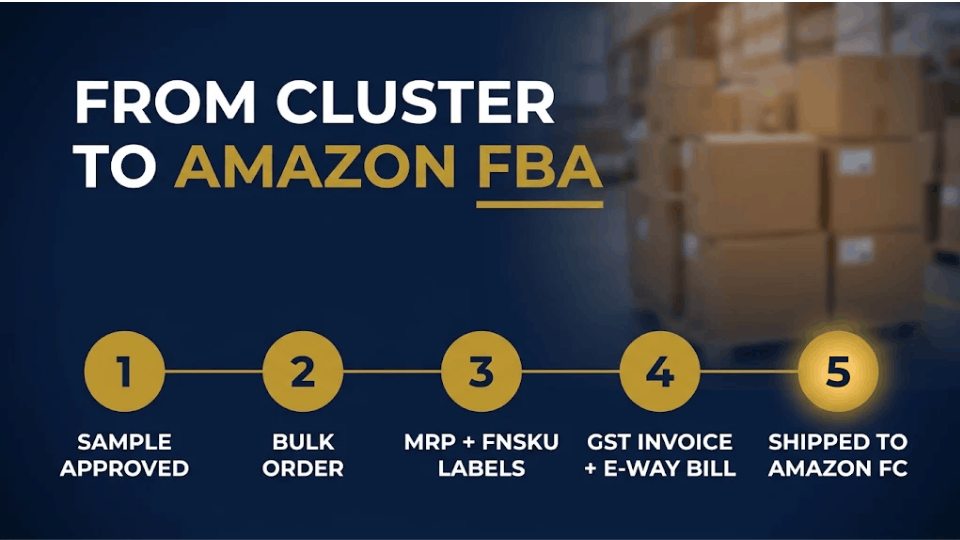
Stock that reaches an Amazon fulfilment centre without the right labels gets delayed, repackaged or sent back, so build these steps into the order.
MRP and Legal Metrology labels
Every retail pack sold in India must carry the Legal Metrology declarations: manufacturer or packer name and address, net quantity, month and year of manufacture or packing, MRP inclusive of all taxes, consumer care details and country of origin. The same details must appear on your Amazon listing. Decide who prints the label, and if you are the packer, your details go on it. The rules were amended in 2025, so check the current version before printing.
FNSKU labels, polybags and carton rules
Each size and colour needs its own FNSKU, placed where it scans without opening the pack, and cartons must follow Amazon.in’s inbound guidelines. Labelling at the factory is cheapest. At Fashion Freak, our accessories brand, we send the barcode and Transparency labels to the supplier with the order, then build each Send to Amazon shipment straight from the supplier’s invoice so quantities match to the unit.
GST invoices and freight to the fulfilment centre
Always buy on a GST invoice billed to your GSTIN, so you can claim input tax credit. Inter-state consignments above ₹50,000 also need an e-way bill. Amazon’s FBA Inbound Pickup Service can collect straight from a manufacturer, but inspect a new supplier’s first batch yourself before you ship direct.
Frequently Asked Questions
Which city is known as the leather city of India?
Kanpur in Uttar Pradesh is called the leather city of India, thanks to its tanneries and history in saddlery and heavy leather. Ambur in Tamil Nadu is often called the leather city of South India. For sellers, speciality matters more than nickname: Kanpur for belts and rugged goods, Kolkata for wallets and bags.
Which city is called the brass city of India?
Moradabad in Uttar Pradesh, known locally as Pital Nagri. It makes brass lamps, bells, puja items, planters and décor, and many units now also work in copper, aluminium and iron. It is a few hours from Delhi, so you can pair a visit with Delhi’s wholesale markets.
Why is Tiruppur called the knitwear capital of India?
Tiruppur has thousands of units handling knitting, dyeing, printing and stitching close together, and it accounts for roughly 90% of India’s knitwear exports. Many units now take domestic and private label orders too, which makes it the natural first stop for t-shirts, innerwear and kidswear.
Which state is famous for the textile industry in India?
Tamil Nadu, Gujarat and Maharashtra lead. Tamil Nadu has Tiruppur and Coimbatore for knitwear and cotton, Gujarat has Surat and Ahmedabad for synthetics and denim, and Maharashtra has power-loom towns like Bhiwandi and Ichalkaranji. Punjab’s Ludhiana and Haryana’s Panipat matter too.
Should I buy from cluster manufacturers or wholesale markets?
For private label on Amazon, buy from cluster manufacturers. Wholesale markets help you test demand with small quantities of ready stock, but you get no branding and share the product with other sellers. Many sellers test with wholesale stock, then move to a cluster factory once the product sells.
Which city is best for leather wallets and bags?
Kolkata. West Bengal has thousands of leather goods makers and drives about half of India’s leather goods exports, so many workshops already make wallets, card holders, slings and laptop bags. Chennai and Kanpur make bags too, but their strengths lie in garments, footwear and heavy leather.
What MOQ should I expect on my first order from a cluster factory?
It varies by product and factory, and small workshops are usually more flexible than large exporters. Knitwear and home-textile units often quote per colour, so ask for the MOQ per variant. Stock materials, fewer colours and a slightly higher first-batch price all help bring it down.
Can my supplier ship directly to an Amazon fulfilment centre?
Yes, if the units are labelled and packed to Amazon.in’s FBA rules and travel with a GST invoice. You create the shipment in Seller Central, and Amazon’s FBA Inbound Pickup Service can collect from the manufacturer. Inspect a new supplier’s first batch yourself before switching to direct shipments.
Conclusion
Searching online tells you who makes a product. Clusters tell you where, and knowing where turns a guess into a supply chain. Match your product to its town: Kolkata for wallets and bags, Kanpur for heavy leather, Moradabad for brass, Tiruppur for knitwear and Panipat for home textiles. Manufacturing clusters in India reward sellers who arrive prepared, so shortlist from home, walk the floor, get the spec and labels in writing, and send stock that Amazon receives on the first try.
If you want help picking the right product before you pick the right town, join our 3-Day Amazon Business Training. We walk you through product selection, sourcing and launching on Amazon.in step by step, so your first cluster trip ends with a product worth selling. Your margins will thank you.