

Last August, Sameer Qureshi from Indore opened a letter he hadn’t seen coming. It came from his state’s Legal Metrology office, about the stainless-steel lunch boxes he’d sold through FBA for five months. The boxes carried his logo and a proud “Made in India” line. They didn’t carry an MRP, a consumer care number or the address of the Rajkot factory that made them, and his Amazon listing was missing the same details.
Sameer had treated his FNSKU sticker as the last label that mattered. The FNSKU tells Amazon what a unit is. Legal Metrology labelling requirements tell the customer, and any inspector, who made it, how much is inside and what it should cost.
Getting this wrong rarely shuts an account overnight. It shows up as a notice, a relabelling job on units already in Amazon’s warehouses, and a listing to fix against a deadline. If you’ve read our guide to FNSKU, GS1 and barcodes, think of this as the next layer. You’ll see what your pack must print, what your listing must repeat, and what changed in 2026.
Why FBA Sellers Can’t Leave Labelling to Amazon
FBA takes storage and delivery off your plate, but not your labelling obligations.
Amazon Ships Your Pack Exactly as It Arrives
Under FBA, your unit is picked, boxed and shipped as it is. Nobody in that chain adds an MRP or corrects your net quantity. Amazon’s FBA India prep manual even points to the Legal Metrology Act, 2009 and the Packaged Commodities Rules, 2011 as the law governing MRP labels. The pack you print is what your customer and any inspector will hold.
The Liability Stays With You, Not the Marketplace
A marketplace that does its due diligence and doesn’t alter what sellers supply isn’t held accountable for the accuracy of those declarations. That leaves the responsibility with the manufacturer, packer, importer or seller. The government has tested this before: in 2020, Amazon was penalised over listings missing details like country of origin, and it admitted sellers hadn’t provided them.
Kavya Menon from Kochi assumed FBA prep covered “labels”, until a one-star review quoted her missing customer care number back at her.
Legal Metrology Compliance for E-commerce Has Two Sides
Rule 6(10) of the Packaged Commodities Rules requires e-commerce platforms to display the same mandatory declarations that appear on your pack. You supply them, so you’re maintaining two surfaces with one set of facts: the physical pack and the Amazon listing.

Legal Metrology Labelling Requirements: The Core List
Legal Metrology labelling requirements come mainly from Rule 6 of the Packaged Commodities Rules, 2011, and cover almost every retail pack you’ll send into FBA.
Mandatory Declarations on Packaged Goods, One by One
Here’s what a standard retail pack has to show:
- The manufacturer’s name and full address, plus the packer’s if different.
- For imported goods, the importer’s name and address, plus the country of origin.
- The common or generic name of the product.
- The net quantity, plus dimensions where size matters.
- The month and year of manufacture, plus a best-before date for perishables.
- The MRP inclusive of all taxes, along with the unit sale price.
- Consumer care details for complaints.
Keep the name and address, net quantity and MRP on the principal display panel, the face a shopper sees first.
Why a Brand Name Isn’t a Generic Name
A brand name doesn’t tell anyone what the product is. Ritika Bansal from Ludhiana’s herbal tea pouch said only “Ritu’s Morning Calm”. Adding “Herbal Infusion” fixed the label and gave her the right value for Amazon’s item type field in one edit.
What’s Exempt in 2026 (and What Isn’t)
Packs of 10 g or 10 ml or less are exempt, except tobacco and, since 1 February 2026, pan masala. Medical devices now follow the Medical Devices Rules, 2017 for label font and dimensions. And since 21 September 2026, the veg/non-veg dot is no longer mandatory on soaps, shampoos, toothpaste and cosmetics. Everything else gets the full list.
MRP Label Requirements in India, Done Right
MRP is the declaration sellers most often get half right.
The Legal Metrology Label Format for MRP
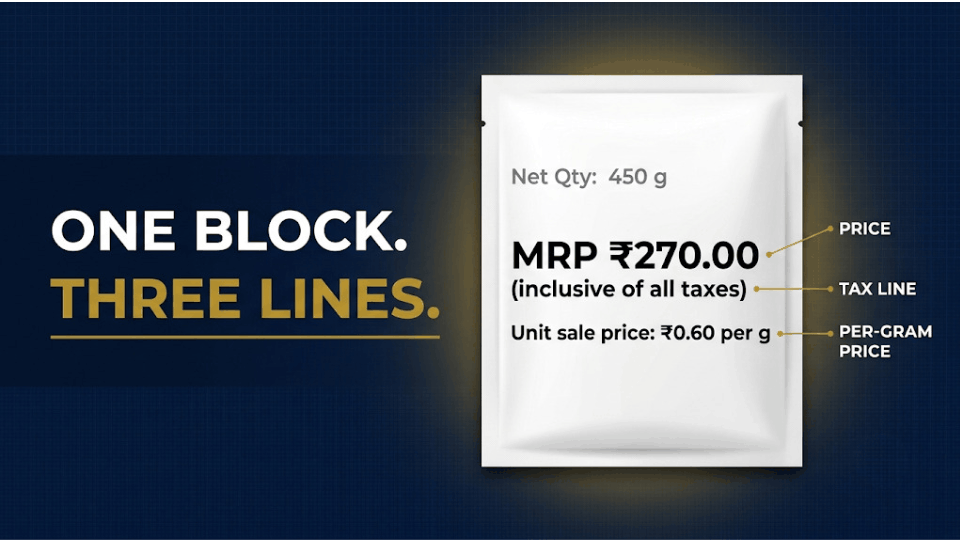
The rules want the price written as a maximum retail price in rupees, followed by “inclusive of all taxes”, for example “MRP ₹499.00 (inclusive of all taxes)”. The figure is rounded to the nearest rupee or 50 paise. A bare “₹499” doesn’t meet the format.
Unit Sale Price: The Line Most Sellers Miss
The unit sale price sits beside the MRP: per gram under 1 kg and per kilogram from 1 kg up, with the same logic for millilitres and litres, centimetres and metres, or per unit. A 450 g pack of masala with an MRP of ₹270 would show ₹0.60 per g. Skip it only when the MRP and unit sale price are the same, as with a single item sold by number.
Nikhil Joshi from Nagpur printed 4,000 cartons for his peanut chikki with a clean “₹180” and nothing else. A consultant caught it two days before inbound, and reprinting cost about ₹9,000, far less than pulling units back from a fulfilment centre.
Can You Sell Above MRP or Print Two MRPs?
No on both counts. Rule 18(2) bars anyone, sellers included, from selling above MRP, so your Seller Central price must never exceed the printed figure. Dual MRPs on identical products are banned as well. And you can’t sticker a new MRP over the old one, except to show a reduced price without covering the original.
Before your next print run, grab our pack artwork checklist, a one-page sheet you can hand your designer so nothing gets missed.
Net Quantity, Manufacturer and Consumer Care
These three tell a buyer what’s in the box and who stands behind it.
Net Quantity Declaration in Standard Units
Net quantity goes in SI units such as grams, millilitres and metres, or by number. Give one figure, not a range like “450–500 g”, and keep the weight of the packaging out of it. For multi-packs, state the count and the quantity of each, such as “3 x 200 ml”. If size is what the buyer pays for, as with bedsheets, declare dimensions too.
Whose Name Goes on a White-Label Pack?
Plenty of FBA brands outsource manufacturing. The label must still name the actual manufacturer and address, with your details added for your role. If you buy in bulk and pack it yourself, you become the packer, which means checking the packer registration requirements with your state’s Legal Metrology department.
Farhan Sheikh from Hyderabad sources glass bottles from a factory in Rajkot, and his first labels showed only his brand. Adding “Manufactured by” with the factory’s address and “Marketed by” with his own fixed it in one revision.
Consumer Care Details That Actually Work
The rules ask for the name, address, phone number and, where you have one, the email address of the person or office that handles complaints. Use a number someone answers, matching your listing. A dead line turns one unhappy customer into a bad review, or a complaint to the state department.
Importer Details on Label: Rules for Imported Goods
If you import finished products for FBA, you carry the heaviest labelling load, and 2026 made the timing stricter.
Importer Name, Address and Country of Origin
An imported pack must show your name and address as the Indian importer, plus the country of origin written plainly, such as “Country of Origin: China”. The overseas factory’s address on its own isn’t enough. The rest of the core list still applies.
Port, Bonded Warehouse or Your Godown?
Importers may use an affixed label instead of reprinting the box, but where you affix it now matters. An 8 October 2026 advisory says declarations must be on before goods clear customs for home consumption. Unless you hold AEO Tier-2 or Tier-3 status, that means a customs bonded warehouse or your own licensed bonded warehouse, not your godown after clearance.
Aarti Deshmukh from Pune imports silicone kitchen tools from Yiwu. She now has the factory print her importer block and MRP on the box before it ships, and her last two containers cleared with zero relabelling.
Do You Need LMPC Registration?
Importers, manufacturers and packers of pre-packaged goods generally need Rule 27 registration with Legal Metrology. Reselling packs that are already compliant doesn’t automatically require it. The 2026 changes added three things: companies must name a director responsible for violations, update their details online every year, and certificates now stay valid until cancelled.
Legal Metrology for Amazon Sellers: The Listing Side
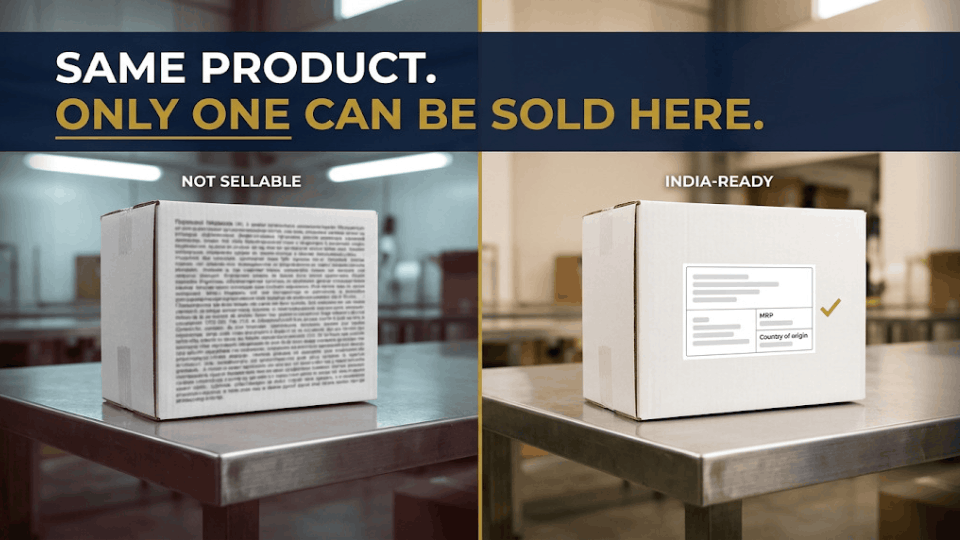
Your listing has to carry the same declarations as your pack, apart from the month and year of manufacture.
The Seller Central Fields That Carry Declarations
These Seller Central fields do the legal work:
- Item Type Name holds the generic name, such as “Petroleum Jelly” rather than the brand.
- Manufacturer and Manufacturer Contact Information hold the maker’s name, address and phone number.
- Packer Contact Information applies when someone else packed it.
- Importer Contact Information and Country of Origin cover anything made outside India.
- Unit Count and the quantity fields must match the net quantity printed on the pack.
- The MRP field must match the printed MRP to the paisa.
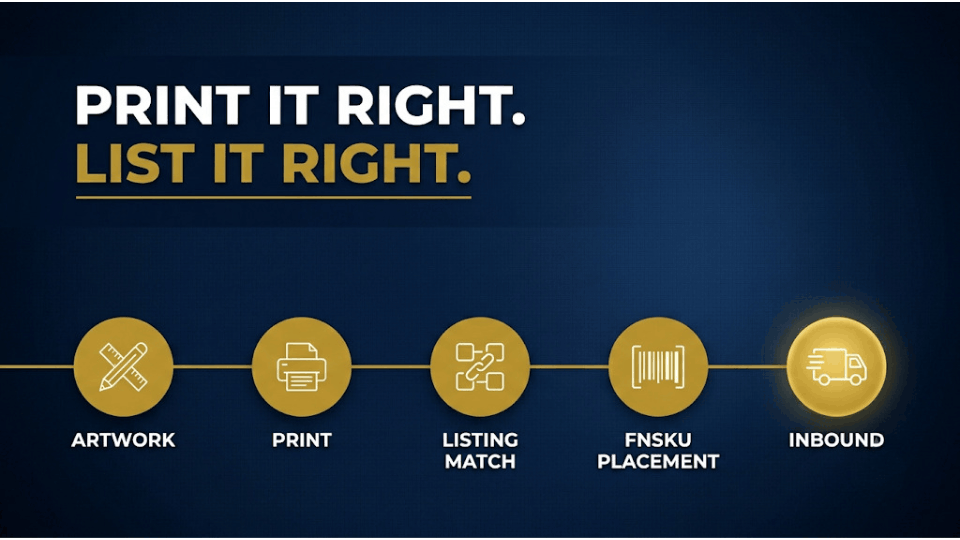
Fill them from your final artwork, and update them whenever the pack changes.
Country of Origin on Your Amazon Listing
Amazon India made country of origin mandatory on all listings in 2020, with importer details for foreign products. From 1 July 2027, platforms must also let shoppers search and sort imported products by country of origin. Amazon builds the filter, but your attribute is what feeds it.
The Pack-to-Listing Match Test
Net quantity has to agree across the title, the bullets and the backend attribute, not just the box. Pooja Iyer from Chennai cut her coffee pack from 500 g to 450 g to hold her price, then left “500 g” in her title for two months. A buyer complained, and the fix took three edits.
Our listing attribute template makes this painless by mapping each pack declaration to its Seller Central field.
Your Legal Metrology Labelling Checklist for FBA
Run these checks before every inbound shipment.
Lock the Artwork Before It Goes to Print
Declarations go in Hindi or English, and they must be legible and prominent. Keep the key ones on the principal display panel, and check the minimum font sizes, which scale with the size of that panel. Then sign off the artwork and listing together.
Where the FNSKU Sticker Can’t Go
Your FNSKU must never cover the MRP block or any other declaration, so leave clear space for it on the artwork. Combos need extra care: the outer box needs its own declarations, even when every item inside is compliant.
Sneha Kulkarni from Nashik learned this with a three-jar pickle combo whose FNSKU sat right over the MRP. An improvement notice gave her time to pull back and relabel 600 units before any penalty applied.
What Happens If an Inspector Finds a Gap
Since 1 May 2026, a first-time lapse under Section 36(1) starts with an improvement notice and time to fix it. A second offence can cost up to ₹5 lakh, and repeat offences ₹25 lakh to ₹50 lakh. Treat the notice as your one warning, not a free pass.
Frequently Asked Questions
What declarations are mandatory on packaged goods?
Under Rule 6, Legal Metrology labelling requirements cover the manufacturer, packer or importer’s name and address, country of origin for imports, the generic name, net quantity, month and year of manufacture, MRP inclusive of all taxes, unit sale price and consumer care details. Perishables also need a best-before or use-by date.
Do Amazon sellers need LMPC registration?
It depends on your role, not on selling through Amazon. If you import, manufacture or pack pre-packaged goods, you generally need Rule 27 registration. If you resell packs that are already fully compliant, you usually don’t. If unsure, ask your state Legal Metrology department first.
What declarations must appear on an Amazon product listing?
Your listing must repeat the declarations on your pack, except the month and year of manufacture. In practice that means the generic name, manufacturer, packer or importer details, country of origin, net quantity, MRP and consumer care information, each in its Seller Central field.
Is MRP mandatory for products sold online?
Yes. Since January 2018, products sold through e-commerce must carry the MRP on the pack and show it on the listing. The MRP must include all taxes, and you can’t sell above it on Amazon or anywhere else.
What is the penalty for violating Legal Metrology rules?
Since 1 May 2026, a first-time declaration lapse under Section 36(1) brings an improvement notice and time to correct it. A second offence can draw a penalty of up to ₹5 lakh, and later offences ₹25 lakh to ₹50 lakh. Short-weight errors fall under a separate, stricter provision.
Can I put MRP or importer details on a sticker?
Not the MRP, as a rule. The one exception is a sticker showing a reduced MRP that doesn’t hide the original. Importers may affix a label carrying the Indian declarations, but it must go on before customs clearance, at a bonded warehouse unless they hold AEO Tier-2 or Tier-3 status.
Is unit sale price mandatory on every pack?
On almost every pack, shown per gram or kilogram, per millilitre or litre, or per unit. Labeling rules waive it only when the MRP and unit sale price are equal.
Do labelling rules change if I use Easy Ship, not FBA?
No. The rules follow the product, so Easy Ship, Self Ship and FBA all need the same declarations. FBA simply raises the stakes, because fixing a label means pulling stock back from Amazon’s warehouses.
Conclusion
Your FNSKU gets a unit into Amazon’s system. Meeting Legal Metrology labelling requirements gets it legally into a customer’s hands. Treat the pack and the listing as one record: print the seven core declarations, mirror them in Seller Central, and change both together whenever anything moves. If you import, lock your labels in before clearance, not after.
Do that, and labelling becomes a five-minute check before each inbound instead of a scramble after a letter like Sameer’s. To build the rest of your FBA business with the same discipline, from product selection to launch, join our 3-Day Amazon Business Training. Your customers, and your peace of mind, will thank you.
