
Last Diwali, Priya Raman from Coimbatore had her best sales week ever. Orders for her stackable kitchen containers jumped from 25 a day to nearly 70. Then the settlement landed. After FBA fees on dozens of ₹349 single-unit orders, her profit was barely higher than a normal week. She had sold more. She hadn’t earned more.
Priya’s problem wasn’t traffic. It was basket size, and the fix was learning to increase average order value on Amazon. Almost every customer bought one box, triggered one full set of FBA fees, and left.
This guide covers the levers that actually work in India: multipacks, quantity discounts, Buy More Save More promotions and cross-selling. You’ll see the FBA fee maths behind each one and finish with a seven-day plan to run before the next sale wave.
Why FBA Sellers Must Increase Average Order Value on Amazon
The global shift: fewer orders, bigger baskets
Across the US, shoppers have changed how they buy. A mid-2026 benchmark from impact.com, covering over 2,300 retail brands, found transactions fell 7% year on year while average order value climbed 16%. People shop less often but put more into each order.
India’s festive twist: more orders, smaller tickets
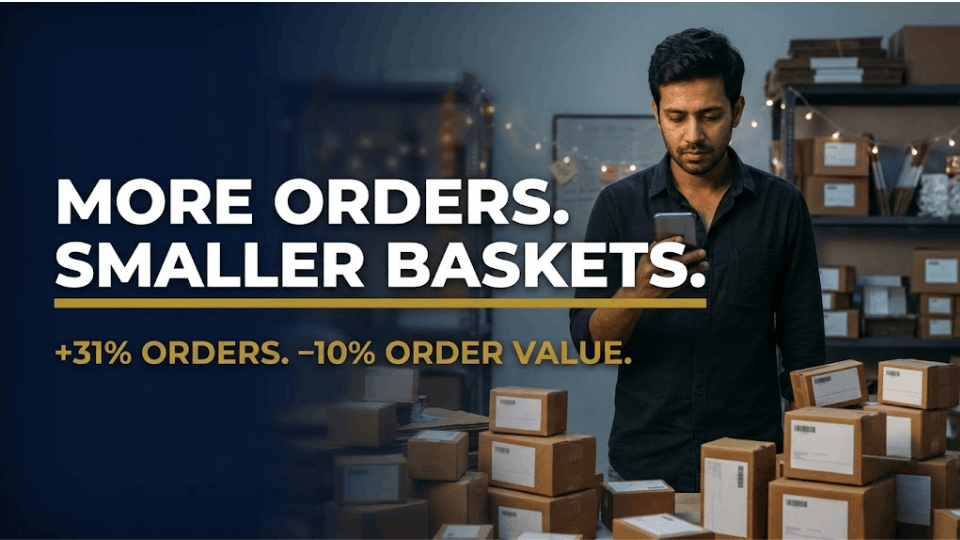
India is moving the other way. Unicommerce data from the first week of this year’s festive sales showed order volumes up 31% while average order value fell 10%. Datum’s full-season forecast says the same thing: more shoppers, more orders, slightly smaller tickets. Indian buyers are clicking “Buy Now” more often, for less each time.
Why small baskets hurt FBA sellers most
That trend is dangerous for FBA sellers because fees are charged per order and per unit, not per rupee of profit. Every single-unit order pays its own closing fee, pick-and-pack and weight handling. On a ₹299 product, those fixed costs can swallow a quarter of the price before you count product cost or ads. The fix is more units in each order, which is exactly what the rest of this guide covers.
Amazon Average Order Value: What Is a Good Amazon AOV?
The AOV formula, with a ₹ example
Average order value is simply revenue divided by the number of orders. If you made ₹1,20,000 last month from 300 orders, your AOV is ₹400. Most sellers never calculate it because they watch daily sales and BSR instead.
How to calculate AOV from Seller Central
Seller Central doesn’t show AOV on any dashboard, so you calculate it yourself. Open Reports, then Business Reports, then Sales and Traffic, and divide Ordered Product Sales by Total Order Items. Do this monthly and per ASIN, because a blended number hides which products drag it down.
What is a good average order value on Amazon?
Forget the US benchmark of around $52. A better test is your AOV compared with your own single-unit price. If your product sells at ₹400 and your AOV is ₹410, almost nobody buys more than one. A healthy target for most consumable brands is an AOV of 1.3 to 1.5 times your single-unit price.
Units per order: the number levers actually move
Alongside AOV, track units per order: Units Ordered divided by Total Order Items, from the same report. If that number sits at 1.0, every lever in this guide is still untapped. Kiran Joshi from Nagpur found his was 1.02 across eight cleaning products. His price wasn’t the problem; his listings never gave anyone a reason to buy two.
The FBA Math: Why Bigger Baskets Protect Your Margin
What a single-unit FBA order really costs you
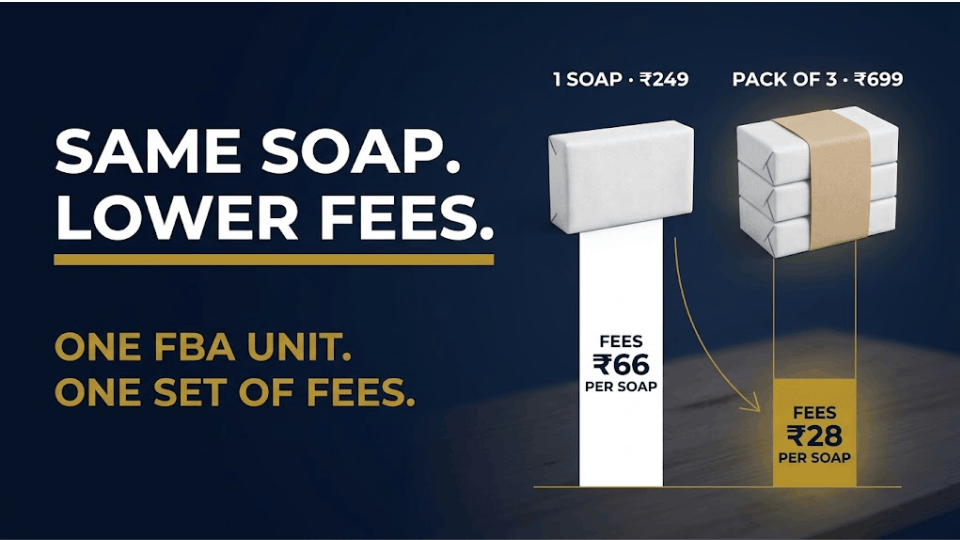
Since March 2026, Amazon India charges zero referral fee on products under ₹1,000. That still leaves the closing fee (raised again in September), FBA pick-and-pack, weight handling and storage. Take a ₹249 herbal soap. With illustrative figures of ₹12 closing, ₹14 pick-and-pack and ₹40 weight handling, about ₹66 of every order goes to fees. That is 26% of the price.
The same product as a pack of 3
Now sell three soaps as one physical multipack at ₹699. It ships as one FBA unit, so you pay one set of fees on a slightly heavier parcel: roughly ₹84 per order, or about ₹28 per soap instead of ₹66. Keep the pack under ₹1,000 to stay in the zero referral fee band, and confirm your exact numbers in the fee preview.
Where the saved margin should go
That ₹38 per soap is your budget. Give part to the customer as a pack discount, put part into Sponsored Products for the pack, and keep the rest as profit. Arjun Mehta from Jaipur did exactly this with his neem soaps. Within two months, his pack of 3 was 40% of orders and his ad budget had grown without extra cash.
For the product side, our guide on building Amazon product bundles covers which items to combine.
Amazon Multipack Pricing: Pack of 2 and Pack of 3 That Sell
Which products make good multipacks?
Multipacks work best for products people use up and buy again, like soaps, hair oil, spice blends, cleaning cloths and stationery. Low-ticket items under ₹500 benefit most. Skip items people buy once, like a phone stand. Nobody needs three.
Setting up pack of 2 and pack of 3 listings
Each multipack is a separate product with its own ASIN and its own barcode. Where your category allows a count variation theme, link the packs so shoppers see a “Pack of 1 / 2 / 3” selector. Be careful: some sellers have been told a single unit and its multipack cannot share a parent, so read our guide to parent-child variation rules before linking.
Amazon multipack pricing: the per-unit discount rule
Pricing a pack of 3 at exactly three times the single price gives shoppers no reason to choose it. Build in a 5 to 10% per-unit saving and show it in the title and main image: “₹233 per soap.” A visible saving moves more shoppers than a hidden one, and our guide to pricing psychology on Amazon explains why.
FBA prep so packs never get split
Pack the units in one outer bag or box, put a single FNSKU label on the outside, and add a “Sold as set, do not separate” sticker. A split pack means one soap for a three-soap price, and your reviews pay for it.
Meena Sundaram from Madurai launched a pack of 2 of her coconut hair oil last March. Today it makes up 35% of her orders, and her AOV rose from ₹289 to ₹402.
How to Use Amazon Quantity Discounts and Business Pricing
How do quantity discounts work on Amazon India?
Amazon Business is live in India, and it lets you offer quantity discounts that only registered business buyers see. You first set a business price for the product, then add up to five discount tiers, for example 5% off at 5 units and 10% off at 10 units. Your retail shoppers see no change at all.
Which sellers benefit most?
This lever suits products businesses restock regularly: stationery, cleaning supplies, packaging and pantry staples. If you sell gift products, it will do little for you. If you sell anything a small office goes through every month, it can become one of your best channels.
Setting tiers that don’t undercut your retail price
Start your first tier at 5 units and keep every tier above your FBA break-even per unit. A 10-unit B2B order often ships as one larger parcel, so your fee per unit drops sharply, and you can afford a deeper discount than you might think.
Ravi Kulkarni from Pune added a 10-unit tier to his gel pens. Within six weeks, office buyers were placing ₹3,000 orders that had never existed before, and his retail price stayed exactly where it was.
Buy More Save More on Amazon: Turn One Item Into a Cart
Setting up Buy More Save More in Promotions
In Seller Central, go to Advertising, then Promotions, and create a percentage-off promotion with a minimum purchase quantity. “Buy 2, save 10%” or “Buy 3, save 15%” are the simplest formats. Select a group of ASINs as qualifying items so shoppers can mix products. It needs no new listing or prep, which makes it the fastest AOV test you can run.
Buy More Save More vs coupons
A coupon’s green badge lifts click-through but discounts a single unit. A quantity promotion only pays out when the customer adds more to the cart. Use coupons to win the click and promotions to grow the basket.
Festive pricing strategy without the bleed
Amazon runs Buy More Save More and Amazon Combos as headline formats during this year’s Great Indian Festival, so shoppers are actively looking for multi-item savings. The risk is stacking: your promotion, a coupon and a deal price can all hit one order. Before any sale, add every discount together and confirm you’re still profitable.
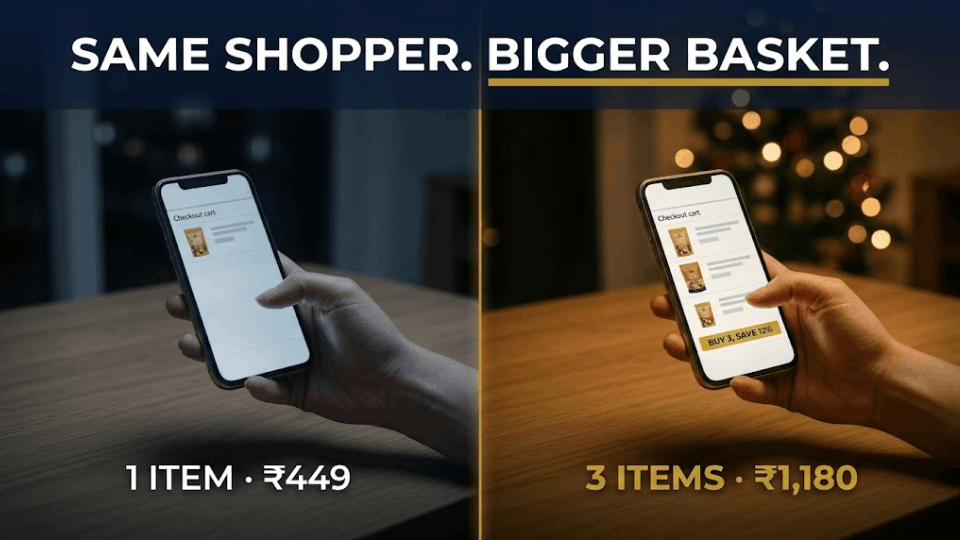
Fathima Basheer from Kozhikode ran “Buy 3, save 12%” across her dry fruit range during the festival. Her units per order rose from 1.2 to 2.1 in the first week.
For the full event plan covering stock, deals and ads, see our Great Indian Festival strategy for sellers.
Cross-Selling on Amazon: From One ASIN to the Next
Brand Store and A+ comparison charts
If you are Brand Registered, your A+ Content can include a comparison chart that links directly to your other products. Your Brand Store does the same job at a larger scale. A shopper who lands on your hair oil should see your shampoo and hair mask one scroll away, not a competitor’s.
Sponsored ads on your own listings
Your own detail pages carry ad slots, and if you don’t fill them, competitors will. Use Sponsored Products or Sponsored Display product targeting to place your complementary items there. These campaigns usually convert well, because the shopper already trusts your brand.
Good-better-best tiers that pull shoppers up
Upselling is the other half of AOV. Offer three versions of a product, such as basic, standard and premium. The premium option makes the middle one look like the smart buy, and many shoppers trade up from the cheapest.
Why Frequently Bought Together can’t be forced
That section comes from real purchase history, so there is no setting for it. Multipacks, promotions and cross-sell ads feed it over time.
Karthik Subramanian from Chennai targeted his fast chargers on his own cable listings. Within six weeks, his AOV rose 22%.
A 7-Day Plan to Increase Average Order Value on Amazon
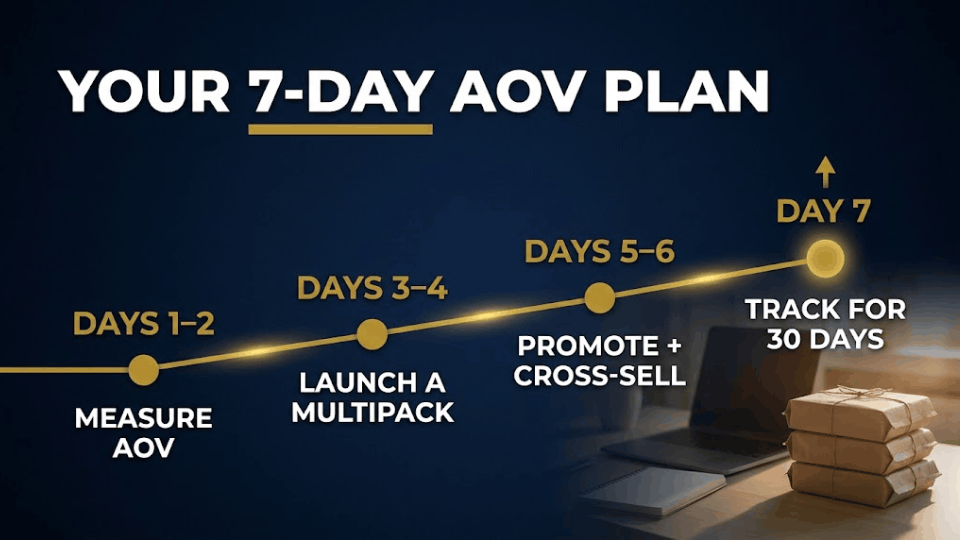
You don’t need to use every lever at once. This plan takes one week, and each step builds on the one before it:
- Days 1–2: Pull your Sales and Traffic report and calculate your current Amazon AOV and units per order for each ASIN. Pick your top two consumable products as test candidates.
- Days 3–4: Create one physical pack of 2 or pack of 3 for your best product, priced with a 5 to 10% per-unit saving and kept under ₹1,000. If you sell to businesses, add one quantity discount tier.
- Days 5–6: Launch one Buy More Save More promotion across a group of related ASINs, and set up a product targeting campaign that places your complementary products on your own listings.
- Day 7: Note your baseline numbers and set a reminder to review them in 30 days: AOV, units per order, conversion rate and TACoS.
After 30 days, compare. If conversion dropped more than AOV rose, your discount was too deep or your pack too big. Adjust one thing and test again.
Frequently Asked Questions
What is a good average order value on Amazon?
There’s no single number for India, because AOV depends on your price point. Compare your AOV with your own single-unit price instead. If they’re nearly equal, customers buy one unit and leave. For most consumable products, aim for an AOV of 1.3 to 1.5 times your single-unit price, then raise the target once multipacks and promotions are running.
How do I calculate my average order value on Amazon?
Go to Reports, then Business Reports, then Sales and Traffic in Seller Central. Divide Ordered Product Sales by Total Order Items for your chosen period. Run it monthly and per ASIN, so you can see which products are dragging your average down.
How can I increase my average order value on Amazon?
Start with the levers available to Indian sellers: physical multipacks priced with a visible per-unit saving, Buy More Save More promotions across related products, B2B quantity discount tiers, and cross-sell ads on your own listings. Test one at a time so you know what’s working.
Should I sell a pack of 2 or a pack of 3 on Amazon?
Start with a pack of 2 for products above ₹400 and a pack of 3 for low-ticket consumables. The pack of 3 usually saves more on FBA fees per unit, but keep the total price under ₹1,000 to stay in the zero referral fee band.
How do quantity discounts work on Amazon India?
They run through Amazon Business. You set a business price, then add up to five discount tiers based on how many units a business buyer orders. Regular retail shoppers never see these prices, so your consumer pricing stays protected.
Does Seller Central show AOV directly?
No. Seller Central doesn’t display AOV as a ready number. You calculate it from the Sales and Traffic report by dividing Ordered Product Sales by Total Order Items.
Will a multipack cannibalise my single-unit sales?
Some single-unit buyers will switch to the pack, and that’s the point. Each switch replaces a low-margin order with a higher-margin one. Watch total profit, not single-unit sales.
Do multipacks need a new barcode and FBA label?
Yes. A multipack is a separate product with its own ASIN, its own barcode and its own FNSKU label, plus a “sold as set” sticker so the fulfilment centre never splits it.
Conclusion
Indian shoppers are placing more orders than ever, but each one is getting smaller. For an FBA seller, that’s a fee problem disguised as a sales win. The answer isn’t chasing more traffic. It’s making every order that arrives worth more.
You now have the levers: multipacks that cut your fee per unit, quantity tiers for business buyers, Buy More Save More promotions that turn one item into a cart, and cross-selling that keeps shoppers inside your brand. Don’t try all of them this week. Pick one, measure it for 30 days, then add the next.
If you want a complete system for pricing, launching and scaling your products on Amazon India, join Aman in the 3-Day Amazon Business Training. Your next sale wave is coming either way. Make sure the baskets are bigger when it does.
