
Last October, Karthik Nair from Kochi did the math that keeps most Amazon sellers up at night. His health-food brand was clearing ₹42 lakh a month, and Amazon was quietly taking ₹9 lakh of it in referral fees, FBA charges, and ad spend before a single rupee reached him. Worse, he had thousands of buyers and couldn’t name one repeat customer. That night he started weighing selling on Amazon vs his own website — not to quit the marketplace, but to stop renting his entire business on land he didn’t own.
If you’ve had that same 2 a.m. thought, this is for you. The question isn’t whether a D2C store is “better” than Amazon. It’s when owning your own storefront starts paying off, and how to add it without torching the machine that’s already working. Get the timing right and D2C becomes the most profitable move you’ll make. Get it wrong and you’ll burn cash on a beautiful website nobody visits.
The Rented-Land Trap Every Amazon Seller Eventually Hits
Selling on Amazon feels safe because it is safe — right up until it isn’t. Then the algorithm shifts, a competitor hijacks your listing, or a policy flag freezes your account overnight. You built a real business on rented land, and the landlord can change the rules while you sleep.
What “you don’t own the customer” really costs you
Here’s the part that stings. When someone buys your product on Amazon, they’re Amazon’s customer, not yours — you never get their email, phone number, or permission to sell to them again. Priya Menon, who runs a candle brand out of Coimbatore, hit this wall: 8,000 orders in eighteen months and no way to tell those buyers about her new collection. Every repeat sale meant paying Amazon to reach a customer she’d already won once.
Why D2C websites for Amazon sellers are suddenly everywhere
The ground has shifted in a way that finally makes owned stores viable. UPI now processes more than 20 billion transactions a month, so checkout friction has collapsed, and under the DPDP Act, owning your customer data is a genuine competitive edge rather than a nice-to-have. This is why D2C websites for Amazon sellers have gone from a fringe idea to a standard second act.

D2C vs Marketplace in India: What Each Channel Actually Costs
Before you choose, understand what each channel takes from you — not just in fees, but in what you permanently trade away. The D2C vs marketplace India debate usually gets framed as a personality contest. It’s really an accounting question.
The difference between D2C and marketplace selling
A marketplace is search-led. Someone types “vitamin C serum” into Amazon and buys from whoever has the best listing, reviews, and sponsored placement — you borrow that audience, you don’t build it. A D2C store is the opposite: you own the storefront, pricing, and every scrap of customer data, but you drive every visitor yourself. One rents you reach; the other builds you an asset.
The margin math that changes everything
Amazon’s referral fees run 12–25% by category, and once you add FBA and advertising, net margin often lands between 10% and 20%. A well-run D2C store can hold 30–50% because there’s no marketplace cut. Rohan Gupta, a home-fragrance seller in Jaipur, found every ₹1,000 sale on his own site was worth nearly double the same sale on Amazon after fees. Our breakdown of Amazon vs Flipkart for new sellers shows how those cuts differ.
What customer data you lose selling only on Amazon
The invisible cost is data. On Amazon you can’t see who bought, what else they browsed, or when they’re ready again — so there’s no retention list and no way to trigger a repeat purchase cheaply. You’re flying blind on the most valuable thing a brand owns: its relationship with the people who already paid. Amazon does hand you aggregate insight through Amazon Brand Analytics, but never the customer themselves.
When Should You Actually Start Your Own D2C Website?
This is the question that matters most, and getting it wrong is expensive in both directions. Launch too early and you’ll pour money into an empty store. Launch too late and you’re handing Amazon margin you should be keeping.
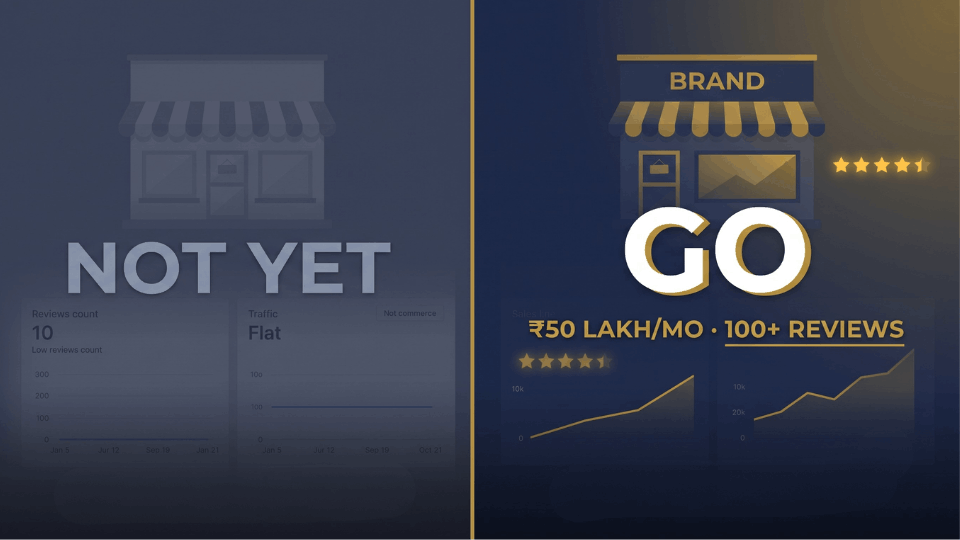
The ₹50 lakh a month, 100-reviews threshold
The clearest signal, and the one most seasoned operators converge on, is roughly ₹50 lakh a month in marketplace revenue with 100-plus genuine reviews. At that point the product is proven, you have social proof to carry to your own site, and your commission bill is large enough that shifting even 20% of repeat buyers to direct makes a real margin difference. Below that line, a D2C store usually solves a problem you don’t have yet.
Green lights — signs you’re ready
You’re ready when demand already exists and just needs somewhere better to land. Watch for growing branded searches for your name, repeat buyers messaging you, review velocity climbing month over month, and a bestseller rank you’re no longer fighting to hold. When several are true at once, the market is telling you it trusts the brand, not just the listing.
Red lights — signs you’re not ready yet
The warning signs are just as clear. If you have no outside traffic source, no brand recognition, a thin catalog, or conversion stuck near 0.5%, a website won’t fix any of it. Anjali Reddy from Hyderabad built a gorgeous Shopify store at ₹18 lakh monthly revenue — it converted at 0.4% for four months because she had no audience to send to it.
Before you spend a rupee on a store, run your real numbers against that threshold. A short channel-readiness check — revenue, reviews, repeat rate, and branded search — tells you honestly whether you’re at the “build it” stage or still validating.
Is It Worth Selling on Your Own Website Instead of Amazon?
Short answer: almost never “instead of.” The magic is in “alongside” — but to see why, you have to see where an owned store struggles on its own.
Own website vs Amazon India — where the trust gap hurts
The own website vs Amazon India comparison lives or dies on trust. A brand-new site has zero built-in credibility, so it typically converts at 0.5–1% until reviews and trust signals push it past 2%. Amazon hands you that trust on day one. Your job on D2C is to transfer the reputation you’ve already earned, not rebuild it from scratch — which is exactly why you build a strong brand presence on Amazon first.
D2C customer acquisition cost in India, and why LTV saves it
Here’s the uncomfortable early math. D2C customer acquisition cost in India runs ₹200–1,200 per customer on Meta ads for a young brand with no social proof, which looks brutal next to Amazon’s “free” traffic. What saves it is the back end: a healthy 25–40% repeat rate is where profit lives. You lose money on the first order and make it back on the second, third, and fourth — orders Amazon would have charged you for every time.
Building the Store: Shopify for D2C in India and What It Costs
Once you’ve cleared the threshold, the build itself is refreshingly cheap compared to what most people fear. Setting up a Shopify store for D2C India is a weekend of work; making it convert is the real job.
How much does a D2C website cost in India?
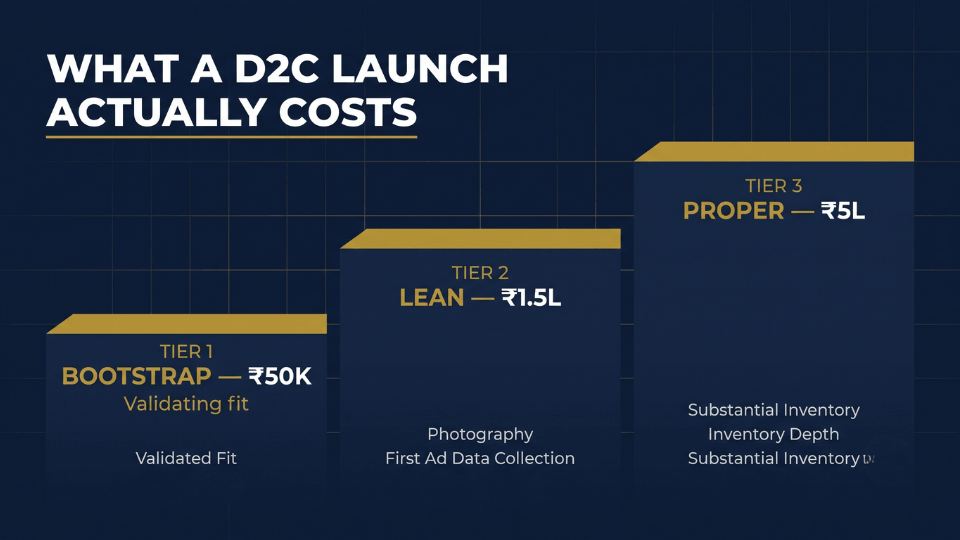
The honest D2C website cost India breakdown is smaller than the ₹5–10 lakh figures agencies love to quote. Shopify Basic runs around ₹2,000 a month, apps for payments and marketing add ₹5,000–15,000 monthly, and a custom build lands anywhere from ₹50,000 to ₹6 lakh. Most sellers don’t need the top of that range — a clean theme, correct configuration, and a good product page beat an expensive custom build every time. Match spend to your validation stage: a ₹50,000 bootstrap validates fit, ₹1.5 lakh adds photography and ad data, ₹5 lakh funds inventory depth. With Amazon traction already, start lean and let marketplace cash fund each step.
Setting up Shopify for Indian buyers
The theme is maybe 10% of the job. The other 90% is configuring for how Indians actually shop: UPI and COD via Razorpay or Cashfree, automatic GST, Shiprocket or Delhivery for logistics, and COD verification to prevent RTO losses that can quietly eat ₹50,000 a month. Meera Iyer from Chennai skipped COD verification at launch and lost ₹40,000 to returns before fixing it in week three.
If you want the exact stack — themes, apps, payment and logistics setup — we configure for sellers making this move, that build sheet saves you the ₹40,000 mistakes most first-timers make.
Can You Sell on Amazon and Your Own Website at the Same Time?
Not only can you — you should. This hybrid model is what nearly every serious Indian brand, from Mamaearth to boAt, actually runs, because the two channels do different jobs.
Keeping pricing consistent so you don’t cannibalize
The one trap to avoid is a price war with yourself. Marketplaces push exclusive discounts that undercut your own store, training customers to buy wherever’s cheapest today. Set pricing guardrails, and reserve your best offers — bundles, loyalty perks, early access — for the channel you own. The same discipline applies when you sell on Meesho and Amazon together.
Amazon captures, D2C compounds
The cleanest way to think about it: Amazon captures demand, your store compounds it. Amazon delivers discovery and volume from ready buyers; your website turns those one-time buyers into a list you sell to again and again at almost no cost. Deepak Shah, a supplements seller in Ahmedabad, kept all acquisition on Amazon and moved only repeat buyers to his site — his blended margin climbed 14 points in two quarters. The same capture-and-compound logic extends to new markets when you start exporting through Amazon Global.
The ₹0.60 WhatsApp message vs the ₹800 Meta ad
Once a customer is on your list, the economics flip. A WhatsApp broadcast costs ₹0.40–0.80 per message and opens at 85–90% — versus another ₹800 Meta ad to re-reach someone you already won. A brand doing ₹50 lakh a month with a 12,000-person WhatsApp list can pull ₹3–5 lakh in monthly sales with zero fresh ad spend. That’s compounding Amazon can’t give you.
Your 6-Month “Alongside” Roadmap
Here’s how sellers who’ve crossed the threshold roll it out without dropping the ball on Amazon.
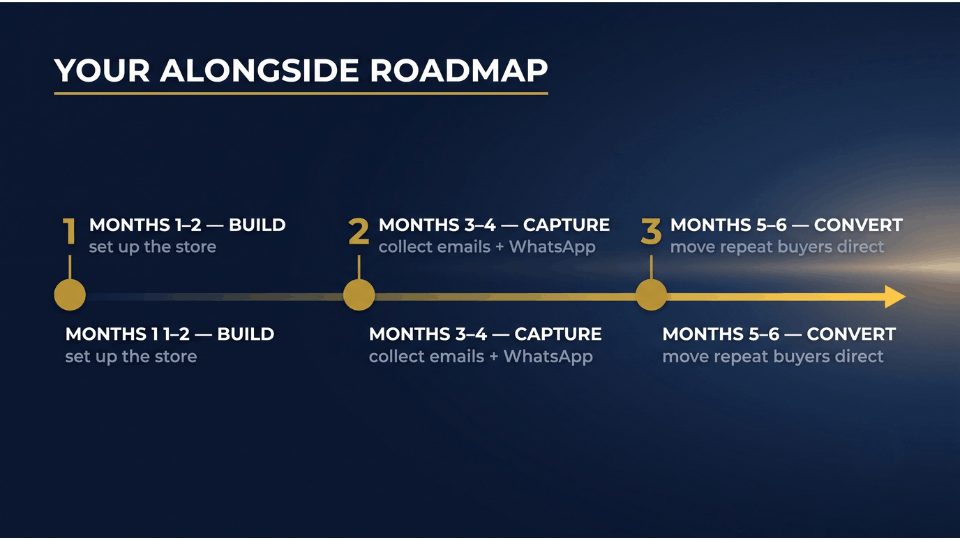
Months 1–2: hit the threshold, build the store
Confirm you’re genuinely at the ₹50 lakh, 100-reviews mark, then build lean. Configure Shopify for UPI, COD, GST, and logistics, load your proven bestsellers, and get the product pages right. Chase live, not perfect.
Months 3–4: drive first traffic, capture contacts
Send your first traffic and, more importantly, start capturing emails and WhatsApp numbers everywhere. A branded card in your Amazon shipments pointing to a store loyalty offer works well. The goal isn’t volume yet — it’s the owned list that makes everything after this cheap.
Months 5–6: move repeat buyers direct, measure the lift
Begin nudging repeat buyers to reorder directly through WhatsApp and email, and watch your blended margin rather than D2C revenue in isolation. If it’s climbing, you’ve proven the model — now pour fuel on it.
Frequently Asked Questions
What is the difference between D2C and marketplace selling in India?
On a marketplace like Amazon or Flipkart, you pay 12–30% in commissions, borrow the platform’s audience, and never own customer data. In D2C, you sell through your own website, pay no marketplace cut, and own pricing and customer relationships — but you drive every visitor yourself. One rents reach; the other builds an asset.
When should an Indian brand start investing in its own D2C website?
The practical signal is around ₹50 lakh in monthly marketplace revenue plus 100 or more genuine reviews. At that point your product is validated, you have social proof to carry over, and your commission bill is big enough that moving repeat buyers direct meaningfully improves margins. Below that, focus on growing your marketplace base first.
Is it worth selling on your own website instead of Amazon?
Rarely “instead of” — almost always “alongside.” A standalone new site converts at just 0.5–1% until it earns trust, while Amazon gives you buyers on day one. The winning play is running both: Amazon captures ready demand, and your store keeps those customers at a fraction of the cost.
How much does it cost to build a D2C website in India?
Less than most guides claim. Shopify Basic is about ₹2,000 a month, apps add ₹5,000–15,000 monthly, and a custom build ranges from ₹50,000 to ₹6 lakh. A bootstrap launch is realistic at ₹50,000. If you already have Amazon traction, start lean and let marketplace revenue fund each upgrade.
Can I sell on Amazon and my own website at the same time?
Yes, and it’s the model most successful Indian brands use. Keep pricing consistent so the channels don’t cannibalize each other, let Amazon handle discovery and volume, and use your store to build a customer list you can sell to repeatedly. Reserve your best offers for the channel you own.
What customer data do you lose by selling only on Amazon?
Nearly all of it. You don’t get buyers’ emails, phone numbers, or browsing behaviour, and you can’t market to them directly afterward. That means no retention list and no lifetime-value visibility — so every repeat sale requires paying Amazon again to reach a customer you already won once.
Which is more profitable in India — D2C or Amazon?
It depends on stage. Amazon is more profitable early because traffic is essentially free to you. D2C wins long-term because margins run 30–50% versus 10–20% after fees, and repeat purchases cost almost nothing. The best path uses Amazon to acquire and D2C to retain.
Do I need GST registration to launch a D2C website?
Yes, in practice. GST registration is mandatory once turnover crosses ₹40 lakh (₹20 lakh in special-category states), and payment gateways and logistics partners expect it. If you’re already selling on Amazon at the scale where D2C makes sense, you’ll almost certainly have it in place already.
Conclusion
D2C was never a replacement for Amazon — it’s the compounding layer you bolt on once Amazon has done the hard part for you. The marketplace validates your product and hands you the reviews and cash flow that make an owned store worth building. The sellers who win don’t agonize over which channel to pick; they sequence them — capture on Amazon, compound on their own site, and keep their blended margin climbing. The discipline is everything: build the store because demand is proven, not because you’re trying to escape. If you want to build the validated, review-rich Amazon foundation that makes a D2C launch actually pay off, our 3-Day Amazon Business Training walks you through exactly how. Your margins will thank you.
