

When Meghana Reddy from Hyderabad launched her stainless-steel lunchbox listing, the first ten days felt like magic. She was showing up on page one for terms she’d barely optimised for, orders trickled in without much ad spend, and she assumed she’d cracked it. By the start of the second month, the orders dried up and her listing slid to page four. Nobody had warned her that the window she’d just wasted had a name.
That window is the Amazon honeymoon period, and it is the single most misunderstood phase of any product launch in India. Used well, it can set the rank your listing keeps for years. Ignored, it quietly closes and leaves you fighting uphill. This guide walks you through what the honeymoon period is, how long it really lasts, and the practical moves that make the first 30 days count — whenever you happen to be launching.
What the Amazon Honeymoon Period Actually Is
The Amazon honeymoon period is the short stretch right after a new product goes live, when Amazon’s search algorithm gives your listing extra visibility while it figures out where you belong. Because a brand-new ASIN has no track record, the algorithm temporarily leans on your keywords, images, price, and early conversions instead of sales history. It is less a gift and more an audition.
Why Amazon boosts new listings
A mature listing earns its rank from months of proven demand. A new one has nothing to prove it with, so the A9/A10 algorithm runs a test: it places your product in front of shoppers and watches how they respond. Strong click-through and conversion tell Amazon you deserve to stay up there, while weak signals tell it to push you down. Our guide on how Amazon’s A9 algorithm works breaks down what it measures.
How long does the honeymoon period last?
Most sellers see the strongest effect across the first 15 to 30 days, with some lingering benefit toward day 60. The exact length varies by category and how competitive your niche is. The safest assumption is simple: treat day one as the start of a 30-day sprint, because that is where your effort compounds hardest.

Is the Honeymoon Period Real, or a Myth?
Here is the honest part most launch guides skip. The popular belief — that every new listing gets 30 days of guaranteed free traffic no matter what — is only partly true. Amazon’s own patent filings around how it handles new products reveal a system far more conditional than “show up and get a boost.”
What the cold start algorithm reveals
Amazon’s cold start algorithm is how the platform ranks products with no history. It doesn’t hand out blanket visibility; it samples shopper response fast and adjusts in real time. If your listing converts, the sampling continues and your rank climbs. If it doesn’t, the boost evaporates within days. The honeymoon, in other words, is conditional approval, not a free pass.
The truth: Amazon judges you from day one
Tarun Bhatia from Chandigarh learned this the hard way. He launched a yoga-mat listing with a weak main image and three rushed bullet points, expecting the algorithm to carry him. Shoppers clicked, didn’t buy, and within a week his impressions collapsed. No boost survives a listing that doesn’t convert. For Indian sellers, the lesson is to stop treating the honeymoon period as a loophole and start treating it as the payoff for work you finish before going live.

Before You Launch: The Pre-Honeymoon Checklist
Since the algorithm starts judging immediately, everything that matters has to be ready before your first order. The honeymoon period rewards preparation, and there is no time to fix a broken foundation once the clock is running.
A listing built to convert
Your title, five bullet points, A+ content, and image stack all need to be finished and sharp on day one. Fill all 250 bytes of backend search terms — most sellers leave that field half empty and lose easy indexing.
Keyword mapping and indexing
Before you drive a single click, confirm your product actually indexes for your priority keywords by searching them and checking you appear. Map your terms into tiers: a handful of primary phrases that define the product, and a wider set of long-tail terms with clear buying intent.
Inventory and pricing readiness
Sneha Nair from Kochi ran out of stock on day eleven of a strong launch and watched her hard-won rank reset almost overnight. Hold enough inventory to cover a fast start, set a reorder trigger early, and know how to handle stockouts before one happens. A stockout during the honeymoon period is one of the most expensive mistakes a new seller can make.
Week 1: Igniting Your Amazon Listing Ranking Boost
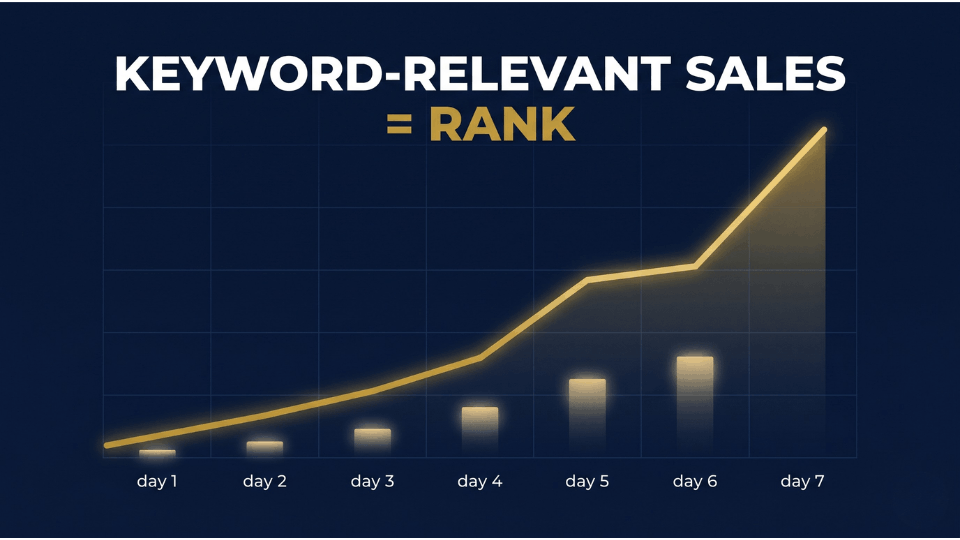
The first seven days set the tone for everything that follows. Your goal is not random sales — it is keyword-relevant sales that tell Amazon precisely which searches you deserve to win.
Driving keyword-relevant sales velocity
A burst of unrelated orders does little for your rank. Real purchases tied to your target keywords are what trigger a genuine listing ranking boost, because they teach the algorithm the exact terms where shoppers choose you. Concentrate your early momentum on the phrases you most want to own, not a scattered spread.
Launch pricing that pulls buyers in
Imran Sheikh from Lucknow launched his phone-stand listing at fifteen percent below his target price for the first ten days. The lower price lifted his conversion rate, conversions lifted his velocity, and velocity lifted his rank. Once reviews and ranking built up, he raised the price in small steps. A modest launch discount buys conversion exactly when you need it most.
Running Amazon PPC During the Honeymoon Period
Paid traffic is how most sellers manufacture early velocity, but Amazon PPC for a new product launch needs a careful hand. Spend recklessly and you’ll burn your budget teaching the algorithm the wrong things. Our walkthrough of your first 30 days of PPC maps the budget and bid plan day by day.
Manual campaigns over auto
Amazon doesn’t understand a brand-new product yet, so auto campaigns often spray spend across irrelevant searches. Start with tightly controlled manual campaigns built around your researched keywords. You get cleaner data, less waste, and faster signal on which terms actually convert.
ACoS expectations during launch
A launch is an investment, so a higher advertising cost of sales is acceptable while you buy rank — many sellers tolerate an ACoS in the thirty to thirty-five percent range during this phase. The number to watch, though, is TACoS, which folds in organic sales and tells you whether your overall account is actually getting healthier.
Protect your brand keywords
Anjali Deshmukh from Nagpur discovered a competitor bidding on her brand name during her launch week. Running ads on your own brand terms is cheap, converts well, and stops rivals from stealing shoppers who are already looking for you.
An Amazon Product Launch Strategy for India
A product launch strategy in India has its own texture. Buyer behaviour, traffic sources, and review dynamics here don’t mirror Western markets, and your launch plan should reflect that.
External traffic and branded searches
Driving shoppers to your listing from WhatsApp groups, Instagram, and regional influencers does two things at once: it generates early sales and lifts branded search demand, which Amazon reads as a strong signal. Vikram Iyer from Coimbatore seeded his kitchenware launch through a few micro-influencers and saw branded searches climb within his first three weeks.
Honest reviews and early-rating risk
Reviews matter enormously for conversion, but chase them carefully. Programmes like Amazon Vine in India bring genuine reviews, and genuine means they can be critical. A cluster of early low ratings can drag a fresh listing down fast, so make sure your product genuinely delivers before you invite scrutiny.
Timing your launch with demand
Aligning a launch with a high-intent shopping window — a festival season or major sale event — stacks natural demand on top of your honeymoon boost, and the two forces compound. Just make sure your inventory and listing are battle-ready before the rush, not scrambling during it.
How to Maximise the First 30 Days of Your Listing
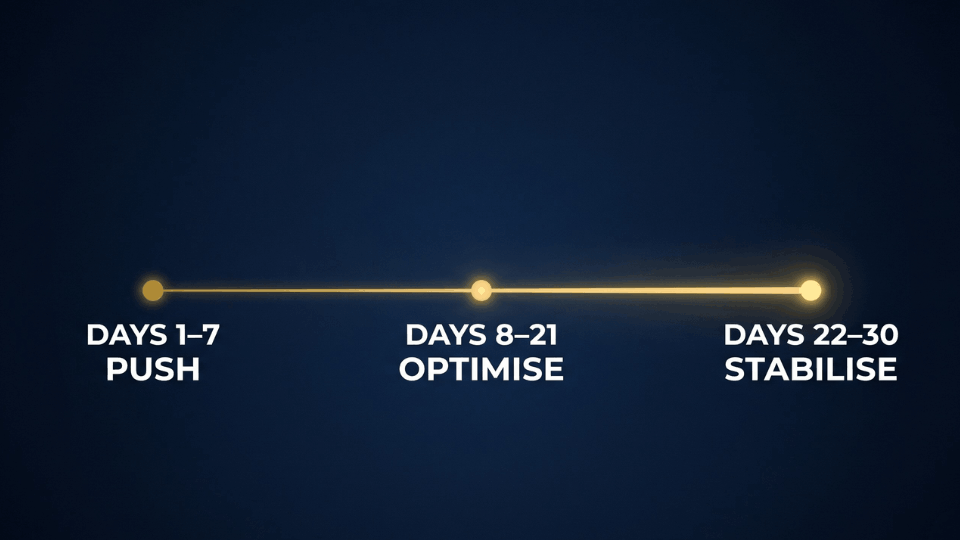
So how do you maximise the honeymoon period across the first 30 days? Think of it as three connected phases, not one long blur.
The day-by-day rhythm
Days one through seven are for pushing controlled, keyword-relevant traffic hard and establishing velocity. Days eight through twenty-one are for optimising based on what the data shows — tightening ad targeting, adding negative keywords, refining your main image. Days twenty-two through thirty are for stabilising: protecting your rank and easing toward sustainable profitability. Our 14-day launch plan for organic rank maps these moves to specific days.
Change one lever at a time
Farhan Qureshi from Bhopal made the classic error of changing his price, main image, and ad budget all on the same day, then had no idea what caused the swing that followed. Adjust one variable at a time and measure its effect on click-through, conversion, and rank. Disciplined, single-lever testing during the honeymoon period teaches you what your specific product responds to — knowledge that keeps paying off long after the window closes.
What Happens When the Honeymoon Period Ends
Every honeymoon period closes, and understanding why helps you keep what you built.
Why ranking cools off
Once Amazon has gathered enough data, it stops leaning on the temporary boost and starts ranking you the way it ranks everyone else — primarily on sales history and conversion. If you used the window to build real velocity and reviews, the transition is smooth. If you didn’t, this is the moment your rank slips.
Can you get a second honeymoon period?
Genuinely, no — not for the same listing. Relisting or tweaking an existing product won’t reset the clock. The only way to trigger a fresh honeymoon period is to launch a truly new ASIN. Ritika Agarwal from Jaipur tried to “restart” a fading listing by editing it heavily and got nothing; a separate new product, properly launched, gave her the fresh boost she was after.
Sustaining rank for the long term
The honeymoon period is a head start, not a finish line. Keep refining your listing, managing ad efficiency, and earning reviews well past day thirty. Long-term profitability — not a temporary spike — is the real prize, and the habits you build in month one are what protect it.
Frequently Asked Questions
How long does the Amazon honeymoon period last?
For most products it runs strongest across the first 15 to 30 days, with some lingering benefit toward day 60. The length varies by category and competition, so rather than counting on a fixed number, treat your first 30 days as the critical sprint that shapes your long-term rank.
Is the Amazon honeymoon period real, or a myth?
It’s partly both. There is a real window where new listings get sampled and can rank quickly, but the idea of guaranteed free traffic regardless of performance is a myth. Amazon judges your clicks and conversions from day one, so the boost only sustains if your listing converts.
How do I maximise the Amazon honeymoon period?
Finish all listing optimisation before launch, drive keyword-relevant sales rather than random orders, use a modest launch discount to lift conversion, run tightly targeted PPC, and never run out of stock. Optimise on data mid-month, then stabilise toward profitability near day 30.
What is Amazon’s cold start algorithm?
It’s the system Amazon uses to rank products with no sales history. Unable to rely on past performance, it leans on your keywords, images, price, and early shopper response, then adjusts your visibility quickly. It’s the mechanism behind what sellers call the honeymoon period.
Can you get a second honeymoon period on Amazon?
Not for the same listing. Editing or relisting an existing product won’t reset the window. The only reliable way to earn a fresh one is to launch a genuinely new ASIN, which Amazon treats as a new product with no history.
When does the honeymoon period actually start counting?
It begins when your listing goes live and is available for sale — for FBA sellers, typically when inventory is received and shows as available. That’s why your listing and keyword work must be done beforehand: the clock starts the moment shoppers can buy.
Does relisting a product trigger a new honeymoon period?
No. Deleting and recreating a listing for the same product generally won’t earn a fresh boost and can even cost you existing reviews and rank. A new honeymoon period requires a truly new product and ASIN, not a workaround.
How much should a new seller in India budget for a launch?
There’s no universal figure — it depends on your category, competition, and price point. Plan for enough ad budget to sustain keyword-relevant traffic through the first 30 days, plus an inventory cushion to avoid stockouts. Treat the spend as an investment in rank and track TACoS to see if it’s working.
Conclusion
Meghana’s lunchbox launch failed not because the honeymoon period is fake, but because she didn’t know it was happening until it had passed. That’s the trap, and now you’re past it. The first 30 days reward the seller who shows up prepared — a listing that converts, inventory that holds, traffic aimed at the right keywords, and the discipline to test one change at a time. Do that, and the rank you earn in month one can carry your product for years.
If you want to launch with that level of preparation, our 3-Day Amazon Business Training walks you through the entire process — from pre-launch foundations to your first profitable month — with the systems Indian sellers actually use. Get your next launch right, and your rankings will thank you long after the honeymoon ends.
