

Recently, a short video about Uniqlo’s plain T-shirts was pulling more than two lakh views a day. No celebrity, no discount. Just stacks of white, grey and navy basics that people buy again and again.
Around the same time, Imran Qureshi from Surat wired ₹3 lakh to a supplier for a glowing gadget he’d spotted in a reel the night before.
Here’s the uncomfortable truth: the best evergreen products to sell on Amazon usually look a lot more like Uniqlo’s T-shirts than Imran’s gadget. One of these businesses will still be selling next October. The other will probably be paying Amazon to store, return or destroy its stock.
You’ll see why flashy products quietly drain an FBA account, why boring ones keep paying for years, and a four-step filter to find your own steady seller on Amazon.in.
The Uniqlo Lesson Most Amazon Sellers in India Ignore
A brand that refused to chase trends
While Zara and H&M race to copy the runway, Uniqlo sells a small range of core styles in a limited set of fabrics. In the US, it launches fewer new items each month than Old Navy or Zara. That narrow range lets it place enormous fabric orders and keep prices low without cutting quality.
Why boring is a business model
The real asset is the customer who buys the same T-shirt in five colours without trying it on, because the last one fit perfectly. A product that removes a decision gets bought again, quietly, without a rupee of ad spend.
What this means if you have ₹2–5 lakh to invest
Arjun Mehta from Indore faced this exact choice last year. With ₹3 lakh saved, he shortlisted two products: an LED galaxy projector trending on Instagram, and a set of expandable kitchen drawer organisers. The projector looked exciting. The organisers looked like something his mother would buy. He picked the organisers because the projector’s top listings were only four months old. Fourteen months later, they still sell 20–25 units a day. When your first ₹3 lakh is also your only ₹3 lakh, you can’t afford a product that only might work.

Evergreen vs Trending Products: What Actually Separates Them
The difference between evergreen and trending products isn’t the category. It’s the shape of the demand.
What evergreen products on Amazon actually are
Evergreen products are things people need in roughly the same quantity every month. A SellerEngine study found their search volume often moves by less than 15% across a full year. In Indian homes, that looks like steel scrubbers, fridge storage boxes, cotton diya wicks and microfibre car cloths. Nobody gets excited about them, and nobody stops buying them.
Trending products borrow their demand
Trending products ride demand created somewhere else: a viral reel, a celebrity mention or a sudden heatwave. That demand is real, but it’s rented. Seasonal is different: Diwali lights return every October, while a viral ice roller may never return.
How to tell an evergreen product from a fad
Run three quick checks before ordering. On Google Trends (India, five years), an evergreen product shows a flat or gently rising line, while a fad shows one sharp mountain. Confirm the pattern in Helium 10’s search-volume history, then track the top sellers’ BSR for 90 days. Priya Nair from Kochi ran these checks on a viral “cloud slipper” and watched its Trends line fall 60% in eight weeks. She dropped it and launched shoe-rack covers instead.
Why Flashy Products Burn Cash in an FBA Account
Everyone spots the same trend in the same week
Jungle Scout points out that products often fail because many sellers discover the same opportunity at the same moment. Rohit Kulkarni from Pune ordered 1,200 mini neck fans in April. By late May, when his stock reached the fulfilment centre, 40-plus near-identical listings had appeared. Prices fell from ₹899 to ₹499, and then the monsoon arrived.
The FBA storage meter keeps running after sales stop
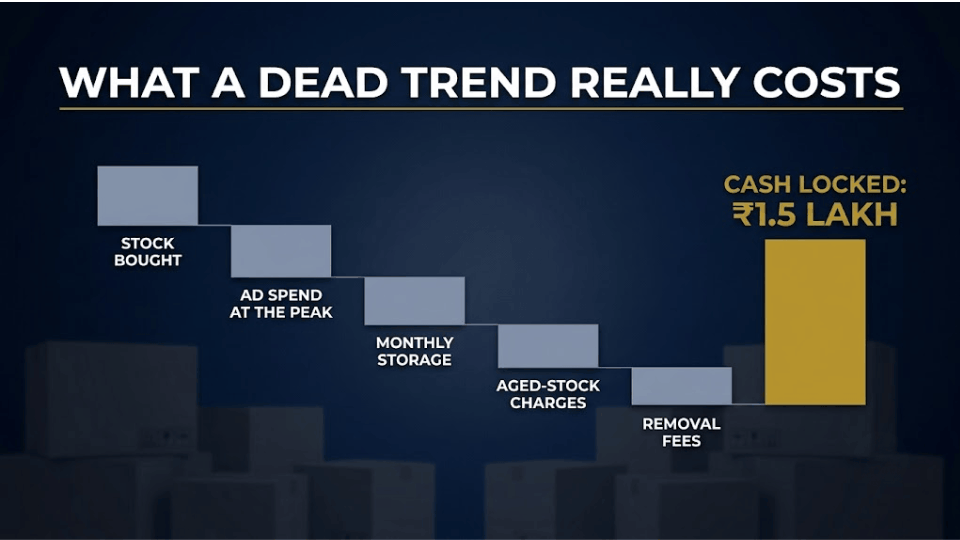
When stock stops moving, Amazon still charges storage every month, more as the stock ages, and removal or disposal fees when you give up. Rohit still had around 700 fans there in October.
Ad costs peak exactly when the trend does
At a trend’s peak, every seller bids on the same keywords. Cost per click and ACoS climb together, and your margin disappears just when volume is highest.
How Amazon dead inventory eats your next product’s budget
Amazon dead inventory is stock that no longer sells fast enough to justify its warehouse space. The fees hurt, but opportunity cost hurts more. The ₹1.5 lakh locked in Rohit’s fans was meant for his second product. To plan stock levels before they become a problem, our guide on Amazon inventory planning walks you through it step by step.
Why Boring Products to Sell on Amazon Are More Profitable
Boring products to sell on Amazon win on three levers at once, and none of them depends on a viral moment.
Repeat purchases compound
A flashy product sells once per customer. A boring product sells every 30, 45 or 60 days to the same person. Deepak Joshi from Lucknow sells microfibre mop refill pads. In his first quarter, he spent about ₹110 on ads for every order. A year later, with reorders landing on their own, that figure is closer to ₹40.
Fewer copycats, less price war
Nobody makes reels about mop pads, so fewer sellers notice the category. Competition grows slowly instead of arriving in one wave, giving you time to earn reviews and rank before anyone undercuts you.
Steady sales make FBA replenishment predictable
When demand barely moves, forecasting becomes simple arithmetic. You know roughly how many units you’ll sell next month, so you send the right quantity to FBA, avoid stockouts and never pay to store a mountain of slow stock. This is where FBA shines: the Prime badge lifts conversions and steady stock keeps the listing ranked.
Profitable Products to Sell on Amazon India: Two Sellers
The most profitable products to sell on Amazon India rarely look profitable in month one. Compare two sellers who each started with about ₹3 lakh.
Kavitha’s cotton kitchen towels
Kavitha Raman from Coimbatore launched a six-pack of cotton kitchen towels. Month one was slow: about eight orders a day, most of them from ads. She stayed patient, added a 12-pack and kept stock steady through FBA. By month ten, she was selling around 30 a day, and close to 60% of those orders came from organic search.
Siddharth’s LED galaxy projector
Siddharth Rao from Bengaluru launched an LED galaxy projector after it blew up on Instagram. His first month brought more than 900 units and a week-long best-seller badge. By month three, a dozen cheaper copies had appeared, his price had fallen by a third and his ACoS had crossed 60%. He ended the year with a removal order for 400 units.
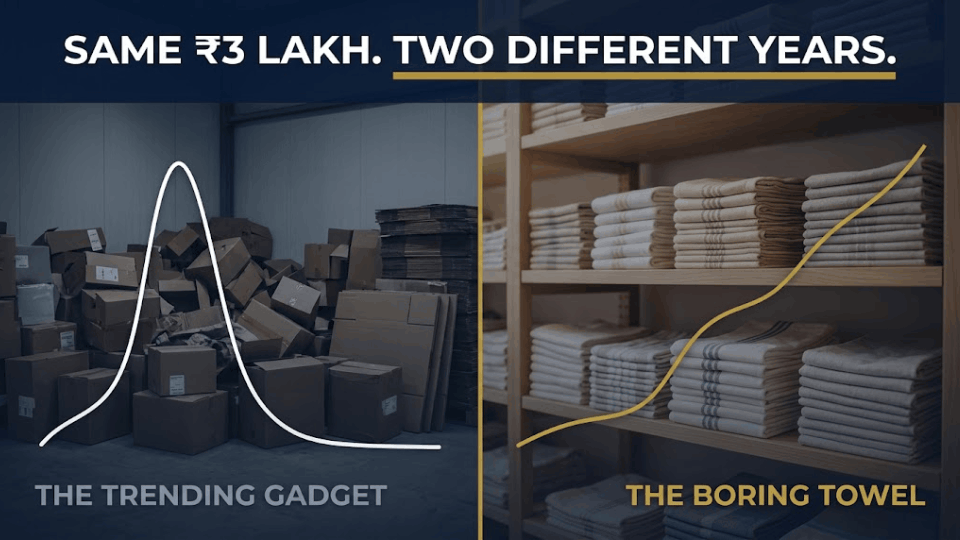
The same ₹3 lakh, two different years
Siddharth’s first month beat Kavitha’s entire first quarter. Over twelve months, the picture flipped. Kavitha finished the year with steady monthly profit and a listing that keeps selling. Siddharth finished it with most of his capital stuck in boxes and no second product.
Evergreen Products to Sell on Amazon That Refill Themselves
Some of the best evergreen products to sell on Amazon are the ones that simply get used up.
The Subscribe & Save test for repeat purchase products
The My Wife Quit Her Job podcast suggests a simple filter: if a buyer could plausibly put it on automatic reorder, it’s a strong boring product. Repeat purchase products don’t need winning again each month; the customer returns because the old pack ran out.
Consumable products to sell on Amazon in Indian homes
Think pooja essentials like cotton wicks and camphor holders, kitchen consumables like scrub pads and cling-wrap refills, microfibre car cloths, pet grooming wipes and garden grow bags. Sana Sheikh from Hyderabad sells long cotton diya wicks. Her customers reorder roughly every six weeks, and Diwali just adds a spike to a steady base.
Boring non-consumables that still sell all year
Not every winner gets used up. Drawer organisers, fridge storage boxes, shoe racks and cable organisers sell all year because homes keep needing them. People need them; nobody shows them off. For a structured way to shortlist products like these, our guide to selecting a winning Amazon product is a good next read.
How to Find Evergreen Products to Sell on Amazon India
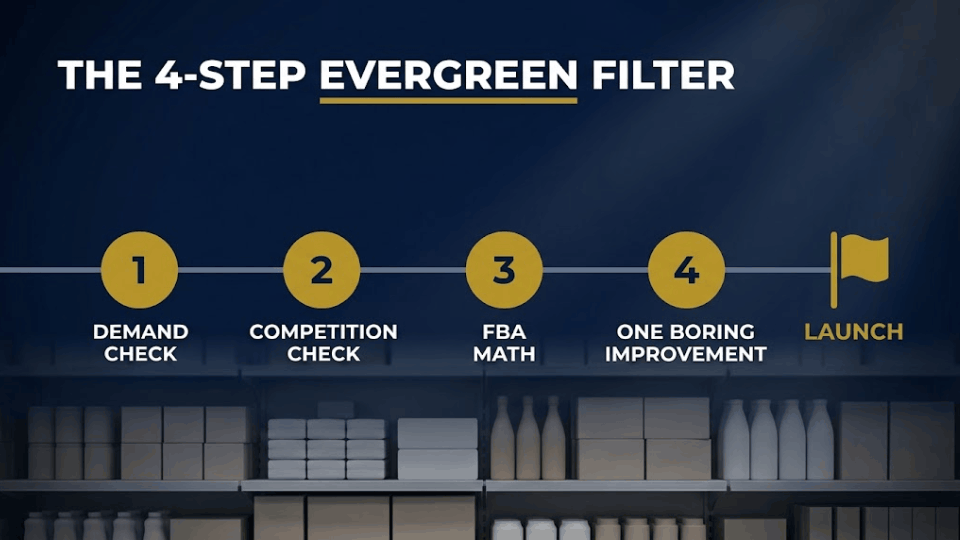
Run every idea through this four-step filter before your first order.
Step 1: Check 12-month demand stability
Look for demand that stays in a narrow band all year, using Google Trends, Helium 10’s search-volume history and Amazon.in autocomplete. Four or five specific autocomplete variations mean buyers are actively searching.
Step 2: Low competition products to sell on Amazon India
On page one, look for top sellers with fewer than 500 reviews, no dominant national brands and room for margin. Low competition products to sell on Amazon India usually hide inside big, boring categories, not empty ones.
Step 3: Run the FBA math before you fall in love
Put the product through the Amazon.in FBA revenue calculator using your real landed cost. Small, light products sit in cheaper fee tiers and are easier to replenish. If the margin only works without ads, it doesn’t work.
Step 4: Find one boring improvement
This is the Uniqlo move. Don’t reinvent the product; make it slightly better in a way buyers notice. Meena Choudhary from Jaipur saw steel scrubber reviews complaining about rust. She launched a stainless six-pack with a hanging hook and, within four months, overtook two long-established sellers. That’s how to choose a product to sell on Amazon when you want it to last.
Where Trending Products to Sell on Amazon India Still Fit
None of this means trending products to sell on Amazon India are off-limits. They just never belong in your catalogue’s foundation.
The 70/30 rule for a growing catalogue
AMZ Prep suggests that durable Amazon businesses keep roughly 70% of their products evergreen for steady cash flow and use the other 30% for trend bets. The evergreen base pays the bills, so a failed trend costs you a lesson, not your business.
Should a beginner sell trending products?
For your first product, no. A beginner doesn’t yet have the cash buffer, the forecasting experience or a steady earner to absorb a crash. Get one boring product working first, then experiment.
How to test a trend without betting the warehouse
When you do test a trend, keep the bet small. Send a first FBA shipment covering 30–45 days of expected sales, set a hard exit date and decide your liquidation price before the stock even ships. Harpreet Kaur from Ludhiana tested a viral desk fan with just 150 units last summer. When sales slowed in week five, she cleared the last 30 at cost, her kitchen-storage line untouched.
Frequently Asked Questions
What are evergreen products on Amazon?
Evergreen products are items with steady demand throughout the year, because people need them every month, not because they’re fashionable. Their search volume barely moves across seasons. In India, think kitchen storage, cleaning consumables, pooja essentials, pet care and car-care basics. They’re the safest start for new sellers.
Are boring products more profitable than trending products?
Over a full year, usually yes. Trending products can earn more early, but copycats, price wars and rising ad costs shrink that fast, and unsold stock adds fees. Boring products start slower, then compound through repeat purchases, organic rank and lower ad spend per order. Profit you can predict beats a spike you can’t repeat.
How do I know if a product is evergreen or just a fad?
Check its five-year Google Trends line for India. A flat or gently rising line suggests evergreen; a single sharp peak suggests a fad. Confirm it with keyword search-volume history in a tool like Helium 10, and check that the top sellers’ BSR stays stable for 90 days.
Should a beginner sell trending products on Amazon India?
Not as a first product. Trends demand fast decisions, accurate forecasting and enough cash to absorb a crash, which most beginners don’t have yet. Start with one evergreen product, get it selling steadily through FBA, then test trends with a small share of your budget.
What is dead inventory on Amazon, and how much does it cost?
Dead inventory is stock that has stopped selling fast enough to justify its space in Amazon’s fulfilment centres. It costs you monthly storage fees, higher charges as it ages, and removal or disposal fees if you pull it out. The biggest cost is the cash it locks up, money meant for your next product.
How do I choose a product to sell on Amazon as a beginner in India?
Look for steady year-round demand, a small and light product, page-one competitors with modest review counts, and a margin that survives ads and FBA fees. Then find one practical improvement over what’s already selling. Skip anything that depends on a viral moment.
How much stock should I send to FBA for my first evergreen product?
Plan for roughly 60–90 days of expected sales in your first shipment. That builds sales history and reviews without heavy storage costs, and steady demand lets you replenish from real numbers. Keep a buffer for your supplier’s lead time so you never go out of stock.
Conclusion
Flashy products make great screenshots. Boring products make great businesses. Uniqlo turned plain T-shirts into a global brand by choosing consistency over novelty, and you can build a steady FBA business on Amazon.in the same way, one kitchen towel, diya wick or drawer organiser at a time.
Before your next order, ask one question: will people still need this next October? If the answer is yes, run it through the four-step filter and start building. If you’d like to learn product selection with real data, alongside sellers working through the same decisions, join our 3-Day Amazon Business Training. Pick the product nobody is talking about. Your future cash flow will thank you.
